Protein tertiary and quaternary structure determination using Bio informatics tools Dipankar Sarkar 2003CS10161 Group #1
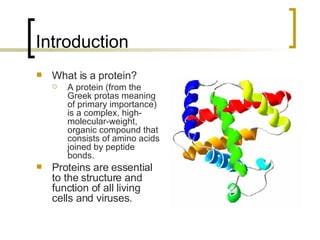
Introduction What is a protein? A protein (from the Greek protas meaning of primary importance) is a complex, high-molecular-weight, organic compound that consists of amino acids joined by peptide bonds. Proteins are essential to the structure and function of all living cells and viruses.
Protein – Component & synthesis Proteins are polymers built from 20 different L-alpha-amino acids. Proteins are assembled from amino acids using information present in genes. Genes are transcribed into RNA, RNA is then subject to post-transcriptional modification and control, resulting in a mature mRNA that undergoes translation into a protein. mRNA is translated by ribosomes that match the three-base codons of the mRNA to the three-base anti-codons of the appropriate tRNA. The enzyme aminoacyl tRNA synthetase catalyzes the formation of covalent peptide bonds between amino acids forming the protein. The two ends of the amino acid chain are referred to as the carboxy terminus (C-terminus) and the amino terminus (N-terminus) based on the nature of the free group on each extremity.
Protein - structure Primary  - amino acid sequence  Secondary  - highly patterned sub-structures  Tertiary   - the overall shape of a single protein molecule Quaternary  - the shape or structure that results from the union of more than one protein molecule
Tertiary structure prediction Aim is of determining the three-dimensional structure of proteins from their amino acid sequences There are two methods of structure prediction De novo protein modeling  – Brute force method of predicting the 3D structure of the protein. Needs a lot of computational power. Example – Rosetta.
Tertiary - Continued Comparative protein modeling  – It uses previously solved structures as starting points, or templates. This is effective because it appears that although the number of actual proteins is vast, there is a limited set of tertiary structural motifs to which most proteins belong. Into 2 more types of modeling :  Homology modelling Protein threading
Quaternary structure prediction In addition to the tertiary structure of the subunits, multiple-subunit proteins possess a quaternary structure, which is the arrangement into which the subunits assemble There are 3 primary methods of predicting protein-protein interaction Phylogenetic distance and co-evolution of interacting domains  – Example – ADVICE
Quaternary - Continued Identification of homologous interacting pairs  – This method consists of searching whether the two sequences have homologues which form a complex in a database of known structures of complexes. Example :- InterPreTS (Interaction Prediction through Tertiary Structure) Identification of structural patterns (target must be a structure)  – The third method builds a library of known protein-protein interfaces from the Protein Data Bank. The sequences in the library are then clustered based on structural alignment and redundant sequences are eliminated. Example :- PRISM
Conclusion Methods used by bioinformatics tools are heavily based on algorithmic research, a key area of computer science research. As structure prediction is composed of NP hard sub-problems, techniques like neural networks and approximation algorithms are heavily used in the bioinformatics tools.
Bibliography Simons, K. T., Bonneau, R., Ruczinski, I., Baker, D.,(1999) Ab initio protein structure prediction of CASP III targets using ROSETTA, Proteins Suppl 3, 171-6. Bates, P.A., Kelley, L.A., MacCallum, R.M. and Sternberg, M.J.E., (2001) Enhancement of Protein Modelling by Human Intervention in Applying the Automatic Programs 3D-JIGSAW and 3D-PSSM., Proteins: Structure, Function and Genetics, Suppl 5:39-46. Tan S.H., Zhang Z., Ng S.K.,(2004) ADVICE: Automated Detection and Validation of Interaction by Co-Evolution.. Nucl. Ac. Res., 32 (Web Server issue):W69-72. Aloy P.,Russell R.B, InterPreTS: Protein Interaction Prediction through Tertiary Structure., Bioinformatics, 19 (1), 161-162. Ogmen U., Keskin O., Aytuna A.S., Nussinov R. and Gursoy A,(2005)  PRISM: protein interactions by structural matching., Nucl. Ac. Res.,33 (Web Server issue):W331-336. Wikipedia, http://www.wikipedia.com.

BEL110 presentation

  • 1.
    Protein tertiary andquaternary structure determination using Bio informatics tools Dipankar Sarkar 2003CS10161 Group #1
  • 2.
    Introduction What isa protein? A protein (from the Greek protas meaning of primary importance) is a complex, high-molecular-weight, organic compound that consists of amino acids joined by peptide bonds. Proteins are essential to the structure and function of all living cells and viruses.
  • 3.
    Protein – Component& synthesis Proteins are polymers built from 20 different L-alpha-amino acids. Proteins are assembled from amino acids using information present in genes. Genes are transcribed into RNA, RNA is then subject to post-transcriptional modification and control, resulting in a mature mRNA that undergoes translation into a protein. mRNA is translated by ribosomes that match the three-base codons of the mRNA to the three-base anti-codons of the appropriate tRNA. The enzyme aminoacyl tRNA synthetase catalyzes the formation of covalent peptide bonds between amino acids forming the protein. The two ends of the amino acid chain are referred to as the carboxy terminus (C-terminus) and the amino terminus (N-terminus) based on the nature of the free group on each extremity.
  • 4.
    Protein - structurePrimary - amino acid sequence Secondary - highly patterned sub-structures Tertiary - the overall shape of a single protein molecule Quaternary - the shape or structure that results from the union of more than one protein molecule
  • 5.
    Tertiary structure predictionAim is of determining the three-dimensional structure of proteins from their amino acid sequences There are two methods of structure prediction De novo protein modeling – Brute force method of predicting the 3D structure of the protein. Needs a lot of computational power. Example – Rosetta.
  • 6.
    Tertiary - ContinuedComparative protein modeling – It uses previously solved structures as starting points, or templates. This is effective because it appears that although the number of actual proteins is vast, there is a limited set of tertiary structural motifs to which most proteins belong. Into 2 more types of modeling : Homology modelling Protein threading
  • 7.
    Quaternary structure predictionIn addition to the tertiary structure of the subunits, multiple-subunit proteins possess a quaternary structure, which is the arrangement into which the subunits assemble There are 3 primary methods of predicting protein-protein interaction Phylogenetic distance and co-evolution of interacting domains – Example – ADVICE
  • 8.
    Quaternary - ContinuedIdentification of homologous interacting pairs – This method consists of searching whether the two sequences have homologues which form a complex in a database of known structures of complexes. Example :- InterPreTS (Interaction Prediction through Tertiary Structure) Identification of structural patterns (target must be a structure) – The third method builds a library of known protein-protein interfaces from the Protein Data Bank. The sequences in the library are then clustered based on structural alignment and redundant sequences are eliminated. Example :- PRISM
  • 9.
    Conclusion Methods usedby bioinformatics tools are heavily based on algorithmic research, a key area of computer science research. As structure prediction is composed of NP hard sub-problems, techniques like neural networks and approximation algorithms are heavily used in the bioinformatics tools.
  • 10.
    Bibliography Simons, K.T., Bonneau, R., Ruczinski, I., Baker, D.,(1999) Ab initio protein structure prediction of CASP III targets using ROSETTA, Proteins Suppl 3, 171-6. Bates, P.A., Kelley, L.A., MacCallum, R.M. and Sternberg, M.J.E., (2001) Enhancement of Protein Modelling by Human Intervention in Applying the Automatic Programs 3D-JIGSAW and 3D-PSSM., Proteins: Structure, Function and Genetics, Suppl 5:39-46. Tan S.H., Zhang Z., Ng S.K.,(2004) ADVICE: Automated Detection and Validation of Interaction by Co-Evolution.. Nucl. Ac. Res., 32 (Web Server issue):W69-72. Aloy P.,Russell R.B, InterPreTS: Protein Interaction Prediction through Tertiary Structure., Bioinformatics, 19 (1), 161-162. Ogmen U., Keskin O., Aytuna A.S., Nussinov R. and Gursoy A,(2005) PRISM: protein interactions by structural matching., Nucl. Ac. Res.,33 (Web Server issue):W331-336. Wikipedia, http://www.wikipedia.com.