INTRODUCTION
• Proteins arethe workhorses that facilitate most
biological processes in a cell.
• Protein–protein interactions occur when two or
more proteins bind together, often to carry out
their biological function.
• These interactions are very important in our
lives,can lead to fatal diseases such as
Alzheimer’s disease.
3.
• The protein–protein interaction have commonly been
termed as the ‘INTERACTOME’ by scientists.
• French researchers first coined the term
"interactome" in 1999; the first protein-protein
interactome data appeared in 2000.
• Today the field—like the 16-years-old...
• Interactome research has racked up more than 600
publications, and databases now house interactions
numbering in thousands.
4.
WHY IS STUDYOF INTERACTOME
IMPORTANT?
• Proteins, like humans, are social animals.
• The work of the cell is accomplished mostly by
macromolecular complexes
• Unlike biological pathways, which represent a
sequence of molecular interactions leading to
a final result — for example, a signalling
cascade — networks are interlinked.
5.
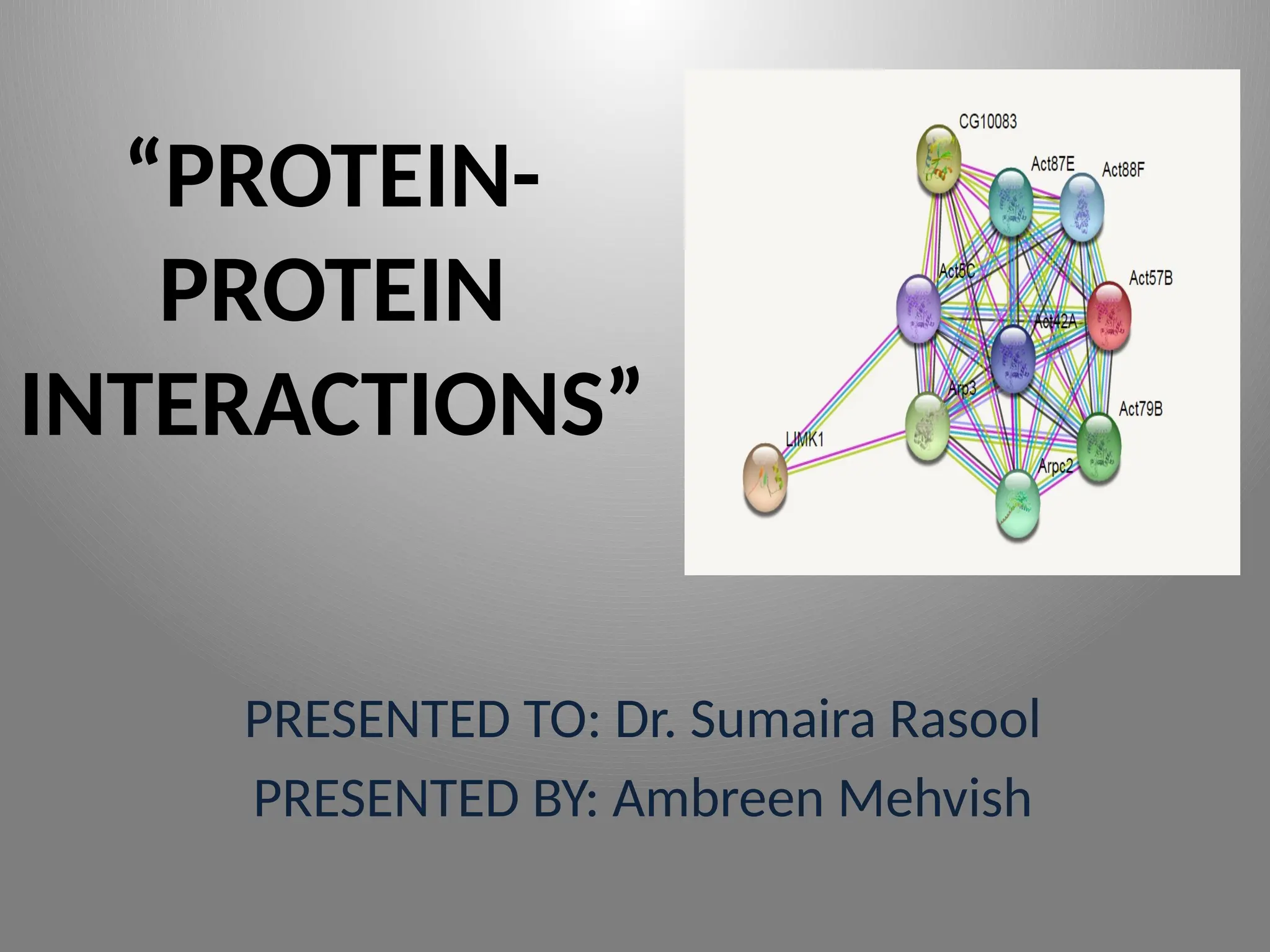
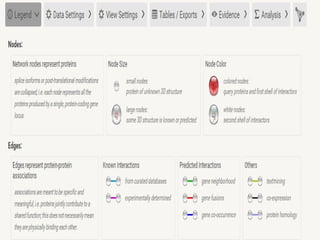
• Represented asstarbursts of protein 'nodes'
linked by interaction 'edges' to form intricate
constellations.
• Furthermore, placing proteins encoded by
disease genes into these networks will let
researchers determine the best candidates for
assessing disease risk and therapies.
• Therefore, finding interaction partners for a
protein can reveal its function.
6.
• The humangenome project effort identified
30,000 genes, but that is not the end goal.
How the genes work in pathways??
• To accomplish this it is necessary to
systematically map gene and protein
interactions.
• The interactome may be tougher to solve than
the genome, but the information, is crucial for
a complete understanding of biology.
7.
CATEGORIES OF PPI
•STABLE: These comprise of interactions that last
for a long duration.
E.g.: Haemoglobin
• TRANSIENT: these are on/off temporary.
Interactions that last a short period of time.
E.g.: Muscle Contraction
8.
METHODS FOR DETECTINGPPI
• Main approaches for detecting interacting
proteins:
1. IN VIVO METHOD:
• Yeast two hybrid system
2. IN VITRO METHOD:
• Immunoprecipitation(ip)/ co-ip
3. IN SILICO METHOD:
• Computational system
9.
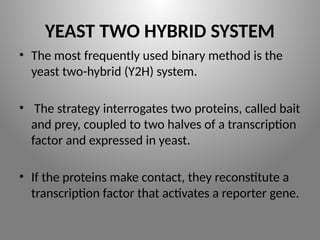
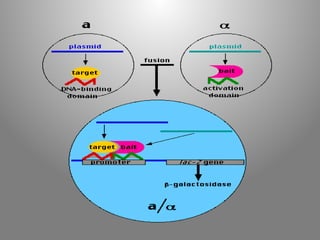
YEAST TWO HYBRIDSYSTEM
• The most frequently used binary method is the
yeast two-hybrid (Y2H) system.
• The strategy interrogates two proteins, called bait
and prey, coupled to two halves of a transcription
factor and expressed in yeast.
• If the proteins make contact, they reconstitute a
transcription factor that activates a reporter gene.
11.
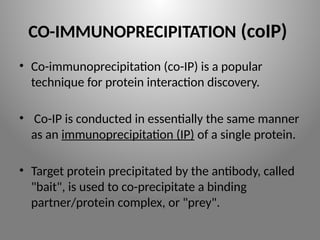
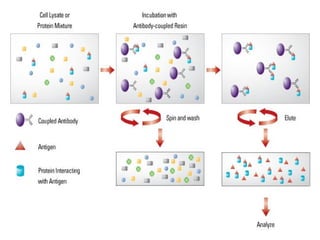
CO-IMMUNOPRECIPITATION (coIP)
• Co-immunoprecipitation(co-IP) is a popular
technique for protein interaction discovery.
• Co-IP is conducted in essentially the same manner
as an immunoprecipitation (IP) of a single protein.
• Target protein precipitated by the antibody, called
"bait", is used to co-precipitate a binding
partner/protein complex, or "prey".
13.
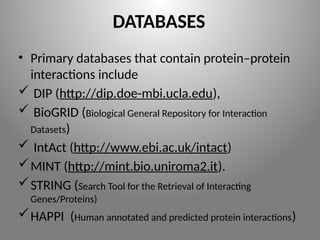
DATABASES
• Primary databasesthat contain protein–protein
interactions include
DIP (http://dip.doe-mbi.ucla.edu),
BioGRID (Biological General Repository for Interaction
Datasets)
IntAct (http://www.ebi.ac.uk/intact)
MINT (http://mint.bio.uniroma2.it).
STRING (Search Tool for the Retrieval of Interacting
Genes/Proteins)
HAPPI (Human annotated and predicted protein interactions)
14.
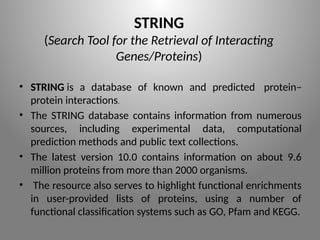
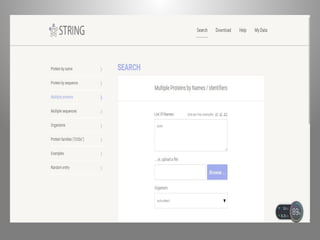
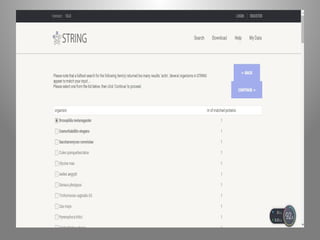
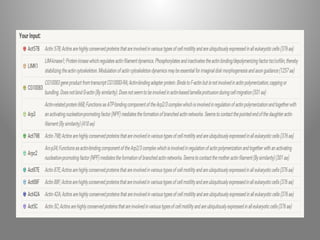
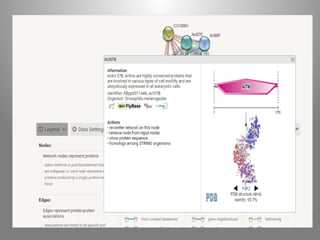
STRING
(Search Tool forthe Retrieval of Interacting
Genes/Proteins)
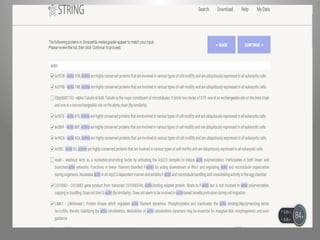
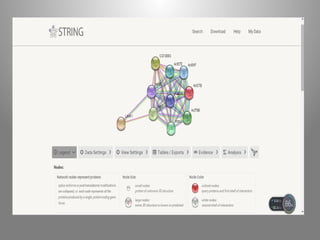
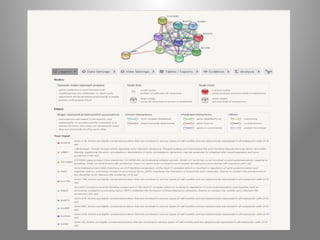
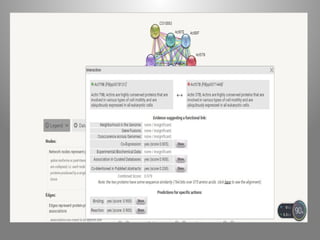
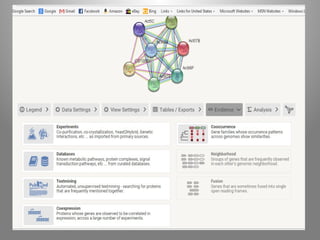
• STRING is a database of known and predicted protein–
protein interactions.
• The STRING database contains information from numerous
sources, including experimental data, computational
prediction methods and public text collections.
• The latest version 10.0 contains information on about 9.6
million proteins from more than 2000 organisms.
• The resource also serves to highlight functional enrichments
in user-provided lists of proteins, using a number of
functional classification systems such as GO, Pfam and KEGG.
15.
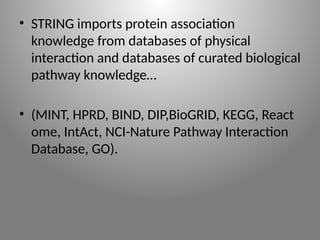
• STRING importsprotein association
knowledge from databases of physical
interaction and databases of curated biological
pathway knowledge…
• (MINT, HPRD, BIND, DIP,BioGRID, KEGG, React
ome, IntAct, NCI-Nature Pathway Interaction
Database, GO).
26.
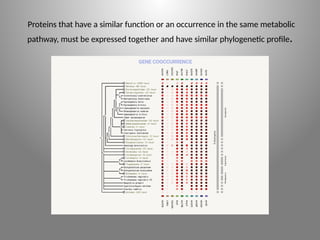
Proteins that havea similar function or an occurrence in the same metabolic
pathway, must be expressed together and have similar phylogenetic profile.
28.
CONCLUSION
• The predictvepower of the interactome model allows
us to examine the organization and coordination of
multiple complex cellular processes and determine how
they are organized into pathways.
• The interactome model can be used to predict poorly
characterized proteins into their functional context
according to their interacting partners within a module.
• One-to-many relationship can be used for pathway
discovery.
#13 Protein–protein interactions are only the raw material for networks. To build a network, researchers typically combine interaction data sets with other sources of data.