COUPLING
REACTIONS
Coupling Reactions
  Coupling   reactions occur between
   organometallic with organic halide with the aid
   of a metal containing catalyst.
  Coupling reactions can be divided into two
   main classes, cross couplings in which two
   different molecules react to form one new
   molecule.
  The other type of coupling is homocoupling,
   in this reaction two similar molecules coupling
   together to form a new molecule.
Main features

  Common     metal used in this field is Pd, in
   addition to Zn, Ni, Cu, B, and Sn.
  Most of coupling reactions are air and
   water sensitive ??
  But, some coupling reactions can be
   carried out in aqueous solutions.
Some thing about Palladium
Important coupling reactions

      Reaction       Year   Reactant 1   Reactant 2   Catalyst

      Kumada         1972    R-MgBr         RX        Pd or Ni
       Heck          1972    Alkene         RX          Pd
    Sonogashira      1973    Alkyne         RX        Pd or Cu
       Nigishi       1977    R-Zn-X         RX        Pd or Ni
       Stille        1977   R-Sn-R3`        RX          Pd
       Suzuki        1979   R-B(OR)2        RX          Pd
      Hyiama         1988    R-Si-R3        RX          Pd
  Buchwald-Hartwig   1994    R2-N-R         RX          Pd
Kumada coupling reaction
  Cross  coupling between aryl or alkyl
   Grignard with aryl or vinyl halocarbon.
  The first Pd or Ni catalysed coupling
   reaction
Kumada coupling
Kumada coupling
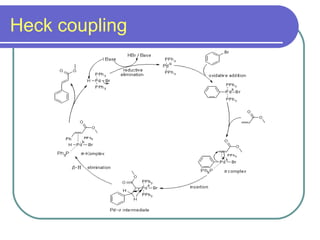
Heck coupling
  Pdcatalyzed coupling between aryl or
  vinyl halides with activated alkene in
  basic media.
Heck coupling
Sonogashira coupling
  Terminal  alkynes with aryl or vinyl
   halides (triflate).
  Pd as a catalyst, Cu as co-catalyst and
   an amine as a base.
Sonogashira coupling
Nigishi coupling

  Pd  or Ni catalyzed coupling organozinc
   compounds with aryl, vinyl, benzyl
   halids.
Nigishi coupling
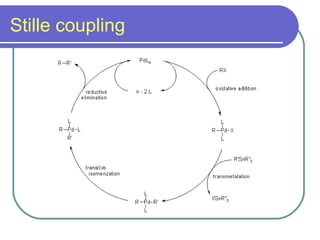
Stille coupling
  Using  tin (stannes) alkyl compounds, wide range
   of R groups, but?????
  Less polar, more toxic???
Stille coupling
Suzuki coupling
 Usingboronic acids or esters B(OR)3 .
 Needs base to activate boron species
Suzuki coupling
Suzuki coupling
Hyiama coupling
  Organosilanes   (Si), with organohalids.
  Needs base or fluoride ion to activate
  Fluorinated, methoxyleted silanes more
   reactive than alkyl ones.
Hyiama coupling
Buchwald-Hartwig coupling

  Pd  catalyzed synthesis of aryl secondry
   or tertiary amines.
  Using primary or secondry amins and
   aryl halides (or triflates)
Buchwald-Hartwig coupling
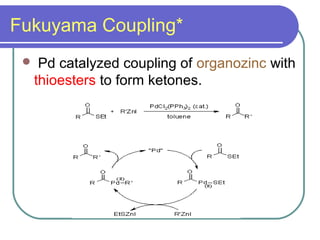
Fukuyama Coupling*
     Pd catalyzed coupling of organozinc with
     thioesters to form ketones.

Coupling reactions 2