Faster R-CNN:
Towards Real-Time Object Detection with
Region Proposal Networks
Shaoqing Ren, Kaiming He, Ross Girshick, Jian Sun
[paper@NIPS15][arXiv][python][matlab][slides by R. Girshick]
Slides by Amaia Salvador [GDoc]
Computer Vision Reading Group (01/03/2016)
1. Introduction
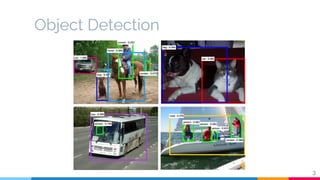
Object Detection
3
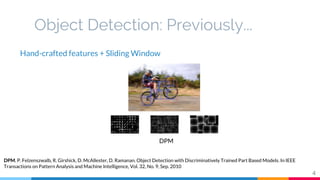
Object Detection: Previously...
DPM. P. Felzenszwalb, R. Girshick, D. McAllester, D. Ramanan. Object Detection with Discriminatively Trained Part Based Models. In IEEE
Transactions on Pattern Analysis and Machine Intelligence, Vol. 32, No. 9, Sep. 2010
DPM
4
Hand-crafted features + Sliding Window
Object Detection: Previously...
R-CNN. Girshick, R., Donahue, J., Darrell, T., & Malik, J. (2014, June). Rich feature hierarchies for accurate object detection and semantic
segmentation. In Computer Vision and Pattern Recognition (CVPR), 2014 IEEE Conference on(pp. 580-587). IEEE.
SPPnet. He, K., Zhang, X., Ren, S., & Sun, J. (2015). Spatial pyramid pooling in deep convolutional networks for visual recognition. Pattern Analysis
and Machine Intelligence, IEEE Transactions on, 37(9), 1904-1916.
Fast R-CNN. Girshick, R. (2015). Fast r-cnn. In Proceedings of the IEEE International Conference on Computer Vision (pp. 1440-1448).
R-CNN SPPnet Fast R-CNN
5
CNN features + Object Proposals
Object Detection: Limitations
Selective Search CPMC
MCG
Object Proposal computation is the bottleneck in
current state of the art object detection systems
Selective Search. Van de Sande, K. E., Uijlings, J. R., Gevers, T., & Smeulders, A. W. (2011, November). Segmentation as selective search for object
recognition. InComputer Vision (ICCV), 2011 IEEE International Conference on (pp. 1879-1886). IEEE.
CPMC. Carreira, J., & Sminchisescu, C. (2010, June). Constrained parametric min-cuts for automatic object segmentation. In Computer Vision
and Pattern Recognition (CVPR), 2010 IEEE Conference on (pp. 3241-3248). IEEE.
MCG. Arbeláez, P., Pont-Tuset, J., Barron, J., Marques, F., & Malik, J. (2014). Multiscale combinatorial grouping. In Proceedings of the IEEE
Conference on Computer Vision and Pattern Recognition (pp. 328-335). 6
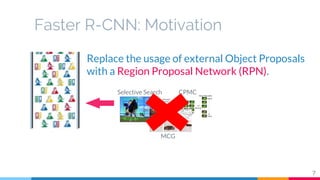
Faster R-CNN: Motivation
Selective Search CPMC
MCG
Replace the usage of external Object Proposals
with a Region Proposal Network (RPN).
7
2. Methodology
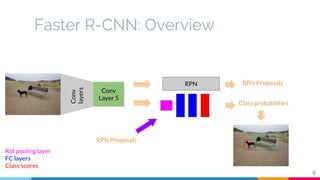
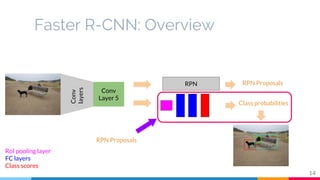
Faster R-CNN: Overview
Conv
Layer 5
Conv
layers
RPN RPN Proposals
RPN Proposals
Class probabilities
RoI pooling layer
FC layers
Class scores
9
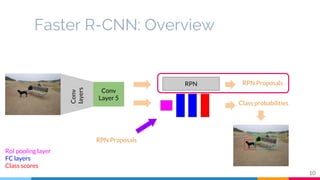
Faster R-CNN: Overview
Conv
Layer 5
Conv
layers
RPN RPN Proposals
RPN Proposals
Class probabilities
RoI pooling layer
FC layers
Class scores
10
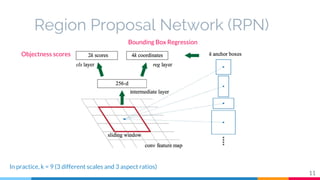
Region Proposal Network (RPN)
11
Objectness scores
Bounding Box Regression
In practice, k = 9 (3 different scales and 3 aspect ratios)
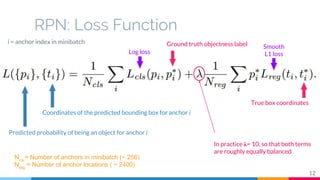
RPN: Loss Function
12
Predicted probability of being an object for anchor i
i = anchor index in minibatch
Coordinates of the predicted bounding box for anchor i
Ground truth objectness label
True box coordinates
Ncls
= Number of anchors in minibatch (~ 256)
Nreg
= Number of anchor locations ( ~ 2400)
Log loss
Smooth
L1 loss
In practice = 10, so that both terms
are roughly equally balanced
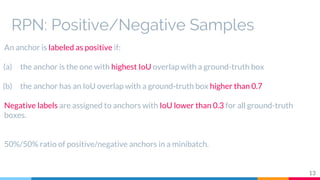
RPN: Positive/Negative Samples
13
An anchor is labeled as positive if:
(a) the anchor is the one with highest IoU overlap with a ground-truth box
(b) the anchor has an IoU overlap with a ground-truth box higher than 0.7
Negative labels are assigned to anchors with IoU lower than 0.3 for all ground-truth
boxes.
50%/50% ratio of positive/negative anchors in a minibatch.
Faster R-CNN: Overview
Conv
Layer 5
Conv
layers
RPN RPN Proposals
RPN Proposals
Class probabilities
RoI pooling layer
FC layers
Class scores
14
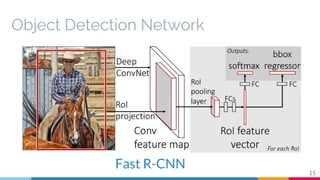
Object Detection Network
15
Fast R-CNN
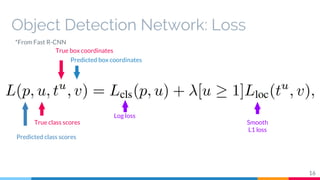
Object Detection Network: Loss
16
*From Fast R-CNN
Predicted class scores
True class scores
True box coordinates
Predicted box coordinates
Log loss
Smooth
L1 loss
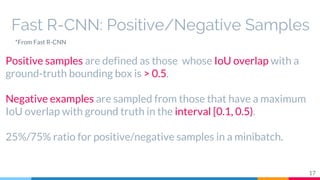
Fast R-CNN: Positive/Negative Samples
17
Positive samples are defined as those whose IoU overlap with a
ground-truth bounding box is > 0.5.
Negative examples are sampled from those that have a maximum
IoU overlap with ground truth in the interval [0.1, 0.5).
25%/75% ratio for positive/negative samples in a minibatch.
*From Fast R-CNN
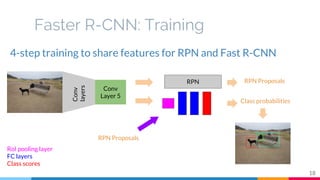
Faster R-CNN: Training
18
Conv
Layer 5
Conv
layers RPN RPN Proposals
RPN Proposals
Class probabilities
RoI pooling layer
FC layers
Class scores
4-step training to share features for RPN and Fast R-CNN
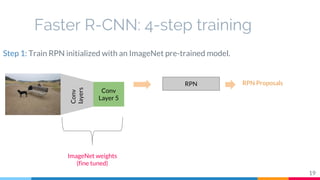
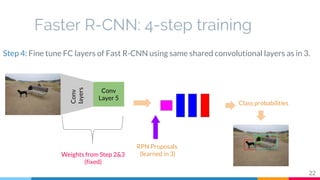
Faster R-CNN: 4-step training
Conv
Layer 5
Conv
layers
RPN RPN Proposals
19
Step 1: Train RPN initialized with an ImageNet pre-trained model.
ImageNet weights
(fine tuned)
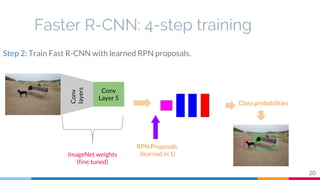
Faster R-CNN: 4-step training
Conv
Layer 5
Conv
layers
RPN Proposals
(learned in 1)
Class probabilities
20
Step 2: Train Fast R-CNN with learned RPN proposals.
ImageNet weights
(fine tuned)
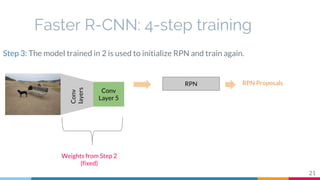
Faster R-CNN: 4-step training
Conv
Layer 5
Conv
layers
RPN RPN Proposals
21
Step 3: The model trained in 2 is used to initialize RPN and train again.
Weights from Step 2
(fixed)
Faster R-CNN: 4-step training
Conv
Layer 5
Conv
layers
RPN Proposals
(learned in 3)
Class probabilities
22
Step 4: Fine tune FC layers of Fast R-CNN using same shared convolutional layers as in 3.
Weights from Step 2&3
(fixed)
3. Experiments
Experiments: CNN Architectures
24
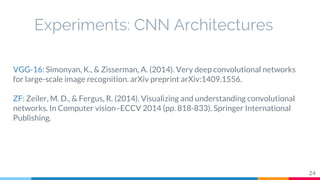
VGG-16: Simonyan, K., & Zisserman, A. (2014). Very deep convolutional networks
for large-scale image recognition. arXiv preprint arXiv:1409.1556.
ZF: Zeiler, M. D., & Fergus, R. (2014). Visualizing and understanding convolutional
networks. In Computer vision–ECCV 2014 (pp. 818-833). Springer International
Publishing.
Experiments: Datasets
25
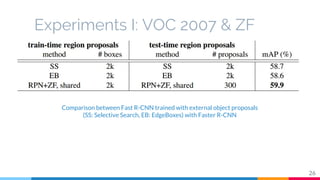
Experiments I: VOC 2007 & ZF
26
Comparison between Fast R-CNN trained with external object proposals
(SS: Selective Search, EB: EdgeBoxes) with Faster R-CNN
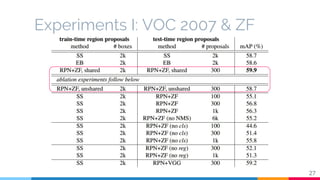
Experiments I: VOC 2007 & ZF
27
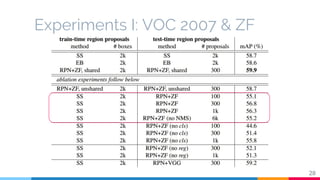
Experiments I: VOC 2007 & ZF
28
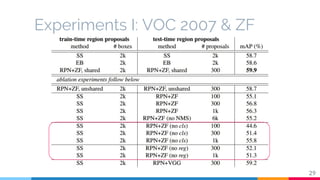
Experiments I: VOC 2007 & ZF
29
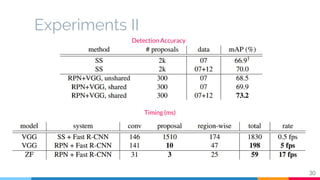
Experiments II
30
Detection Accuracy
Timing (ms)
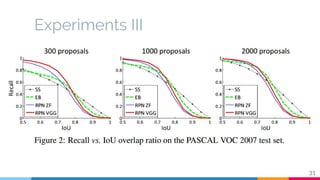
Experiments III
31
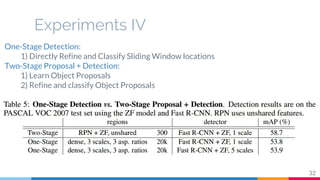
Experiments IV
32
One-Stage Detection:
1) Directly Refine and Classify Sliding Window locations
Two-Stage Proposal + Detection:
1) Learn Object Proposals
2) Refine and classify Object Proposals
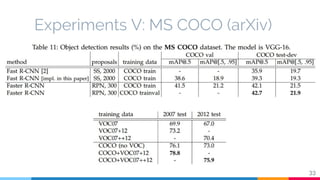
Experiments V: MS COCO (arXiv)
33
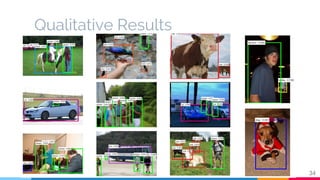
Qualitative Results
34
4. Summary
Summary
36
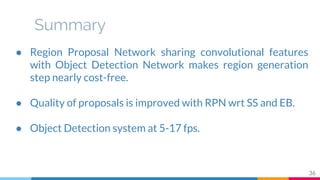
● Region Proposal Network sharing convolutional features
with Object Detection Network makes region generation
step nearly cost-free.
● Quality of proposals is improved with RPN wrt SS and EB.
● Object Detection system at 5-17 fps.
Summary
37
● Faster R-CNN is the basis of the winners of COCO and
ILSVRC 2015 object detection competitions [1].
● RPN is also used in the winning entries of ILSVRC 2015
localization [1] and COCO 2015 segmentation competitions
[2].
[1] K. He, X. Zhang, S. Ren, and J. Sun, “Deep residual learning for image recognition,”
arXiv:1512.03385, 2015.
[2] J. Dai, K. He, and J. Sun, “Instance-aware semantic segmentation via multi-task
network cascades,” arXiv:1512.04412, 2015.
Thank you !
Questions?

Faster R-CNN: Towards real-time object detection with region proposal networks (UPC Reading Group)

  • 1.
    Faster R-CNN: Towards Real-TimeObject Detection with Region Proposal Networks Shaoqing Ren, Kaiming He, Ross Girshick, Jian Sun [paper@NIPS15][arXiv][python][matlab][slides by R. Girshick] Slides by Amaia Salvador [GDoc] Computer Vision Reading Group (01/03/2016)
  • 2.
  • 3.
  • 4.
    Object Detection: Previously... DPM.P. Felzenszwalb, R. Girshick, D. McAllester, D. Ramanan. Object Detection with Discriminatively Trained Part Based Models. In IEEE Transactions on Pattern Analysis and Machine Intelligence, Vol. 32, No. 9, Sep. 2010 DPM 4 Hand-crafted features + Sliding Window
  • 5.
    Object Detection: Previously... R-CNN.Girshick, R., Donahue, J., Darrell, T., & Malik, J. (2014, June). Rich feature hierarchies for accurate object detection and semantic segmentation. In Computer Vision and Pattern Recognition (CVPR), 2014 IEEE Conference on(pp. 580-587). IEEE. SPPnet. He, K., Zhang, X., Ren, S., & Sun, J. (2015). Spatial pyramid pooling in deep convolutional networks for visual recognition. Pattern Analysis and Machine Intelligence, IEEE Transactions on, 37(9), 1904-1916. Fast R-CNN. Girshick, R. (2015). Fast r-cnn. In Proceedings of the IEEE International Conference on Computer Vision (pp. 1440-1448). R-CNN SPPnet Fast R-CNN 5 CNN features + Object Proposals
  • 6.
    Object Detection: Limitations SelectiveSearch CPMC MCG Object Proposal computation is the bottleneck in current state of the art object detection systems Selective Search. Van de Sande, K. E., Uijlings, J. R., Gevers, T., & Smeulders, A. W. (2011, November). Segmentation as selective search for object recognition. InComputer Vision (ICCV), 2011 IEEE International Conference on (pp. 1879-1886). IEEE. CPMC. Carreira, J., & Sminchisescu, C. (2010, June). Constrained parametric min-cuts for automatic object segmentation. In Computer Vision and Pattern Recognition (CVPR), 2010 IEEE Conference on (pp. 3241-3248). IEEE. MCG. Arbeláez, P., Pont-Tuset, J., Barron, J., Marques, F., & Malik, J. (2014). Multiscale combinatorial grouping. In Proceedings of the IEEE Conference on Computer Vision and Pattern Recognition (pp. 328-335). 6
  • 7.
    Faster R-CNN: Motivation SelectiveSearch CPMC MCG Replace the usage of external Object Proposals with a Region Proposal Network (RPN). 7
  • 8.
  • 9.
    Faster R-CNN: Overview Conv Layer5 Conv layers RPN RPN Proposals RPN Proposals Class probabilities RoI pooling layer FC layers Class scores 9
  • 10.
    Faster R-CNN: Overview Conv Layer5 Conv layers RPN RPN Proposals RPN Proposals Class probabilities RoI pooling layer FC layers Class scores 10
  • 11.
    Region Proposal Network(RPN) 11 Objectness scores Bounding Box Regression In practice, k = 9 (3 different scales and 3 aspect ratios)
  • 12.
    RPN: Loss Function 12 Predictedprobability of being an object for anchor i i = anchor index in minibatch Coordinates of the predicted bounding box for anchor i Ground truth objectness label True box coordinates Ncls = Number of anchors in minibatch (~ 256) Nreg = Number of anchor locations ( ~ 2400) Log loss Smooth L1 loss In practice = 10, so that both terms are roughly equally balanced
  • 13.
    RPN: Positive/Negative Samples 13 Ananchor is labeled as positive if: (a) the anchor is the one with highest IoU overlap with a ground-truth box (b) the anchor has an IoU overlap with a ground-truth box higher than 0.7 Negative labels are assigned to anchors with IoU lower than 0.3 for all ground-truth boxes. 50%/50% ratio of positive/negative anchors in a minibatch.
  • 14.
    Faster R-CNN: Overview Conv Layer5 Conv layers RPN RPN Proposals RPN Proposals Class probabilities RoI pooling layer FC layers Class scores 14
  • 15.
  • 16.
    Object Detection Network:Loss 16 *From Fast R-CNN Predicted class scores True class scores True box coordinates Predicted box coordinates Log loss Smooth L1 loss
  • 17.
    Fast R-CNN: Positive/NegativeSamples 17 Positive samples are defined as those whose IoU overlap with a ground-truth bounding box is > 0.5. Negative examples are sampled from those that have a maximum IoU overlap with ground truth in the interval [0.1, 0.5). 25%/75% ratio for positive/negative samples in a minibatch. *From Fast R-CNN
  • 18.
    Faster R-CNN: Training 18 Conv Layer5 Conv layers RPN RPN Proposals RPN Proposals Class probabilities RoI pooling layer FC layers Class scores 4-step training to share features for RPN and Fast R-CNN
  • 19.
    Faster R-CNN: 4-steptraining Conv Layer 5 Conv layers RPN RPN Proposals 19 Step 1: Train RPN initialized with an ImageNet pre-trained model. ImageNet weights (fine tuned)
  • 20.
    Faster R-CNN: 4-steptraining Conv Layer 5 Conv layers RPN Proposals (learned in 1) Class probabilities 20 Step 2: Train Fast R-CNN with learned RPN proposals. ImageNet weights (fine tuned)
  • 21.
    Faster R-CNN: 4-steptraining Conv Layer 5 Conv layers RPN RPN Proposals 21 Step 3: The model trained in 2 is used to initialize RPN and train again. Weights from Step 2 (fixed)
  • 22.
    Faster R-CNN: 4-steptraining Conv Layer 5 Conv layers RPN Proposals (learned in 3) Class probabilities 22 Step 4: Fine tune FC layers of Fast R-CNN using same shared convolutional layers as in 3. Weights from Step 2&3 (fixed)
  • 23.
  • 24.
    Experiments: CNN Architectures 24 VGG-16:Simonyan, K., & Zisserman, A. (2014). Very deep convolutional networks for large-scale image recognition. arXiv preprint arXiv:1409.1556. ZF: Zeiler, M. D., & Fergus, R. (2014). Visualizing and understanding convolutional networks. In Computer vision–ECCV 2014 (pp. 818-833). Springer International Publishing.
  • 25.
  • 26.
    Experiments I: VOC2007 & ZF 26 Comparison between Fast R-CNN trained with external object proposals (SS: Selective Search, EB: EdgeBoxes) with Faster R-CNN
  • 27.
    Experiments I: VOC2007 & ZF 27
  • 28.
    Experiments I: VOC2007 & ZF 28
  • 29.
    Experiments I: VOC2007 & ZF 29
  • 30.
  • 31.
  • 32.
    Experiments IV 32 One-Stage Detection: 1)Directly Refine and Classify Sliding Window locations Two-Stage Proposal + Detection: 1) Learn Object Proposals 2) Refine and classify Object Proposals
  • 33.
    Experiments V: MSCOCO (arXiv) 33
  • 34.
  • 35.
  • 36.
    Summary 36 ● Region ProposalNetwork sharing convolutional features with Object Detection Network makes region generation step nearly cost-free. ● Quality of proposals is improved with RPN wrt SS and EB. ● Object Detection system at 5-17 fps.
  • 37.
    Summary 37 ● Faster R-CNNis the basis of the winners of COCO and ILSVRC 2015 object detection competitions [1]. ● RPN is also used in the winning entries of ILSVRC 2015 localization [1] and COCO 2015 segmentation competitions [2]. [1] K. He, X. Zhang, S. Ren, and J. Sun, “Deep residual learning for image recognition,” arXiv:1512.03385, 2015. [2] J. Dai, K. He, and J. Sun, “Instance-aware semantic segmentation via multi-task network cascades,” arXiv:1512.04412, 2015.
  • 38.