Perfecting Your Punctuation William E. Sledzik aka, Professor ToughSledding Disclaimer : The many examples used in these slides are drawn from textbooks, workbooks, lecture notes -- even student papers -- over my 20+ years in the classroom.  Some may have been lifted from copyrighted sources and have long since become separated from their credit lines. I owe special thanks to Laura Kessler and Duncan MacDonald, authors of “When Words Collide and to Carole Rich, whose text “Writing and Reporting News” is my guidebook for teaching the  style of writing we use most often in public relations. http://toughsledding.wordpress.com
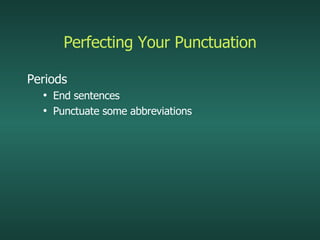
Perfecting Your Punctuation Periods End sentences Punctuate some abbreviations
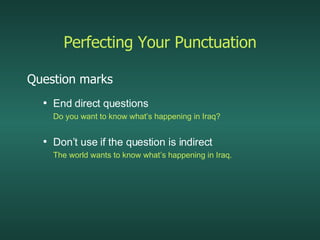
Perfecting Your Punctuation Question marks End direct questions Do you want to know what’s happening in Iraq? Don’t use if the question is indirect The world wants to know what’s happening in Iraq.
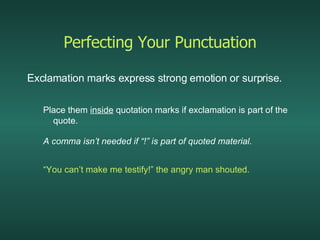
Perfecting Your Punctuation Exclamation marks express strong emotion or surprise.  Place them  inside  quotation marks if exclamation is part of the quote. A comma isn’t needed if “!” is part of quoted material. “ You can’t make me testify!” the angry man shouted.
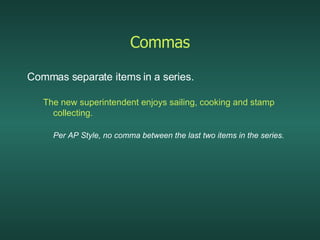
Commas Commas separate items in a series. The new superintendent enjoys sailing, cooking and stamp collecting. Per AP Style, no comma between the last two items in the series.
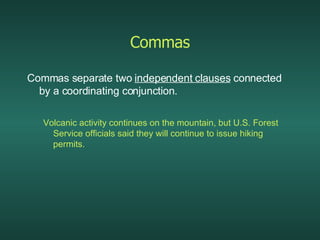
Commas Commas separate two  independent clauses  connected by a coordinating conjunction. Volcanic activity continues on the mountain, but U.S. Forest Service officials said they will continue to issue hiking permits.
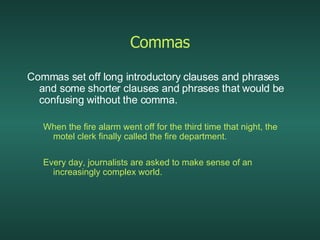
Commas Commas set off long introductory clauses and phrases and some shorter clauses and phrases that would be confusing without the comma. When the fire alarm went off for the third time that night, the motel clerk finally called the fire department. Every day, journalists are asked to make sense of an increasingly complex world.
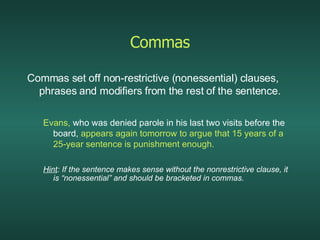
Commas Commas set off non-restrictive (nonessential) clauses, phrases and modifiers from the rest of the sentence. Evans,  who was denied parole in his last two visits before the board,  appears again tomorrow to argue that 15 years of a 25-year sentence is punishment enough. Hint : If the sentence makes sense without the nonrestrictive clause, it is “nonessential” and should be bracketed in commas.
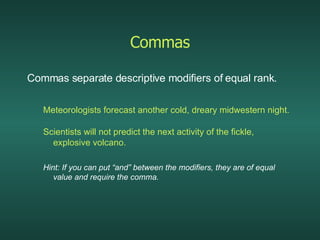
Commas Commas separate descriptive modifiers of equal rank. Meteorologists forecast another cold, dreary midwestern night. Scientists will not predict the next activity of the fickle, explosive volcano. Hint: If you can put “and” between the modifiers, they are of equal value and require the comma.
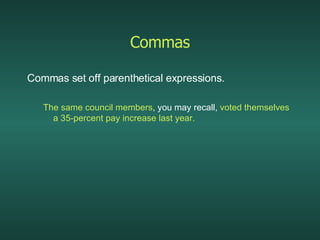
Commas Commas set off parenthetical expressions. The same council members , you may recall,  voted themselves a 35-percent pay increase last year.
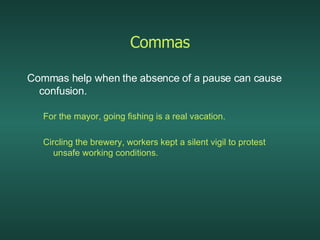
Commas Commas help when the absence of a pause can cause confusion. For the mayor, going fishing is a real vacation. Circling the brewery, workers kept a silent vigil to protest unsafe working conditions.
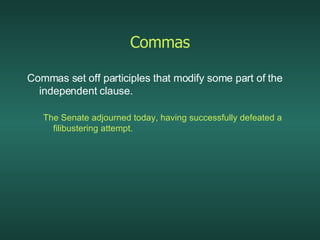
Commas Commas set off participles that modify some part of the independent clause. The Senate adjourned today, having successfully defeated a filibustering attempt.
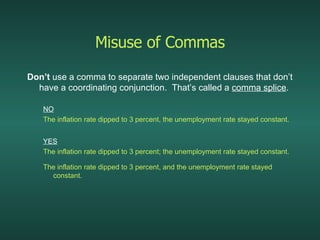
Misuse of Commas Don’t  use a comma to separate two independent clauses that don’t have a coordinating conjunction.  That’s called a  comma splice . NO The inflation rate dipped to 3 percent, the unemployment rate stayed constant. YES   The inflation rate dipped to 3 percent; the unemployment rate stayed constant. The inflation rate dipped to 3 percent, and the unemployment rate stayed constant.
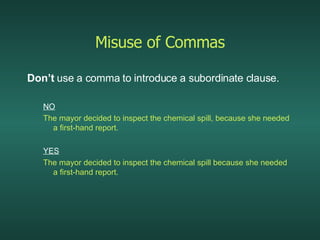
Misuse of Commas Don’t  use a comma to introduce a subordinate clause. NO The mayor decided to inspect the chemical spill, because she needed a first-hand report. YES The mayor decided to inspect the chemical spill because she needed a first-hand report.
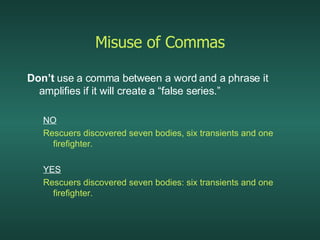
Misuse of Commas Don’t  use a comma between a word and a phrase it amplifies if it will create a “false series.” NO Rescuers discovered seven bodies, six transients and one firefighter. YES Rescuers discovered seven bodies: six transients and one firefighter.
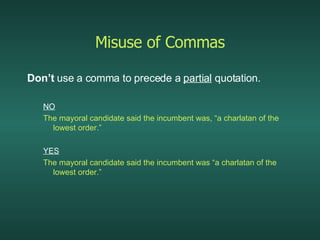
Misuse of Commas Don’t  use a comma to precede a  partial  quotation. NO The mayoral candidate said the incumbent was, “a charlatan of the lowest order.” YES The mayoral candidate said the incumbent was “a charlatan of the lowest order.”
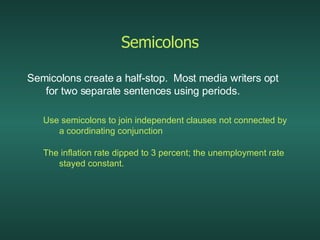
Semicolons Semicolons create a half-stop.  Most media writers opt for two separate sentences using periods.  Use semicolons to join independent clauses not connected by a coordinating conjunction The inflation rate dipped to 3 percent; the unemployment rate stayed constant.
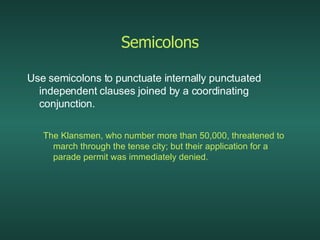
Semicolons Use semicolons to punctuate internally punctuated independent clauses joined by a coordinating conjunction. The Klansmen, who number more than 50,000, threatened to march through the tense city; but their application for a parade permit was immediately denied.
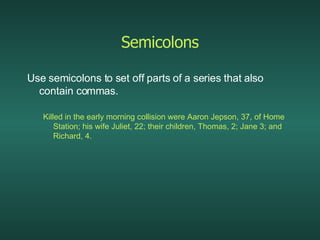
Semicolons Use semicolons to set off parts of a series that also contain commas. Killed in the early morning collision were Aaron Jepson, 37, of Home Station; his wife Juliet, 22; their children, Thomas, 2; Jane 3; and Richard, 4.
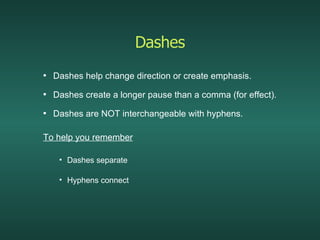
Dashes Dashes help change direction or create emphasis.  Dashes create a longer pause than a comma (for effect). Dashes are NOT interchangeable with hyphens. To help you remember Dashes separate Hyphens connect
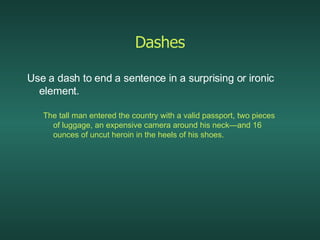
Dashes Use a dash to end a sentence in a surprising or ironic element. The tall man entered the country with a valid passport, two pieces of luggage, an expensive camera around his neck—and 16 ounces of uncut heroin in the heels of his shoes.
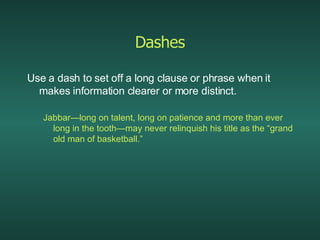
Dashes Use a dash to set off a long clause or phrase when it makes information clearer or more distinct. Jabbar—long on talent, long on patience and more than ever long in the tooth—may never relinquish his title as the “grand old man of basketball.”
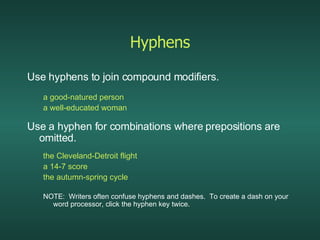
Hyphens Use hyphens to join compound modifiers. a good-natured person a well-educated woman Use a hyphen for combinations where prepositions are omitted. the Cleveland-Detroit flight a 14-7 score the autumn-spring cycle NOTE:  Writers often confuse hyphens and dashes.  To create a dash on your word processor, click the hyphen key twice.
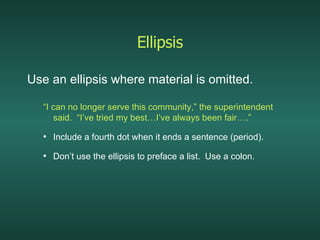
Ellipsis Use an ellipsis where material is omitted. “ I can no longer serve this community,” the superintendent said.  “I’ve tried my best…I’ve always been fair….” Include a fourth dot when it ends a sentence (period). Don’t use the ellipsis to preface a list.  Use a colon.
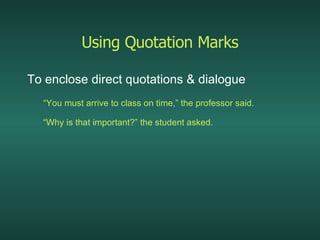
Using Quotation Marks To enclose direct quotations & dialogue “ You must arrive to class on time,” the professor said. “ Why is that important?” the student asked.
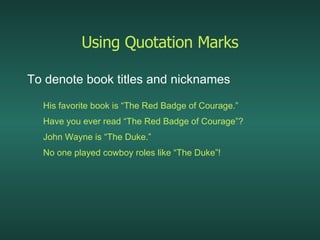
Using Quotation Marks To denote book titles and nicknames His favorite book is “The Red Badge of Courage.” Have you ever read “The Red Badge of Courage”? John Wayne is “The Duke.” No one played cowboy roles like “The Duke”!
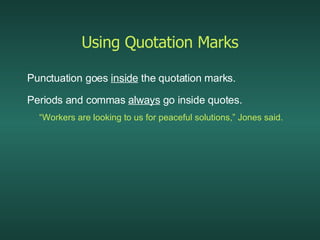
Using Quotation Marks Punctuation goes  inside  the quotation marks. Periods and commas  always  go inside quotes. “ Workers are looking to us for peaceful solutions,” Jones said.
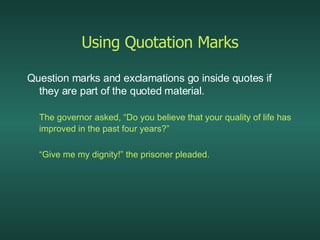
Using Quotation Marks Question marks and exclamations go inside quotes if they are part of the quoted material. The governor asked, “Do you believe that your quality of life has improved in the past four years?” “ Give me my dignity!” the prisoner pleaded.
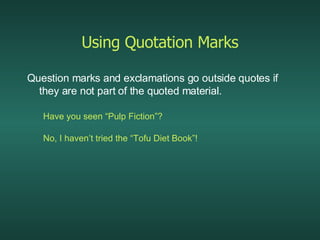
Using Quotation Marks Question marks and exclamations go outside quotes if they are not part of the quoted material. Have you seen “Pulp Fiction”? No, I haven’t tried the “Tofu Diet Book”!
Perfecting Your Punctuation Master the punctuation rules laid out in the 30 slides and you’ll understand 90 percent of what careful writers must know to also be “correct” writers. And drop me a line when you find a typo.  There’s bound to be at least one in there!

Perfecting Your Punctuation

  • 1.
    Perfecting Your PunctuationWilliam E. Sledzik aka, Professor ToughSledding Disclaimer : The many examples used in these slides are drawn from textbooks, workbooks, lecture notes -- even student papers -- over my 20+ years in the classroom. Some may have been lifted from copyrighted sources and have long since become separated from their credit lines. I owe special thanks to Laura Kessler and Duncan MacDonald, authors of “When Words Collide and to Carole Rich, whose text “Writing and Reporting News” is my guidebook for teaching the style of writing we use most often in public relations. http://toughsledding.wordpress.com
  • 2.
    Perfecting Your PunctuationPeriods End sentences Punctuate some abbreviations
  • 3.
    Perfecting Your PunctuationQuestion marks End direct questions Do you want to know what’s happening in Iraq? Don’t use if the question is indirect The world wants to know what’s happening in Iraq.
  • 4.
    Perfecting Your PunctuationExclamation marks express strong emotion or surprise. Place them inside quotation marks if exclamation is part of the quote. A comma isn’t needed if “!” is part of quoted material. “ You can’t make me testify!” the angry man shouted.
  • 5.
    Commas Commas separateitems in a series. The new superintendent enjoys sailing, cooking and stamp collecting. Per AP Style, no comma between the last two items in the series.
  • 6.
    Commas Commas separatetwo independent clauses connected by a coordinating conjunction. Volcanic activity continues on the mountain, but U.S. Forest Service officials said they will continue to issue hiking permits.
  • 7.
    Commas Commas setoff long introductory clauses and phrases and some shorter clauses and phrases that would be confusing without the comma. When the fire alarm went off for the third time that night, the motel clerk finally called the fire department. Every day, journalists are asked to make sense of an increasingly complex world.
  • 8.
    Commas Commas setoff non-restrictive (nonessential) clauses, phrases and modifiers from the rest of the sentence. Evans, who was denied parole in his last two visits before the board, appears again tomorrow to argue that 15 years of a 25-year sentence is punishment enough. Hint : If the sentence makes sense without the nonrestrictive clause, it is “nonessential” and should be bracketed in commas.
  • 9.
    Commas Commas separatedescriptive modifiers of equal rank. Meteorologists forecast another cold, dreary midwestern night. Scientists will not predict the next activity of the fickle, explosive volcano. Hint: If you can put “and” between the modifiers, they are of equal value and require the comma.
  • 10.
    Commas Commas setoff parenthetical expressions. The same council members , you may recall, voted themselves a 35-percent pay increase last year.
  • 11.
    Commas Commas helpwhen the absence of a pause can cause confusion. For the mayor, going fishing is a real vacation. Circling the brewery, workers kept a silent vigil to protest unsafe working conditions.
  • 12.
    Commas Commas setoff participles that modify some part of the independent clause. The Senate adjourned today, having successfully defeated a filibustering attempt.
  • 13.
    Misuse of CommasDon’t use a comma to separate two independent clauses that don’t have a coordinating conjunction. That’s called a comma splice . NO The inflation rate dipped to 3 percent, the unemployment rate stayed constant. YES The inflation rate dipped to 3 percent; the unemployment rate stayed constant. The inflation rate dipped to 3 percent, and the unemployment rate stayed constant.
  • 14.
    Misuse of CommasDon’t use a comma to introduce a subordinate clause. NO The mayor decided to inspect the chemical spill, because she needed a first-hand report. YES The mayor decided to inspect the chemical spill because she needed a first-hand report.
  • 15.
    Misuse of CommasDon’t use a comma between a word and a phrase it amplifies if it will create a “false series.” NO Rescuers discovered seven bodies, six transients and one firefighter. YES Rescuers discovered seven bodies: six transients and one firefighter.
  • 16.
    Misuse of CommasDon’t use a comma to precede a partial quotation. NO The mayoral candidate said the incumbent was, “a charlatan of the lowest order.” YES The mayoral candidate said the incumbent was “a charlatan of the lowest order.”
  • 17.
    Semicolons Semicolons createa half-stop. Most media writers opt for two separate sentences using periods. Use semicolons to join independent clauses not connected by a coordinating conjunction The inflation rate dipped to 3 percent; the unemployment rate stayed constant.
  • 18.
    Semicolons Use semicolonsto punctuate internally punctuated independent clauses joined by a coordinating conjunction. The Klansmen, who number more than 50,000, threatened to march through the tense city; but their application for a parade permit was immediately denied.
  • 19.
    Semicolons Use semicolonsto set off parts of a series that also contain commas. Killed in the early morning collision were Aaron Jepson, 37, of Home Station; his wife Juliet, 22; their children, Thomas, 2; Jane 3; and Richard, 4.
  • 20.
    Dashes Dashes helpchange direction or create emphasis. Dashes create a longer pause than a comma (for effect). Dashes are NOT interchangeable with hyphens. To help you remember Dashes separate Hyphens connect
  • 21.
    Dashes Use adash to end a sentence in a surprising or ironic element. The tall man entered the country with a valid passport, two pieces of luggage, an expensive camera around his neck—and 16 ounces of uncut heroin in the heels of his shoes.
  • 22.
    Dashes Use adash to set off a long clause or phrase when it makes information clearer or more distinct. Jabbar—long on talent, long on patience and more than ever long in the tooth—may never relinquish his title as the “grand old man of basketball.”
  • 23.
    Hyphens Use hyphensto join compound modifiers. a good-natured person a well-educated woman Use a hyphen for combinations where prepositions are omitted. the Cleveland-Detroit flight a 14-7 score the autumn-spring cycle NOTE: Writers often confuse hyphens and dashes. To create a dash on your word processor, click the hyphen key twice.
  • 24.
    Ellipsis Use anellipsis where material is omitted. “ I can no longer serve this community,” the superintendent said. “I’ve tried my best…I’ve always been fair….” Include a fourth dot when it ends a sentence (period). Don’t use the ellipsis to preface a list. Use a colon.
  • 25.
    Using Quotation MarksTo enclose direct quotations & dialogue “ You must arrive to class on time,” the professor said. “ Why is that important?” the student asked.
  • 26.
    Using Quotation MarksTo denote book titles and nicknames His favorite book is “The Red Badge of Courage.” Have you ever read “The Red Badge of Courage”? John Wayne is “The Duke.” No one played cowboy roles like “The Duke”!
  • 27.
    Using Quotation MarksPunctuation goes inside the quotation marks. Periods and commas always go inside quotes. “ Workers are looking to us for peaceful solutions,” Jones said.
  • 28.
    Using Quotation MarksQuestion marks and exclamations go inside quotes if they are part of the quoted material. The governor asked, “Do you believe that your quality of life has improved in the past four years?” “ Give me my dignity!” the prisoner pleaded.
  • 29.
    Using Quotation MarksQuestion marks and exclamations go outside quotes if they are not part of the quoted material. Have you seen “Pulp Fiction”? No, I haven’t tried the “Tofu Diet Book”!
  • 30.
    Perfecting Your PunctuationMaster the punctuation rules laid out in the 30 slides and you’ll understand 90 percent of what careful writers must know to also be “correct” writers. And drop me a line when you find a typo. There’s bound to be at least one in there!