Using Modifiers
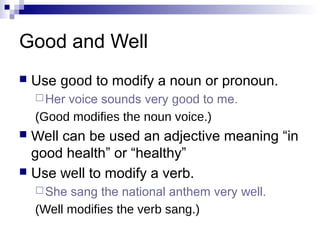
Good and Well
   Use good to modify a noun or pronoun.
     Hervoice sounds very good to me.
    (Good modifies the noun voice.)
 Well can be used an adjective meaning “in
  good health” or “healthy”
 Use well to modify a verb.
     She sang the national anthem very well.
    (Well modifies the verb sang.)
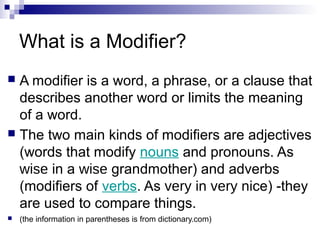
What is a Modifier?
 A modifier is a word, a phrase, or a clause that
  describes another word or limits the meaning
  of a word.
 The two main kinds of modifiers are adjectives
  (words that modify nouns and pronouns. As
  wise in a wise grandmother) and adverbs
  (modifiers of verbs. As very in very nice) -they
  are used to compare things.
   (the information in parentheses is from dictionary.com)
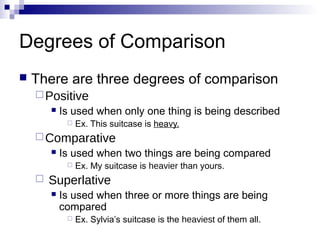
Degrees of Comparison
   There are three degrees of comparison
     Positive
           Is used when only one thing is being described
                Ex. This suitcase is heavy.
     Comparative
           Is used when two things are being compared
                Ex. My suitcase is heavier than yours.
       Superlative
           Is used when three or more things are being
            compared
                Ex. Sylvia’s suitcase is the heaviest of them all.
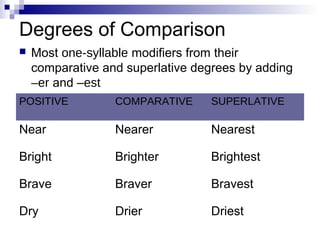
Degrees of Comparison
   Most one-syllable modifiers from their
    comparative and superlative degrees by adding
    –er and –est
POSITIVE          COMPARATIVE     SUPERLATIVE

Near              Nearer          Nearest

Bright            Brighter        Brightest

Brave             Braver          Bravest

Dry               Drier           Driest
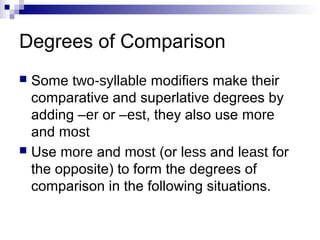
Degrees of Comparison
 Some two-syllable modifiers make their
  comparative and superlative degrees by
  adding –er or –est, they also use more
  and most
 Use more and most (or less and least for
  the opposite) to form the degrees of
  comparison in the following situations.
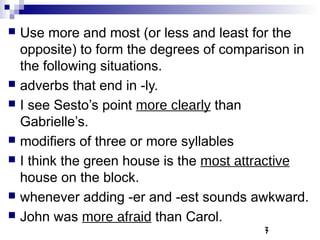
   Use more and most (or less and least for the
    opposite) to form the degrees of comparison in
    the following situations.
   adverbs that end in -ly.
   I see Sesto’s point more clearly than
    Gabrielle’s.
   modifiers of three or more syllables
   I think the green house is the most attractive
    house on the block.
   whenever adding -er and -est sounds awkward.
   John was more afraid than Carol.
                                          7
                                          7
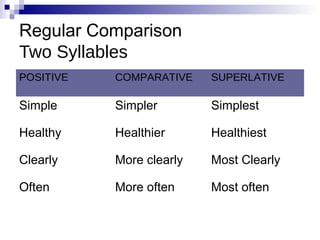
Regular Comparison
Two Syllables
POSITIVE   COMPARATIVE    SUPERLATIVE

Simple     Simpler        Simplest

Healthy    Healthier      Healthiest

Clearly    More clearly   Most Clearly

Often      More often     Most often
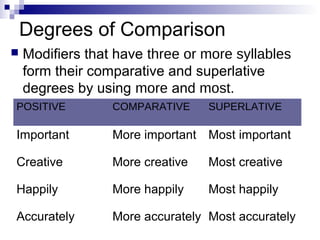
Degrees of Comparison
   Modifiers that have three or more syllables
    form their comparative and superlative
    degrees by using more and most.
POSITIVE          COMPARATIVE     SUPERLATIVE

Important         More important Most important

Creative          More creative   Most creative

Happily           More happily    Most happily

Accurately        More accurately Most accurately
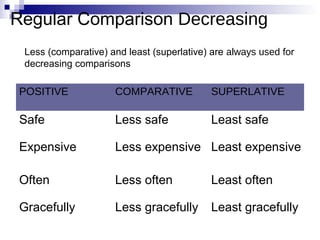
Regular Comparison Decreasing
 Less (comparative) and least (superlative) are always used for
 decreasing comparisons

 POSITIVE            COMPARATIVE           SUPERLATIVE

 Safe                Less safe             Least safe

 Expensive           Less expensive Least expensive

 Often               Less often            Least often

 Gracefully          Less gracefully       Least gracefully
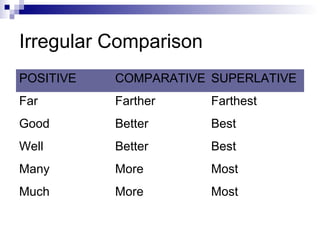
Irregular Comparison
POSITIVE   COMPARATIVE SUPERLATIVE
Far        Farther     Farthest
Good       Better      Best
Well       Better      Best
Many       More        Most
Much       More        Most
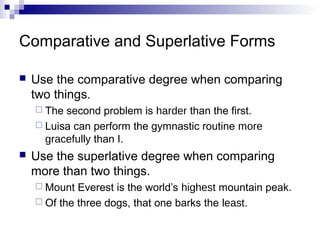
Comparative and Superlative Forms

   Use the comparative degree when comparing
    two things.
     The second problem is harder than the first.
     Luisa can perform the gymnastic routine more
      gracefully than I.
   Use the superlative degree when comparing
    more than two things.
     Mount  Everest is the world’s highest mountain peak.
     Of the three dogs, that one barks the least.
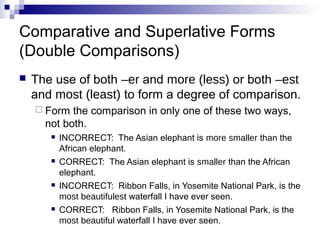
Comparative and Superlative Forms
(Double Comparisons)
   The use of both –er and more (less) or both –est
    and most (least) to form a degree of comparison.
     Form  the comparison in only one of these two ways,
      not both.
          INCORRECT: The Asian elephant is more smaller than the
           African elephant.
          CORRECT: The Asian elephant is smaller than the African
           elephant.
          INCORRECT: Ribbon Falls, in Yosemite National Park, is the
           most beautifulest waterfall I have ever seen.
          CORRECT: Ribbon Falls, in Yosemite National Park, is the
           most beautiful waterfall I have ever seen.
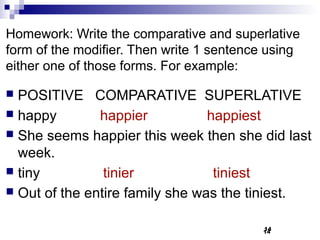
Homework: Write the comparative and superlative
form of the modifier. Then write 1 sentence using
either one of those forms. For example:

 POSITIVE COMPARATIVE SUPERLATIVE
 happy        happier           happiest
 She seems happier this week then she did last
  week.
 tiny          tinier            tiniest
 Out of the entire family she was the tiniest.


                                          14
                                          14
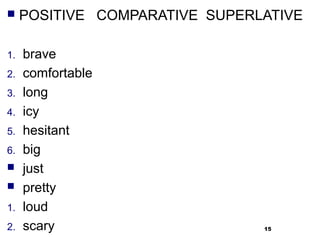
    POSITIVE COMPARATIVE SUPERLATIVE

1.   brave
2.   comfortable
3.   long
4.   icy
5.   hesitant
6.   big
    just
    pretty
1.   loud
2.   scary                      15

Using modifiers

  • 1.
  • 2.
    Good and Well  Use good to modify a noun or pronoun.  Hervoice sounds very good to me. (Good modifies the noun voice.)  Well can be used an adjective meaning “in good health” or “healthy”  Use well to modify a verb.  She sang the national anthem very well. (Well modifies the verb sang.)
  • 3.
    What is aModifier?  A modifier is a word, a phrase, or a clause that describes another word or limits the meaning of a word.  The two main kinds of modifiers are adjectives (words that modify nouns and pronouns. As wise in a wise grandmother) and adverbs (modifiers of verbs. As very in very nice) -they are used to compare things.  (the information in parentheses is from dictionary.com)
  • 4.
    Degrees of Comparison  There are three degrees of comparison  Positive  Is used when only one thing is being described  Ex. This suitcase is heavy.  Comparative  Is used when two things are being compared  Ex. My suitcase is heavier than yours.  Superlative  Is used when three or more things are being compared  Ex. Sylvia’s suitcase is the heaviest of them all.
  • 5.
    Degrees of Comparison  Most one-syllable modifiers from their comparative and superlative degrees by adding –er and –est POSITIVE COMPARATIVE SUPERLATIVE Near Nearer Nearest Bright Brighter Brightest Brave Braver Bravest Dry Drier Driest
  • 6.
    Degrees of Comparison Some two-syllable modifiers make their comparative and superlative degrees by adding –er or –est, they also use more and most  Use more and most (or less and least for the opposite) to form the degrees of comparison in the following situations.
  • 7.
    Use more and most (or less and least for the opposite) to form the degrees of comparison in the following situations.  adverbs that end in -ly.  I see Sesto’s point more clearly than Gabrielle’s.  modifiers of three or more syllables  I think the green house is the most attractive house on the block.  whenever adding -er and -est sounds awkward.  John was more afraid than Carol. 7 7
  • 8.
    Regular Comparison Two Syllables POSITIVE COMPARATIVE SUPERLATIVE Simple Simpler Simplest Healthy Healthier Healthiest Clearly More clearly Most Clearly Often More often Most often
  • 9.
    Degrees of Comparison  Modifiers that have three or more syllables form their comparative and superlative degrees by using more and most. POSITIVE COMPARATIVE SUPERLATIVE Important More important Most important Creative More creative Most creative Happily More happily Most happily Accurately More accurately Most accurately
  • 10.
    Regular Comparison Decreasing Less (comparative) and least (superlative) are always used for decreasing comparisons POSITIVE COMPARATIVE SUPERLATIVE Safe Less safe Least safe Expensive Less expensive Least expensive Often Less often Least often Gracefully Less gracefully Least gracefully
  • 11.
    Irregular Comparison POSITIVE COMPARATIVE SUPERLATIVE Far Farther Farthest Good Better Best Well Better Best Many More Most Much More Most
  • 12.
    Comparative and SuperlativeForms  Use the comparative degree when comparing two things.  The second problem is harder than the first.  Luisa can perform the gymnastic routine more gracefully than I.  Use the superlative degree when comparing more than two things.  Mount Everest is the world’s highest mountain peak.  Of the three dogs, that one barks the least.
  • 13.
    Comparative and SuperlativeForms (Double Comparisons)  The use of both –er and more (less) or both –est and most (least) to form a degree of comparison.  Form the comparison in only one of these two ways, not both.  INCORRECT: The Asian elephant is more smaller than the African elephant.  CORRECT: The Asian elephant is smaller than the African elephant.  INCORRECT: Ribbon Falls, in Yosemite National Park, is the most beautifulest waterfall I have ever seen.  CORRECT: Ribbon Falls, in Yosemite National Park, is the most beautiful waterfall I have ever seen.
  • 14.
    Homework: Write thecomparative and superlative form of the modifier. Then write 1 sentence using either one of those forms. For example:  POSITIVE COMPARATIVE SUPERLATIVE  happy happier happiest  She seems happier this week then she did last week.  tiny tinier tiniest  Out of the entire family she was the tiniest. 14 14
  • 15.
    POSITIVE COMPARATIVE SUPERLATIVE 1. brave 2. comfortable 3. long 4. icy 5. hesitant 6. big  just  pretty 1. loud 2. scary 15