Summary 
What is a summary? 
What do we look for when we write a summary? 
--Who 
--What 
--Where 
--When 
--Why 
--How
Summary 
Step One: 
--Preview the material and think of a few questions that you have 
about it. 
Step Two: 
--Read the material and take notes. Look for the 5Ws. 
Step Three: 
--After you’re finished reading, put the material away and write in 
your own words what the article was about. 
Here’s a good method: Pretend you are picking up the telephone to 
tell a friend about the article. Just use your regular conversational 
tone and tell it like it is…briefly, with emphasis on what is important, 
and the impact that article might have on them. Then write it just like 
you said it, and revise and edit later.
Summary 
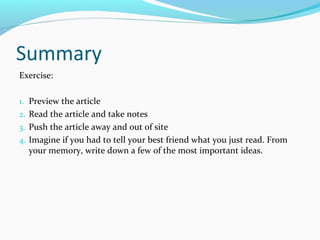
Exercise: 
1. Preview the article 
2. Read the article and take notes 
3. Push the article away and out of site 
4. Imagine if you had to tell your best friend what you just read. From 
your memory, write down a few of the most important ideas.
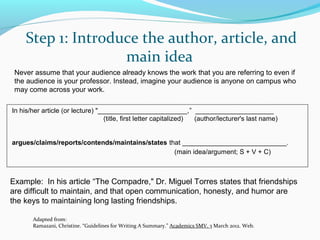
Step 1: Introduce the author, article, and 
main idea 
Never assume that your audience already knows the work that you are referring to even if 
the audience is your professor. Instead, imagine your audience is anyone on campus who 
may come across your work. 
In his/her article (or lecture) "________________________,” _____________________ 
(title, first letter capitalized) (author/lecturer's last name) 
argues/claims/reports/contends/maintains/states that ____________________________. 
(main idea/argument; S + V + C) 
Example: In his article “The Compadre," Dr. Miguel Torres states that friendships 
are difficult to maintain, and that open communication, honesty, and humor are 
the keys to maintaining long lasting friendships. 
Adapted from: 
Ramazani, Christine. “Guidelines for Writing A Summary.” Academics SMV. 3 March 2012. Web.
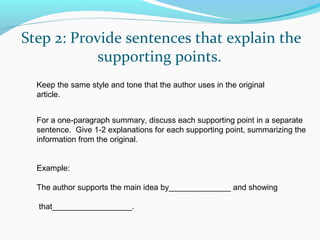
Step 2: Provide sentences that explain the 
supporting points. 
Keep the same style and tone that the author uses in the original 
article. 
For a one-paragraph summary, discuss each supporting point in a separate 
sentence. Give 1-2 explanations for each supporting point, summarizing the 
information from the original. 
Example: 
The author supports the main idea by______________ and showing 
that__________________.
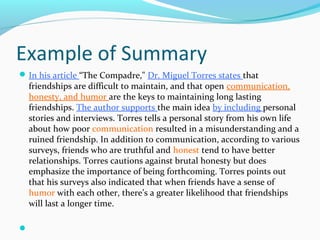
Example of Summary 
In his article “The Compadre," Dr. Miguel Torres states that 
friendships are difficult to maintain, and that open communication, 
honesty, and humor are the keys to maintaining long lasting 
friendships. The author supports the main idea by including personal 
stories and interviews. Torres tells a personal story from his own life 
about how poor communication resulted in a misunderstanding and a 
ruined friendship. In addition to communication, according to various 
surveys, friends who are truthful and honest tend to have better 
relationships. Torres cautions against brutal honesty but does 
emphasize the importance of being forthcoming. Torres points out 
that his surveys also indicated that when friends have a sense of 
humor with each other, there’s a greater likelihood that friendships 
will last a longer time. 

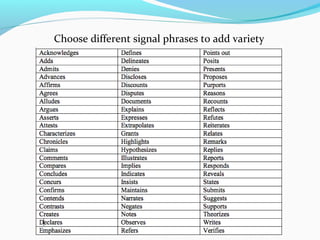
Choose different signal phrases to add variety
Evaluation 
After writing the summary, add an evaluation. 
What’s an evaluation? 
--Your opinion about what you’ve read.
Evaluation 
What should I include in the evaluation? 
--Did you like or dislike the article? Why? 
--Comment on the author’s ideas. Consider if they were 
well developed and supported. 
--Comment on the author’s style of writing. Consider if 
it was easy to read and understand. You can discuss 
word choice, sentence length, etc. 
--Comment on if you would recommend the article to 
someone else to read.
Example of Evaluation 
Dr. Torres’s article covers some important issues 
that give the reader valuable insight into maintaining 
friendships. His ideas are clear and easy to 
understand, and his work seems to be well researched 
and documented. Torres’s style of writing is concise 
and to the point. He does not use unnecessary jargon 
or fancy language that makes it difficult to read. 
Other readers who are interested in maintaining 
friendships would benefit from reading his article.

Summary ppt

  • 2.
    Summary What isa summary? What do we look for when we write a summary? --Who --What --Where --When --Why --How
  • 3.
    Summary Step One: --Preview the material and think of a few questions that you have about it. Step Two: --Read the material and take notes. Look for the 5Ws. Step Three: --After you’re finished reading, put the material away and write in your own words what the article was about. Here’s a good method: Pretend you are picking up the telephone to tell a friend about the article. Just use your regular conversational tone and tell it like it is…briefly, with emphasis on what is important, and the impact that article might have on them. Then write it just like you said it, and revise and edit later.
  • 4.
    Summary Exercise: 1.Preview the article 2. Read the article and take notes 3. Push the article away and out of site 4. Imagine if you had to tell your best friend what you just read. From your memory, write down a few of the most important ideas.
  • 5.
    Step 1: Introducethe author, article, and main idea Never assume that your audience already knows the work that you are referring to even if the audience is your professor. Instead, imagine your audience is anyone on campus who may come across your work. In his/her article (or lecture) "________________________,” _____________________ (title, first letter capitalized) (author/lecturer's last name) argues/claims/reports/contends/maintains/states that ____________________________. (main idea/argument; S + V + C) Example: In his article “The Compadre," Dr. Miguel Torres states that friendships are difficult to maintain, and that open communication, honesty, and humor are the keys to maintaining long lasting friendships. Adapted from: Ramazani, Christine. “Guidelines for Writing A Summary.” Academics SMV. 3 March 2012. Web.
  • 6.
    Step 2: Providesentences that explain the supporting points. Keep the same style and tone that the author uses in the original article. For a one-paragraph summary, discuss each supporting point in a separate sentence. Give 1-2 explanations for each supporting point, summarizing the information from the original. Example: The author supports the main idea by______________ and showing that__________________.
  • 7.
    Example of Summary In his article “The Compadre," Dr. Miguel Torres states that friendships are difficult to maintain, and that open communication, honesty, and humor are the keys to maintaining long lasting friendships. The author supports the main idea by including personal stories and interviews. Torres tells a personal story from his own life about how poor communication resulted in a misunderstanding and a ruined friendship. In addition to communication, according to various surveys, friends who are truthful and honest tend to have better relationships. Torres cautions against brutal honesty but does emphasize the importance of being forthcoming. Torres points out that his surveys also indicated that when friends have a sense of humor with each other, there’s a greater likelihood that friendships will last a longer time. 
  • 8.
    Choose different signalphrases to add variety
  • 9.
    Evaluation After writingthe summary, add an evaluation. What’s an evaluation? --Your opinion about what you’ve read.
  • 10.
    Evaluation What shouldI include in the evaluation? --Did you like or dislike the article? Why? --Comment on the author’s ideas. Consider if they were well developed and supported. --Comment on the author’s style of writing. Consider if it was easy to read and understand. You can discuss word choice, sentence length, etc. --Comment on if you would recommend the article to someone else to read.
  • 11.
    Example of Evaluation Dr. Torres’s article covers some important issues that give the reader valuable insight into maintaining friendships. His ideas are clear and easy to understand, and his work seems to be well researched and documented. Torres’s style of writing is concise and to the point. He does not use unnecessary jargon or fancy language that makes it difficult to read. Other readers who are interested in maintaining friendships would benefit from reading his article.