The Doppler Effect
Victoria Nguyen LO5
Daily life scenario
 You’re sitting in the car when suddenly you hear a distant siren from behind
you. As the ambulance approaches your car, the sound of its siren gets
louder and louder. But once the ambulance passes your car, the sound of
its siren gets softer. Why?
 Well, its because of the Doppler effect!
Doppler effect
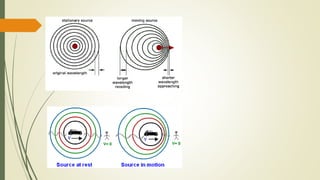
 The Doppler effect is a phenomenon that states that an approaching
source of sound will generate a high frequency and switch to lower
frequency as it passes by due to the compression and expansion of the
sound waves’ wavelength
Scenarios of the Doppler effect
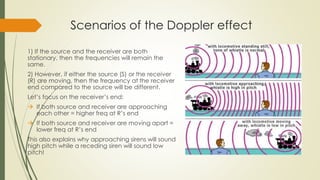
1) If the source and the receiver are both
stationary, then the frequencies will remain the
same.
2) However, if either the source (S) or the receiver
(R) are moving, then the frequency at the receiver
end compared to the source will be different.
Let’s focus on the receiver’s end:
 If both source and receiver are approaching
each other = higher freq at R’s end
 If both source and receiver are moving apart =
lower freq at R’s end
This also explains why approaching sirens will sound
high pitch while a receding siren will sound low
pitch!
The Doppler effect equation
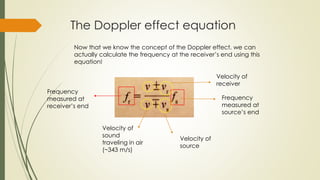
Now that we know the concept of the Doppler effect, we can
actually calculate the frequency at the receiver’s end using this
equation!
Frequency
measured at
receiver’s end
Velocity of
sound
traveling in air
(~343 m/s)
Velocity of
source
Velocity of
receiver
Frequency
measured at
source’s end
But what do these signs mean???
No need to panic! These signs just represent different scenarios of the
movement of the source and the receiver!
An end moving TOWARDS a stationary end
When either the source or the receiver is
moving TOWARDS the stationary end,
use the + sign on top and – sign on the
bottom.
This makes sense because by doing so,
we are increasing the numerator and
decreasing the denominator, which will
give us a higher R frequency, supporting
the Doppler effect.
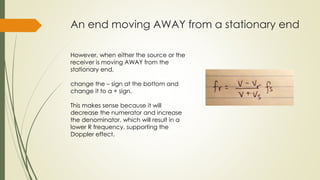
An end moving AWAY from a stationary end
However, when either the source or the
receiver is moving AWAY from the
stationary end,
change the – sign at the bottom and
change it to a + sign.
This makes sense because it will
decrease the numerator and increase
the denominator, which will result in a
lower R frequency, supporting the
Doppler effect.
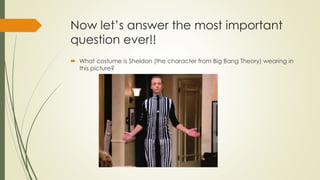
Now let’s answer the most important
question ever!!
 What costume is Sheldon (the character from Big Bang Theory) wearing in
this picture?
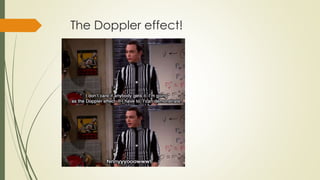
The Doppler effect!
Hope you enjoyed this presentation.
Now you know what the Doppler effect
is about!

The Doppler Effect

  • 1.
  • 2.
    Daily life scenario You’re sitting in the car when suddenly you hear a distant siren from behind you. As the ambulance approaches your car, the sound of its siren gets louder and louder. But once the ambulance passes your car, the sound of its siren gets softer. Why?  Well, its because of the Doppler effect!
  • 3.
    Doppler effect  TheDoppler effect is a phenomenon that states that an approaching source of sound will generate a high frequency and switch to lower frequency as it passes by due to the compression and expansion of the sound waves’ wavelength
  • 5.
    Scenarios of theDoppler effect 1) If the source and the receiver are both stationary, then the frequencies will remain the same. 2) However, if either the source (S) or the receiver (R) are moving, then the frequency at the receiver end compared to the source will be different. Let’s focus on the receiver’s end:  If both source and receiver are approaching each other = higher freq at R’s end  If both source and receiver are moving apart = lower freq at R’s end This also explains why approaching sirens will sound high pitch while a receding siren will sound low pitch!
  • 6.
    The Doppler effectequation Now that we know the concept of the Doppler effect, we can actually calculate the frequency at the receiver’s end using this equation! Frequency measured at receiver’s end Velocity of sound traveling in air (~343 m/s) Velocity of source Velocity of receiver Frequency measured at source’s end
  • 7.
    But what dothese signs mean??? No need to panic! These signs just represent different scenarios of the movement of the source and the receiver!
  • 8.
    An end movingTOWARDS a stationary end When either the source or the receiver is moving TOWARDS the stationary end, use the + sign on top and – sign on the bottom. This makes sense because by doing so, we are increasing the numerator and decreasing the denominator, which will give us a higher R frequency, supporting the Doppler effect.
  • 9.
    An end movingAWAY from a stationary end However, when either the source or the receiver is moving AWAY from the stationary end, change the – sign at the bottom and change it to a + sign. This makes sense because it will decrease the numerator and increase the denominator, which will result in a lower R frequency, supporting the Doppler effect.
  • 10.
    Now let’s answerthe most important question ever!!  What costume is Sheldon (the character from Big Bang Theory) wearing in this picture?
  • 11.
  • 12.
    Hope you enjoyedthis presentation. Now you know what the Doppler effect is about!