
VIKASH YADAV
MBA 1st SEM
CA & MIS
SPCJ INSTITUTE
 Data
 Types of data
 Information
 Types of information
 Data vs. Information
 The term has been derived from Latin word
“datum". Any fact or figure that is collected
by experience, experiment or observation
within a computer system is termed as data.
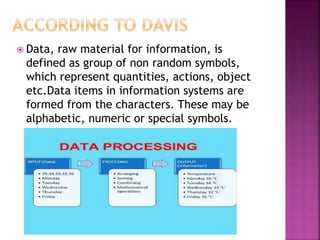
 Data, raw material for information, is
defined as group of non random symbols,
which represent quantities, actions, object
etc.Data items in information systems are
formed from the characters. These may be
alphabetic, numeric or special symbols.
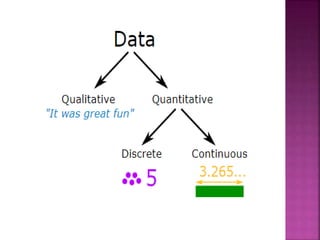
 Data can be qualitative or quantitative.
 Qualitative data is descriptive information (it describes something)
eg:He is brown and black
He has long hair
He has lots of energy
 Quantitative data is numerical information (numbers)
 Quantitative data can be Discrete or Continuous:
 Discrete data can only take certain values (like whole numbers)
eg:He has 4 legs
He has 2 brothers
 Continuous data can take any value (within a range)
eg:He weighs 25.5 kg
He is 565 mm tall
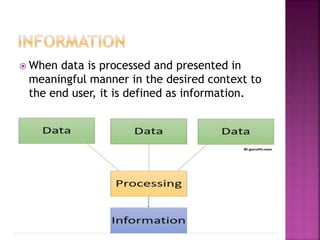
 When data is processed and presented in
meaningful manner in the desired context to
the end user, it is defined as information.
 “Information is data that has been processed
into a form that is meaningful to the
recipient and is of real or perceived value in
current or prospective action or decision”.
 The above definition of information exercises
on the value of information in decision
making. Information is also considered as an
effective tool for building motivation
improving perception that may influence
future decision
 STRATEGIC INFORMATION – Concerned with long
term policy defines the objectives of a business
and checks how well these objectives are met.
Eg –acquiring a new plant, a new product.
 TACTICAL INFORMATION-Concerned with the
information needed for exercising control over
business resources, like budgeting ,quality
control, service level etc.
 OPERATIONAL INFORMATION-Concerned with
proper conduction of specific operational tasks
as planned.eg various operator specific,
machine and shift specific jobs for quality
control checks.
 PLANNING INFORMATION
 CONTROL INFORMATION
 KNOWLEDGE INFORMATION
 ORGANIZATIONAL INFORMATION
 FUNCTIONAL/OPERATIONAL INFORMATION
 DATABASE INFORMATION
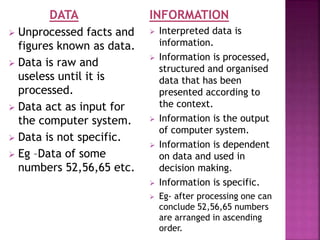
DATA
 Unprocessed facts and
figures known as data.
 Data is raw and
useless until it is
processed.
 Data act as input for
the computer system.
 Data is not specific.
 Eg –Data of some
numbers 52,56,65 etc.
INFORMATION
 Interpreted data is
information.
 Information is processed,
structured and organised
data that has been
presented according to
the context.
 Information is the output
of computer system.
 Information is dependent
on data and used in
decision making.
 Information is specific.
 Eg- after processing one can
conclude 52,56,65 numbers
are arranged in ascending
order.
Data and information

Data and information

  • 1.
    VIKASH YADAV MBA 1stSEM CA & MIS SPCJ INSTITUTE
  • 2.
     Data  Typesof data  Information  Types of information  Data vs. Information
  • 3.
     The termhas been derived from Latin word “datum". Any fact or figure that is collected by experience, experiment or observation within a computer system is termed as data.
  • 4.
     Data, rawmaterial for information, is defined as group of non random symbols, which represent quantities, actions, object etc.Data items in information systems are formed from the characters. These may be alphabetic, numeric or special symbols.
  • 5.
     Data canbe qualitative or quantitative.  Qualitative data is descriptive information (it describes something) eg:He is brown and black He has long hair He has lots of energy  Quantitative data is numerical information (numbers)  Quantitative data can be Discrete or Continuous:  Discrete data can only take certain values (like whole numbers) eg:He has 4 legs He has 2 brothers  Continuous data can take any value (within a range) eg:He weighs 25.5 kg He is 565 mm tall
  • 7.
     When datais processed and presented in meaningful manner in the desired context to the end user, it is defined as information.
  • 8.
     “Information isdata that has been processed into a form that is meaningful to the recipient and is of real or perceived value in current or prospective action or decision”.  The above definition of information exercises on the value of information in decision making. Information is also considered as an effective tool for building motivation improving perception that may influence future decision
  • 10.
     STRATEGIC INFORMATION– Concerned with long term policy defines the objectives of a business and checks how well these objectives are met. Eg –acquiring a new plant, a new product.  TACTICAL INFORMATION-Concerned with the information needed for exercising control over business resources, like budgeting ,quality control, service level etc.  OPERATIONAL INFORMATION-Concerned with proper conduction of specific operational tasks as planned.eg various operator specific, machine and shift specific jobs for quality control checks.
  • 11.
     PLANNING INFORMATION CONTROL INFORMATION  KNOWLEDGE INFORMATION  ORGANIZATIONAL INFORMATION  FUNCTIONAL/OPERATIONAL INFORMATION  DATABASE INFORMATION
  • 13.
    DATA  Unprocessed factsand figures known as data.  Data is raw and useless until it is processed.  Data act as input for the computer system.  Data is not specific.  Eg –Data of some numbers 52,56,65 etc. INFORMATION  Interpreted data is information.  Information is processed, structured and organised data that has been presented according to the context.  Information is the output of computer system.  Information is dependent on data and used in decision making.  Information is specific.  Eg- after processing one can conclude 52,56,65 numbers are arranged in ascending order.