INFORMATION
- WHAT IS INFORMATION?
- ATTRIBUTES OF INFORMATION
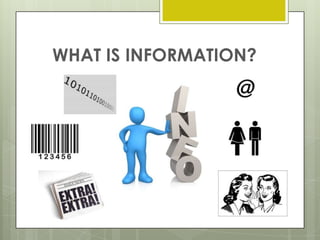
WHAT IS INFORMATION?
DEFINITION
Ordered sequence of symbols that can be
interpreted as a message.
 Information can be recorded as signs, or
transmitted as signals.
 Information is any kind of event that affects
the state of a dynamic system.

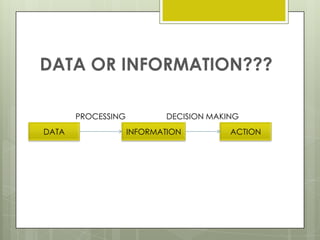
DATA OR INFORMATION???
PROCESSING
DATA

DECISION MAKING
INFORMATION

ACTION
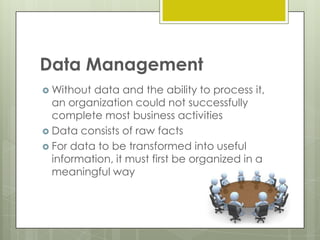
Data Management
 Without

data and the ability to process it,
an organization could not successfully
complete most business activities
 Data consists of raw facts
 For data to be transformed into useful
information, it must first be organized in a
meaningful way
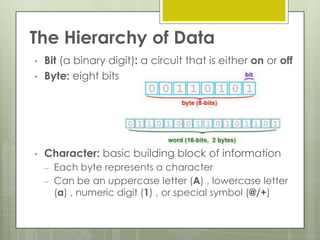
The Hierarchy of Data
•

Bit (a binary digit): a circuit that is either on or off
Byte: eight bits

•

Character: basic building block of information

•

–
–

Each byte represents a character
Can be an uppercase letter (A) , lowercase letter
(a) , numeric digit (1) , or special symbol (@/+)
•

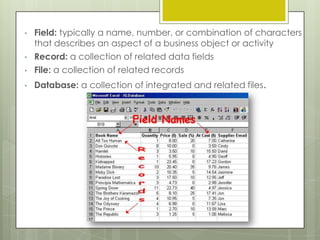
Field: typically a name, number, or combination of characters
that describes an aspect of a business object or activity
Record: a collection of related data fields
File: a collection of related records

•

Database: a collection of integrated and related files.

•
•
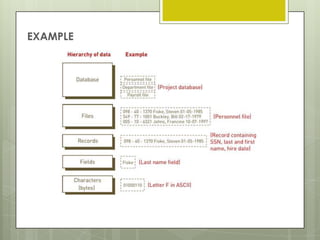
EXAMPLE
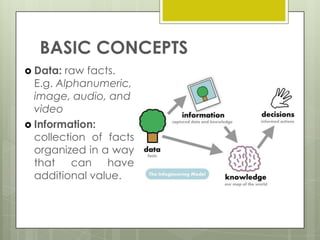
BASIC CONCEPTS
 Data:

raw facts.
E.g. Alphanumeric,
image, audio, and
video
 Information:
collection of facts
organized in a way
that can have
additional value.
Value of Information??
It is directly linked to how it helps decision
makers
achieve
their
organization’s
OBJECTIVES and can be MEASURED:
- in time required to make a decision
- Increased profits to the company
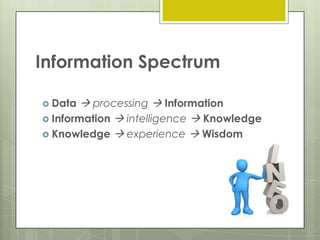
Information Spectrum
 Data

 processing  Information
 Information  intelligence  Knowledge
 Knowledge  experience  Wisdom
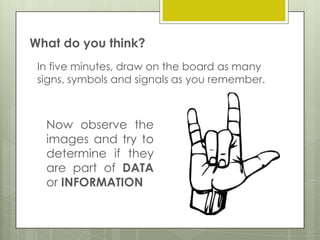
What do you think?
In five minutes, draw on the board as many
signs, symbols and signals as you remember.

Now observe the
images and try to
determine if they
are part of DATA
or INFORMATION
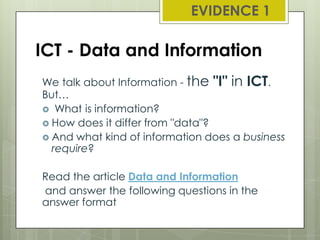
EVIDENCE 1

ICT - Data and Information
We talk about Information - the "I" in ICT.
But…
 What is information?
 How does it differ from "data"?
 And what kind of information does a business
require?

Read the article Data and Information
and answer the following questions in the
answer format
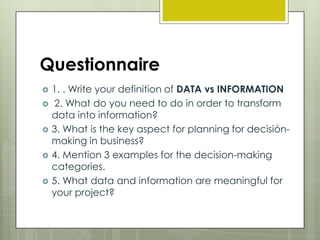
Questionnaire






1. . Write your definition of DATA vs INFORMATION
2. What do you need to do in order to transform
data into information?
3. What is the key aspect for planning for decisiónmaking in business?
4. Mention 3 examples for the decision-making
categories.
5. What data and information are meaningful for
your project?
Attributes of
Information
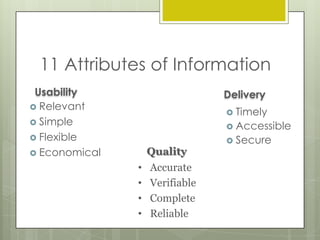
11 Attributes of Information
Usability
 Relevant
 Simple
 Flexible
 Economical

Delivery
 Timely
 Accessible

Quality

•
•
•
•

Accurate
Verifiable
Complete
Reliable

 Secure
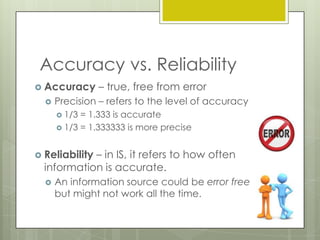
Accuracy vs. Reliability
 Accuracy


– true, free from error

Precision – refers to the level of accuracy
 1/3

= 1.333 is accurate
 1/3 = 1.333333 is more precise
 Reliability

– in IS, it refers to how often
information is accurate.


An information source could be error free
but might not work all the time.
Weather Forecasting
What do you think?
Are weather-people:






A. reliable,
B. accurate,
C. both, or
D. neither?
Accurate vs. Reliable
1. Weatherman A
can predict tomorrow´s
temperature to the
exact degree (C°)
- but only 40% of the
time, the other 60% he
cannot interpret the
raw* data.

2. Weatherman B
can predict tomorrow´s
temperature but it may
be off by 5 degrees
- His system works 95% of
the time

Who is more accurate?
Who is more reliable?
*Raw: Not processed
EVIDENCE 2

Can you guess??..
What attributes are described?
Respond in the answer format.

1. My calculator always does
multiplication correctly in never makes an
error. My calculator is __________ .
2. However, I dropped it in the sink and
sometimes it doesn´t turn on. So, my
calculation is not _________
3. I put the reports on the website so
everyone can access them.
This makes the reports more ________.

4. The reports are PDF files which cannot be
modified easily, so we also provide the data
in standard XML format which can be
converted to any other format.
The XML format is more ___________.
5. Teacher: My student evaluation report
includes 23 answers from all 31 students. It´s
hard for me to tell if my students are good or
bad, because the data is not__________.

6. The student evaluation report includes only
my average score, which is very _______ and
easy to interpret, but I’d like all the data.
 THIS

IS THE END
OF THIS MODULE.

INFORMATION
Go to next module: Information
Systems

Module 4 information_attributes

  • 1.
    INFORMATION - WHAT ISINFORMATION? - ATTRIBUTES OF INFORMATION
  • 2.
  • 3.
    DEFINITION Ordered sequence ofsymbols that can be interpreted as a message.  Information can be recorded as signs, or transmitted as signals.  Information is any kind of event that affects the state of a dynamic system. 
  • 4.
  • 5.
    Data Management  Without dataand the ability to process it, an organization could not successfully complete most business activities  Data consists of raw facts  For data to be transformed into useful information, it must first be organized in a meaningful way
  • 6.
    The Hierarchy ofData • Bit (a binary digit): a circuit that is either on or off Byte: eight bits • Character: basic building block of information • – – Each byte represents a character Can be an uppercase letter (A) , lowercase letter (a) , numeric digit (1) , or special symbol (@/+)
  • 7.
    • Field: typically aname, number, or combination of characters that describes an aspect of a business object or activity Record: a collection of related data fields File: a collection of related records • Database: a collection of integrated and related files. • •
  • 8.
  • 9.
    BASIC CONCEPTS  Data: rawfacts. E.g. Alphanumeric, image, audio, and video  Information: collection of facts organized in a way that can have additional value.
  • 10.
    Value of Information?? Itis directly linked to how it helps decision makers achieve their organization’s OBJECTIVES and can be MEASURED: - in time required to make a decision - Increased profits to the company
  • 11.
    Information Spectrum  Data processing  Information  Information  intelligence  Knowledge  Knowledge  experience  Wisdom
  • 12.
    What do youthink? In five minutes, draw on the board as many signs, symbols and signals as you remember. Now observe the images and try to determine if they are part of DATA or INFORMATION
  • 13.
    EVIDENCE 1 ICT -Data and Information We talk about Information - the "I" in ICT. But…  What is information?  How does it differ from "data"?  And what kind of information does a business require? Read the article Data and Information and answer the following questions in the answer format
  • 14.
    Questionnaire      1. . Writeyour definition of DATA vs INFORMATION 2. What do you need to do in order to transform data into information? 3. What is the key aspect for planning for decisiónmaking in business? 4. Mention 3 examples for the decision-making categories. 5. What data and information are meaningful for your project?
  • 15.
  • 16.
    11 Attributes ofInformation Usability  Relevant  Simple  Flexible  Economical Delivery  Timely  Accessible Quality • • • • Accurate Verifiable Complete Reliable  Secure
  • 17.
    Accuracy vs. Reliability Accuracy  – true, free from error Precision – refers to the level of accuracy  1/3 = 1.333 is accurate  1/3 = 1.333333 is more precise  Reliability – in IS, it refers to how often information is accurate.  An information source could be error free but might not work all the time.
  • 18.
    Weather Forecasting What doyou think? Are weather-people:     A. reliable, B. accurate, C. both, or D. neither?
  • 19.
    Accurate vs. Reliable 1.Weatherman A can predict tomorrow´s temperature to the exact degree (C°) - but only 40% of the time, the other 60% he cannot interpret the raw* data. 2. Weatherman B can predict tomorrow´s temperature but it may be off by 5 degrees - His system works 95% of the time Who is more accurate? Who is more reliable? *Raw: Not processed
  • 20.
    EVIDENCE 2 Can youguess??.. What attributes are described? Respond in the answer format. 1. My calculator always does multiplication correctly in never makes an error. My calculator is __________ . 2. However, I dropped it in the sink and sometimes it doesn´t turn on. So, my calculation is not _________
  • 21.
    3. I putthe reports on the website so everyone can access them. This makes the reports more ________. 4. The reports are PDF files which cannot be modified easily, so we also provide the data in standard XML format which can be converted to any other format. The XML format is more ___________.
  • 22.
    5. Teacher: Mystudent evaluation report includes 23 answers from all 31 students. It´s hard for me to tell if my students are good or bad, because the data is not__________. 6. The student evaluation report includes only my average score, which is very _______ and easy to interpret, but I’d like all the data.
  • 23.
     THIS IS THEEND OF THIS MODULE. INFORMATION Go to next module: Information Systems

Editor's Notes