DATAVS INFORMATION
Mr Tariq Saleem Ghayyur
Lecturer Education, SU
1
MEANING OF DATA
2
 Set of value of qualitative and quantitative
data.
 Raw material or fact.
 Limitless and present everywhere in universe.
 Helps in production of information.
DATAPROCESSING
3
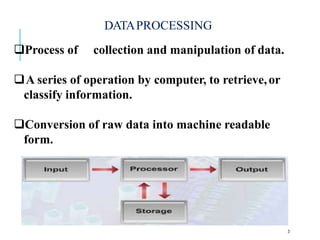
Process of collection and manipulation of data.
A series of operation by computer, to retrieve,or
classify information.
Conversion of raw data into machine readable
form.
INFORMATION
4
 Processed form of interrelated data into
meaningful form.
 It is summarization of structured data.
 Information is used for management decision.
 Information should be always in the order.
DIFFERENCE BETWEEN DATAAND INFORMATION
5
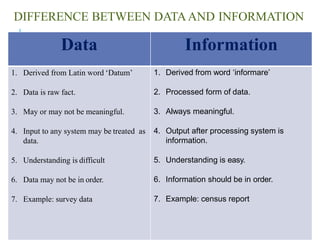
Data Information
1. Derived from Latin word ‘Datum’
2. Data is raw fact.
3. May or may not be meaningful.
4. Input to any system may be treated as
data.
5. Understanding is difficult
6. Data may not be in order.
7. Example: survey data
1. Derived from word ‘informare’
2. Processed form of data.
3. Always meaningful.
4. Output after processing system is
information.
5. Understanding is easy.
6. Information should be in order.
7. Example: census report
CHARACTERISTICS OF
INFORMATION
Good information is that which is used
and which creates value. Experience and
research shows that good information
has numerous qualities.
Good information is relevant for its
purpose, sufficiently accurate for its
purpose, complete enough for the
problem, reliable and targeted to the
right person. It is also communicated in
time for its purpose, contains the right
level of detail and is communicated by 6
AVAILABILITY/ACCESSIBILITY
Information should be easy to obtain or
access. Information kept in a book of
some kind is only available and easy to
access if you have the book to hand. A
good example of availability is a
telephone directory, as every home has
one for its local area. It is probably the
first place you look for a local number.
But nobody keeps the whole country’s
telephone books so for numbers further
afield you probably phone a directory
enquiry number. For business premises,
say for a hotel in London, you would 7
ACCURACY
Information needs to be accurate enough for
the use to which it is going to be put. To
obtain information that is 100% accurate is
usually unrealistic as it is likely to be too
expensive to produce on time. The degree
of accuracy depends upon the
circumstances. At operational levels
information may need to be accurate to the
nearest penny – on a supermarket till
receipt, for example. At tactical level
department heads may see weekly
summaries correct to the nearest £100,
whereas at strategic level directors may look
at comparing stores’ performances over
8
RELIABILITY OR OBJECTIVITY
Reliability deals with the truth of information or the
objectivity with which it is presented. You can only
really use information confidently if you are sure of
its reliability and objectivity.
When researching for an essay in any subject, we
might make straight for the library to find a suitable
book. We are reasonably confident that the
information found in a book, especially one that the
library has purchased, is reliable and (in the case of
factual information) objective. The book has been
written and the author’s name is usually printed for
all to see. The publisher should have employed an
editor and an expert in the field to edit the book and
question any factual doubts they may have. In short,
much time and energy goes into publishing a book
9
RELEVANCE/APPROPRIATEN
ESS
Information should be relevant to the
purpose for which it is required. It must be
suitable. What is relevant for one manager
may not be relevant for another. The user
will become frustrated if information
contains data irrelevant to the task in hand.
For example, a market research company
may give information on users’ perceptions
of the quality of a product. This is not
relevant for the manager who wants to know
opinions on relative prices of the product
and its rivals. The information gained would
not be relevant to the purpose. 10
COMPLETENESS
Information should contain all the details
required by the user. Otherwise, it may not be
useful as the basis for making a decision. For
example, if an organization is supplied with
information regarding the costs of supplying a
fleet of cars for the sales force, and servicing
and maintenance costs are not included, then
a costing based on the information supplied
will be considerably underestimated.
Ideally all the information needed for a
particular decision should be
available. However, this rarely happens; good
information is often incomplete. To meet all
11
LEVEL OF
DETAIL/CONCISENESS
Information should be in a form that is
short enough to allow for its examination
and use. There should be no extraneous
information. For example, it is very
common practice to summarize financial
data and present this information, both in
the form of figures and by using a chart or
graph. We would say that the graph is
more concise than the tables of figures as
there is little or no extraneous information
in the graph or chart. Clearly there is a
trade-off between level of detail and
conciseness. 12
PRESENTATION
The presentation of information is
important to the user. Information can be
more easily assimilated if it is
aesthetically pleasing. For example, a
marketing report that includes graphs of
statistics will be more concise as well as
more aesthetically pleasing to the users
within the organization. Many
organizations use presentation software
and show summary information via a data
projector. These presentations have
usually been well thought out to be
visually attractive and to convey the13
TIMING
Information must be on time for the
purpose for which it is required.
Information received too late will be
irrelevant. For example, if you receive a
brochure from a theatre and notice there
was a concert by your favourite band
yesterday, then the information is too
late to be of use.
14
VALUE OF INFORMATION
The relative importance of information
for decision-making can increase or
decrease its value to an organization.
For example, an organization requires
information on a competitor’s
performance that is critical to their own
decision on whether to invest in new
machinery for their factory. The value of
this information would be high. Always
keep in mind that information should be
available on time, within cost constraints
and be legally obtained. 15
COST OF INFORMATION
Information should be available within set
cost levels that may vary dependent on
situation. If costs are too high to obtain
information an organization may decide
to seek slightly less comprehensive
information elsewhere. For example, an
organization wants to commission a
market survey on a new product. The
survey could cost more than the forecast
initial profit from the product. In that
situation, the organization would
probably decide that a less costly source
of information should be used, even if it16
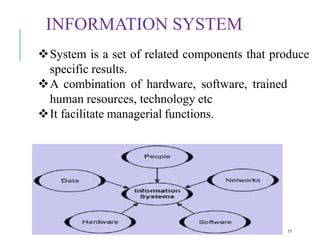
INFORMATION SYSTEM
17
System is a set of related components that produce
specific results.
A combination of hardware, software, trained
human resources, technology etc
It facilitate managerial functions.
CHARACTERISTICS OF
INFORMATION SYSTEM
1. Accuracy: MIS is key measure of
effectiveness.
2. Timeliness: MIS has to make decision
of future of organization based on
data of present.
3. Completeness: An effective MIS
presents all the most relevant and
useful information for a particular
decision.
4. Cost effectiveness: It must be understood
by the receiver so that he will interpret it
18
NEED OF INFORMATION
SYSTEM
19
1. Provide efficiency
2. Accurate measurement
3. Better decision making
4. Competitive advantage
5. Operational excellence
6. Reduce operating cost

Data vs Information

  • 1.
    DATAVS INFORMATION Mr TariqSaleem Ghayyur Lecturer Education, SU 1
  • 2.
    MEANING OF DATA 2 Set of value of qualitative and quantitative data.  Raw material or fact.  Limitless and present everywhere in universe.  Helps in production of information.
  • 3.
    DATAPROCESSING 3 Process of collectionand manipulation of data. A series of operation by computer, to retrieve,or classify information. Conversion of raw data into machine readable form.
  • 4.
    INFORMATION 4  Processed formof interrelated data into meaningful form.  It is summarization of structured data.  Information is used for management decision.  Information should be always in the order.
  • 5.
    DIFFERENCE BETWEEN DATAANDINFORMATION 5 Data Information 1. Derived from Latin word ‘Datum’ 2. Data is raw fact. 3. May or may not be meaningful. 4. Input to any system may be treated as data. 5. Understanding is difficult 6. Data may not be in order. 7. Example: survey data 1. Derived from word ‘informare’ 2. Processed form of data. 3. Always meaningful. 4. Output after processing system is information. 5. Understanding is easy. 6. Information should be in order. 7. Example: census report
  • 6.
    CHARACTERISTICS OF INFORMATION Good informationis that which is used and which creates value. Experience and research shows that good information has numerous qualities. Good information is relevant for its purpose, sufficiently accurate for its purpose, complete enough for the problem, reliable and targeted to the right person. It is also communicated in time for its purpose, contains the right level of detail and is communicated by 6
  • 7.
    AVAILABILITY/ACCESSIBILITY Information should beeasy to obtain or access. Information kept in a book of some kind is only available and easy to access if you have the book to hand. A good example of availability is a telephone directory, as every home has one for its local area. It is probably the first place you look for a local number. But nobody keeps the whole country’s telephone books so for numbers further afield you probably phone a directory enquiry number. For business premises, say for a hotel in London, you would 7
  • 8.
    ACCURACY Information needs tobe accurate enough for the use to which it is going to be put. To obtain information that is 100% accurate is usually unrealistic as it is likely to be too expensive to produce on time. The degree of accuracy depends upon the circumstances. At operational levels information may need to be accurate to the nearest penny – on a supermarket till receipt, for example. At tactical level department heads may see weekly summaries correct to the nearest £100, whereas at strategic level directors may look at comparing stores’ performances over 8
  • 9.
    RELIABILITY OR OBJECTIVITY Reliabilitydeals with the truth of information or the objectivity with which it is presented. You can only really use information confidently if you are sure of its reliability and objectivity. When researching for an essay in any subject, we might make straight for the library to find a suitable book. We are reasonably confident that the information found in a book, especially one that the library has purchased, is reliable and (in the case of factual information) objective. The book has been written and the author’s name is usually printed for all to see. The publisher should have employed an editor and an expert in the field to edit the book and question any factual doubts they may have. In short, much time and energy goes into publishing a book 9
  • 10.
    RELEVANCE/APPROPRIATEN ESS Information should berelevant to the purpose for which it is required. It must be suitable. What is relevant for one manager may not be relevant for another. The user will become frustrated if information contains data irrelevant to the task in hand. For example, a market research company may give information on users’ perceptions of the quality of a product. This is not relevant for the manager who wants to know opinions on relative prices of the product and its rivals. The information gained would not be relevant to the purpose. 10
  • 11.
    COMPLETENESS Information should containall the details required by the user. Otherwise, it may not be useful as the basis for making a decision. For example, if an organization is supplied with information regarding the costs of supplying a fleet of cars for the sales force, and servicing and maintenance costs are not included, then a costing based on the information supplied will be considerably underestimated. Ideally all the information needed for a particular decision should be available. However, this rarely happens; good information is often incomplete. To meet all 11
  • 12.
    LEVEL OF DETAIL/CONCISENESS Information shouldbe in a form that is short enough to allow for its examination and use. There should be no extraneous information. For example, it is very common practice to summarize financial data and present this information, both in the form of figures and by using a chart or graph. We would say that the graph is more concise than the tables of figures as there is little or no extraneous information in the graph or chart. Clearly there is a trade-off between level of detail and conciseness. 12
  • 13.
    PRESENTATION The presentation ofinformation is important to the user. Information can be more easily assimilated if it is aesthetically pleasing. For example, a marketing report that includes graphs of statistics will be more concise as well as more aesthetically pleasing to the users within the organization. Many organizations use presentation software and show summary information via a data projector. These presentations have usually been well thought out to be visually attractive and to convey the13
  • 14.
    TIMING Information must beon time for the purpose for which it is required. Information received too late will be irrelevant. For example, if you receive a brochure from a theatre and notice there was a concert by your favourite band yesterday, then the information is too late to be of use. 14
  • 15.
    VALUE OF INFORMATION Therelative importance of information for decision-making can increase or decrease its value to an organization. For example, an organization requires information on a competitor’s performance that is critical to their own decision on whether to invest in new machinery for their factory. The value of this information would be high. Always keep in mind that information should be available on time, within cost constraints and be legally obtained. 15
  • 16.
    COST OF INFORMATION Informationshould be available within set cost levels that may vary dependent on situation. If costs are too high to obtain information an organization may decide to seek slightly less comprehensive information elsewhere. For example, an organization wants to commission a market survey on a new product. The survey could cost more than the forecast initial profit from the product. In that situation, the organization would probably decide that a less costly source of information should be used, even if it16
  • 17.
    INFORMATION SYSTEM 17 System isa set of related components that produce specific results. A combination of hardware, software, trained human resources, technology etc It facilitate managerial functions.
  • 18.
    CHARACTERISTICS OF INFORMATION SYSTEM 1.Accuracy: MIS is key measure of effectiveness. 2. Timeliness: MIS has to make decision of future of organization based on data of present. 3. Completeness: An effective MIS presents all the most relevant and useful information for a particular decision. 4. Cost effectiveness: It must be understood by the receiver so that he will interpret it 18
  • 19.
    NEED OF INFORMATION SYSTEM 19 1.Provide efficiency 2. Accurate measurement 3. Better decision making 4. Competitive advantage 5. Operational excellence 6. Reduce operating cost