WAP
Mrs. Vasanthi Muniasamy
WHAT IS WAP?
WAP is Wireless Application Protocol
WAP is an open international standard for
application layer network communications
in a wireless communication environment.
Its main use is to enable access to the
Internet (HTTP) from a mobile phone or
PDA.
WHAT IS PROTOCOL?
A Protocol is a set of guidelines or rules.
In computing and internet
FEATURES OF WAP












WAP stands for W ireless A pplication P rotocol
WAP is an application communication protocol
WAP is used to access services and information
WAP is inherited from Internet standards
WAP is for handheld devices such as mobile
phones
WAP is a protocol designed for micro browsers
WAP enables the creating of web applications for
mobile devices.
WAP uses the mark-up language WML (not HTML)
WML is defined as an XML 1.0 application
WAP Micro Browsers






To fit into a small wireless terminal, WAP uses a
Micro Browser.
A Micro Browser is a small piece of software that
makes minimal demands on hardware, memory
and CPU. It can display information written in a
restricted mark-up language called WML.
The Micro Browser can also interpret a reduced
version of JavaScript called WMLScript.
COMPONENTS OF WAP

WML





WML stands for W ireless M arkup L anguage. It
is a mark-up language inherited from HTML, but
WML is based on XML, so it is much stricter
than HTML.

Differs from HTML in the following





WML was specifically designed for wireless
terminals with a target screen that is only a few lines
long and about an inch wide.
WML is case sensitive , and all tags and attributes
should be in lowercase.
WML doesn't assume that a keyboard or a mouse is
available for user input
WAP Components (contd)…


WAP Gateway



Encoder: converts WML to binarized WML
Adaptor: provides additional information
through HTTP header




Translate HTTP requests to WSP.
Convert between SSL and WTLS
Convert transport protocols (TCP and WDP
WML Script


WML uses WML Script to run simple code
on the client. WML Script is a light
JavaScript language. However, WML
scripts are not embedded in the WML
pages. WML pages only contains
references to script URLs. WML scripts
need to be compiled into byte code on a
server before they can run in a WAP
browser.
WAP Homepages




WAP homepages are not very different from
HTML homepages. The markup language used
for WAP is WML (Wireless Markup Language).
WML uses tags - just like HTML - but the syntax
is stricter and conforms to the XML 1.0 standard.
WML pages have the extension *.WML, just like
HTML pages have the extension *.HTML.
WML Tags




WML is mostly about text. Tags that would slow
down the communication with handheld devices
are not a part of the WML standard. The use of
tables and images is strongly restricted. 
Since WML is an XML application, all tags are
case sensitive (<wml> is not the same as
<WML>), and all tags must be properly closed.
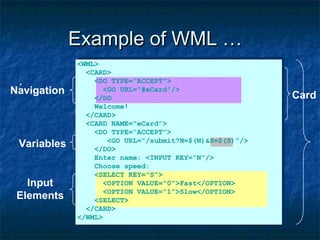
Example of WML …
.

Navigation

Variables

Input
Elements

<WML>
<CARD>
<DO TYPE=“ACCEPT”>
<GO URL=“#eCard”/>
</DO
Welcome!
</CARD>
<CARD NAME=“eCard”>
<DO TYPE=“ACCEPT”>
<GO URL=“/submit?N=$(N)&S=$(S)”/>
</DO>
Enter name: <INPUT KEY=“N”/>
Choose speed:
<SELECT KEY=“S”>
<OPTION VALUE=“0”>Fast</OPTION>
<OPTION VALUE=“1”>Slow</OPTION>
<SELECT>
</CARD>
</WML>

Card
WML Decks and Cards
WML pages are called DECKS. They are
constructed as a set of CARDS, related to
each other with links. When a WML page
is accessed from a mobile phone, all the
cards in the page are downloaded from
the WAP server. Navigation between the
cards is done by the phone computer inside the phone - without any extra
access trips to the server.
Limitations of Internet for
Wireless Applications


Traditional Internet applications cannot run on
mobile devices because of the following
limitations:








Low bandwidth network
High Latency network
Limited connection stability
Small display size
Limited input facility
Limited memory
Limited processing power
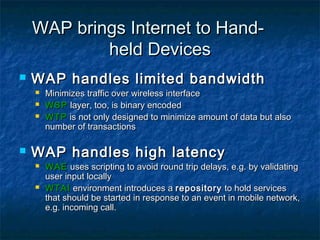
WAP brings Internet to Handheld Devices


WAP handles limited bandwidth






Minimizes traffic over wireless interface
WSP layer, too, is binary encoded
WTP is not only designed to minimize amount of data but also
number of transactions

WAP handles high latency




WAE uses scripting to avoid round trip delays, e.g. by validating
user input locally
WTAI environment introduces a repository to hold services
that should be started in response to an event in mobile network,
e.g. incoming call.
WAP brings (contd)…


WAP handles less stable
connections






The sessions supported by WSP are assumed to be long-lived.
WTP layer has been kept very simple compared to TCP
WTP supports selective retransmission of data

WAP handles small displays



WML structures its documents in ‘Decks & Cards’
When an application is executed, user navigates through a series of cards
WAP brings (contd)…


WAP handles limited input
facilities







The WML elements can be easily be implemented without much
input required from the key-board
Deck & Cards model requires minimal navigation between pages
Soft buttons or user-definable keys are also supported by WML

WAP handles limited memory and
CPU




Defining a light weight protocol stack
Limited functionality provided by WML & WMLScript
Binary encoding of WML & WMLScript
Some WAP applications


Location-based
services







Real-time traffic reporting
Event/restaurant recommendation
Highly customized ads
Instant messaging-type “buddy”
location

Enterprise solutions





Email access
Database access
A “global intranet”
Information updates “pushed” to
WAP devices

Financial services
–
–
–
–

Banking
Bill-paying
Stock trading
Funds transfers

Travel services
– Schedules and rescheduling
– Reservations
WAP Technology

WAP Technology

  • 1.
  • 2.
    WHAT IS WAP? WAPis Wireless Application Protocol WAP is an open international standard for application layer network communications in a wireless communication environment. Its main use is to enable access to the Internet (HTTP) from a mobile phone or PDA.
  • 3.
    WHAT IS PROTOCOL? AProtocol is a set of guidelines or rules. In computing and internet
  • 4.
    FEATURES OF WAP          WAPstands for W ireless A pplication P rotocol WAP is an application communication protocol WAP is used to access services and information WAP is inherited from Internet standards WAP is for handheld devices such as mobile phones WAP is a protocol designed for micro browsers WAP enables the creating of web applications for mobile devices. WAP uses the mark-up language WML (not HTML) WML is defined as an XML 1.0 application
  • 5.
    WAP Micro Browsers    Tofit into a small wireless terminal, WAP uses a Micro Browser. A Micro Browser is a small piece of software that makes minimal demands on hardware, memory and CPU. It can display information written in a restricted mark-up language called WML. The Micro Browser can also interpret a reduced version of JavaScript called WMLScript.
  • 6.
    COMPONENTS OF WAP WML   WMLstands for W ireless M arkup L anguage. It is a mark-up language inherited from HTML, but WML is based on XML, so it is much stricter than HTML. Differs from HTML in the following    WML was specifically designed for wireless terminals with a target screen that is only a few lines long and about an inch wide. WML is case sensitive , and all tags and attributes should be in lowercase. WML doesn't assume that a keyboard or a mouse is available for user input
  • 7.
    WAP Components (contd)…  WAPGateway   Encoder: converts WML to binarized WML Adaptor: provides additional information through HTTP header    Translate HTTP requests to WSP. Convert between SSL and WTLS Convert transport protocols (TCP and WDP
  • 8.
    WML Script  WML usesWML Script to run simple code on the client. WML Script is a light JavaScript language. However, WML scripts are not embedded in the WML pages. WML pages only contains references to script URLs. WML scripts need to be compiled into byte code on a server before they can run in a WAP browser.
  • 9.
    WAP Homepages   WAP homepagesare not very different from HTML homepages. The markup language used for WAP is WML (Wireless Markup Language). WML uses tags - just like HTML - but the syntax is stricter and conforms to the XML 1.0 standard. WML pages have the extension *.WML, just like HTML pages have the extension *.HTML.
  • 10.
    WML Tags   WML ismostly about text. Tags that would slow down the communication with handheld devices are not a part of the WML standard. The use of tables and images is strongly restricted.  Since WML is an XML application, all tags are case sensitive (<wml> is not the same as <WML>), and all tags must be properly closed.
  • 11.
    Example of WML… . Navigation Variables Input Elements <WML> <CARD> <DO TYPE=“ACCEPT”> <GO URL=“#eCard”/> </DO Welcome! </CARD> <CARD NAME=“eCard”> <DO TYPE=“ACCEPT”> <GO URL=“/submit?N=$(N)&S=$(S)”/> </DO> Enter name: <INPUT KEY=“N”/> Choose speed: <SELECT KEY=“S”> <OPTION VALUE=“0”>Fast</OPTION> <OPTION VALUE=“1”>Slow</OPTION> <SELECT> </CARD> </WML> Card
  • 12.
    WML Decks andCards WML pages are called DECKS. They are constructed as a set of CARDS, related to each other with links. When a WML page is accessed from a mobile phone, all the cards in the page are downloaded from the WAP server. Navigation between the cards is done by the phone computer inside the phone - without any extra access trips to the server.
  • 13.
    Limitations of Internetfor Wireless Applications  Traditional Internet applications cannot run on mobile devices because of the following limitations:        Low bandwidth network High Latency network Limited connection stability Small display size Limited input facility Limited memory Limited processing power
  • 15.
    WAP brings Internetto Handheld Devices  WAP handles limited bandwidth     Minimizes traffic over wireless interface WSP layer, too, is binary encoded WTP is not only designed to minimize amount of data but also number of transactions WAP handles high latency   WAE uses scripting to avoid round trip delays, e.g. by validating user input locally WTAI environment introduces a repository to hold services that should be started in response to an event in mobile network, e.g. incoming call.
  • 16.
    WAP brings (contd)…  WAPhandles less stable connections     The sessions supported by WSP are assumed to be long-lived. WTP layer has been kept very simple compared to TCP WTP supports selective retransmission of data WAP handles small displays   WML structures its documents in ‘Decks & Cards’ When an application is executed, user navigates through a series of cards
  • 17.
    WAP brings (contd)…  WAPhandles limited input facilities     The WML elements can be easily be implemented without much input required from the key-board Deck & Cards model requires minimal navigation between pages Soft buttons or user-definable keys are also supported by WML WAP handles limited memory and CPU    Defining a light weight protocol stack Limited functionality provided by WML & WMLScript Binary encoding of WML & WMLScript
  • 18.
    Some WAP applications  Location-based services      Real-timetraffic reporting Event/restaurant recommendation Highly customized ads Instant messaging-type “buddy” location Enterprise solutions     Email access Database access A “global intranet” Information updates “pushed” to WAP devices Financial services – – – – Banking Bill-paying Stock trading Funds transfers Travel services – Schedules and rescheduling – Reservations

Editor's Notes

  • #17 Sessions by WSP – Sessions are assumed to be long-lived, so problem of lost connections is addressed by allowing lost sessions to be resumed even when dynamically assigned IP addresses are used WTP… Since no connection is set up, the effects of lost connections and other times of inactivity are minimized The unpredictable nature of wireless connection means that small segments of message are often lost Selective retransmission – meaning that only lost segments arev retransmitted and not the entire message as in TCP CARDS &amp; DECK Card - is a single unit of interaction with the end-user, such as a text-screen, a selection list or a combo of these. A card is typically small enuff to be displayed on a small screen DECK – Series of cards used for making an application