
ARTIFICIAL NEURAL NETWORKS
AIMS Education
Introduction
• Simple computational elements forming a large
network
– Emphasis on learning (pattern recognition)
– Local computation (neurons)
• Configured for a particular application
– Pattern recognition/data classification
• ANN algorithm
– Modeled after brain
• Brain: 100,000 times slower response
– Complex tasks (image, sound recognition, motion con)
– –10,000,000,000 times efficient in energy
consumption/op
AIMS Education
Introduction (Contd….)
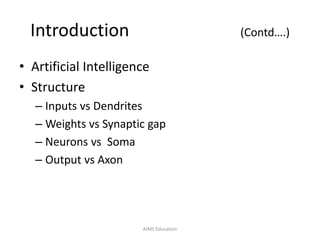
• Artificial Intelligence
• Structure
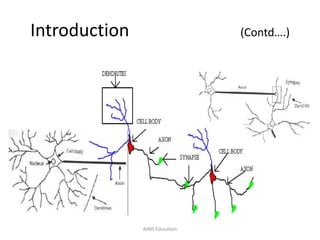
– Inputs vs Dendrites
– Weights vs Synaptic gap
– Neurons vs Soma
– Output vs Axon
AIMS Education
Introduction (Contd….)
AIMS Education
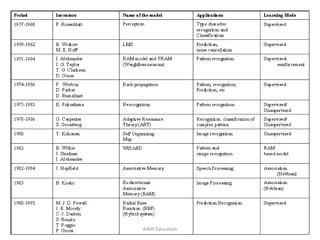
History
AIMS Education
Definition
A neural network is a massively parallel
distributed processor made up of simple
processing units, which has a natural tendency
for storing experiential knowledge and making
it available for use
AIMS Education
Introduction (Contd….)
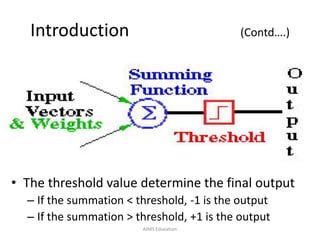
• The threshold value determine the final output
– If the summation < threshold, -1 is the output
– If the summation > threshold, +1 is the output
AIMS Education
Introduction (Contd….)
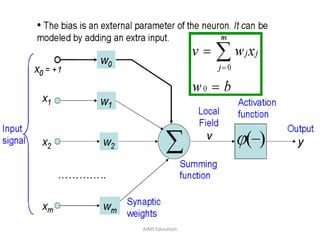
• The neuron is the basic information
processing unit of an ANN.
• It consists of:
– A set of links, describing the neuron inputs, with
weightsW1, W2, …, Wm
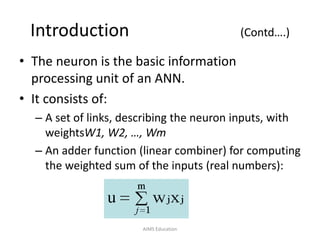
– An adder function (linear combiner) for computing
the weighted sum of the inputs (real numbers):
AIMS Education
Introduction (Contd….)
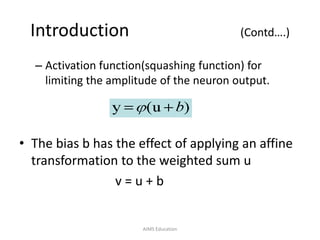
– Activation function(squashing function) for
limiting the amplitude of the neuron output.
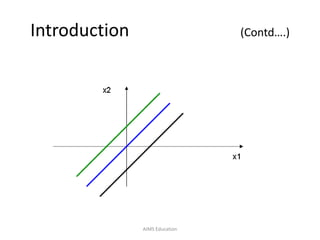
• The bias b has the effect of applying an affine
transformation to the weighted sum u
v = u + b
AIMS Education
Introduction (Contd….)
AIMS Education
AIMS Education
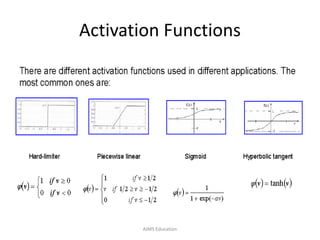
Activation Functions
AIMS Education
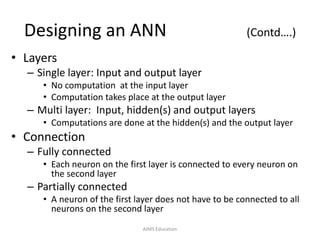
Designing an ANN
• Designing an ANN consist of
– Arranging neurons in various layers
– Deciding the type of connections among neurons for
different layers, as well as among the neurons within a
layer
– Deciding the way a neuron receives input and
produces output
• Determining the strength of connection within
the network by allowing the network learn the
appropriate values of connection weights by
using a training data set.
• The process of designing a neural network is an
iterative process
AIMS Education
Designing an ANN (Contd….)
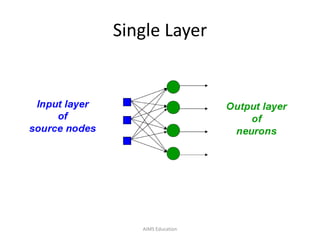
• Layers
– Single layer: Input and output layer
• No computation at the input layer
• Computation takes place at the output layer
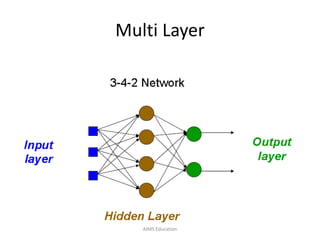
– Multi layer: Input, hidden(s) and output layers
• Computations are done at the hidden(s) and the output layer
• Connection
– Fully connected
• Each neuron on the first layer is connected to every neuron on
the second layer
– Partially connected
• A neuron of the first layer does not have to be connected to all
neurons on the second layer
AIMS Education
Designing an ANN (Contd….)
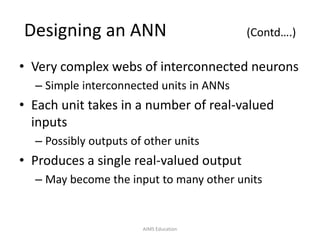
• Very complex webs of interconnected neurons
– Simple interconnected units in ANNs
• Each unit takes in a number of real-valued
inputs
– Possibly outputs of other units
• Produces a single real-valued output
– May become the input to many other units
AIMS Education
Single Layer
AIMS Education
Multi Layer
AIMS Education
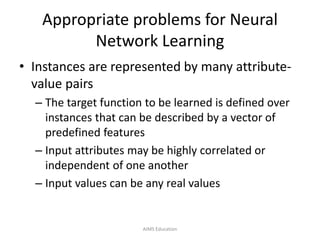
Appropriate problems for Neural
Network Learning
• Instances are represented by many attribute-
value pairs
– The target function to be learned is defined over
instances that can be described by a vector of
predefined features
– Input attributes may be highly correlated or
independent of one another
– Input values can be any real values
AIMS Education
Appropriate problems for Neural
Network Learning (Contd….)
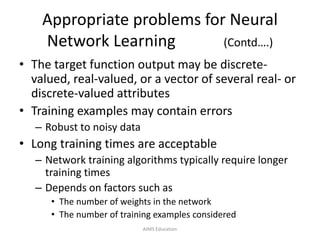
• The target function output may be discrete-
valued, real-valued, or a vector of several real- or
discrete-valued attributes
• Training examples may contain errors
– Robust to noisy data
• Long training times are acceptable
– Network training algorithms typically require longer
training times
– Depends on factors such as
• The number of weights in the network
• The number of training examples considered
AIMS Education
Appropriate problems for Neural
Network Learning (Contd….)
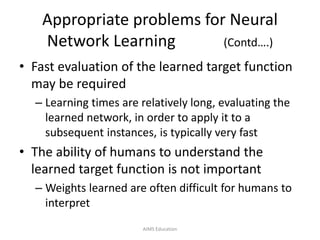
• Fast evaluation of the learned target function
may be required
– Learning times are relatively long, evaluating the
learned network, in order to apply it to a
subsequent instances, is typically very fast
• The ability of humans to understand the
learned target function is not important
– Weights learned are often difficult for humans to
interpret
AIMS Education
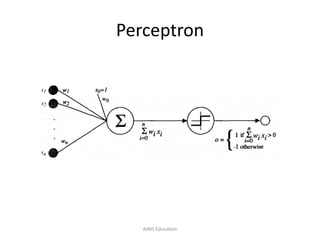
Perceptron
AIMS Education
Perceptron (Contd….)
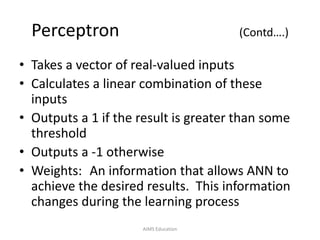
• Takes a vector of real-valued inputs
• Calculates a linear combination of these
inputs
• Outputs a 1 if the result is greater than some
threshold
• Outputs a -1 otherwise
• Weights: An information that allows ANN to
achieve the desired results. This information
changes during the learning process
AIMS Education
Perceptron (Contd….)
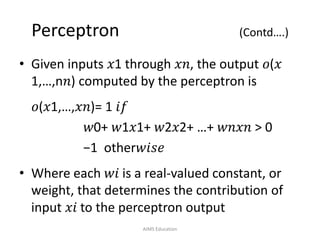
• Given inputs 𝑥1 through 𝑥𝑛, the output 𝑜(𝑥
1,…,n𝑛) computed by the perceptron is
𝑜(𝑥1,…,𝑥𝑛)= 1 𝑖𝑓
𝑤0+ 𝑤1𝑥1+ 𝑤2𝑥2+ …+ 𝑤𝑛𝑥𝑛 > 0
−1 other𝑤𝑖𝑠𝑒
• Where each 𝑤𝑖 is a real-valued constant, or
weight, that determines the contribution of
input 𝑥𝑖 to the perceptron output
AIMS Education
Perceptron (Contd….)
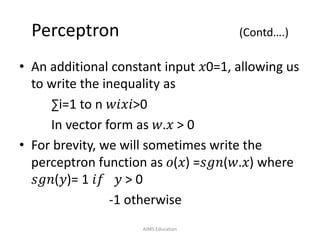
• An additional constant input 𝑥0=1, allowing us
to write the inequality as
∑i=1 to n 𝑤𝑖𝑥𝑖>0
In vector form as 𝑤.𝑥 > 0
• For brevity, we will sometimes write the
perceptron function as 𝑜(𝑥) =𝑠𝑔𝑛(𝑤.𝑥) where
𝑠𝑔𝑛(𝑦)= 1 𝑖𝑓 𝑦 > 0
-1 otherwise
AIMS Education
Representational Power of
Perceptrons
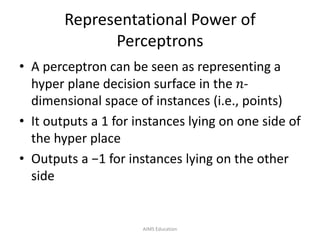
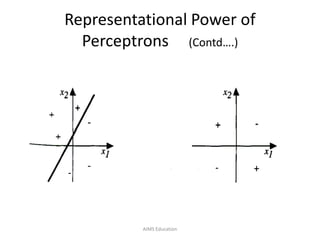
• A perceptron can be seen as representing a
hyper plane decision surface in the 𝑛-
dimensional space of instances (i.e., points)
• It outputs a 1 for instances lying on one side of
the hyper place
• Outputs a −1 for instances lying on the other
side
AIMS Education
Representational Power of
Perceptrons (Contd….)
AIMS Education
Representational Power of
Perceptrons (Contd….)
• The equation for the decision surface is 𝑤.𝑥 =0
• Some sets of positive and negative examples
cannot be separated by any hyperplace
• The ones that can be separated are called
linearly separable sets of examples
AIMS Education
Perceptron Training Rule
• How to learn the weights for a single perceptron?
• The task is to learn a weight vector that causes
the perceptron to produce the correct ±1 output
for each of the given training examples
• Perceptron rule and delta rule algorithms
– Provide the basis for learning networks of many units
AIMS Education
Perceptron Training Rule (Contd….)
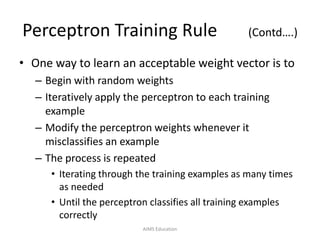
• One way to learn an acceptable weight vector is to
– Begin with random weights
– Iteratively apply the perceptron to each training
example
– Modify the perceptron weights whenever it
misclassifies an example
– The process is repeated
• Iterating through the training examples as many times
as needed
• Until the perceptron classifies all training examples
correctly
AIMS Education
Perceptron Training Rule (Contd….)
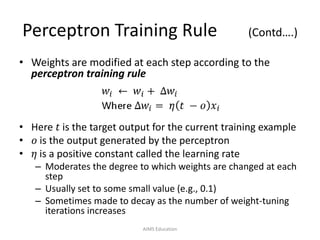
• Weights are modified at each step according to the
perceptron training rule
• Here 𝑡 is the target output for the current training example
• 𝑜 is the output generated by the perceptron
• 𝜂 is a positive constant called the learning rate
– Moderates the degree to which weights are changed at each
step
– Usually set to some small value (e.g., 0.1)
– Sometimes made to decay as the number of weight-tuning
iterations increases
AIMS Education
Perceptron Training Rule (Contd….)
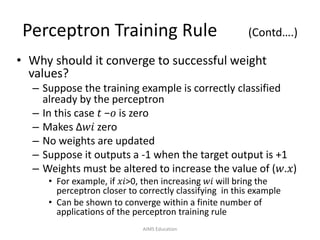
• Why should it converge to successful weight
values?
– Suppose the training example is correctly classified
already by the perceptron
– In this case 𝑡 −𝑜 is zero
– Makes Δ𝑤𝑖 zero
– No weights are updated
– Suppose it outputs a -1 when the target output is +1
– Weights must be altered to increase the value of (𝑤.𝑥)
• For example, if 𝑥𝑖>0, then increasing 𝑤𝑖 will bring the
perceptron closer to correctly classifying in this example
• Can be shown to converge within a finite number of
applications of the perceptron training rule
AIMS Education
Gradient Descent and the Delta Rule
• Perceptron rule works fine when the training
examples are linearly separable
– Otherwise can fail to converge
• Delta rule is defined to overcome this hurdle
• If training examples are not linearly separable
• Delta rule converges to the best fit
approximation to the target concept
AIMS Education
Delta Rule (Contd….)
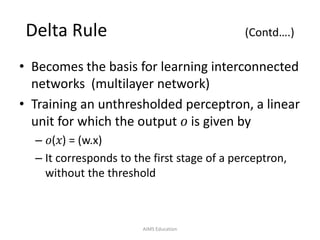
• Becomes the basis for learning interconnected
networks (multilayer network)
• Training an unthresholded perceptron, a linear
unit for which the output 𝑜 is given by
– 𝑜(𝑥) = (w.x)
– It corresponds to the first stage of a perceptron,
without the threshold
AIMS Education
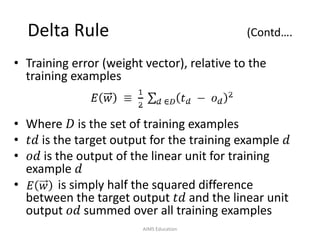
Delta Rule (Contd….
• Training error (weight vector), relative to the
training examples
• Where 𝐷 is the set of training examples
• 𝑡𝑑 is the target output for the training example 𝑑
• 𝑜𝑑 is the output of the linear unit for training
example 𝑑
• is simply half the squared difference
between the target output 𝑡𝑑 and the linear unit
output 𝑜𝑑 summed over all training examples
AIMS Education

ARTIFICIAL NEURAL NETWORKS

  • 1.
  • 2.
    Introduction • Simple computationalelements forming a large network – Emphasis on learning (pattern recognition) – Local computation (neurons) • Configured for a particular application – Pattern recognition/data classification • ANN algorithm – Modeled after brain • Brain: 100,000 times slower response – Complex tasks (image, sound recognition, motion con) – –10,000,000,000 times efficient in energy consumption/op AIMS Education
  • 3.
    Introduction (Contd….) • ArtificialIntelligence • Structure – Inputs vs Dendrites – Weights vs Synaptic gap – Neurons vs Soma – Output vs Axon AIMS Education
  • 4.
  • 5.
  • 6.
  • 7.
    Definition A neural networkis a massively parallel distributed processor made up of simple processing units, which has a natural tendency for storing experiential knowledge and making it available for use AIMS Education
  • 8.
    Introduction (Contd….) • Thethreshold value determine the final output – If the summation < threshold, -1 is the output – If the summation > threshold, +1 is the output AIMS Education
  • 9.
    Introduction (Contd….) • Theneuron is the basic information processing unit of an ANN. • It consists of: – A set of links, describing the neuron inputs, with weightsW1, W2, …, Wm – An adder function (linear combiner) for computing the weighted sum of the inputs (real numbers): AIMS Education
  • 10.
    Introduction (Contd….) – Activationfunction(squashing function) for limiting the amplitude of the neuron output. • The bias b has the effect of applying an affine transformation to the weighted sum u v = u + b AIMS Education
  • 11.
  • 12.
  • 13.
  • 14.
    Designing an ANN •Designing an ANN consist of – Arranging neurons in various layers – Deciding the type of connections among neurons for different layers, as well as among the neurons within a layer – Deciding the way a neuron receives input and produces output • Determining the strength of connection within the network by allowing the network learn the appropriate values of connection weights by using a training data set. • The process of designing a neural network is an iterative process AIMS Education
  • 15.
    Designing an ANN(Contd….) • Layers – Single layer: Input and output layer • No computation at the input layer • Computation takes place at the output layer – Multi layer: Input, hidden(s) and output layers • Computations are done at the hidden(s) and the output layer • Connection – Fully connected • Each neuron on the first layer is connected to every neuron on the second layer – Partially connected • A neuron of the first layer does not have to be connected to all neurons on the second layer AIMS Education
  • 16.
    Designing an ANN(Contd….) • Very complex webs of interconnected neurons – Simple interconnected units in ANNs • Each unit takes in a number of real-valued inputs – Possibly outputs of other units • Produces a single real-valued output – May become the input to many other units AIMS Education
  • 17.
  • 18.
  • 19.
    Appropriate problems forNeural Network Learning • Instances are represented by many attribute- value pairs – The target function to be learned is defined over instances that can be described by a vector of predefined features – Input attributes may be highly correlated or independent of one another – Input values can be any real values AIMS Education
  • 20.
    Appropriate problems forNeural Network Learning (Contd….) • The target function output may be discrete- valued, real-valued, or a vector of several real- or discrete-valued attributes • Training examples may contain errors – Robust to noisy data • Long training times are acceptable – Network training algorithms typically require longer training times – Depends on factors such as • The number of weights in the network • The number of training examples considered AIMS Education
  • 21.
    Appropriate problems forNeural Network Learning (Contd….) • Fast evaluation of the learned target function may be required – Learning times are relatively long, evaluating the learned network, in order to apply it to a subsequent instances, is typically very fast • The ability of humans to understand the learned target function is not important – Weights learned are often difficult for humans to interpret AIMS Education
  • 22.
  • 23.
    Perceptron (Contd….) • Takesa vector of real-valued inputs • Calculates a linear combination of these inputs • Outputs a 1 if the result is greater than some threshold • Outputs a -1 otherwise • Weights: An information that allows ANN to achieve the desired results. This information changes during the learning process AIMS Education
  • 24.
    Perceptron (Contd….) • Giveninputs 𝑥1 through 𝑥𝑛, the output 𝑜(𝑥 1,…,n𝑛) computed by the perceptron is 𝑜(𝑥1,…,𝑥𝑛)= 1 𝑖𝑓 𝑤0+ 𝑤1𝑥1+ 𝑤2𝑥2+ …+ 𝑤𝑛𝑥𝑛 > 0 −1 other𝑤𝑖𝑠𝑒 • Where each 𝑤𝑖 is a real-valued constant, or weight, that determines the contribution of input 𝑥𝑖 to the perceptron output AIMS Education
  • 25.
    Perceptron (Contd….) • Anadditional constant input 𝑥0=1, allowing us to write the inequality as ∑i=1 to n 𝑤𝑖𝑥𝑖>0 In vector form as 𝑤.𝑥 > 0 • For brevity, we will sometimes write the perceptron function as 𝑜(𝑥) =𝑠𝑔𝑛(𝑤.𝑥) where 𝑠𝑔𝑛(𝑦)= 1 𝑖𝑓 𝑦 > 0 -1 otherwise AIMS Education
  • 26.
    Representational Power of Perceptrons •A perceptron can be seen as representing a hyper plane decision surface in the 𝑛- dimensional space of instances (i.e., points) • It outputs a 1 for instances lying on one side of the hyper place • Outputs a −1 for instances lying on the other side AIMS Education
  • 27.
    Representational Power of Perceptrons(Contd….) AIMS Education
  • 28.
    Representational Power of Perceptrons(Contd….) • The equation for the decision surface is 𝑤.𝑥 =0 • Some sets of positive and negative examples cannot be separated by any hyperplace • The ones that can be separated are called linearly separable sets of examples AIMS Education
  • 29.
    Perceptron Training Rule •How to learn the weights for a single perceptron? • The task is to learn a weight vector that causes the perceptron to produce the correct ±1 output for each of the given training examples • Perceptron rule and delta rule algorithms – Provide the basis for learning networks of many units AIMS Education
  • 30.
    Perceptron Training Rule(Contd….) • One way to learn an acceptable weight vector is to – Begin with random weights – Iteratively apply the perceptron to each training example – Modify the perceptron weights whenever it misclassifies an example – The process is repeated • Iterating through the training examples as many times as needed • Until the perceptron classifies all training examples correctly AIMS Education
  • 31.
    Perceptron Training Rule(Contd….) • Weights are modified at each step according to the perceptron training rule • Here 𝑡 is the target output for the current training example • 𝑜 is the output generated by the perceptron • 𝜂 is a positive constant called the learning rate – Moderates the degree to which weights are changed at each step – Usually set to some small value (e.g., 0.1) – Sometimes made to decay as the number of weight-tuning iterations increases AIMS Education
  • 32.
    Perceptron Training Rule(Contd….) • Why should it converge to successful weight values? – Suppose the training example is correctly classified already by the perceptron – In this case 𝑡 −𝑜 is zero – Makes Δ𝑤𝑖 zero – No weights are updated – Suppose it outputs a -1 when the target output is +1 – Weights must be altered to increase the value of (𝑤.𝑥) • For example, if 𝑥𝑖>0, then increasing 𝑤𝑖 will bring the perceptron closer to correctly classifying in this example • Can be shown to converge within a finite number of applications of the perceptron training rule AIMS Education
  • 33.
    Gradient Descent andthe Delta Rule • Perceptron rule works fine when the training examples are linearly separable – Otherwise can fail to converge • Delta rule is defined to overcome this hurdle • If training examples are not linearly separable • Delta rule converges to the best fit approximation to the target concept AIMS Education
  • 34.
    Delta Rule (Contd….) •Becomes the basis for learning interconnected networks (multilayer network) • Training an unthresholded perceptron, a linear unit for which the output 𝑜 is given by – 𝑜(𝑥) = (w.x) – It corresponds to the first stage of a perceptron, without the threshold AIMS Education
  • 35.
    Delta Rule (Contd…. •Training error (weight vector), relative to the training examples • Where 𝐷 is the set of training examples • 𝑡𝑑 is the target output for the training example 𝑑 • 𝑜𝑑 is the output of the linear unit for training example 𝑑 • is simply half the squared difference between the target output 𝑡𝑑 and the linear unit output 𝑜𝑑 summed over all training examples AIMS Education