Nadar Sarawathi College Of Arts & Science, Theni.
R.Preethi.
S.Subhalakshmi.
Introduction:
Artificial Neural Networks are computational models
inspired by human brain, used to solve complex problems. This
paper is written to introduce artificial neural networks with new
comers from computers science researchers and developers. This
paper covers only those concepts from Biological Neural
Network which are compulsory for computer science field.BNN
have many other parts which are not covered here because of
unnecessity.To understand ANN, basics of BNN(nervous system)
should be clear.
Artificial Neural Network.
The idea of ANNs is based on the
belief that working of human brain by
making the right connections, can be
imitated using silicon and wires as living
neurons and dendrites.
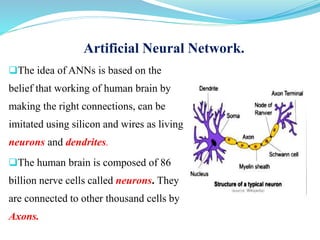
The human brain is composed of 86
billion nerve cells called neurons. They
are connected to other thousand cells by
Axons.
Stimuli from external environment or inputs from sensory
organs are accepted by dendrites. These inputs create electric
impulses, which quickly travel through the neural network.
 A neuron can then send the message to other neuron to handle
the issue or does not send it forward.
ANNs are composed of multiple nodes, which imitate
biological neurons of human brain. The neurons are connected
by links and they interact with each other. The nodes can take
input data and perform simple operations on the data.
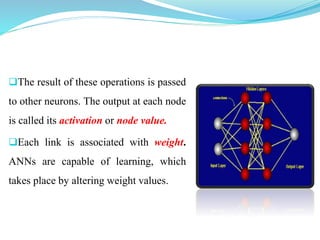
The result of these operations is passed
to other neurons. The output at each node
is called its activation or node value.
Each link is associated with weight.
ANNs are capable of learning, which
takes place by altering weight values.
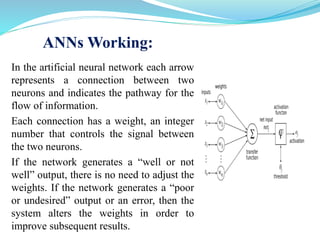
ANNs Working:
In the artificial neural network each arrow
represents a connection between two
neurons and indicates the pathway for the
flow of information.
Each connection has a weight, an integer
number that controls the signal between
the two neurons.
If the network generates a “well or not
well” output, there is no need to adjust the
weights. If the network generates a “poor
or undesired” output or an error, then the
system alters the weights in order to
improve subsequent results.
Artificial Neural Network Architecture:
An Artificial Neural Network is
defied as a data processing system
consisting of a large number of simple
highly interconnected processing elements
in an inspired by the structure of the
cerebral cortex of the brain.
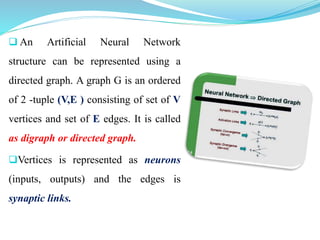
 An Artificial Neural Network
structure can be represented using a
directed graph. A graph G is an ordered
of 2 -tuple (V,E ) consisting of set of V
vertices and set of E edges. It is called
as digraph or directed graph.
Vertices is represented as neurons
(inputs, outputs) and the edges is
synaptic links.
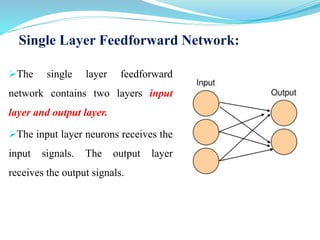
Single Layer Feedforward Network:
The single layer feedforward
network contains two layers input
layer and output layer.
The input layer neurons receives the
input signals. The output layer
receives the output signals.
The synaptic links will carry their weight and connects to each
input and output neuron.
Such a network is a said to be feedforward in a type acyclic in
nature.
The input layer transmits the signals to the output layer. Hence
this is called as single layer feedforward network.
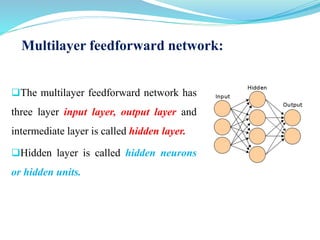
Multilayer feedforward network:
The multilayer feedforward network has
three layer input layer, output layer and
intermediate layer is called hidden layer.
Hidden layer is called hidden neurons
or hidden units.
One input layer, one output layer and two hidden layer .
The input layer neurons are linked to the hidden layer neurons
and weight is carried in their links is called input hidden layer
weight.
The hidden layer neurons are linked to the output layer neurons
and the weights are called as hidden output layer weights.
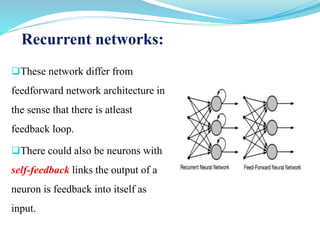
Recurrent networks:
These network differ from
feedforward network architecture in
the sense that there is atleast
feedback loop.
There could also be neurons with
self-feedback links the output of a
neuron is feedback into itself as
input.
Characteristics of neural network:
The neural network has mapping capabilities, that is they can
map input patterns to their associated output patterns.
The neural networks process the capability to generalize.
The Neural network are robust systems and are fault tolerant.
Recall all patterns from incomplete, or noisy patterns.
The neural network can process information in parallel, at
high speed, and in a distributed manner.
APPLICATIONS:
 Airline Security Control.
 Investment Management and Risk
Control.
 Prediction of Thrift Failures.
 Prediction of Stock Price Index.
 OCR Systems.
 Industrial Process Control.
 Data Validation.
 Risk Management.
 Target Marketing.
 Sales Forecasting.
 Customer Research.
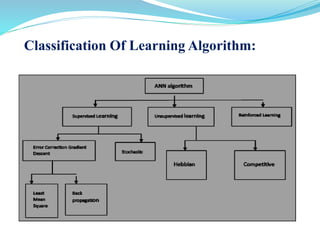
Classification Of Learning Algorithm:
Learning Methods.
Learning method has three types they
are:
 Supervised learning.
 Unsupervised learning.
Reinforced.
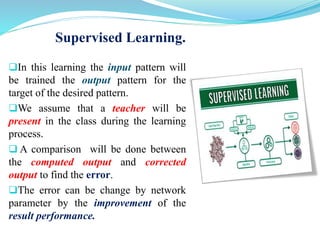
Supervised Learning.
In this learning the input pattern will
be trained the output pattern for the
target of the desired pattern.
We assume that a teacher will be
present in the class during the learning
process.
 A comparison will be done between
the computed output and corrected
output to find the error.
The error can be change by network
parameter by the improvement of the
result performance.
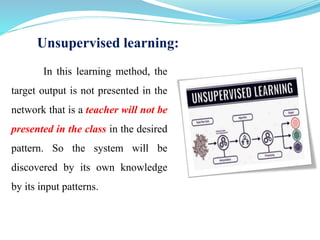
Unsupervised learning:
In this learning method, the
target output is not presented in the
network that is a teacher will not be
presented in the class in the desired
pattern. So the system will be
discovered by its own knowledge
by its input patterns.
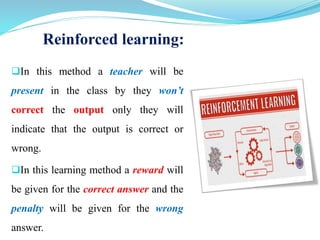
Reinforced learning:
In this method a teacher will be
present in the class by they won’t
correct the output only they will
indicate that the output is correct or
wrong.
In this learning method a reward will
be given for the correct answer and the
penalty will be given for the wrong
answer.
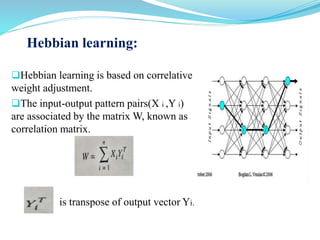
Hebbian learning:
Hebbian learning is based on correlative
weight adjustment.
The input-output pattern pairs(X i ,Y i)
are associated by the matrix W, known as
correlation matrix.
is transpose of output vector Yi.
Gradient descent learning:
This is based on the minimization of
error E defined in terms of weights
and the activation function of the
network.
If Wij is the weight update of the
link connecting ith and jth neuron of
the two layers Wij is defined as
Competitive learning:
The neurons which respond strongly to input stimuli have their
weights updated.
When an input pattern is presented, all neurons in the layer
compete and the winning neuron undergoes weight adjustment.
That “winner takes all “ strategy.
Stochastic learning:
In this the weights are adjusted in a probabilistic fashion.
Conclusion:
In this paper we discuss about the Artificial neural network,
methods and application of Artificial neural network. In this Artificial
neural network technology is developing day by day. It is useful for
all human that is it will reduce the time of learning and by this it
solves our learning problem. We can save more and more time and
money in any work. A process of learning speed will be increased
and so it is benefit for us. A improvement should be need for day by
day in our technology period. We can develop much more algorithms
and problems.
Artificial neural network

Artificial neural network

  • 1.
    Nadar Sarawathi CollegeOf Arts & Science, Theni. R.Preethi. S.Subhalakshmi.
  • 2.
    Introduction: Artificial Neural Networksare computational models inspired by human brain, used to solve complex problems. This paper is written to introduce artificial neural networks with new comers from computers science researchers and developers. This paper covers only those concepts from Biological Neural Network which are compulsory for computer science field.BNN have many other parts which are not covered here because of unnecessity.To understand ANN, basics of BNN(nervous system) should be clear.
  • 3.
    Artificial Neural Network. Theidea of ANNs is based on the belief that working of human brain by making the right connections, can be imitated using silicon and wires as living neurons and dendrites. The human brain is composed of 86 billion nerve cells called neurons. They are connected to other thousand cells by Axons.
  • 4.
    Stimuli from externalenvironment or inputs from sensory organs are accepted by dendrites. These inputs create electric impulses, which quickly travel through the neural network.  A neuron can then send the message to other neuron to handle the issue or does not send it forward. ANNs are composed of multiple nodes, which imitate biological neurons of human brain. The neurons are connected by links and they interact with each other. The nodes can take input data and perform simple operations on the data.
  • 5.
    The result ofthese operations is passed to other neurons. The output at each node is called its activation or node value. Each link is associated with weight. ANNs are capable of learning, which takes place by altering weight values.
  • 6.
    ANNs Working: In theartificial neural network each arrow represents a connection between two neurons and indicates the pathway for the flow of information. Each connection has a weight, an integer number that controls the signal between the two neurons. If the network generates a “well or not well” output, there is no need to adjust the weights. If the network generates a “poor or undesired” output or an error, then the system alters the weights in order to improve subsequent results.
  • 7.
    Artificial Neural NetworkArchitecture: An Artificial Neural Network is defied as a data processing system consisting of a large number of simple highly interconnected processing elements in an inspired by the structure of the cerebral cortex of the brain.
  • 8.
     An ArtificialNeural Network structure can be represented using a directed graph. A graph G is an ordered of 2 -tuple (V,E ) consisting of set of V vertices and set of E edges. It is called as digraph or directed graph. Vertices is represented as neurons (inputs, outputs) and the edges is synaptic links.
  • 9.
    Single Layer FeedforwardNetwork: The single layer feedforward network contains two layers input layer and output layer. The input layer neurons receives the input signals. The output layer receives the output signals.
  • 10.
    The synaptic linkswill carry their weight and connects to each input and output neuron. Such a network is a said to be feedforward in a type acyclic in nature. The input layer transmits the signals to the output layer. Hence this is called as single layer feedforward network.
  • 11.
    Multilayer feedforward network: Themultilayer feedforward network has three layer input layer, output layer and intermediate layer is called hidden layer. Hidden layer is called hidden neurons or hidden units.
  • 12.
    One input layer,one output layer and two hidden layer . The input layer neurons are linked to the hidden layer neurons and weight is carried in their links is called input hidden layer weight. The hidden layer neurons are linked to the output layer neurons and the weights are called as hidden output layer weights.
  • 13.
    Recurrent networks: These networkdiffer from feedforward network architecture in the sense that there is atleast feedback loop. There could also be neurons with self-feedback links the output of a neuron is feedback into itself as input.
  • 14.
    Characteristics of neuralnetwork: The neural network has mapping capabilities, that is they can map input patterns to their associated output patterns. The neural networks process the capability to generalize. The Neural network are robust systems and are fault tolerant. Recall all patterns from incomplete, or noisy patterns. The neural network can process information in parallel, at high speed, and in a distributed manner.
  • 15.
    APPLICATIONS:  Airline SecurityControl.  Investment Management and Risk Control.  Prediction of Thrift Failures.  Prediction of Stock Price Index.  OCR Systems.  Industrial Process Control.  Data Validation.  Risk Management.  Target Marketing.  Sales Forecasting.  Customer Research.
  • 16.
  • 17.
    Learning Methods. Learning methodhas three types they are:  Supervised learning.  Unsupervised learning. Reinforced.
  • 18.
    Supervised Learning. In thislearning the input pattern will be trained the output pattern for the target of the desired pattern. We assume that a teacher will be present in the class during the learning process.  A comparison will be done between the computed output and corrected output to find the error. The error can be change by network parameter by the improvement of the result performance.
  • 19.
    Unsupervised learning: In thislearning method, the target output is not presented in the network that is a teacher will not be presented in the class in the desired pattern. So the system will be discovered by its own knowledge by its input patterns.
  • 20.
    Reinforced learning: In thismethod a teacher will be present in the class by they won’t correct the output only they will indicate that the output is correct or wrong. In this learning method a reward will be given for the correct answer and the penalty will be given for the wrong answer.
  • 21.
    Hebbian learning: Hebbian learningis based on correlative weight adjustment. The input-output pattern pairs(X i ,Y i) are associated by the matrix W, known as correlation matrix. is transpose of output vector Yi.
  • 22.
    Gradient descent learning: Thisis based on the minimization of error E defined in terms of weights and the activation function of the network. If Wij is the weight update of the link connecting ith and jth neuron of the two layers Wij is defined as
  • 23.
    Competitive learning: The neuronswhich respond strongly to input stimuli have their weights updated. When an input pattern is presented, all neurons in the layer compete and the winning neuron undergoes weight adjustment. That “winner takes all “ strategy. Stochastic learning: In this the weights are adjusted in a probabilistic fashion.
  • 24.
    Conclusion: In this paperwe discuss about the Artificial neural network, methods and application of Artificial neural network. In this Artificial neural network technology is developing day by day. It is useful for all human that is it will reduce the time of learning and by this it solves our learning problem. We can save more and more time and money in any work. A process of learning speed will be increased and so it is benefit for us. A improvement should be need for day by day in our technology period. We can develop much more algorithms and problems.