Towards complex adaptive architectures
A journey from hypes and habits to real needs

Uwe Friedrichsen, codecentric AG, 2015
@ufried
Uwe Friedrichsen | uwe.friedrichsen@codecentric.de | http://slideshare.net/ufried | http://ufried.tumblr.com
Time for some storytelling …
Story #1

The story of markets
Formal part of
value creation
Solution:
machine
Dynamic part
of value
creation
Solution: man
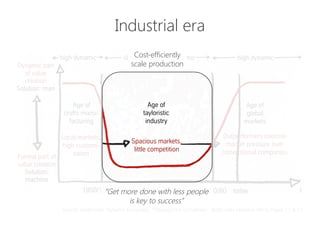
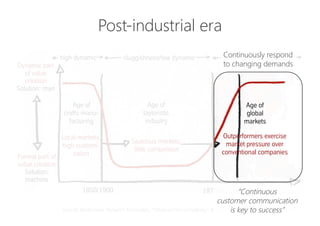
sluggishness/low dynamic high dynamichigh dynamic
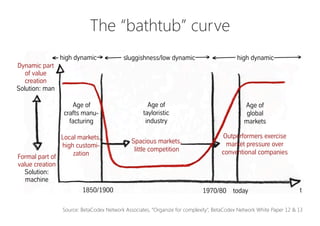
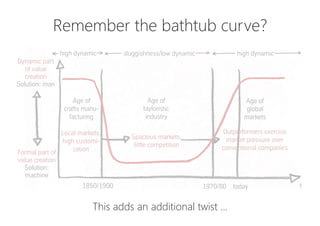
The historical course of market dynamics
and the recent rise of highly dynamic and complex markets
The dominance of high dynamics and complexity is neither good nor bad. It‘s a historical fact.
t1970/80 today
Age of
crafts manu-
facturing
Age of
tayloristic
industry
Age of
global
markets
1850/1900
Spacious markets,
little competition
Local markets,
high customi-
zation
Outperformers exercise
market pressure over
conventional companies
We call the graph shown here the “Taylor Bathtub”.
The “bathtub” curve
Source: BetaCodex Network Associates, “Organize for complexity”, BetaCodex Network White Paper 12 & 13
Formal part of
value creation
Solution:
machine
Dynamic part
of value
creation
Solution: man
sluggishness/low dynamic high dynamichigh dynamic
The historical course of market dynamics
and the recent rise of highly dynamic and complex markets
The dominance of high dynamics and complexity is neither good nor bad. It‘s a historical fact.
t1970/80 today
Age of
crafts manu-
facturing
Age of
tayloristic
industry
Age of
global
markets
1850/1900
Spacious markets,
little competition
Local markets,
high customi-
zation
Outperformers exercise
market pressure over
conventional companies
We call the graph shown here the “Taylor Bathtub”.
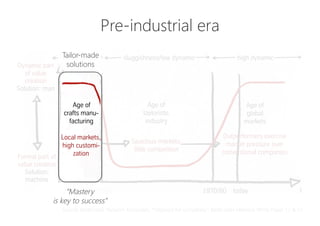
Pre-industrial era
Source: BetaCodex Network Associates, “Organize for complexity”, BetaCodex Network White Paper 12 & 13
Tailor-made
solutions
“Mastery
is key to success”
Formal part of
value creation
Solution:
machine
Dynamic part
of value
creation
Solution: man
sluggishness/low dynamic high dynamichigh dynamic
The historical course of market dynamics
and the recent rise of highly dynamic and complex markets
The dominance of high dynamics and complexity is neither good nor bad. It‘s a historical fact.
t1970/80 today
Age of
crafts manu-
facturing
Age of
tayloristic
industry
Age of
global
markets
1850/1900
Spacious markets,
little competition
Local markets,
high customi-
zation
Outperformers exercise
market pressure over
conventional companies
We call the graph shown here the “Taylor Bathtub”.
Industrial era
Source: BetaCodex Network Associates, “Organize for complexity”, BetaCodex Network White Paper 12 & 13
Cost-efficiently
scale production
“Get more done with less people
is key to success”
Formal part of
value creation
Solution:
machine
Dynamic part
of value
creation
Solution: man
sluggishness/low dynamic high dynamichigh dynamic
The historical course of market dynamics
and the recent rise of highly dynamic and complex markets
The dominance of high dynamics and complexity is neither good nor bad. It‘s a historical fact.
t1970/80 today
Age of
crafts manu-
facturing
Age of
tayloristic
industry
Age of
global
markets
1850/1900
Spacious markets,
little competition
Local markets,
high customi-
zation
Outperformers exercise
market pressure over
conventional companies
We call the graph shown here the “Taylor Bathtub”.
Post-industrial era
Source: BetaCodex Network Associates, “Organize for complexity”, BetaCodex Network White Paper 12 & 13
Continuously respond
to changing demands
“Continuous
customer communication
is key to success”
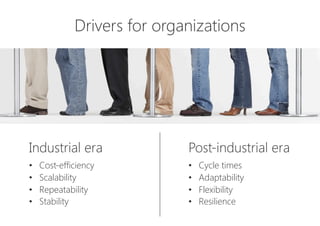
Industrial era

•  Cost-efficiency
•  Scalability
•  Repeatability
•  Stability
Drivers for organizations
Post-industrial era

•  Cycle times
•  Adaptability
•  Flexibility
•  Resilience
Story #2

The story of organizations
The predominant
industrial organization …
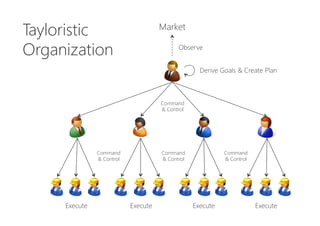
Market
Observe
Derive Goals & Create Plan
Execute
Execute
Command
& Control
Execute
Command
& Control
Execute
Command
& Control
Command
& Control
Tayloristic
Organization
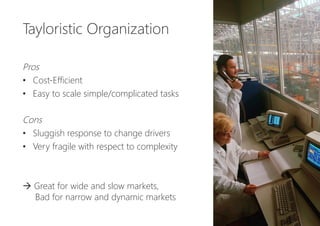
Tayloristic Organization


Pros
•  Cost-Efficient
•  Easy to scale simple/complicated tasks

Cons
•  Sluggish response to change drivers
•  Very fragile with respect to complexity


à Great for wide and slow markets,

Bad for narrow and dynamic markets
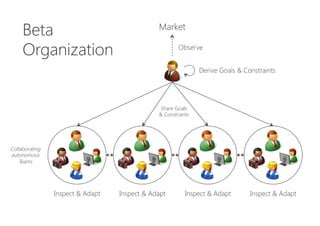
A post-industrial organization
sometimes seen in the wild …
Market
Observe
Derive Goals & Constraints
Beta
Organization
Share Goals
& Constraints
Collaborating
autonomous
Teams
Inspect & Adapt
 Inspect & Adapt
Inspect & Adapt
Inspect & Adapt
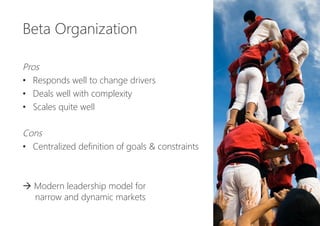
Beta Organization


Pros
•  Responds well to change drivers
•  Deals well with complexity
•  Scales quite well

Cons
•  Centralized definition of goals & constraints


à Modern leadership model for

narrow and dynamic markets
An ideal post-industrial organization
not yet seen in the wild …
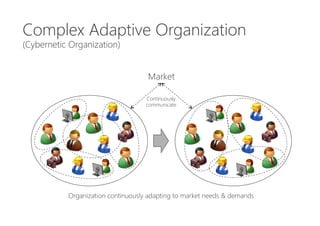
Market
Complex Adaptive Organization
(Cybernetic Organization)
Continuously
communicate
Organization continuously adapting to market needs & demands
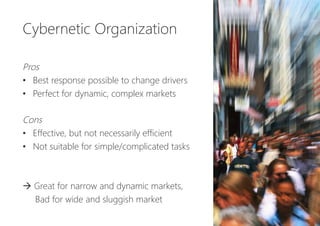
Cybernetic Organization


Pros
•  Best response possible to change drivers
•  Perfect for dynamic, complex markets

Cons
•  Effective, but not necessarily efficient
•  Not suitable for simple/complicated tasks


à Great for narrow and dynamic markets,
Bad for wide and sluggish market
Story #3

The story of IT
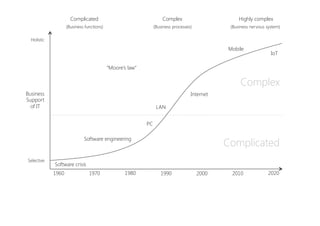
1960
 1970
 1980
 1990
 2000
 2010
 2020
Complicated

(Business functions)
Complex

(Business processes)
Highly complex

(Business nervous system)
Software crisis
Software engineering
PC
LAN
Internet
Business
Support
of IT
Selective
Holistic
Complicated
Complex
“Moore’s law”
Mobile
IoT
1960
 1970
 1980
 1990
 2000
 2010
 2020
Complicated

(Business functions)
Complex

(business processes)
Highly complex

(Business nervous system)
Software crisis
Software engineering
PC
LAN
Internet
Business
Support
of IT
Selective
Holistic
Complicated
Complex
“Moore’s law”
Mobile
IoT
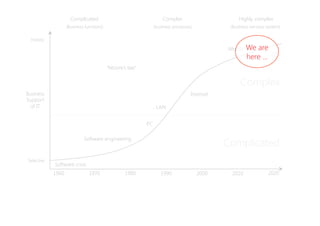
We are
here …
1960
 1970
 1980
 1990
 2000
 2010
 2020
Complicated

(Business functions)
Complex

(business processes)
Highly complex

(Business nervous system)
Software crisis
Software engineering
PC
LAN
Internet
Business
Support
of IT
Selective
Holistic
Complicated
Complex
“Moore’s law”
Mobile
IoT
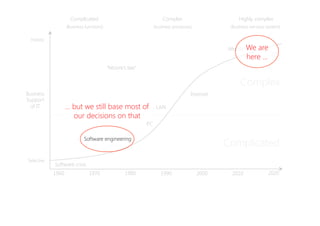
… but we still base most of
our decisions on that
We are
here …
Formal part of
value creation
Solution:
machine
Dynamic part
of value
creation
Solution: man
sluggishness/low dynamic high dynamichigh dynamic
The historical course of market dynamics
and the recent rise of highly dynamic and complex markets
The dominance of high dynamics and complexity is neither good nor bad. It‘s a historical fact.
t1970/80 today
Age of
crafts manu-
facturing
Age of
tayloristic
industry
Age of
global
markets
1850/1900
Spacious markets,
little competition
Local markets,
high customi-
zation
Outperformers exercise
market pressure over
conventional companies
We call the graph shown here the “Taylor Bathtub”.
Remember the bathtub curve?


This adds an additional twist …
1960
 1970
 1980
 1990
 2000
 2010
 2020
Complicated

(Business functions)
Complex

(business processes)
Highly complex

(Business nervous system)
Software crisis
Software engineering
PC
LAN
Internet
Business
Support
of IT
Selective
Holistic
Complicated
Complex
“Moore’s law”
Mobile
IoT
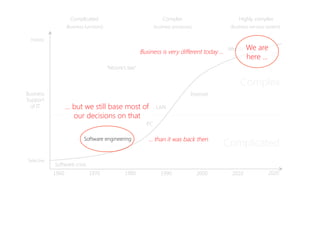
… but we still base most of
our decisions on that
We are
here …
Business is very different today …
… than it was back then
Business
Market
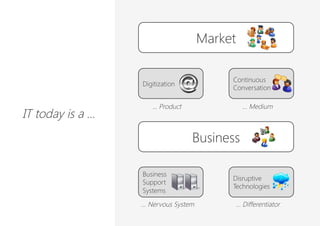
IT today is a …
… Nervous System
… Medium
… Product
… Differentiator
Disruptive
Technologies
Business
Support
Systems
Continuous
Conversation
Digitization
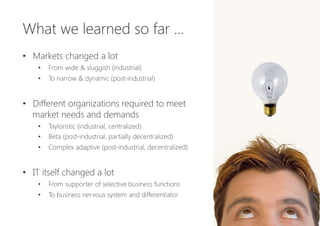
What we learned so far …

•  Markets changed a lot
•  From wide & sluggish (industrial)
•  To narrow & dynamic (post-industrial)
•  Different organizations required to meet
market needs and demands
•  Tayloristic (industrial, centralized)
•  Beta (post-industrial, partially decentralized)
•  Complex adaptive (post-industrial, decentralized)
•  IT itself changed a lot
•  From supporter of selective business functions
•  To business nervous system and differentiator
Time for a law …
Conway’s law: Organizations which design systems [...] are constrained to produce designs
which are copies of the communication structures of these organizations
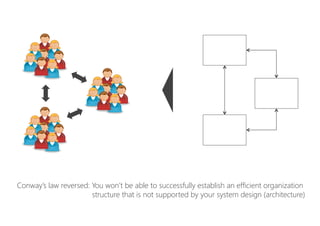
Conway’s law reversed: You won’t be able to successfully establish an efficient organization

structure that is not supported by your system design (architecture)
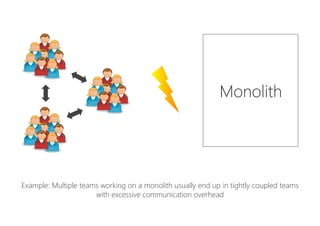
Monolith
Example: Multiple teams working on a monolith usually end up in tightly coupled teams
with excessive communication overhead
Time for architecture …
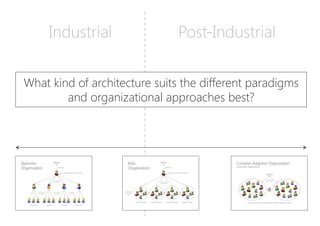
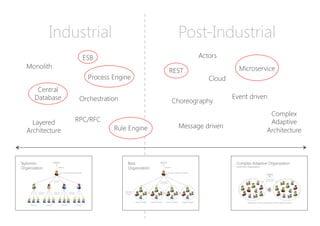
Industrial
 Post-Industrial
What kind of architecture suits the different paradigms
and organizational approaches best?
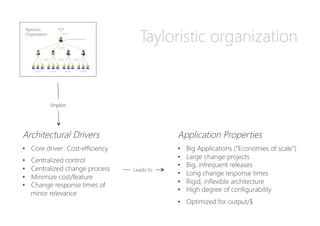
Tayloristic organization
Architectural Drivers

•  Core driver: Cost-efficiency
•  Centralized control
•  Centralized change process
•  Minimize cost/feature
•  Change response times of
minor relevance
Implies
Application Properties

•  Big Applications (“Economies of scale”)
•  Large change projects
•  Big, infrequent releases
•  Long change response times
•  Rigid, inflexible architecture
•  High degree of configurability
•  Optimized for output/$
Leads to
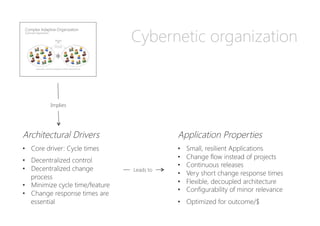
Cybernetic organization
Architectural Drivers

•  Core driver: Cycle times
•  Decentralized control
•  Decentralized change
process
•  Minimize cycle time/feature
•  Change response times are
essential
Implies
Application Properties

•  Small, resilient Applications
•  Change flow instead of projects
•  Continuous releases
•  Very short change response times
•  Flexible, decoupled architecture
•  Configurability of minor relevance
•  Optimized for outcome/$
Leads to
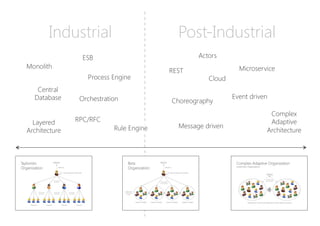
Time to locate some
architectural styles and technologies …
Industrial
 Post-Industrial
Monolith
Layered
Architecture
Process Engine
Rule Engine
ESB
Microservice
REST
Event driven
Message driven
Complex
Adaptive
Architecture
Actors
Central
Database
Cloud
Orchestration
 Choreography
RPC/RFC
Time for some mismatches …
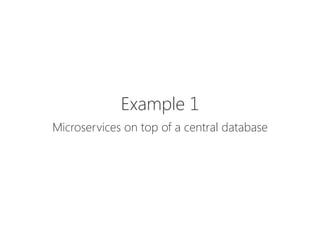
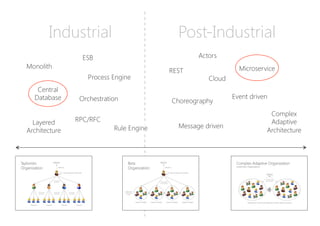
Example 1

Microservices on top of a central database
Industrial
 Post-Industrial
Monolith
Layered
Architecture
Process Engine
Rule Engine
ESB
Microservice
REST
Event driven
Message driven
Complex
Adaptive
Architecture
Actors
Central
Database
Cloud
Orchestration
 Choreography
RPC/RFC
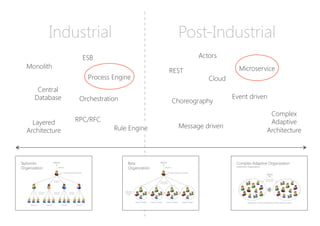
Example 2

Microservices orchestrated by a process engine
Industrial
 Post-Industrial
Monolith
Layered
Architecture
Process Engine
Rule Engine
ESB
Microservice
REST
Event driven
Message driven
Complex
Adaptive
Architecture
Actors
Central
Database
Cloud
Orchestration
 Choreography
RPC/RFC
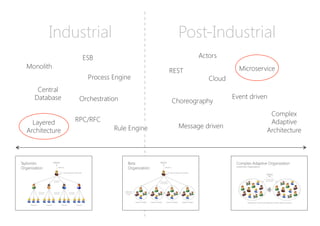
Example 3

Layered Microservice Architecture
Industrial
 Post-Industrial
Monolith
Layered
Architecture
Process Engine
Rule Engine
ESB
Microservice
REST
Event driven
Message driven
Complex
Adaptive
Architecture
Actors
Central
Database
Cloud
Orchestration
 Choreography
RPC/RFC
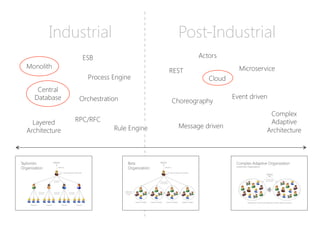
Example 4

“Cloudifying” a traditional monolith
Industrial
 Post-Industrial
Monolith
Layered
Architecture
Process Engine
Rule Engine
ESB
Microservice
REST
Event driven
Message driven
Complex
Adaptive
Architecture
Actors
Central
Database
Cloud
Orchestration
 Choreography
RPC/RFC
Example 5

Architectural requirement from an actual customer project
Industrial
 Post-Industrial
Monolith
Layered
Architecture
Process Engine
Rule Engine
ESB
Microservice
REST
Event driven
Message driven
Complex
Adaptive
Architecture
Actors
Central
Database
Cloud
Orchestration
 Choreography
RPC/RFC
Time to come to an end …
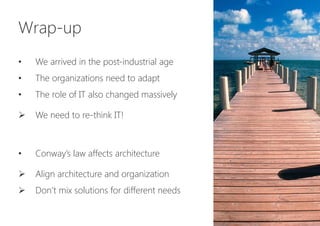
Wrap-up

•  We arrived in the post-industrial age
•  The organizations need to adapt
•  The role of IT also changed massively
Ø  We need to re-think IT!
•  Conway’s law affects architecture
Ø  Align architecture and organization
Ø  Don’t mix solutions for different needs
Don’t go for hypes or habits.

Go for needs.
@ufried
Uwe Friedrichsen | uwe.friedrichsen@codecentric.de | http://slideshare.net/ufried | http://ufried.tumblr.com
Towards complex adaptive architectures

Towards complex adaptive architectures

  • 1.
    Towards complex adaptivearchitectures A journey from hypes and habits to real needs Uwe Friedrichsen, codecentric AG, 2015
  • 2.
    @ufried Uwe Friedrichsen |uwe.friedrichsen@codecentric.de | http://slideshare.net/ufried | http://ufried.tumblr.com
  • 3.
    Time for somestorytelling …
  • 4.
  • 5.
    Formal part of valuecreation Solution: machine Dynamic part of value creation Solution: man sluggishness/low dynamic high dynamichigh dynamic The historical course of market dynamics and the recent rise of highly dynamic and complex markets The dominance of high dynamics and complexity is neither good nor bad. It‘s a historical fact. t1970/80 today Age of crafts manu- facturing Age of tayloristic industry Age of global markets 1850/1900 Spacious markets, little competition Local markets, high customi- zation Outperformers exercise market pressure over conventional companies We call the graph shown here the “Taylor Bathtub”. The “bathtub” curve Source: BetaCodex Network Associates, “Organize for complexity”, BetaCodex Network White Paper 12 & 13
  • 6.
    Formal part of valuecreation Solution: machine Dynamic part of value creation Solution: man sluggishness/low dynamic high dynamichigh dynamic The historical course of market dynamics and the recent rise of highly dynamic and complex markets The dominance of high dynamics and complexity is neither good nor bad. It‘s a historical fact. t1970/80 today Age of crafts manu- facturing Age of tayloristic industry Age of global markets 1850/1900 Spacious markets, little competition Local markets, high customi- zation Outperformers exercise market pressure over conventional companies We call the graph shown here the “Taylor Bathtub”. Pre-industrial era Source: BetaCodex Network Associates, “Organize for complexity”, BetaCodex Network White Paper 12 & 13 Tailor-made solutions “Mastery is key to success”
  • 7.
    Formal part of valuecreation Solution: machine Dynamic part of value creation Solution: man sluggishness/low dynamic high dynamichigh dynamic The historical course of market dynamics and the recent rise of highly dynamic and complex markets The dominance of high dynamics and complexity is neither good nor bad. It‘s a historical fact. t1970/80 today Age of crafts manu- facturing Age of tayloristic industry Age of global markets 1850/1900 Spacious markets, little competition Local markets, high customi- zation Outperformers exercise market pressure over conventional companies We call the graph shown here the “Taylor Bathtub”. Industrial era Source: BetaCodex Network Associates, “Organize for complexity”, BetaCodex Network White Paper 12 & 13 Cost-efficiently scale production “Get more done with less people is key to success”
  • 8.
    Formal part of valuecreation Solution: machine Dynamic part of value creation Solution: man sluggishness/low dynamic high dynamichigh dynamic The historical course of market dynamics and the recent rise of highly dynamic and complex markets The dominance of high dynamics and complexity is neither good nor bad. It‘s a historical fact. t1970/80 today Age of crafts manu- facturing Age of tayloristic industry Age of global markets 1850/1900 Spacious markets, little competition Local markets, high customi- zation Outperformers exercise market pressure over conventional companies We call the graph shown here the “Taylor Bathtub”. Post-industrial era Source: BetaCodex Network Associates, “Organize for complexity”, BetaCodex Network White Paper 12 & 13 Continuously respond to changing demands “Continuous customer communication is key to success”
  • 9.
    Industrial era •  Cost-efficiency • Scalability •  Repeatability •  Stability Drivers for organizations Post-industrial era •  Cycle times •  Adaptability •  Flexibility •  Resilience
  • 10.
    Story #2 The storyof organizations
  • 11.
  • 12.
    Market Observe Derive Goals &Create Plan Execute Execute Command & Control Execute Command & Control Execute Command & Control Command & Control Tayloristic Organization
  • 13.
    Tayloristic Organization Pros •  Cost-Efficient • Easy to scale simple/complicated tasks Cons •  Sluggish response to change drivers •  Very fragile with respect to complexity à Great for wide and slow markets,
 Bad for narrow and dynamic markets
  • 14.
  • 15.
    Market Observe Derive Goals &Constraints Beta Organization Share Goals & Constraints Collaborating autonomous Teams Inspect & Adapt Inspect & Adapt Inspect & Adapt Inspect & Adapt
  • 16.
    Beta Organization Pros •  Respondswell to change drivers •  Deals well with complexity •  Scales quite well Cons •  Centralized definition of goals & constraints à Modern leadership model for
 narrow and dynamic markets
  • 17.
    An ideal post-industrialorganization not yet seen in the wild …
  • 18.
    Market Complex Adaptive Organization (CyberneticOrganization) Continuously communicate Organization continuously adapting to market needs & demands
  • 19.
    Cybernetic Organization Pros •  Bestresponse possible to change drivers •  Perfect for dynamic, complex markets Cons •  Effective, but not necessarily efficient •  Not suitable for simple/complicated tasks à Great for narrow and dynamic markets, Bad for wide and sluggish market
  • 20.
  • 21.
    1960 1970 1980 1990 2000 2010 2020 Complicated (Business functions) Complex (Business processes) Highly complex (Business nervous system) Software crisis Software engineering PC LAN Internet Business Support of IT Selective Holistic Complicated Complex “Moore’s law” Mobile IoT
  • 22.
    1960 1970 1980 1990 2000 2010 2020 Complicated (Business functions) Complex (business processes) Highly complex (Business nervous system) Software crisis Software engineering PC LAN Internet Business Support of IT Selective Holistic Complicated Complex “Moore’s law” Mobile IoT We are here …
  • 23.
    1960 1970 1980 1990 2000 2010 2020 Complicated (Business functions) Complex (business processes) Highly complex (Business nervous system) Software crisis Software engineering PC LAN Internet Business Support of IT Selective Holistic Complicated Complex “Moore’s law” Mobile IoT … but we still base most of our decisions on that We are here …
  • 24.
    Formal part of valuecreation Solution: machine Dynamic part of value creation Solution: man sluggishness/low dynamic high dynamichigh dynamic The historical course of market dynamics and the recent rise of highly dynamic and complex markets The dominance of high dynamics and complexity is neither good nor bad. It‘s a historical fact. t1970/80 today Age of crafts manu- facturing Age of tayloristic industry Age of global markets 1850/1900 Spacious markets, little competition Local markets, high customi- zation Outperformers exercise market pressure over conventional companies We call the graph shown here the “Taylor Bathtub”. Remember the bathtub curve? This adds an additional twist …
  • 25.
    1960 1970 1980 1990 2000 2010 2020 Complicated (Business functions) Complex (business processes) Highly complex (Business nervous system) Software crisis Software engineering PC LAN Internet Business Support of IT Selective Holistic Complicated Complex “Moore’s law” Mobile IoT … but we still base most of our decisions on that We are here … Business is very different today … … than it was back then
  • 26.
    Business Market IT today isa … … Nervous System … Medium … Product … Differentiator Disruptive Technologies Business Support Systems Continuous Conversation Digitization
  • 27.
    What we learnedso far … •  Markets changed a lot •  From wide & sluggish (industrial) •  To narrow & dynamic (post-industrial) •  Different organizations required to meet market needs and demands •  Tayloristic (industrial, centralized) •  Beta (post-industrial, partially decentralized) •  Complex adaptive (post-industrial, decentralized) •  IT itself changed a lot •  From supporter of selective business functions •  To business nervous system and differentiator
  • 28.
    Time for alaw …
  • 29.
    Conway’s law: Organizationswhich design systems [...] are constrained to produce designs which are copies of the communication structures of these organizations
  • 30.
    Conway’s law reversed:You won’t be able to successfully establish an efficient organization
 structure that is not supported by your system design (architecture)
  • 31.
    Monolith Example: Multiple teamsworking on a monolith usually end up in tightly coupled teams with excessive communication overhead
  • 32.
  • 33.
    Industrial Post-Industrial What kindof architecture suits the different paradigms and organizational approaches best?
  • 34.
    Tayloristic organization Architectural Drivers • Core driver: Cost-efficiency •  Centralized control •  Centralized change process •  Minimize cost/feature •  Change response times of minor relevance Implies Application Properties •  Big Applications (“Economies of scale”) •  Large change projects •  Big, infrequent releases •  Long change response times •  Rigid, inflexible architecture •  High degree of configurability •  Optimized for output/$ Leads to
  • 35.
    Cybernetic organization Architectural Drivers • Core driver: Cycle times •  Decentralized control •  Decentralized change process •  Minimize cycle time/feature •  Change response times are essential Implies Application Properties •  Small, resilient Applications •  Change flow instead of projects •  Continuous releases •  Very short change response times •  Flexible, decoupled architecture •  Configurability of minor relevance •  Optimized for outcome/$ Leads to
  • 36.
    Time to locatesome architectural styles and technologies …
  • 37.
    Industrial Post-Industrial Monolith Layered Architecture Process Engine RuleEngine ESB Microservice REST Event driven Message driven Complex Adaptive Architecture Actors Central Database Cloud Orchestration Choreography RPC/RFC
  • 38.
    Time for somemismatches …
  • 39.
    Example 1 Microservices ontop of a central database
  • 40.
    Industrial Post-Industrial Monolith Layered Architecture Process Engine RuleEngine ESB Microservice REST Event driven Message driven Complex Adaptive Architecture Actors Central Database Cloud Orchestration Choreography RPC/RFC
  • 41.
  • 42.
    Industrial Post-Industrial Monolith Layered Architecture Process Engine RuleEngine ESB Microservice REST Event driven Message driven Complex Adaptive Architecture Actors Central Database Cloud Orchestration Choreography RPC/RFC
  • 43.
  • 44.
    Industrial Post-Industrial Monolith Layered Architecture Process Engine RuleEngine ESB Microservice REST Event driven Message driven Complex Adaptive Architecture Actors Central Database Cloud Orchestration Choreography RPC/RFC
  • 45.
    Example 4 “Cloudifying” atraditional monolith
  • 46.
    Industrial Post-Industrial Monolith Layered Architecture Process Engine RuleEngine ESB Microservice REST Event driven Message driven Complex Adaptive Architecture Actors Central Database Cloud Orchestration Choreography RPC/RFC
  • 47.
    Example 5 Architectural requirementfrom an actual customer project
  • 48.
    Industrial Post-Industrial Monolith Layered Architecture Process Engine RuleEngine ESB Microservice REST Event driven Message driven Complex Adaptive Architecture Actors Central Database Cloud Orchestration Choreography RPC/RFC
  • 49.
    Time to cometo an end …
  • 50.
    Wrap-up •  We arrivedin the post-industrial age •  The organizations need to adapt •  The role of IT also changed massively Ø  We need to re-think IT! •  Conway’s law affects architecture Ø  Align architecture and organization Ø  Don’t mix solutions for different needs
  • 51.
    Don’t go forhypes or habits.
 Go for needs.
  • 52.
    @ufried Uwe Friedrichsen |uwe.friedrichsen@codecentric.de | http://slideshare.net/ufried | http://ufried.tumblr.com