The Multiplier Effect / Multiplier Process
A change in one of the components of aggregate demand can lead
to a multiplied final change in the level of GDP
The Multiplier Effect / Multiplier Process
A change in one of the components of aggregate demand can lead
to a multiplied final change in the level of GDP

The multiplier effect comes about because injections of new
demand for goods and services into the circular flow of income
stimulate further rounds of spending – in other words “one
person’s spending is another’s income”
This can lead to a bigger eventual effect on output and
employment
An Example of the Multiplier Effect

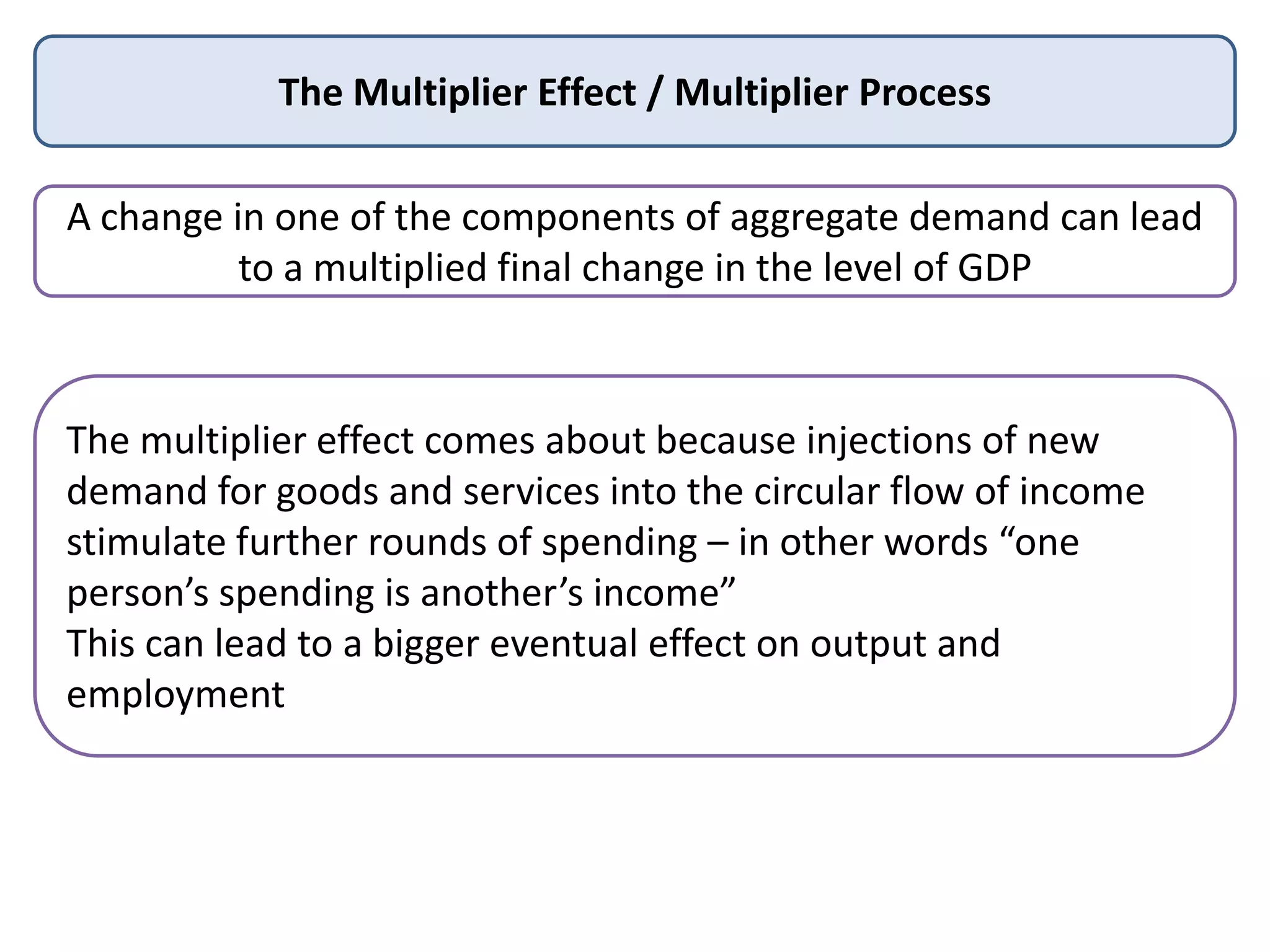
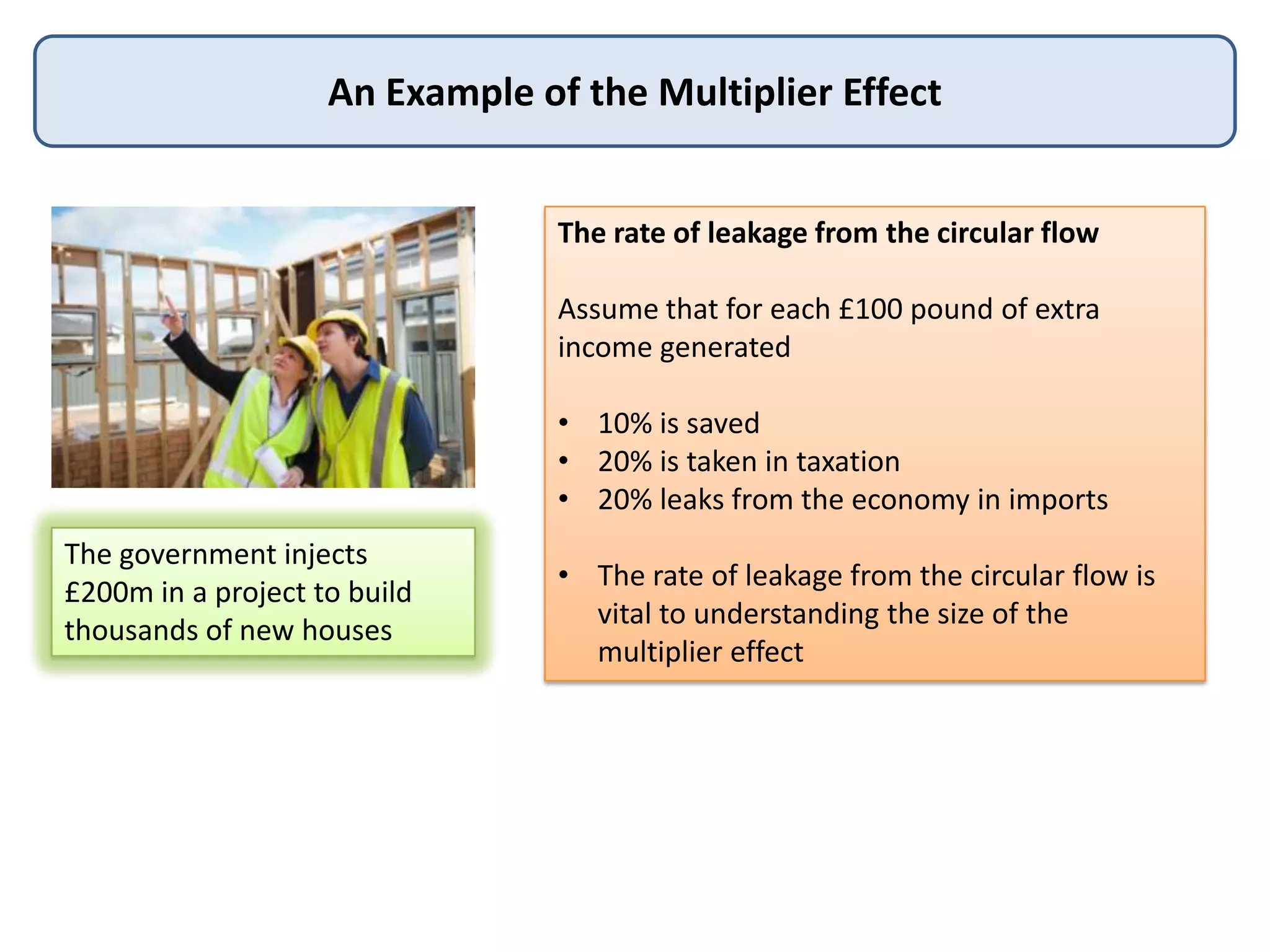
The government injects
£200m in a project to build
thousands of new houses

Why is the final increase in
measured GDP likely to be
more than £200m?

If the final rise in GDP is £300m the value of the multiplier = 1.5
If the final rise in GDP is £250m the value of the multiplier = 1.25
An Example of the Multiplier Effect

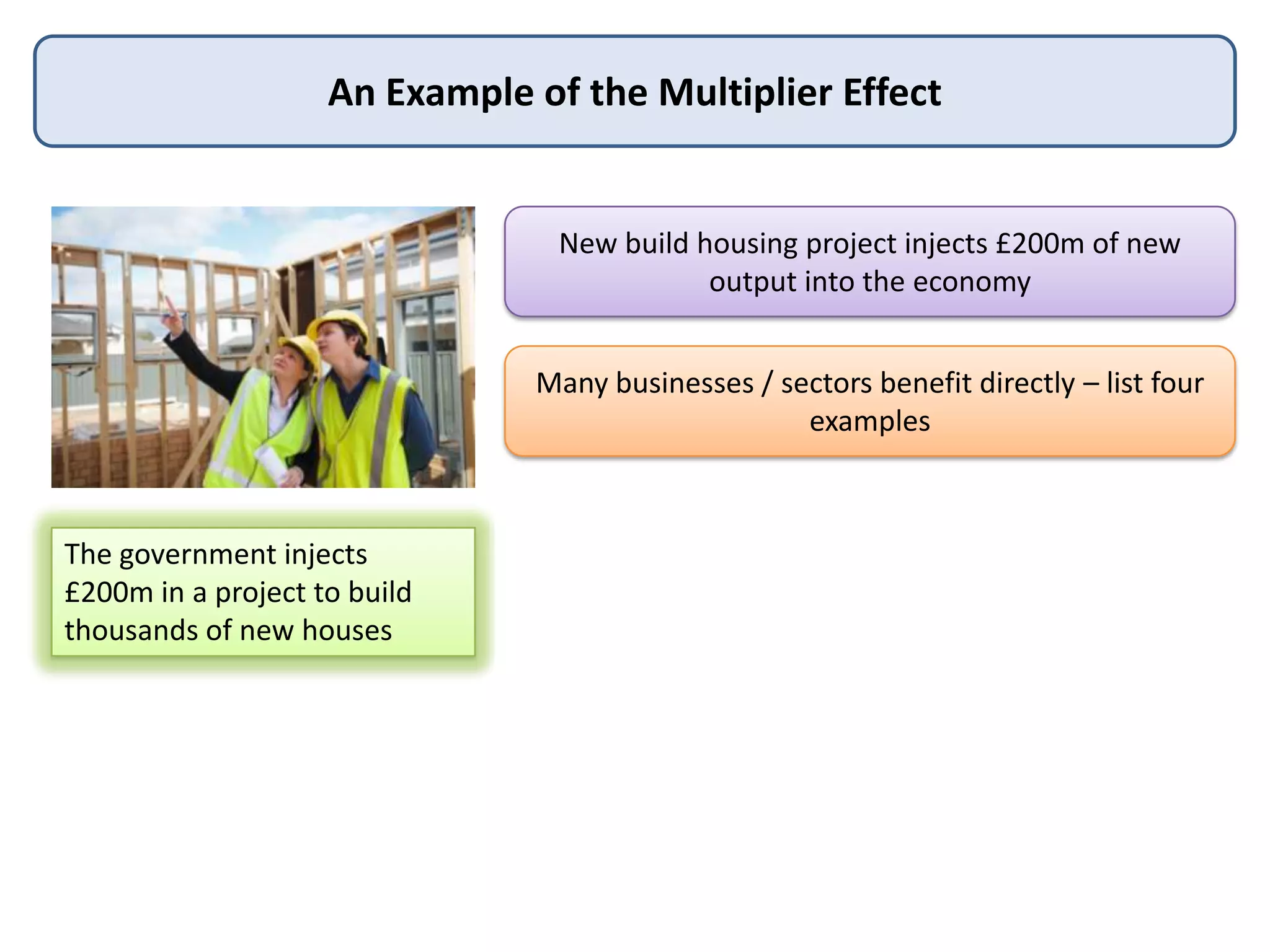
New build housing project injects £200m of new
output into the economy
Many businesses / sectors benefit directly – list four
examples

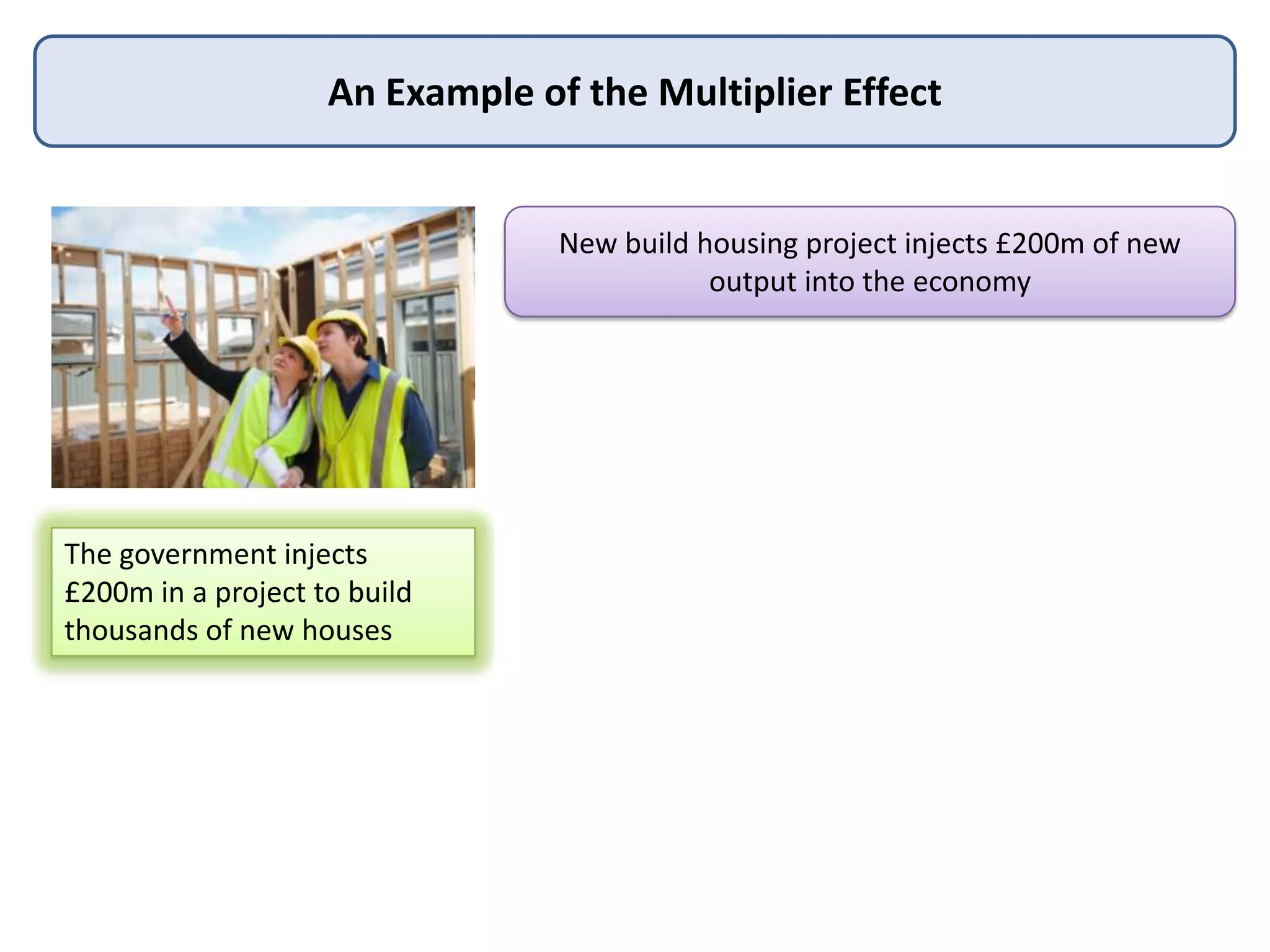
The government injects
£200m in a project to build
thousands of new houses

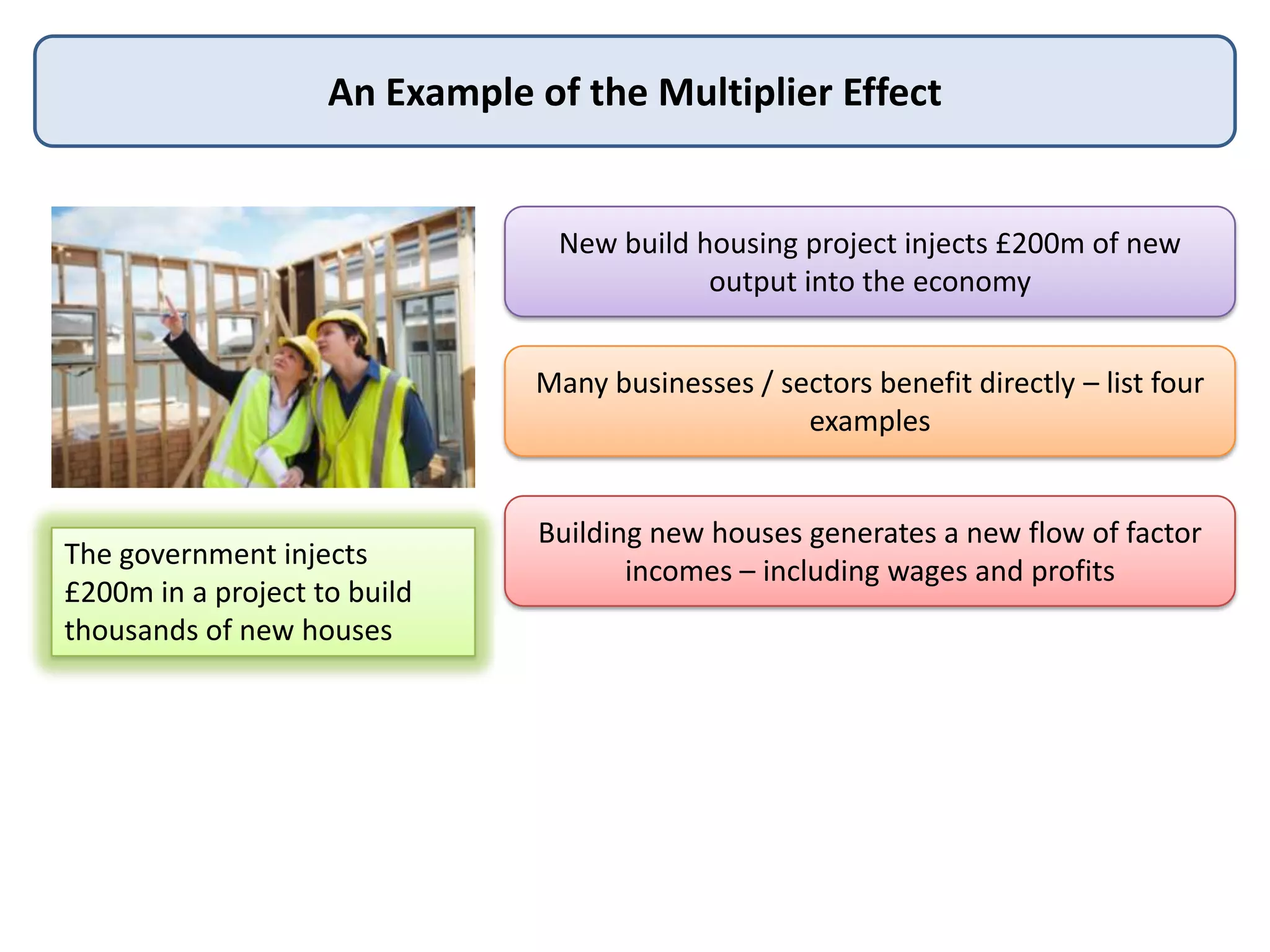
Building new houses generates a new flow of factor
incomes – including wages and profits

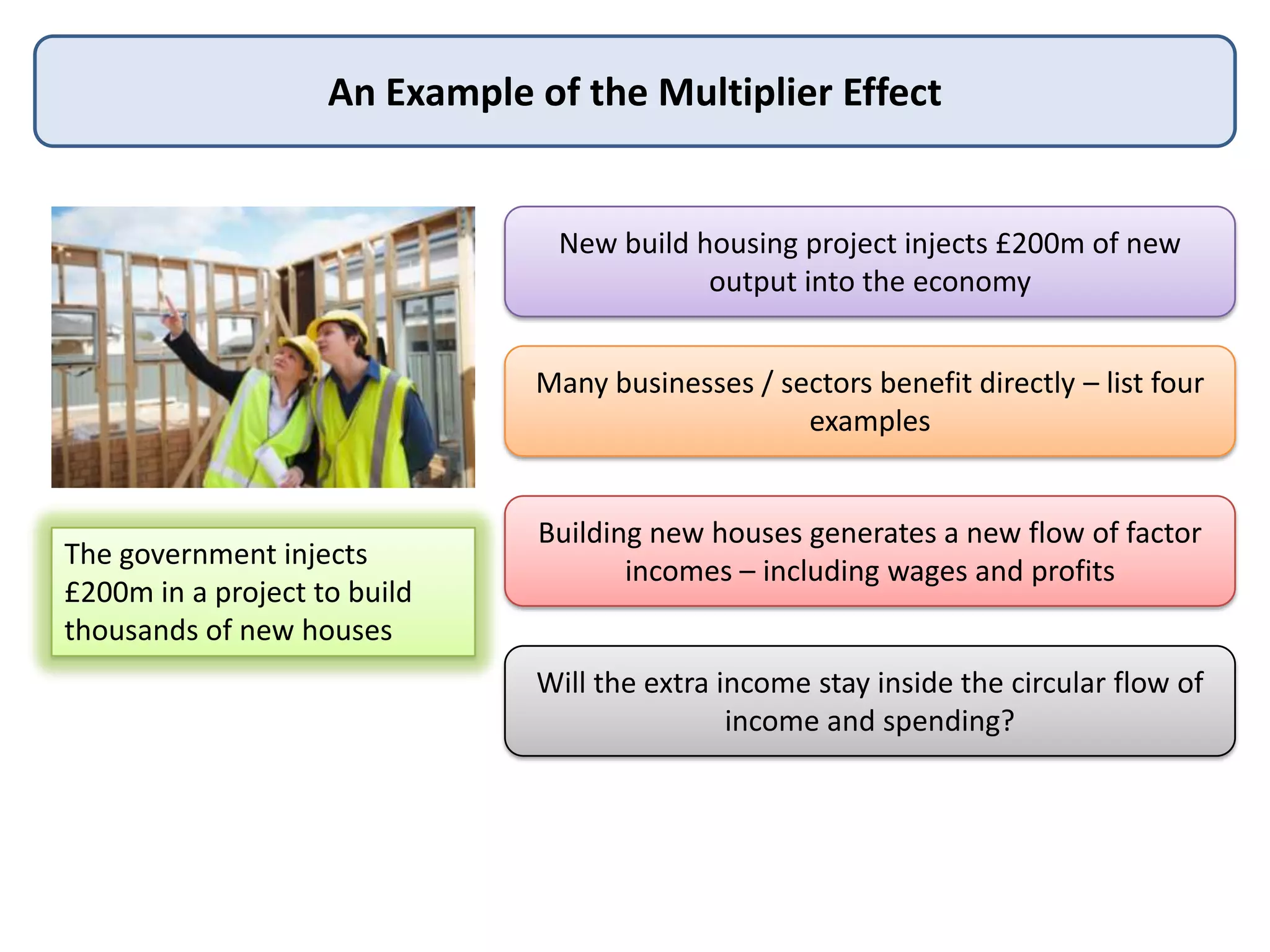
Will the extra income stay inside the circular flow of
income and spending?

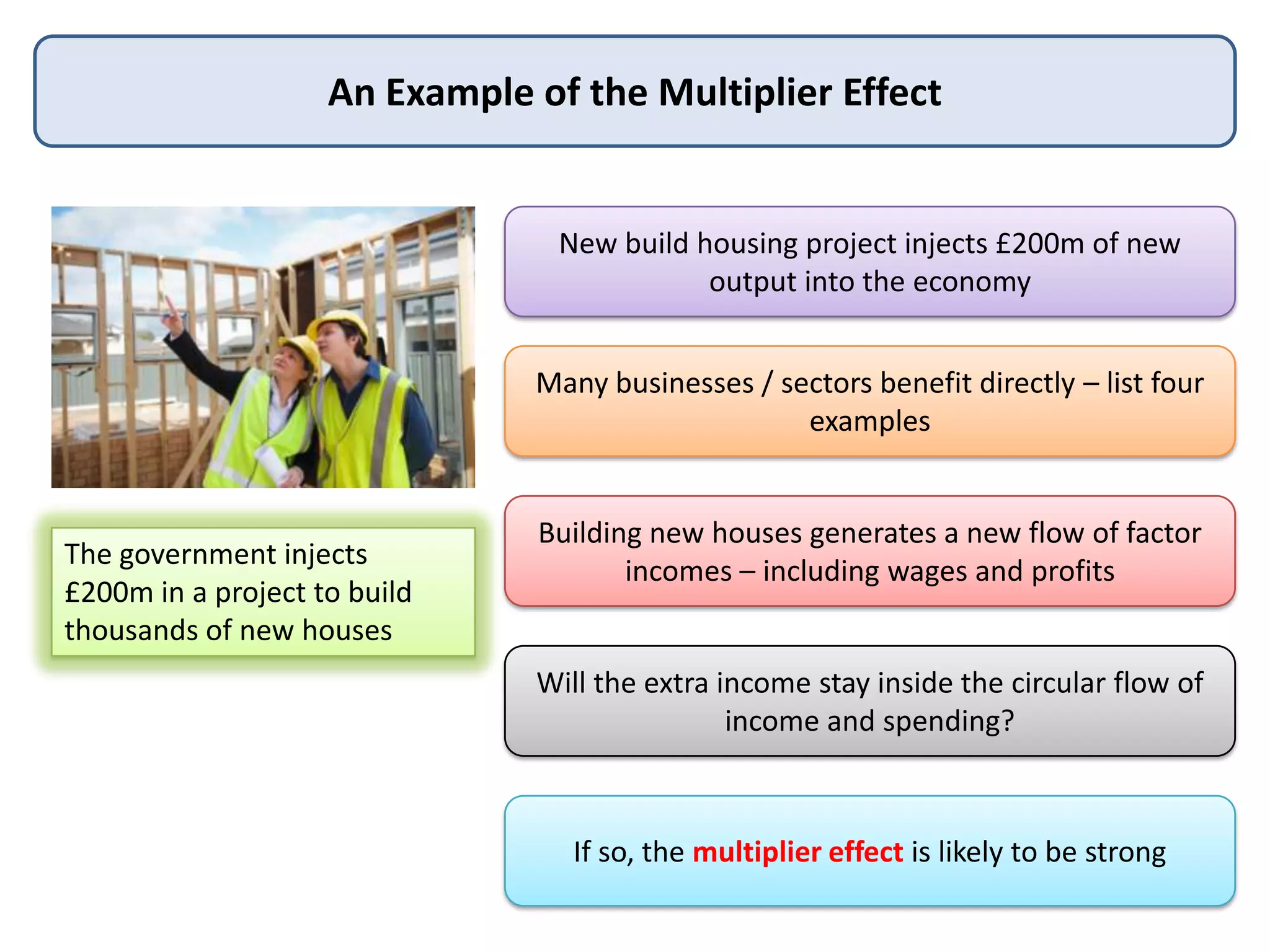
If so, the multiplier effect is likely to be strong
An Example of the Multiplier Effect

New build housing project injects £200m of new
output into the economy
Many businesses / sectors benefit directly – list four
examples

The government injects
£200m in a project to build
thousands of new houses

Building new houses generates a new flow of factor
incomes – including wages and profits

Will the extra income stay inside the circular flow of
income and spending?

If so, the multiplier effect is likely to be strong
An Example of the Multiplier Effect

New build housing project injects £200m of new
output into the economy
Many businesses / sectors benefit directly – list four
examples

The government injects
£200m in a project to build
thousands of new houses

Building new houses generates a new flow of factor
incomes – including wages and profits

Will the extra income stay inside the circular flow of
income and spending?

If so, the multiplier effect is likely to be strong
An Example of the Multiplier Effect

New build housing project injects £200m of new
output into the economy
Many businesses / sectors benefit directly – list four
examples

The government injects
£200m in a project to build
thousands of new houses

Building new houses generates a new flow of factor
incomes – including wages and profits

Will the extra income stay inside the circular flow of
income and spending?

If so, the multiplier effect is likely to be strong
An Example of the Multiplier Effect

New build housing project injects £200m of new
output into the economy
Many businesses / sectors benefit directly – list four
examples

The government injects
£200m in a project to build
thousands of new houses

Building new houses generates a new flow of factor
incomes – including wages and profits

Will the extra income stay inside the circular flow of
income and spending?

If so, the multiplier effect is likely to be strong
An Example of the Multiplier Effect
The rate of leakage from the circular flow
Assume that for each £100 pound of extra
income generated

• 10% is saved
• 20% is taken in taxation
• 20% leaks from the economy in imports
The government injects
£200m in a project to build
thousands of new houses

• The rate of leakage from the circular flow is
vital to understanding the size of the
multiplier effect
An Example of the Multiplier Effect

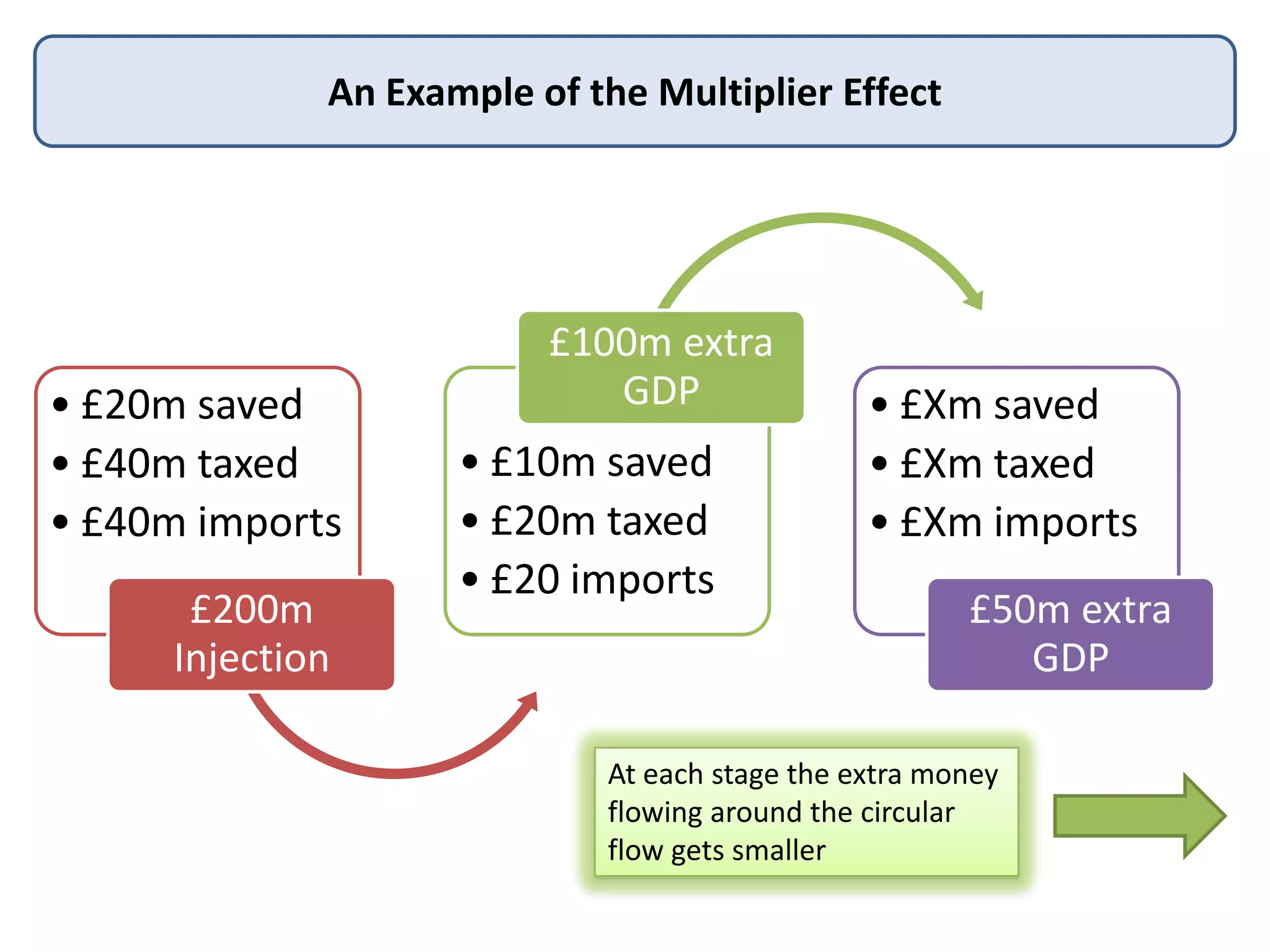
• £20m saved
• £40m taxed
• £40m imports
£200m
Injection

£100m extra
GDP

• £10m saved
• £20m taxed
• £20 imports

• £Xm saved
• £Xm taxed
• £Xm imports
£50m extra
GDP

At each stage the extra money
flowing around the circular
flow gets smaller
An Example of the Multiplier Effect

The formal calculation for the value of the multiplier is
Multiplier = 1 / (sum of the propensity to save + tax + import)
An Example of the Multiplier Effect

Multiplier = 1 / (sum of the propensity to save + tax + import)
If propensity to save = 0.1
Propensity to tax = 0.2
Propensity to import = 0.2
Then the multiplier = 1/0.5 = 2
An Example of the Multiplier Effect

Multiplier = 1 / (sum of the propensity to save + tax + import)
If propensity to save = 0.2
Propensity to tax = 0.3
Propensity to import = 0.3
Then the multiplier = 1/0.8 = 1.25
An Example of the Multiplier Effect

When the rate of leakage
from the circular flow is
high ………. The value of
the multiplier effect will
be small

Multiplier = 1 / (sum of the propensity to save + tax + import)
If propensity to save = 0.2
Propensity to tax = 0.3
Propensity to import = 0.3
Then the multiplier = 1/0.8 = 1.25
Key Factors Affecting the Value of the Multiplier

Propensity
to import

Avoiding
crowding
out effects

Amount of
spare
capacity

The value
of the
multiplier

Propensity
to save

Propensity
to tax
The IMF on the Fiscal Multiplier
Government investment—things like infrastructure building—results in higher
multipliers. Economists at the IMF have calculated the long-run multiplier at 1.5 for
developed countries and 1.6 for developing countries. In other words, developing
countries really benefit from government investment over government
consumption. Investment can build the productive capacity of the economy,
resulting in beneficial long-term effects.
Many governments have been introducing fiscal austerity policies – cutting
spending and lifting taxes in a bid to lower their budget deficits. The fiscal multiplier
effect is important here too. If the multiplier is 0.5, then an initial government
expenditure reduction of 1 per cent of GDP reduces real output by 0.5 per cent. If,
however, the multiplier is 1.7, then the same initial public spending cut of 1 per
cent of GDP would reduce real output by 1.7 per cent. The big danger of a high
fiscal multiplier is that a period of deep cuts in state spending will cause an even
larger drop in GDP which in turn will increase the size of the budget deficit. Fiscal
austerity can turn out to be self-defeating.
One problem is that the actual value of the multiplier effect is likely to change at
different points of the economic cycle.
(Source: Adapted from the Economist and other news reports, July 2013)
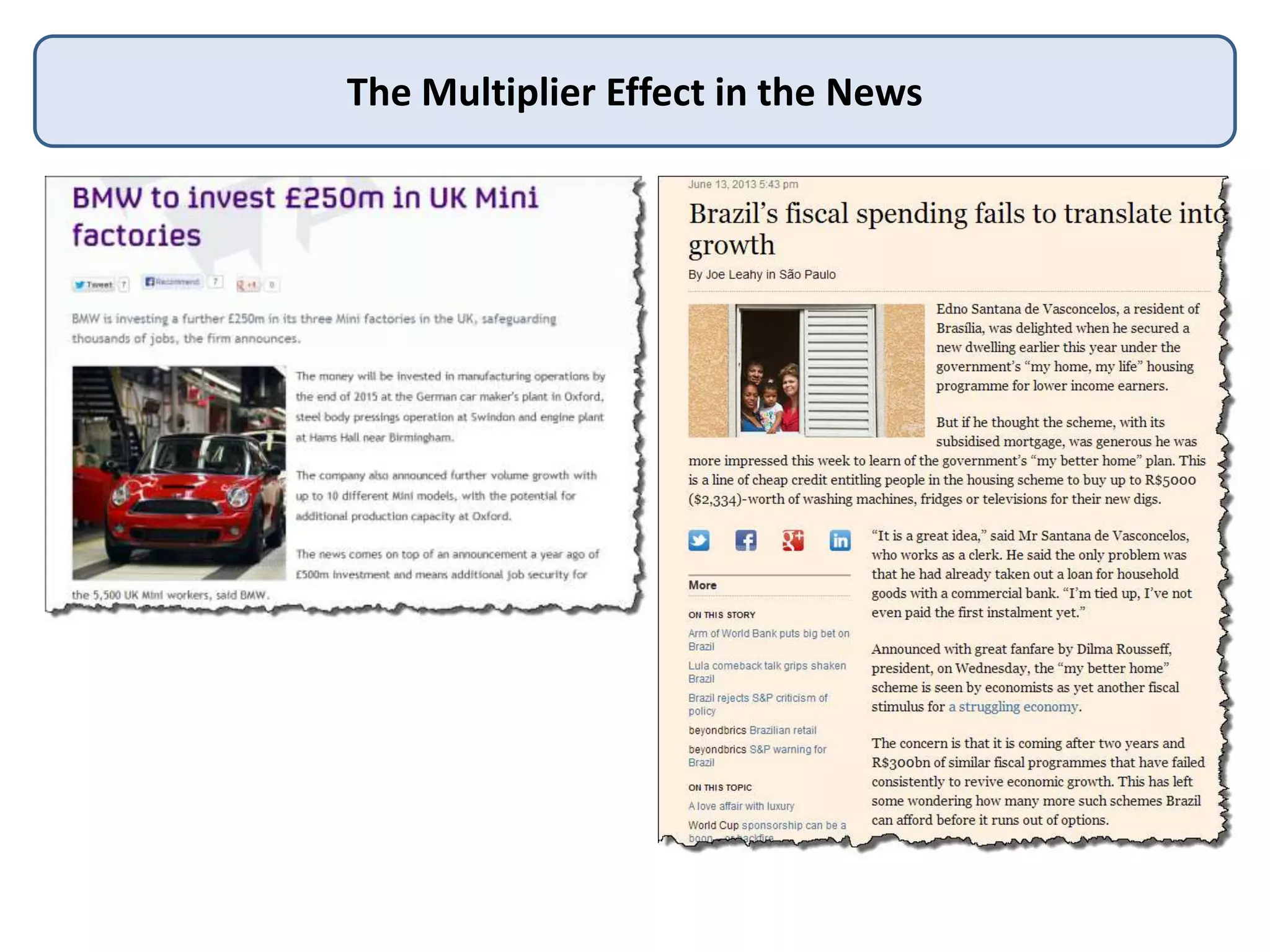
The Multiplier Effect in the News
What are the main objectives of macroeconomic policies?

Price Stability – Low
Positive Inflation

Sustainable Growth of
Real GDP

Improved
Competitiveness / Trade

Falling Unemployment

Sound Government
Finances

Higher Average Living
Standards

Equitable Distribution of
Income and Wealth
AS Macro Course Support
Get help from fellow
students, teachers and
tutor2u on Twitter:

#econ2
@tutor2u

@tutor2u-econ

The Multiplier Effect

  • 1.
    The Multiplier Effect/ Multiplier Process A change in one of the components of aggregate demand can lead to a multiplied final change in the level of GDP
  • 2.
    The Multiplier Effect/ Multiplier Process A change in one of the components of aggregate demand can lead to a multiplied final change in the level of GDP The multiplier effect comes about because injections of new demand for goods and services into the circular flow of income stimulate further rounds of spending – in other words “one person’s spending is another’s income” This can lead to a bigger eventual effect on output and employment
  • 3.
    An Example ofthe Multiplier Effect The government injects £200m in a project to build thousands of new houses Why is the final increase in measured GDP likely to be more than £200m? If the final rise in GDP is £300m the value of the multiplier = 1.5 If the final rise in GDP is £250m the value of the multiplier = 1.25
  • 4.
    An Example ofthe Multiplier Effect New build housing project injects £200m of new output into the economy Many businesses / sectors benefit directly – list four examples The government injects £200m in a project to build thousands of new houses Building new houses generates a new flow of factor incomes – including wages and profits Will the extra income stay inside the circular flow of income and spending? If so, the multiplier effect is likely to be strong
  • 5.
    An Example ofthe Multiplier Effect New build housing project injects £200m of new output into the economy Many businesses / sectors benefit directly – list four examples The government injects £200m in a project to build thousands of new houses Building new houses generates a new flow of factor incomes – including wages and profits Will the extra income stay inside the circular flow of income and spending? If so, the multiplier effect is likely to be strong
  • 6.
    An Example ofthe Multiplier Effect New build housing project injects £200m of new output into the economy Many businesses / sectors benefit directly – list four examples The government injects £200m in a project to build thousands of new houses Building new houses generates a new flow of factor incomes – including wages and profits Will the extra income stay inside the circular flow of income and spending? If so, the multiplier effect is likely to be strong
  • 7.
    An Example ofthe Multiplier Effect New build housing project injects £200m of new output into the economy Many businesses / sectors benefit directly – list four examples The government injects £200m in a project to build thousands of new houses Building new houses generates a new flow of factor incomes – including wages and profits Will the extra income stay inside the circular flow of income and spending? If so, the multiplier effect is likely to be strong
  • 8.
    An Example ofthe Multiplier Effect New build housing project injects £200m of new output into the economy Many businesses / sectors benefit directly – list four examples The government injects £200m in a project to build thousands of new houses Building new houses generates a new flow of factor incomes – including wages and profits Will the extra income stay inside the circular flow of income and spending? If so, the multiplier effect is likely to be strong
  • 9.
    An Example ofthe Multiplier Effect The rate of leakage from the circular flow Assume that for each £100 pound of extra income generated • 10% is saved • 20% is taken in taxation • 20% leaks from the economy in imports The government injects £200m in a project to build thousands of new houses • The rate of leakage from the circular flow is vital to understanding the size of the multiplier effect
  • 10.
    An Example ofthe Multiplier Effect • £20m saved • £40m taxed • £40m imports £200m Injection £100m extra GDP • £10m saved • £20m taxed • £20 imports • £Xm saved • £Xm taxed • £Xm imports £50m extra GDP At each stage the extra money flowing around the circular flow gets smaller
  • 11.
    An Example ofthe Multiplier Effect The formal calculation for the value of the multiplier is Multiplier = 1 / (sum of the propensity to save + tax + import)
  • 12.
    An Example ofthe Multiplier Effect Multiplier = 1 / (sum of the propensity to save + tax + import) If propensity to save = 0.1 Propensity to tax = 0.2 Propensity to import = 0.2 Then the multiplier = 1/0.5 = 2
  • 13.
    An Example ofthe Multiplier Effect Multiplier = 1 / (sum of the propensity to save + tax + import) If propensity to save = 0.2 Propensity to tax = 0.3 Propensity to import = 0.3 Then the multiplier = 1/0.8 = 1.25
  • 14.
    An Example ofthe Multiplier Effect When the rate of leakage from the circular flow is high ………. The value of the multiplier effect will be small Multiplier = 1 / (sum of the propensity to save + tax + import) If propensity to save = 0.2 Propensity to tax = 0.3 Propensity to import = 0.3 Then the multiplier = 1/0.8 = 1.25
  • 15.
    Key Factors Affectingthe Value of the Multiplier Propensity to import Avoiding crowding out effects Amount of spare capacity The value of the multiplier Propensity to save Propensity to tax
  • 16.
    The IMF onthe Fiscal Multiplier Government investment—things like infrastructure building—results in higher multipliers. Economists at the IMF have calculated the long-run multiplier at 1.5 for developed countries and 1.6 for developing countries. In other words, developing countries really benefit from government investment over government consumption. Investment can build the productive capacity of the economy, resulting in beneficial long-term effects. Many governments have been introducing fiscal austerity policies – cutting spending and lifting taxes in a bid to lower their budget deficits. The fiscal multiplier effect is important here too. If the multiplier is 0.5, then an initial government expenditure reduction of 1 per cent of GDP reduces real output by 0.5 per cent. If, however, the multiplier is 1.7, then the same initial public spending cut of 1 per cent of GDP would reduce real output by 1.7 per cent. The big danger of a high fiscal multiplier is that a period of deep cuts in state spending will cause an even larger drop in GDP which in turn will increase the size of the budget deficit. Fiscal austerity can turn out to be self-defeating. One problem is that the actual value of the multiplier effect is likely to change at different points of the economic cycle. (Source: Adapted from the Economist and other news reports, July 2013)
  • 17.
  • 18.
    What are themain objectives of macroeconomic policies? Price Stability – Low Positive Inflation Sustainable Growth of Real GDP Improved Competitiveness / Trade Falling Unemployment Sound Government Finances Higher Average Living Standards Equitable Distribution of Income and Wealth
  • 19.
    AS Macro CourseSupport Get help from fellow students, teachers and tutor2u on Twitter: #econ2 @tutor2u @tutor2u-econ