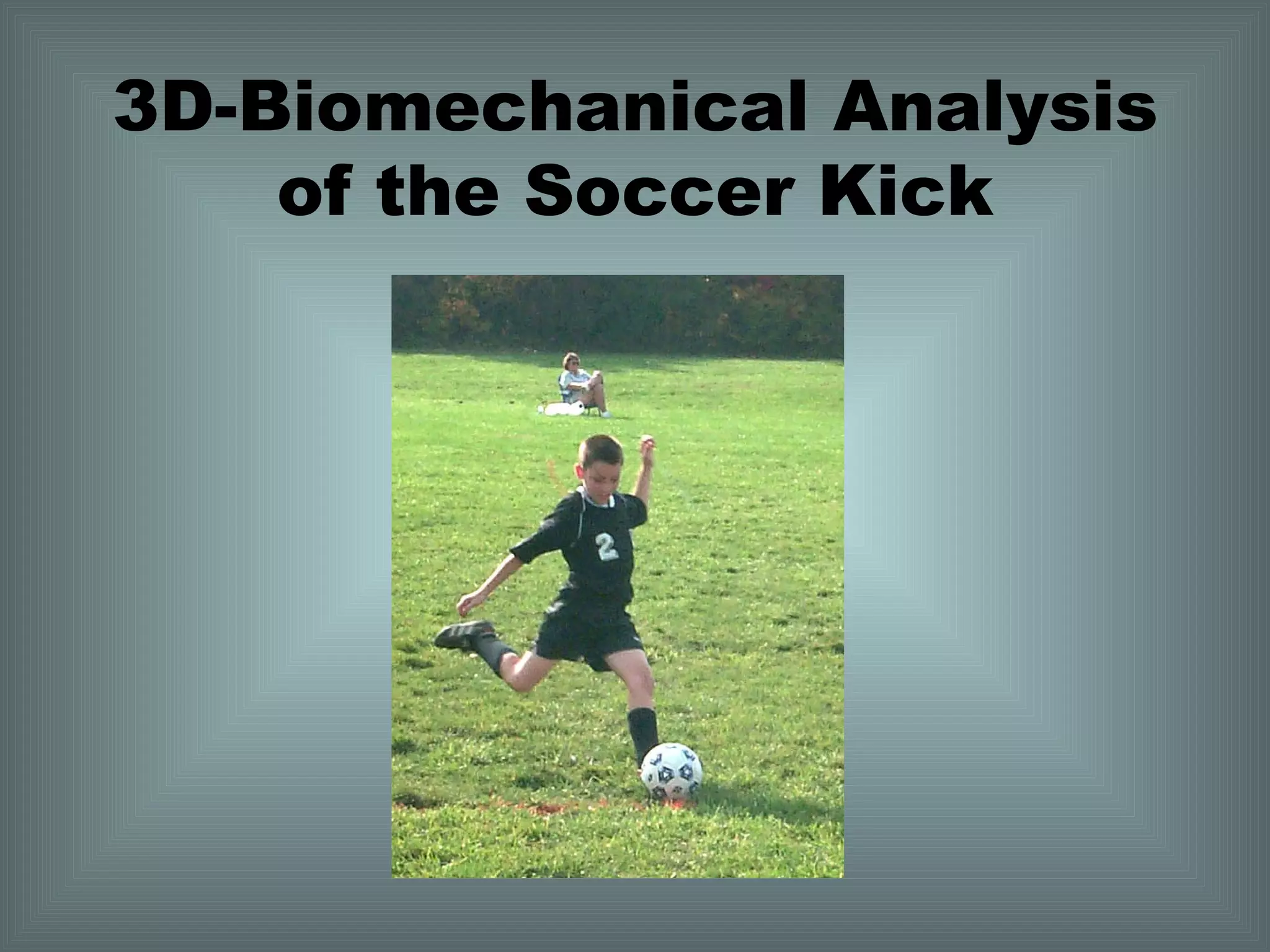
3D-Biomechanical Analysis of the Soccer Kick
Introduction We chose to look at the biomechanics of the soccer kick Two different kicks were looked at: The straight kick The sweep kick
Purpose & Objectives We sought to look at the angular velocities, moments and powers at the hip and knee joints The different contributions of the specific muscle groups for each of the kicks
Literature reviewed Majority of previous studies have  focused  on the kinematics Very few studies have performed 3-D analysis, those that have did kinematics only Previous studies found: hip flexion followed by hip extension moment produces knee extension, not the knee extensors Knee flexors are active during knee extension to prevent hyperextension (study by D.G.E. Robertson, C. Fernando, M. Hart & F. Beaulieu)
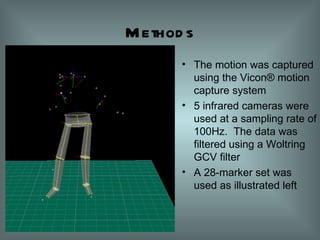
Methods The motion was captured using the Vicon ® motion capture system 5 infrared cameras were used at a sampling rate of 100Hz.  The data was filtered using a Woltring GCV filter A 28-marker set was used as illustrated left
Methods The different kicking styles were analyzed for moment forces and power. The first style looked at was the straight kick- where the athlete approaches the ball straight on. The next style was the sweep kick- where the athlete approaches the ball from the side. Subject was a male 22 year old experienced soccer player Performed 4 trials of each kick, and we attempted to analyze the best trials
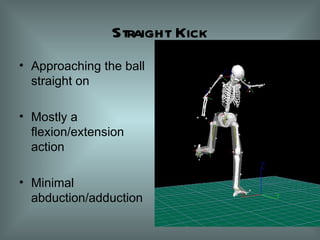
Straight Kick Approaching the ball straight on Mostly a flexion/extension action Minimal abduction/adduction
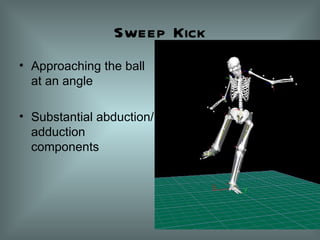
Sweep Kick Approaching the ball at an angle Substantial abduction/adduction components
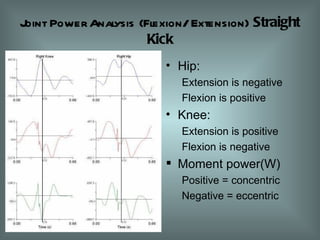
Joint Power Analysis (Flexion/ Extension)  Straight Kick Hip: Extension is negative Flexion is positive Knee: Extension is positive Flexion is negative Moment power(W) Positive = concentric Negative = eccentric
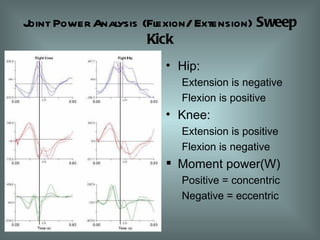
Joint Power Analysis (Flexion/ Extension)  Sweep Kick Hip: Extension is negative Flexion is positive Knee: Extension is positive Flexion is negative Moment power(W) Positive = concentric Negative = eccentric
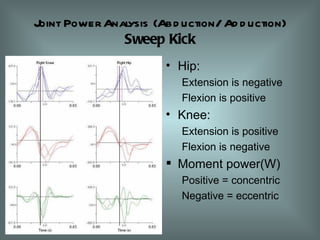
Joint Power Analysis (Abduction/ Adduction)  Sweep Kick Hip: Extension is negative Flexion is positive Knee: Extension is positive Flexion is negative Moment power(W) Positive = concentric Negative = eccentric
Analysis Summary The hip flexors and extensors are responsible for producing the majority of the kicking force During knee extension, the flexors are active just before strike preventing hyperextension Hip extensor action just prior to contact is what initiates knee extension
Analysis Summary The abduction/ adduction curves follow a similar path to the flexion/ extension graphs. The magnitudes of the abduction/ adduction are substantial for the velocities and moments, but much smaller for the powers. Anatomical structures resist moments thus reducing powers
Conclusions and Recommendations Our results supported the previous studies concerning the powers and forces for flexion/ extension Our abduction/ adduction results were what we expected based on anatomical predicions Some studies have shown that the sweep kick produces higher ball velocities, possibly due to the added abduction/ adduction forces of the limb.  Now that more 3D capture technology is available more kinetic studies should be done.

Kicking

  • 1.
  • 2.
    Introduction We choseto look at the biomechanics of the soccer kick Two different kicks were looked at: The straight kick The sweep kick
  • 3.
    Purpose & ObjectivesWe sought to look at the angular velocities, moments and powers at the hip and knee joints The different contributions of the specific muscle groups for each of the kicks
  • 4.
    Literature reviewed Majorityof previous studies have focused on the kinematics Very few studies have performed 3-D analysis, those that have did kinematics only Previous studies found: hip flexion followed by hip extension moment produces knee extension, not the knee extensors Knee flexors are active during knee extension to prevent hyperextension (study by D.G.E. Robertson, C. Fernando, M. Hart & F. Beaulieu)
  • 5.
    Methods The motionwas captured using the Vicon ® motion capture system 5 infrared cameras were used at a sampling rate of 100Hz. The data was filtered using a Woltring GCV filter A 28-marker set was used as illustrated left
  • 6.
    Methods The differentkicking styles were analyzed for moment forces and power. The first style looked at was the straight kick- where the athlete approaches the ball straight on. The next style was the sweep kick- where the athlete approaches the ball from the side. Subject was a male 22 year old experienced soccer player Performed 4 trials of each kick, and we attempted to analyze the best trials
  • 7.
    Straight Kick Approachingthe ball straight on Mostly a flexion/extension action Minimal abduction/adduction
  • 8.
    Sweep Kick Approachingthe ball at an angle Substantial abduction/adduction components
  • 9.
    Joint Power Analysis(Flexion/ Extension) Straight Kick Hip: Extension is negative Flexion is positive Knee: Extension is positive Flexion is negative Moment power(W) Positive = concentric Negative = eccentric
  • 10.
    Joint Power Analysis(Flexion/ Extension) Sweep Kick Hip: Extension is negative Flexion is positive Knee: Extension is positive Flexion is negative Moment power(W) Positive = concentric Negative = eccentric
  • 11.
    Joint Power Analysis(Abduction/ Adduction) Sweep Kick Hip: Extension is negative Flexion is positive Knee: Extension is positive Flexion is negative Moment power(W) Positive = concentric Negative = eccentric
  • 12.
    Analysis Summary Thehip flexors and extensors are responsible for producing the majority of the kicking force During knee extension, the flexors are active just before strike preventing hyperextension Hip extensor action just prior to contact is what initiates knee extension
  • 13.
    Analysis Summary Theabduction/ adduction curves follow a similar path to the flexion/ extension graphs. The magnitudes of the abduction/ adduction are substantial for the velocities and moments, but much smaller for the powers. Anatomical structures resist moments thus reducing powers
  • 14.
    Conclusions and RecommendationsOur results supported the previous studies concerning the powers and forces for flexion/ extension Our abduction/ adduction results were what we expected based on anatomical predicions Some studies have shown that the sweep kick produces higher ball velocities, possibly due to the added abduction/ adduction forces of the limb. Now that more 3D capture technology is available more kinetic studies should be done.