Open educational practice
in language teaching
#oep #CoP
Sustaining a professional community of
practice
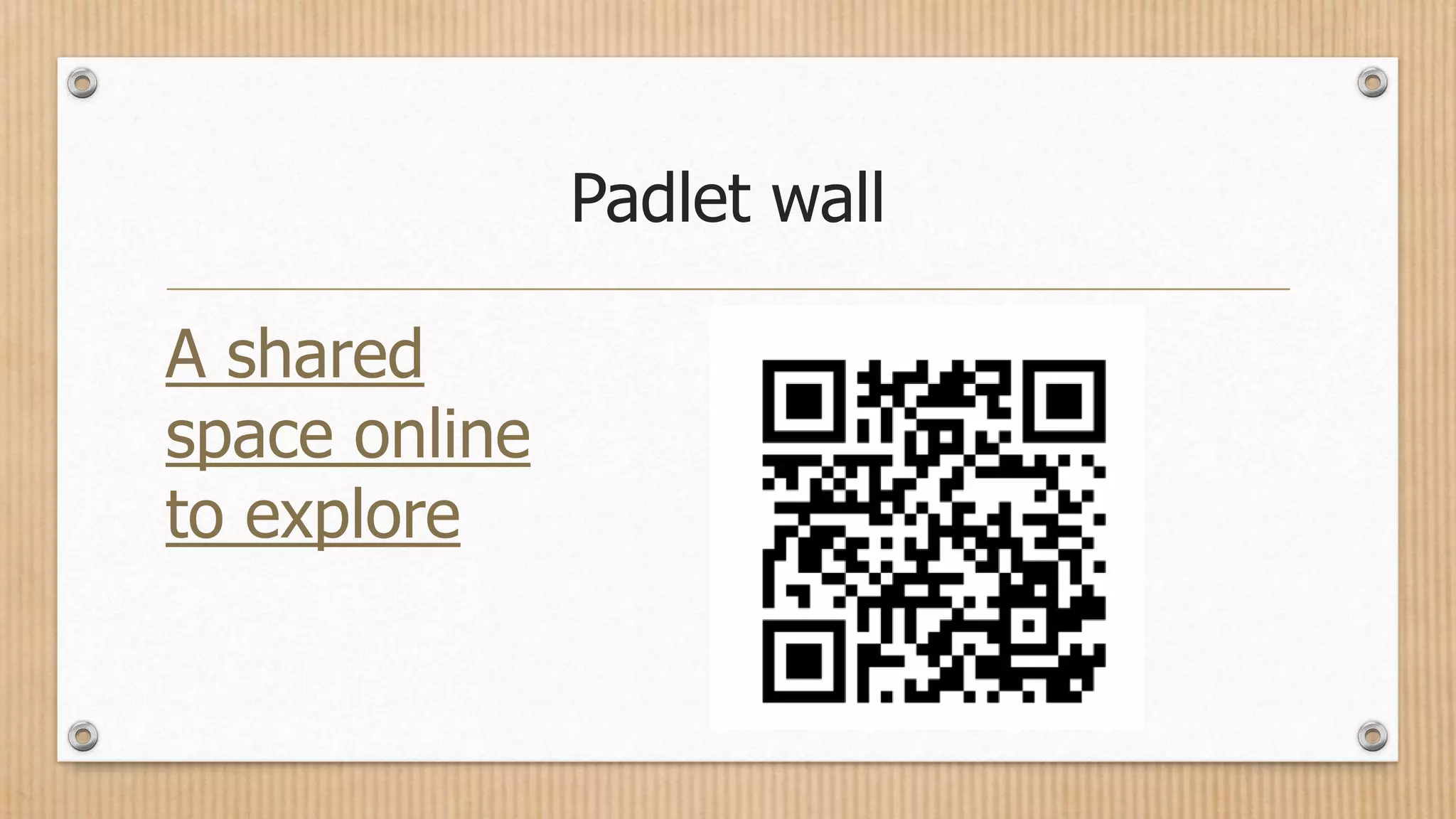
Padlet wall
A shared
space online
to explore
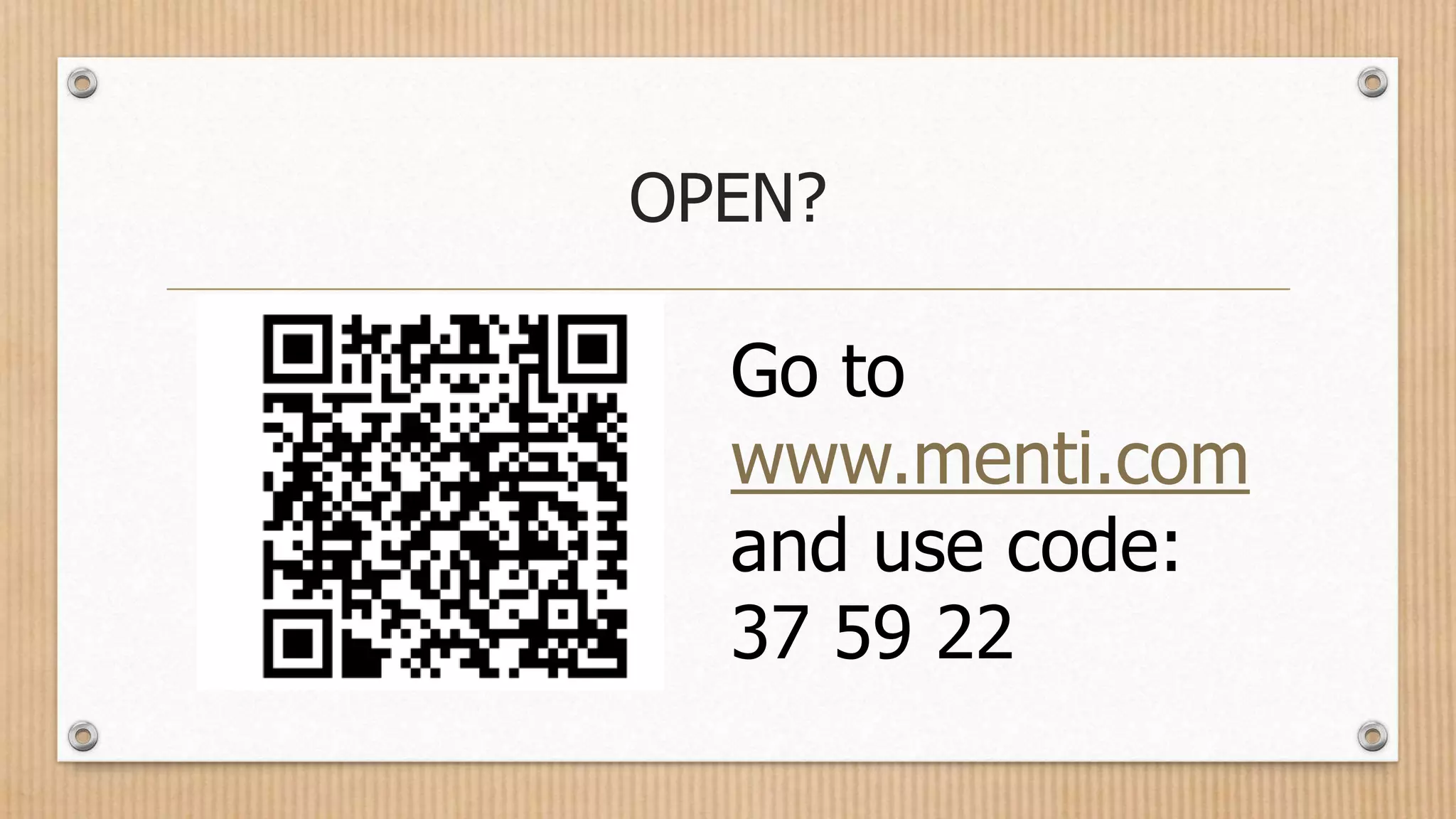
OPEN?
Go to
www.menti.com
and use code:
37 59 22
Openness is….
• “a constantly negotiated space” (Cronin, 2017)
• “rooted in the human right to access high-quality education” (OER
Commons)
• “about our values: access, equity, innovation & creativity” (Ryan Merckley,
Creative Commons)
• “draws upon open technologies that facilitate collaborative, flexible
learning and the open sharing of teaching practices that empower
educators to benefit from the best ideas of their colleagues.” (Cape Town
declaration)
Openness isn’t…
• Risking your privacy and sharing your data without a care in the
world!
• A licence for others to take your intellectual property and claim it as
their own
• A means for others to monetise your creations leaving you working
for free
• Easy!
Designing with an open mindset
• Classroom outputs can provide authentic learning resources for others
• Protect identities and data through class or group accounts
• “Audience effect” adds authenticity, can lead to serendipitous connections
• Contribution to knowledge creation through TedX, Wikipedia
• Collaboration and creativity can help to create more meaningful learning
opportunities
What are “Little OER” ?
• Grassroots resources shared openly online on channels such as
YouTube
• Small scale, high granularity, low production values, “quick and
dirty”
• Often use open licences (Creative Commons) for ease of reuse and
recognition of origin
• Invite participation and re-contextualization on the part of the
consumer cum producer
Sharing teaching practice
e.g. Computer-Mediated Communication SIG Eurocall
• Webinar collection of “show and tell” practices including:
• LangOER project
• Fansubbing and social media practices
• Use of open tools such as padlet, wix to create OER for
language learners
Sustainability of language teaching?
• Sustainability of education (MacKinnon et al, 2016) is concerned with the
ongoing ability of an educational endeavour to meet its goals.
• Open practice driven by shared conviction of the significance of language
and intercultural learning for all.
• a "commons thinking" approach (see Kenrick, 2009), drawing together
university's wider role in stewardship of knowledge creation and the
academic discourse which facilitates it through recognising OEP and the
value of workload considerations in order to foster a culture of
collaboration.
6 easy steps to open your work
• Set up your own professional digital presence (video clip)
• Curate resources which are relevant to your work (Pearltrees, Diigo, Scoop.it)
• Author and share resources openly (e.g. Slideshare, Quizlet, Hiaku Deck)
• Join an open learning community (e.g. #LTHEchat, #BYOD4L,
#makingsense18)
• Use social media to connect with others (e.g.Twitter, YouTube, LinkedIn)
• Blog or contribute to a shared blog
• Bruns, A. (2005). Some exploratory notes on produsers and produsage. Retrieved 25.11.15, from
http://snurb.info/index.php?q=node/329
• Bradley, R and Vigmo, S. (2016). Pedagogical framing of OER - The case of language teaching. Open
Praxis [online] vol. 8 (4), pp. 283–295. Available at
https://openpraxis.org/index.php/OpenPraxis/article/view/336 [Accessed 13th Jan. 2018].
• Cronin, C. (2017) Openness and Praxis: Exploring the Use of Open Educational Practices in Higher
Education. IRRODL [online] Available http://www.irrodl.org/index.php/irrodl/article/view/3096
[Accessed 13 Jan.2018]
• MacKinnon, T & Pasfield-Neofitou, S. (2016) OER “produsage” as a model to support language teaching
and learning. education policy analysis archives, [S.l.], v. 24, p. 40. Available at:
http://epaa.asu.edu/ojs/article/view/1825
• MacKinnon, T et al., (2016). A Meta-Analysis of Open Educational Communities of Practice and
Sustainability in Higher Educational Policy. Alsic [En ligne], Vol. 19. http://alsic.revues.org/2908
• Weller, M. (2011) The Digital Scholar. London: Bloomsbury
References

Open educational practice in language teaching

  • 1.
    Open educational practice inlanguage teaching #oep #CoP Sustaining a professional community of practice
  • 2.
    Padlet wall A shared spaceonline to explore
  • 3.
  • 4.
    Openness is…. • “aconstantly negotiated space” (Cronin, 2017) • “rooted in the human right to access high-quality education” (OER Commons) • “about our values: access, equity, innovation & creativity” (Ryan Merckley, Creative Commons) • “draws upon open technologies that facilitate collaborative, flexible learning and the open sharing of teaching practices that empower educators to benefit from the best ideas of their colleagues.” (Cape Town declaration)
  • 5.
    Openness isn’t… • Riskingyour privacy and sharing your data without a care in the world! • A licence for others to take your intellectual property and claim it as their own • A means for others to monetise your creations leaving you working for free • Easy!
  • 6.
    Designing with anopen mindset • Classroom outputs can provide authentic learning resources for others • Protect identities and data through class or group accounts • “Audience effect” adds authenticity, can lead to serendipitous connections • Contribution to knowledge creation through TedX, Wikipedia • Collaboration and creativity can help to create more meaningful learning opportunities
  • 7.
    What are “LittleOER” ? • Grassroots resources shared openly online on channels such as YouTube • Small scale, high granularity, low production values, “quick and dirty” • Often use open licences (Creative Commons) for ease of reuse and recognition of origin • Invite participation and re-contextualization on the part of the consumer cum producer
  • 8.
    Sharing teaching practice e.g.Computer-Mediated Communication SIG Eurocall • Webinar collection of “show and tell” practices including: • LangOER project • Fansubbing and social media practices • Use of open tools such as padlet, wix to create OER for language learners
  • 9.
    Sustainability of languageteaching? • Sustainability of education (MacKinnon et al, 2016) is concerned with the ongoing ability of an educational endeavour to meet its goals. • Open practice driven by shared conviction of the significance of language and intercultural learning for all. • a "commons thinking" approach (see Kenrick, 2009), drawing together university's wider role in stewardship of knowledge creation and the academic discourse which facilitates it through recognising OEP and the value of workload considerations in order to foster a culture of collaboration.
  • 10.
    6 easy stepsto open your work • Set up your own professional digital presence (video clip) • Curate resources which are relevant to your work (Pearltrees, Diigo, Scoop.it) • Author and share resources openly (e.g. Slideshare, Quizlet, Hiaku Deck) • Join an open learning community (e.g. #LTHEchat, #BYOD4L, #makingsense18) • Use social media to connect with others (e.g.Twitter, YouTube, LinkedIn) • Blog or contribute to a shared blog
  • 11.
    • Bruns, A.(2005). Some exploratory notes on produsers and produsage. Retrieved 25.11.15, from http://snurb.info/index.php?q=node/329 • Bradley, R and Vigmo, S. (2016). Pedagogical framing of OER - The case of language teaching. Open Praxis [online] vol. 8 (4), pp. 283–295. Available at https://openpraxis.org/index.php/OpenPraxis/article/view/336 [Accessed 13th Jan. 2018]. • Cronin, C. (2017) Openness and Praxis: Exploring the Use of Open Educational Practices in Higher Education. IRRODL [online] Available http://www.irrodl.org/index.php/irrodl/article/view/3096 [Accessed 13 Jan.2018] • MacKinnon, T & Pasfield-Neofitou, S. (2016) OER “produsage” as a model to support language teaching and learning. education policy analysis archives, [S.l.], v. 24, p. 40. Available at: http://epaa.asu.edu/ojs/article/view/1825 • MacKinnon, T et al., (2016). A Meta-Analysis of Open Educational Communities of Practice and Sustainability in Higher Educational Policy. Alsic [En ligne], Vol. 19. http://alsic.revues.org/2908 • Weller, M. (2011) The Digital Scholar. London: Bloomsbury References

Editor's Notes

  • #5 Movement https://en.wikipedia.org/wiki/Open_education Has roots in work of John Dewey, Freire – education is a political act Economy of digital – what you give away you still have.
  • #6 Keep your eyes open
  • #7 Student sharing https://warwick.mediaspace.kaltura.com/media/Gertrud+Kiss+on+Mahara+student+sharing/1_0rtq9gkp https://padlet.com/profteresamac/2h32vilfhzds
  • #8 Explained by Martin Weller Paper EPAA http://epaa.asu.edu/ojs/article/view/1825
  • #9 https://docs.google.com/document/d/1qSGwawOp6qIBQFXJ182JpVbLLWRw_Zw4o9-BtW8YXK8/edit?usp=sharing
  • #10 https://alsic.revues.org/2908 Drive – what motivates us: being part of something bigger