Overview

 Continuity Equation
 Navier-Stokes Equation
  (a bit of vector notation...)
 Examples (all laminar flow)
  Flow between stationary parallel horizontal
   plates
  Flow between inclined parallel plates
  Pipe flow (Hagen Poiseuille)
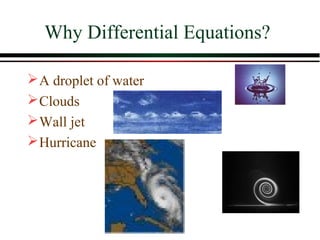
Why Differential Equations?

 A droplet of water
 Clouds
 Wall jet
 Hurricane
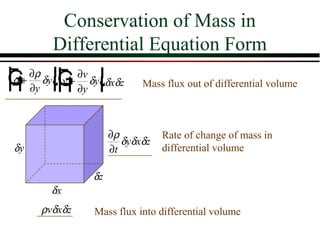
Conservation of Mass in
        Differential Equation Form
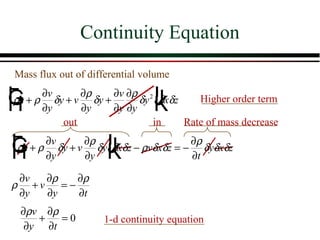
F+ ∂ρ δyIF+ ∂v δyIδxδz
G ∂y Jv ∂y J
         G K
H K
ρ
         H                  Mass flux out of differential volume


                     ∂ρ          Rate of change of mass in
                        δyδxδz
 δy                  ∂t          differential volume

                δz
        δx
      ρvδxδz    Mass flux into differential volume
Continuity Equation
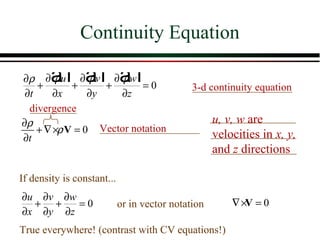
 Mass flux out of differential volume
Fv + ρ ∂v δy + v ∂ρ δy + ∂v ∂ρ δy Iδxδz
G ∂y ∂y ∂y ∂y J
H
ρ
                                  K          Higher order term
                                2


            out                  in       Rate of mass decrease
Fv + ρ ∂v δy + v ∂ρ δyIδxδz − ρvδxδz = − ∂ρ δyδxδz
G ∂y ∂y J
H
ρ
                      K                  ∂t

    ∂v    ∂ρ    ∂ρ
ρ      +v    =−
    ∂y    ∂y    ∂t
    ∂ρv ∂ρ
       +   =0        1-d continuity equation
     ∂y ∂t
Continuity Equation

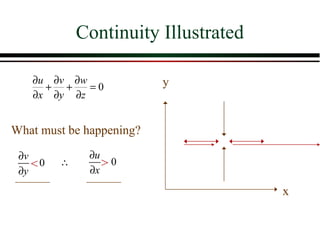
        af af a f
∂ ρ ∂ ρu ∂ ρv ∂ ρw
    +       +      +      =0                  3-d continuity equation
 ∂t     ∂x      ∂y   ∂z
  divergence
∂ρ                                                  u, v, w are
    + ∇ ×ρ V = 0 Vector notation                    velocities in x, y,
∂t
                                                    and z directions

If density is constant...
∂u ∂v ∂w
  + +    =0                 or in vector notation       ∇ ×V = 0
∂x ∂y ∂z
True everywhere! (contrast with CV equations!)
Continuity Illustrated

   ∂u ∂v ∂w               y
     + +    =0
   ∂x ∂y ∂z


What must be happening?

 ∂v           ∂u
    <0   ∴       >0
 ∂y           ∂x

                                      x
Navier-Stokes Equations

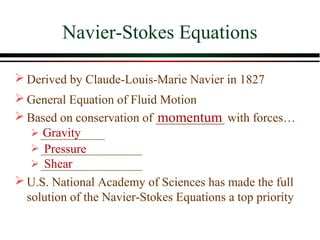
 Derived by Claude-Louis-Marie Navier in 1827
 General Equation of Fluid Motion
                            momentum
 Based on conservation of ___________ with forces…
     Gravity
    ____________
      Pressure
    ___________________
      Shear
    ___________________
 U.S. National Academy of Sciences has made the full
  solution of the Navier-Stokes Equations a top priority
Navier-Stokes Equations
V ρa = ∑ F
                                   Navier-Stokes Equation
ρ a + ρ g = −∇p + µ∇ V  2

                                   g is constant
ρ a = − ( ∇p + ρ g ) + µ∇ 2 V      a is a function of t, x, y, z
ρa = Inertial forces [N/m3], a is Lagrangian acceleration

 Is acceleration zero when ∂V/ ∂ t = 0?              NO!
− ( ∇p + ρ g ) = Pressure gradient (not due to change in elevation)
     ∇p + ρ g ≠ 0   V ≠0
  If _________ then _____
                                            du
µ∇ V = Shear stress gradient
    2                                  τ =µ         τ = µ∇V
                                            dx
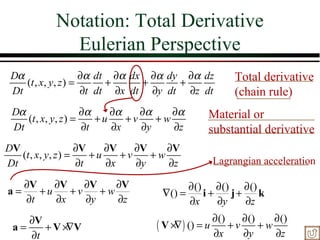
Notation: Total Derivative
             Eulerian Perspective
 Dα                  ∂α dt ∂α dx ∂α dy ∂α dz        Total derivative
    (t , x, y, z ) =      +     +     +
 Dt                  ∂t dt ∂x dt ∂y dt ∂z dt        (chain rule)
 Dα                  ∂α    ∂α    ∂α    ∂α     Material or
    (t , x, y, z ) =    +u    +v    +w
 Dt                  ∂t    ∂x    ∂y    ∂z     substantial derivative
DV                  ∂V    ∂V    ∂V    ∂V
   (t , x, y, z ) =    +u    +v    +w
Dt                  ∂t    ∂x    ∂y    ∂z       Lagrangian acceleration

   ∂V    ∂V    ∂V    ∂V                   ∂ () ∂ () ∂ ()
a=    +u    +v    +w                ∇() =     i+    j+    k
   ∂t    ∂x    ∂y    ∂z                   ∂x     ∂y    ∂z
    ∂V                                           ∂ () ∂ () ∂ ()
 a=    +V× V
          ∇                       ( V ×∇ ) () = u + v + w
    ∂t                                           ∂x   ∂y   ∂z
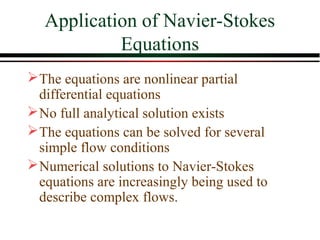
Application of Navier-Stokes
            Equations
 The equations are nonlinear partial
  differential equations
 No full analytical solution exists
 The equations can be solved for several
  simple flow conditions
 Numerical solutions to Navier-Stokes
  equations are increasingly being used to
  describe complex flows.
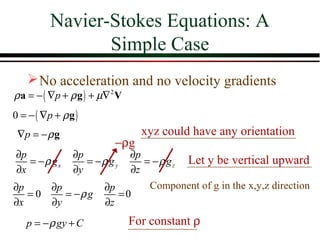
Navier-Stokes Equations: A
               Simple Case
     No acceleration and no velocity gradients
ρ a = − ( ∇p + ρ g ) + µ∇ 2 V
0 = − ( ∇p + ρ g )
∇p = − ρ g                   xyz could have any orientation
                       −ρg
∂p           ∂p          ∂p
   = −ρ gx      = −ρ g y    = − ρ g z Let y be vertical upward
∂x           ∂y          ∂z
∂p      ∂p          ∂p       Component of g in the x,y,z direction
   =0      = −ρ g      =0
∂x      ∂y          ∂z
  p = − ρ gy + C           For constant ρ
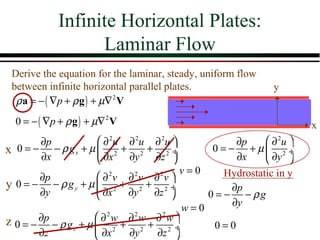
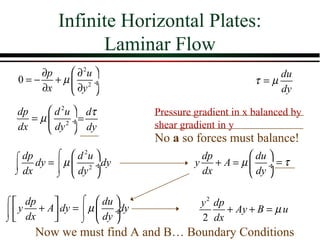
Infinite Horizontal Plates:
                   Laminar Flow
 Derive the equation for the laminar, steady, uniform flow
 between infinite horizontal parallel plates.                y
  ρ a = − ( ∇p + ρ g ) + µ∇ 2 V
  0 = − ( ∇p + ρ g ) + µ∇ 2 V                                      x
       ∂p           ∂ 2u ∂ 2u ∂ 2u                ∂p  ∂ 2u 
x 0 = − − ρ gx + µ  2 + 2 + 2 ÷               0 = − +µ 2 ÷
       ∂x           ∂x   ∂y   ∂z                  ∂x  ∂y 
                                        v=0     Hydrostatic in y
       ∂p          ∂ v ∂ v ∂ v
                          2     2   2
y 0 = − − ρ gy + µ  2 + 2 + 2 ÷                 ∂p
       ∂y           ∂x ∂y  ∂z             0 = − − ρg
                                        w=0      ∂y
       ∂p           ∂2w ∂2w ∂2w 
z 0 = − − ρ gz + µ  2 + 2 + 2 ÷                0=0
       ∂z           ∂x  ∂y  ∂z 
Infinite Horizontal Plates:
                   Laminar Flow
       ∂p  ∂ 2u                                           du
  0 = − +µ 2 ÷                                        τ =µ
       ∂x  ∂y                                             dy

  dp      d 2u  dτ            Pressure gradient in x balanced by
     = µ  2 ÷=
  dx      dy  dy              shear gradient in y
                                No a so forces must balance!
             ⌠  2                                   du 
 ⌠   dp       µ d u dy                    dp
 
 
        dy =   2 ÷                     y    + A = µ ÷=τ
 ⌡   dx      ⌡  dy 
                                          dx         dy 

⌠                 ⌠  du 
      dp                                 y 2 dp
 y

         + A dy =  µ  ÷
                   
                           dy                    + Ay + B = µ u
⌡    dx          ⌡  dy                2 dx
        Now we must find A and B… Boundary Conditions
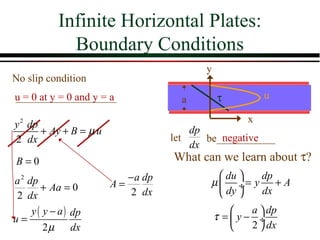
Infinite Horizontal Plates:
              Boundary Conditions
                                          y
No slip condition
u = 0 at y = 0 and y = a              a       τ         u

y 2 dp                                              x
       + Ay + B = µ u                   dp
2 dx                                let       negative
                                           be___________
                                        dx
B=0                                 What can we learn about τ?
a 2 dp                     − a dp             du  dp
        + Aa = 0        A=                 µ  ÷= y + A
 2 dx                       2 dx              dy  dx
     y ( y − a ) dp                                a  dp
u=                                            τ =y− ÷
         2µ      dx                                2  dx
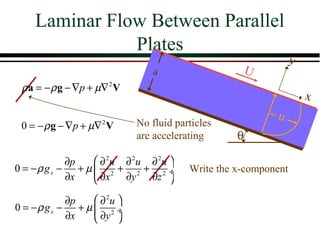
Laminar Flow Between Parallel
               Plates
                                                               y
                                a                      U
 ρ a = − ρ g − ∇p + µ∇ 2 V
                                                                   x
                                                           u
 0 = − ρ g − ∇p + µ∇ V
                     2       No fluid particles
                             are accelerating      θ

           ∂p    ∂ 2u ∂ 2u ∂ 2u 
0 = −ρ gx − + µ  2 + 2 + 2 ÷            Write the x-component
           ∂x    ∂x   ∂y   ∂z 

           ∂p    ∂ 2u 
0 = −ρ gx − + µ  2 ÷
           ∂x    ∂y 
Flow between Parallel Plates
           ∂p    ∂ 2u 
0 = −ρ gx − + µ  2 ÷       u is only a function of y
           ∂x    ∂y 

            dp    d 2u 
0 = −ρ gx −    +µ 2 ÷                 g x = g ׈
                                                i
            dx    dy 

     d 2u       dp        General equation describing laminar
  µ  2 ÷= ρ gx +
                            flow between parallel plates with the
     dy         dx
                            only velocity in the x direction
Flow Between Parallel Plates:
                 Integration
     2
                                                y
    d u           dp          a         U
µ        = ρ gx +
    dy 2          dx
                                                    x
⌠ d u    2
           ⌠         dp 
 µ 2 dy =   ρ g x + ÷dy                  u
⌡ dy       ⌡         dx 
  du             dp               θ
µ    = y  ρ g x + ÷+ A = τ
  dy             dx 

⌠ du     ⌠            dp   
 µ dy =   y  ρ g x + ÷+ A ÷dy
⌡ dy     ⌡            dx   
     y2       dp 
µ u =  ρ g x + ÷+ Ay + B
     2        dx 
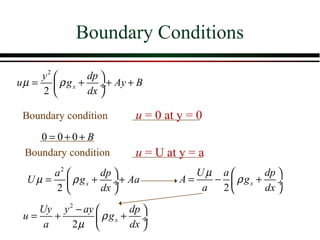
Boundary Conditions

     y2       dp 
u µ =  ρ g x + ÷+ Ay + B
     2        dx 

 Boundary condition      u = 0 at y = 0
    0 = 0+0+ B
 Boundary condition      u = U at y = a
       a2       dp                 Uµ a        dp 
  U µ =  ρ g x + ÷+ Aa           A=    −  ρ gx + ÷
       2        dx                  a  2       dx 

    Uy y 2 − ay        dp 
 u=    +         ρ gx + ÷
     a    2µ           dx 
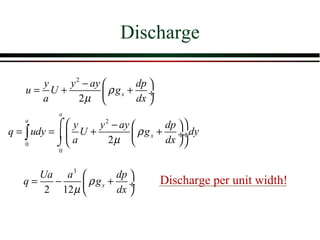
Discharge

      y   y 2 − ay        dp 
    u= U+           ρ gx + ÷
      a      2µ           dx 
           a
   a
            ⌠ y    y 2 − ay         dp  
q = ∫ udy =   U +           ρ g x + ÷÷dy
    0       ⌡ a       2µ            dx  
           0


      Ua a 3         dp 
   q=   −      ρ gx + ÷           Discharge per unit width!
       2 12 µ        dx 
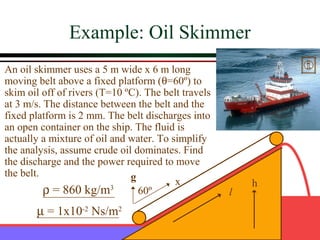
Example: Oil Skimmer
An oil skimmer uses a 5 m wide x 6 m long
moving belt above a fixed platform (θ=60º) to
skim oil off of rivers (T=10 ºC). The belt travels
at 3 m/s. The distance between the belt and the
fixed platform is 2 mm. The belt discharges into
an open container on the ship. The fluid is
actually a mixture of oil and water. To simplify
the analysis, assume crude oil dominates. Find
the discharge and the power required to move
the belt.                     g          x               h
          ρ = 860 kg/m    3
                                60º                  l
       µ = 1x10⁻² Ns/m2
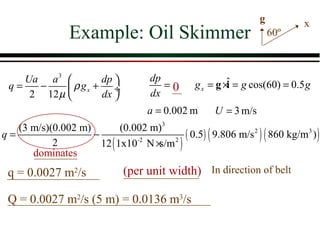
g          x
                Example: Oil Skimmer                                 60º


    Ua a 3         dp              dp
 q=   −      ρ gx + ÷                  =0      g x = g ׈ = g cos(60) = 0.5 g
                                                         i
     2 12 µ        dx              dx
                                    a = 0.002 m      U = 3 m/s
   (3 m/s)(0.002 m)         (0.002 m)3
q=                  −                     ( 0.5) ( 9.806 m/s 2 ) ( 860 kg/m3 ) )
           2          12 ( 1x10-2 N × 2 )
                                     s/m
      dominates
 q = 0.0027 m2/s              (per unit width) In direction of belt

 Q = 0.0027 m2/s (5 m) = 0.0136 m3/s
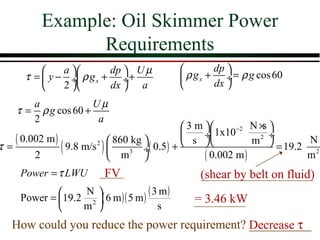
Example: Oil Skimmer Power
          Requirements
  How do we get the power requirement?
    ___________________________
     Power = Force x Velocity [N·m/s]
  What is the force acting on the belt?
     Shear force (τ·L · W)
      ___________________________
  Remember the equation for shear?
     τ=µ(du/dy)
    _____________          Evaluate at y = a.
  du             dp             Uµ a        dp 
µ    = y  ρ g x + ÷+ A       A=     −  ρ gx + ÷
  dy             dx              a  2       dx 
                  a       dp  U µ
         τ =  y − ÷ ρ g x + ÷+
                  2       dx  a
Example: Oil Skimmer Power
                Requirements
              a        dp  U µ                     dp 
      τ =  y − ÷ ρ g x + ÷+                   ρ g x + ÷ = ρ g cos 60
              2        dx  a                       dx 
       a             Uµ
    τ = ρ g cos 60 +
       2              a
                                           3 m       −2 N × 
                                                              s
   ( 0.002 m )                                 ÷ 1x10         ÷
                            860 kg                        m2          N
τ=
        2
               ( 9.8 m/s )  m3 ÷( 0.5) +
                        2

                                   
                                            s 
                                                ( 0.002 m )
                                                                  = 19.2 2
                                                                        m
     Power = τ LWU        FV                       (shear by belt on fluid)
             19.2 N ( 6 m )( 5 m ) ( 3 m )
     Power =       2                            = 3.46 kW
                 m                    s
   How could you reduce the power requirement? Decrease τ
                                               __________
Example: Oil Skimmer
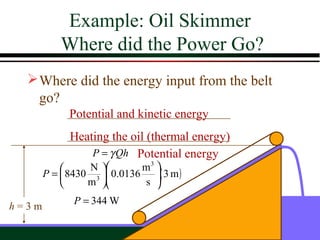
           Where did the Power Go?
   Where did the energy input from the belt
    go?
            Potential and kinetic energy
             Heating the oil (thermal energy)
                 P = γ Qh Potential energy
          8430 N  0.0136 m ( 3 m )
                             3
       P=          
                 3 
                               
              m          s 
              P = 344 W
h=3m
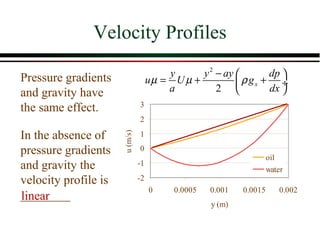
Velocity Profiles

Pressure gradients                       y      y 2 − ay        dp 
                                     uµ = U µ +           ρ gx + ÷
and gravity have                         a          2           dx 
                                3
the same effect.
                                2

In the absence of               1
                      u (m/s)

pressure gradients              0
                                                                     oil
and gravity the                 -1
                                                                     water
velocity profile is             -2
                                     0     0.0005   0.001   0.0015      0.002
________
linear
                                                    y (m)
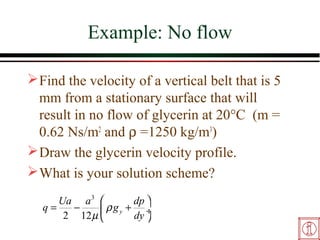
Example: No flow

 Find the velocity of a vertical belt that is 5
  mm from a stationary surface that will
  result in no flow of glycerin at 20°C (m =
  0.62 Ns/m2 and ρ =1250 kg/m3)
 Draw the glycerin velocity profile.
 What is your solution scheme?
     Ua a 3           dp 
  q=   −      ρ g y + dy ÷
      2 12 µ             
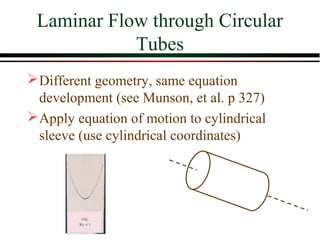
Laminar Flow through Circular
            Tubes
 Different geometry, same equation
  development (see Munson, et al. p 327)
 Apply equation of motion to cylindrical
  sleeve (use cylindrical coordinates)
Laminar Flow through Circular
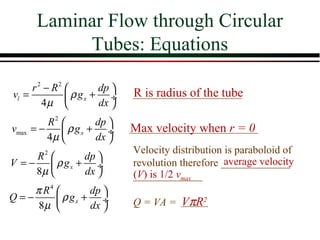
             Tubes: Equations

     r 2 − R2        dp 
vl =           ρ gx + ÷     R is radius of the tube
        4µ           dx 
          R2        dp 
vmax   =−     ρ gx + ÷      Max velocity when r = 0
          4µ        dx 
                             Velocity distribution is paraboloid of
     R2        dp 
V =−     ρ gx + ÷                                 average velocity
                             revolution therefore _____________
     8µ        dx          (V) is 1/2 vmax
                             _____________
    π R4        dp 
Q=−       ρ gx + ÷          Q = VA = VπR2
     8µ         dx 
Laminar Flow through Circular
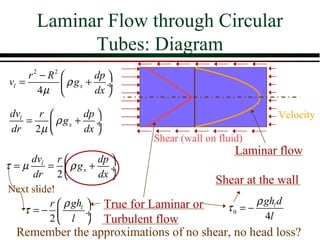
            Tubes: Diagram
     r 2 − R2        dp 
vl =           ρ gx + ÷
        4µ           dx 

dvl   r        dp                                          Velocity
    =    ρ gx + ÷
dr 2 µ         dx 
                               Shear (wall on fluid)
                                                  Laminar flow
      dvl r           dp 
τ =µ      =  ρ gx + ÷
      dr 2            dx 
                                             Shear at the wall
 Next slide!
           r  ρ ghl  True for Laminar or             ρ ghl d
    τ =−            ÷                          τ0 = −
           2  l  Turbulent flow                        4l
  Remember the approximations of no shear, no head loss?
Relationship between head loss
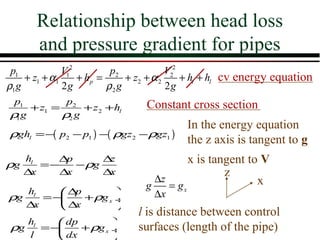
       and pressure gradient for pipes
 p1            V12         p2             V22
     + z1 + α1     + hp =      + z2 + α 2     + ht + hl cv energy equation
ρ1 g           2g         ρ2 g            2g
p1         p2                    Constant cross section
   + z1 =      + z 2 +hl
ρg
 1        ρ2 g
                                           In the energy equation
ρghl =−( p2 − p1 ) −( ρgz2 − ρgz1 )
                                           the z axis is tangent to g
ρg
   hl
      =−
         ∆p
            − ρg
                 ∆z                        x is tangent to V
   ∆x    ∆x      ∆x                                z
                                   ∆z                     x
                                 g    = gx
     hl   ∆p                     ∆x
ρg      =−   + ρg x ÷
     ∆x   ∆x        
                               l is distance between control
     hl    dp        
ρg      =−    + ρg x ÷        surfaces (length of the pipe)
     l     dx        
The Hagen-Poiseuille Equation
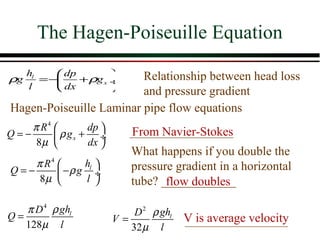
   hl    dp            Relationship between head loss
ρg    =−    + ρg x ÷
   l     dx            and pressure gradient
Hagen-Poiseuille Laminar pipe flow equations
    π R4        dp        From Navier-Stokes
Q=−       ρ gx + ÷
     8µ         dx 
                            What happens if you double the
    π R4       hl         pressure gradient in a horizontal
Q=−       −ρ g l ÷
     8µ                   tube? ____________
                                   flow doubles

   π D 4 ρ ghl              D 2 ρ ghl
Q=                      V=              V is average velocity
   128µ l                  32 µ l
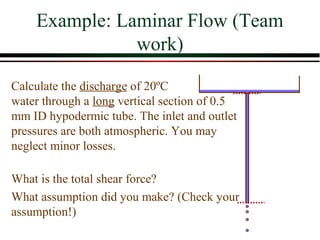
Example: Laminar Flow (Team
               work)

Calculate the discharge of 20ºC
water through a long vertical section of 0.5
mm ID hypodermic tube. The inlet and outlet
pressures are both atmospheric. You may
neglect minor losses.

What is the total shear force?
What assumption did you make? (Check your
assumption!)
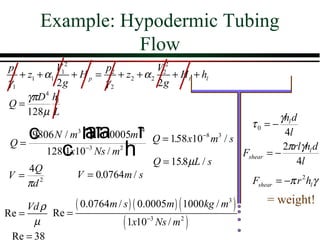
Example: Hypodermic Tubing
                   Flow
p1           V12        p2            V22
   + z1 + α1     + Hp =    + z2 + α 2     + H t + hl
γ1           2g         γ2            2g
     γπD 4 hl
Q=
     128µ L
                                                                        γhl d
                   afa             f
                                                                τ0 = −
    c              h
      9806 N / m3 π 0.0005m
                                   4
                                         Q = 158 x10−8 m3 / s
                                              .
                                                                         4l
 Q=
              c
          128 1x10⁻³ Ns / m2   h         Q = 158µL / s
                                                .
                                                              Fshear = −
                                                                         2πrlγhl d
                                                                             4l
  4Q
V= 2              V = 0.0764m / s
  πd                                                             Fshear = −π r 2 hl γ

     Vd ρ         ( 0.0764m / s ) ( 0.0005m ) ( 1000kg / m3 )        = weight!
Re =      Re =
      µ                        ( 1x10   −3
                                             Ns / m 2 )
 Re = 38
Summary

 Navier-Stokes Equations and the Continuity
  Equation describe complex flow including
  turbulence
 The Navier-Stokes Equations can be solved
  analytically for several simple flows
 Numerical solutions are required to describe
  turbulent flows
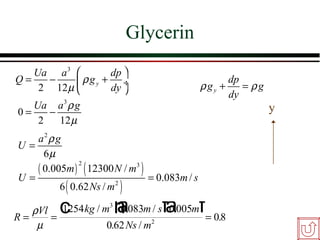
Glycerin
   Ua a 3           dp 
Q=   −      ρ g y + dy ÷
    2 12 µ                                   ρgy +
                                                    dp
                                                       = ρg
                                                   dy
   Ua a 3 ρ g                                                 y
0=    −
    2   12 µ
   a2 ρ g
U=
     6µ
   ( 0.005m ) ( 12300 N / m3 )
               2

U=                             = 0.083m / s
         6 ( 0.62 Ns / m )
                        2


   ρVl c kg / m h.083m / sfa005mf
                a    3
        1254     0         0.
R=    =                           = 0.8
    µ                0.62 Ns / m2

Basic differential equations in fluid mechanics

  • 1.
    Overview  Continuity Equation Navier-Stokes Equation (a bit of vector notation...)  Examples (all laminar flow) Flow between stationary parallel horizontal plates Flow between inclined parallel plates Pipe flow (Hagen Poiseuille)
  • 2.
    Why Differential Equations? A droplet of water  Clouds  Wall jet  Hurricane
  • 3.
    Conservation of Massin Differential Equation Form F+ ∂ρ δyIF+ ∂v δyIδxδz G ∂y Jv ∂y J G K H K ρ H Mass flux out of differential volume ∂ρ Rate of change of mass in δyδxδz δy ∂t differential volume δz δx ρvδxδz Mass flux into differential volume
  • 4.
    Continuity Equation Massflux out of differential volume Fv + ρ ∂v δy + v ∂ρ δy + ∂v ∂ρ δy Iδxδz G ∂y ∂y ∂y ∂y J H ρ K Higher order term 2 out in Rate of mass decrease Fv + ρ ∂v δy + v ∂ρ δyIδxδz − ρvδxδz = − ∂ρ δyδxδz G ∂y ∂y J H ρ K ∂t ∂v ∂ρ ∂ρ ρ +v =− ∂y ∂y ∂t ∂ρv ∂ρ + =0 1-d continuity equation ∂y ∂t
  • 5.
    Continuity Equation af af a f ∂ ρ ∂ ρu ∂ ρv ∂ ρw + + + =0 3-d continuity equation ∂t ∂x ∂y ∂z divergence ∂ρ u, v, w are + ∇ ×ρ V = 0 Vector notation velocities in x, y, ∂t and z directions If density is constant... ∂u ∂v ∂w + + =0 or in vector notation ∇ ×V = 0 ∂x ∂y ∂z True everywhere! (contrast with CV equations!)
  • 6.
    Continuity Illustrated ∂u ∂v ∂w y + + =0 ∂x ∂y ∂z What must be happening? ∂v ∂u <0 ∴ >0 ∂y ∂x x
  • 7.
    Navier-Stokes Equations  Derivedby Claude-Louis-Marie Navier in 1827  General Equation of Fluid Motion momentum  Based on conservation of ___________ with forces… Gravity  ____________ Pressure  ___________________ Shear  ___________________  U.S. National Academy of Sciences has made the full solution of the Navier-Stokes Equations a top priority
  • 8.
    Navier-Stokes Equations V ρa= ∑ F Navier-Stokes Equation ρ a + ρ g = −∇p + µ∇ V 2 g is constant ρ a = − ( ∇p + ρ g ) + µ∇ 2 V a is a function of t, x, y, z ρa = Inertial forces [N/m3], a is Lagrangian acceleration Is acceleration zero when ∂V/ ∂ t = 0? NO! − ( ∇p + ρ g ) = Pressure gradient (not due to change in elevation) ∇p + ρ g ≠ 0 V ≠0 If _________ then _____ du µ∇ V = Shear stress gradient 2 τ =µ τ = µ∇V dx
  • 9.
    Notation: Total Derivative Eulerian Perspective Dα ∂α dt ∂α dx ∂α dy ∂α dz Total derivative (t , x, y, z ) = + + + Dt ∂t dt ∂x dt ∂y dt ∂z dt (chain rule) Dα ∂α ∂α ∂α ∂α Material or (t , x, y, z ) = +u +v +w Dt ∂t ∂x ∂y ∂z substantial derivative DV ∂V ∂V ∂V ∂V (t , x, y, z ) = +u +v +w Dt ∂t ∂x ∂y ∂z Lagrangian acceleration ∂V ∂V ∂V ∂V ∂ () ∂ () ∂ () a= +u +v +w ∇() = i+ j+ k ∂t ∂x ∂y ∂z ∂x ∂y ∂z ∂V ∂ () ∂ () ∂ () a= +V× V ∇ ( V ×∇ ) () = u + v + w ∂t ∂x ∂y ∂z
  • 10.
    Application of Navier-Stokes Equations  The equations are nonlinear partial differential equations  No full analytical solution exists  The equations can be solved for several simple flow conditions  Numerical solutions to Navier-Stokes equations are increasingly being used to describe complex flows.
  • 11.
    Navier-Stokes Equations: A Simple Case  No acceleration and no velocity gradients ρ a = − ( ∇p + ρ g ) + µ∇ 2 V 0 = − ( ∇p + ρ g ) ∇p = − ρ g xyz could have any orientation −ρg ∂p ∂p ∂p = −ρ gx = −ρ g y = − ρ g z Let y be vertical upward ∂x ∂y ∂z ∂p ∂p ∂p Component of g in the x,y,z direction =0 = −ρ g =0 ∂x ∂y ∂z p = − ρ gy + C For constant ρ
  • 12.
    Infinite Horizontal Plates: Laminar Flow Derive the equation for the laminar, steady, uniform flow between infinite horizontal parallel plates. y ρ a = − ( ∇p + ρ g ) + µ∇ 2 V 0 = − ( ∇p + ρ g ) + µ∇ 2 V x ∂p  ∂ 2u ∂ 2u ∂ 2u  ∂p  ∂ 2u  x 0 = − − ρ gx + µ  2 + 2 + 2 ÷ 0 = − +µ 2 ÷ ∂x  ∂x ∂y ∂z  ∂x  ∂y  v=0 Hydrostatic in y ∂p ∂ v ∂ v ∂ v 2 2 2 y 0 = − − ρ gy + µ  2 + 2 + 2 ÷ ∂p ∂y  ∂x ∂y ∂z  0 = − − ρg w=0 ∂y ∂p  ∂2w ∂2w ∂2w  z 0 = − − ρ gz + µ  2 + 2 + 2 ÷ 0=0 ∂z  ∂x ∂y ∂z 
  • 13.
    Infinite Horizontal Plates: Laminar Flow ∂p  ∂ 2u  du 0 = − +µ 2 ÷ τ =µ ∂x  ∂y  dy dp  d 2u  dτ Pressure gradient in x balanced by = µ  2 ÷= dx  dy  dy shear gradient in y No a so forces must balance! ⌠  2   du  ⌠ dp  µ d u dy dp   dy =   2 ÷ y + A = µ ÷=τ ⌡ dx ⌡  dy   dx  dy  ⌠ ⌠  du  dp  y 2 dp  y  + A dy =  µ  ÷  dy + Ay + B = µ u ⌡ dx  ⌡  dy  2 dx Now we must find A and B… Boundary Conditions
  • 14.
    Infinite Horizontal Plates: Boundary Conditions y No slip condition u = 0 at y = 0 and y = a a τ u y 2 dp x + Ay + B = µ u dp 2 dx let negative be___________ dx B=0 What can we learn about τ? a 2 dp − a dp  du  dp + Aa = 0 A= µ  ÷= y + A 2 dx 2 dx  dy  dx y ( y − a ) dp  a  dp u= τ =y− ÷ 2µ dx  2  dx
  • 15.
    Laminar Flow BetweenParallel Plates y a U ρ a = − ρ g − ∇p + µ∇ 2 V x u 0 = − ρ g − ∇p + µ∇ V 2 No fluid particles are accelerating θ ∂p  ∂ 2u ∂ 2u ∂ 2u  0 = −ρ gx − + µ  2 + 2 + 2 ÷ Write the x-component ∂x  ∂x ∂y ∂z  ∂p  ∂ 2u  0 = −ρ gx − + µ  2 ÷ ∂x  ∂y 
  • 16.
    Flow between ParallelPlates ∂p  ∂ 2u  0 = −ρ gx − + µ  2 ÷ u is only a function of y ∂x  ∂y  dp  d 2u  0 = −ρ gx − +µ 2 ÷ g x = g ׈ i dx  dy   d 2u  dp General equation describing laminar µ  2 ÷= ρ gx + flow between parallel plates with the  dy  dx only velocity in the x direction
  • 17.
    Flow Between ParallelPlates: Integration 2 y d u dp a U µ = ρ gx + dy 2 dx x ⌠ d u 2 ⌠ dp   µ 2 dy =   ρ g x + ÷dy u ⌡ dy ⌡ dx  du  dp  θ µ = y  ρ g x + ÷+ A = τ dy  dx  ⌠ du ⌠  dp    µ dy =   y  ρ g x + ÷+ A ÷dy ⌡ dy ⌡  dx   y2  dp  µ u =  ρ g x + ÷+ Ay + B 2  dx 
  • 18.
    Boundary Conditions y2  dp  u µ =  ρ g x + ÷+ Ay + B 2  dx  Boundary condition u = 0 at y = 0 0 = 0+0+ B Boundary condition u = U at y = a a2  dp  Uµ a  dp  U µ =  ρ g x + ÷+ Aa A= −  ρ gx + ÷ 2 dx  a 2 dx  Uy y 2 − ay  dp  u= +  ρ gx + ÷ a 2µ  dx 
  • 19.
    Discharge y y 2 − ay  dp  u= U+  ρ gx + ÷ a 2µ  dx  a a ⌠ y y 2 − ay  dp   q = ∫ udy =   U +  ρ g x + ÷÷dy 0 ⌡ a 2µ  dx   0 Ua a 3  dp  q= −  ρ gx + ÷ Discharge per unit width! 2 12 µ  dx 
  • 20.
    Example: Oil Skimmer Anoil skimmer uses a 5 m wide x 6 m long moving belt above a fixed platform (θ=60º) to skim oil off of rivers (T=10 ºC). The belt travels at 3 m/s. The distance between the belt and the fixed platform is 2 mm. The belt discharges into an open container on the ship. The fluid is actually a mixture of oil and water. To simplify the analysis, assume crude oil dominates. Find the discharge and the power required to move the belt. g x h ρ = 860 kg/m 3 60º l µ = 1x10⁻² Ns/m2
  • 21.
    g x Example: Oil Skimmer 60º Ua a 3  dp  dp q= −  ρ gx + ÷ =0 g x = g ׈ = g cos(60) = 0.5 g i 2 12 µ  dx  dx a = 0.002 m U = 3 m/s (3 m/s)(0.002 m) (0.002 m)3 q= − ( 0.5) ( 9.806 m/s 2 ) ( 860 kg/m3 ) ) 2 12 ( 1x10-2 N × 2 ) s/m dominates q = 0.0027 m2/s (per unit width) In direction of belt Q = 0.0027 m2/s (5 m) = 0.0136 m3/s
  • 22.
    Example: Oil SkimmerPower Requirements  How do we get the power requirement? ___________________________ Power = Force x Velocity [N·m/s]  What is the force acting on the belt?  Shear force (τ·L · W) ___________________________  Remember the equation for shear? τ=µ(du/dy) _____________ Evaluate at y = a. du  dp  Uµ a  dp  µ = y  ρ g x + ÷+ A A= −  ρ gx + ÷ dy  dx  a 2 dx   a  dp  U µ τ =  y − ÷ ρ g x + ÷+  2  dx  a
  • 23.
    Example: Oil SkimmerPower Requirements  a  dp  U µ  dp  τ =  y − ÷ ρ g x + ÷+  ρ g x + ÷ = ρ g cos 60  2  dx  a  dx  a Uµ τ = ρ g cos 60 + 2 a  3 m  −2 N ×  s ( 0.002 m )  ÷ 1x10 ÷  860 kg  m2  N τ= 2 ( 9.8 m/s )  m3 ÷( 0.5) + 2    s  ( 0.002 m ) = 19.2 2 m Power = τ LWU FV (shear by belt on fluid) 19.2 N ( 6 m )( 5 m ) ( 3 m ) Power =  2 = 3.46 kW  m  s How could you reduce the power requirement? Decrease τ __________
  • 24.
    Example: Oil Skimmer Where did the Power Go?  Where did the energy input from the belt go? Potential and kinetic energy Heating the oil (thermal energy) P = γ Qh Potential energy  8430 N  0.0136 m ( 3 m ) 3 P=  3    m  s  P = 344 W h=3m
  • 25.
    Velocity Profiles Pressure gradients y y 2 − ay  dp  uµ = U µ +  ρ gx + ÷ and gravity have a 2  dx  3 the same effect. 2 In the absence of 1 u (m/s) pressure gradients 0 oil and gravity the -1 water velocity profile is -2 0 0.0005 0.001 0.0015 0.002 ________ linear y (m)
  • 26.
    Example: No flow Find the velocity of a vertical belt that is 5 mm from a stationary surface that will result in no flow of glycerin at 20°C (m = 0.62 Ns/m2 and ρ =1250 kg/m3)  Draw the glycerin velocity profile.  What is your solution scheme? Ua a 3  dp  q= −  ρ g y + dy ÷ 2 12 µ  
  • 27.
    Laminar Flow throughCircular Tubes  Different geometry, same equation development (see Munson, et al. p 327)  Apply equation of motion to cylindrical sleeve (use cylindrical coordinates)
  • 28.
    Laminar Flow throughCircular Tubes: Equations r 2 − R2  dp  vl =  ρ gx + ÷ R is radius of the tube 4µ  dx  R2  dp  vmax =−  ρ gx + ÷ Max velocity when r = 0 4µ  dx  Velocity distribution is paraboloid of R2  dp  V =−  ρ gx + ÷ average velocity revolution therefore _____________ 8µ  dx  (V) is 1/2 vmax _____________ π R4  dp  Q=−  ρ gx + ÷ Q = VA = VπR2 8µ  dx 
  • 29.
    Laminar Flow throughCircular Tubes: Diagram r 2 − R2  dp  vl =  ρ gx + ÷ 4µ  dx  dvl r  dp  Velocity =  ρ gx + ÷ dr 2 µ  dx  Shear (wall on fluid) Laminar flow dvl r  dp  τ =µ =  ρ gx + ÷ dr 2  dx  Shear at the wall Next slide! r  ρ ghl  True for Laminar or ρ ghl d τ =−  ÷ τ0 = − 2  l  Turbulent flow 4l Remember the approximations of no shear, no head loss?
  • 30.
    Relationship between headloss and pressure gradient for pipes p1 V12 p2 V22 + z1 + α1 + hp = + z2 + α 2 + ht + hl cv energy equation ρ1 g 2g ρ2 g 2g p1 p2 Constant cross section + z1 = + z 2 +hl ρg 1 ρ2 g In the energy equation ρghl =−( p2 − p1 ) −( ρgz2 − ρgz1 ) the z axis is tangent to g ρg hl =− ∆p − ρg ∆z x is tangent to V ∆x ∆x ∆x z ∆z x g = gx hl ∆p  ∆x ρg =− + ρg x ÷ ∆x ∆x  l is distance between control hl  dp  ρg =− + ρg x ÷ surfaces (length of the pipe) l  dx 
  • 31.
    The Hagen-Poiseuille Equation hl  dp  Relationship between head loss ρg =− + ρg x ÷ l  dx  and pressure gradient Hagen-Poiseuille Laminar pipe flow equations π R4  dp  From Navier-Stokes Q=−  ρ gx + ÷ 8µ  dx  What happens if you double the π R4  hl  pressure gradient in a horizontal Q=−  −ρ g l ÷ 8µ   tube? ____________ flow doubles π D 4 ρ ghl D 2 ρ ghl Q= V= V is average velocity 128µ l 32 µ l
  • 32.
    Example: Laminar Flow(Team work) Calculate the discharge of 20ºC water through a long vertical section of 0.5 mm ID hypodermic tube. The inlet and outlet pressures are both atmospheric. You may neglect minor losses. What is the total shear force? What assumption did you make? (Check your assumption!)
  • 33.
    Example: Hypodermic Tubing Flow p1 V12 p2 V22 + z1 + α1 + Hp = + z2 + α 2 + H t + hl γ1 2g γ2 2g γπD 4 hl Q= 128µ L γhl d afa f τ0 = − c h 9806 N / m3 π 0.0005m 4 Q = 158 x10−8 m3 / s . 4l Q= c 128 1x10⁻³ Ns / m2 h Q = 158µL / s . Fshear = − 2πrlγhl d 4l 4Q V= 2 V = 0.0764m / s πd Fshear = −π r 2 hl γ Vd ρ ( 0.0764m / s ) ( 0.0005m ) ( 1000kg / m3 ) = weight! Re = Re = µ ( 1x10 −3 Ns / m 2 ) Re = 38
  • 34.
    Summary  Navier-Stokes Equationsand the Continuity Equation describe complex flow including turbulence  The Navier-Stokes Equations can be solved analytically for several simple flows  Numerical solutions are required to describe turbulent flows
  • 35.
    Glycerin Ua a 3  dp  Q= −  ρ g y + dy ÷ 2 12 µ  ρgy + dp = ρg  dy Ua a 3 ρ g y 0= − 2 12 µ a2 ρ g U= 6µ ( 0.005m ) ( 12300 N / m3 ) 2 U= = 0.083m / s 6 ( 0.62 Ns / m ) 2 ρVl c kg / m h.083m / sfa005mf a 3 1254 0 0. R= = = 0.8 µ 0.62 Ns / m2