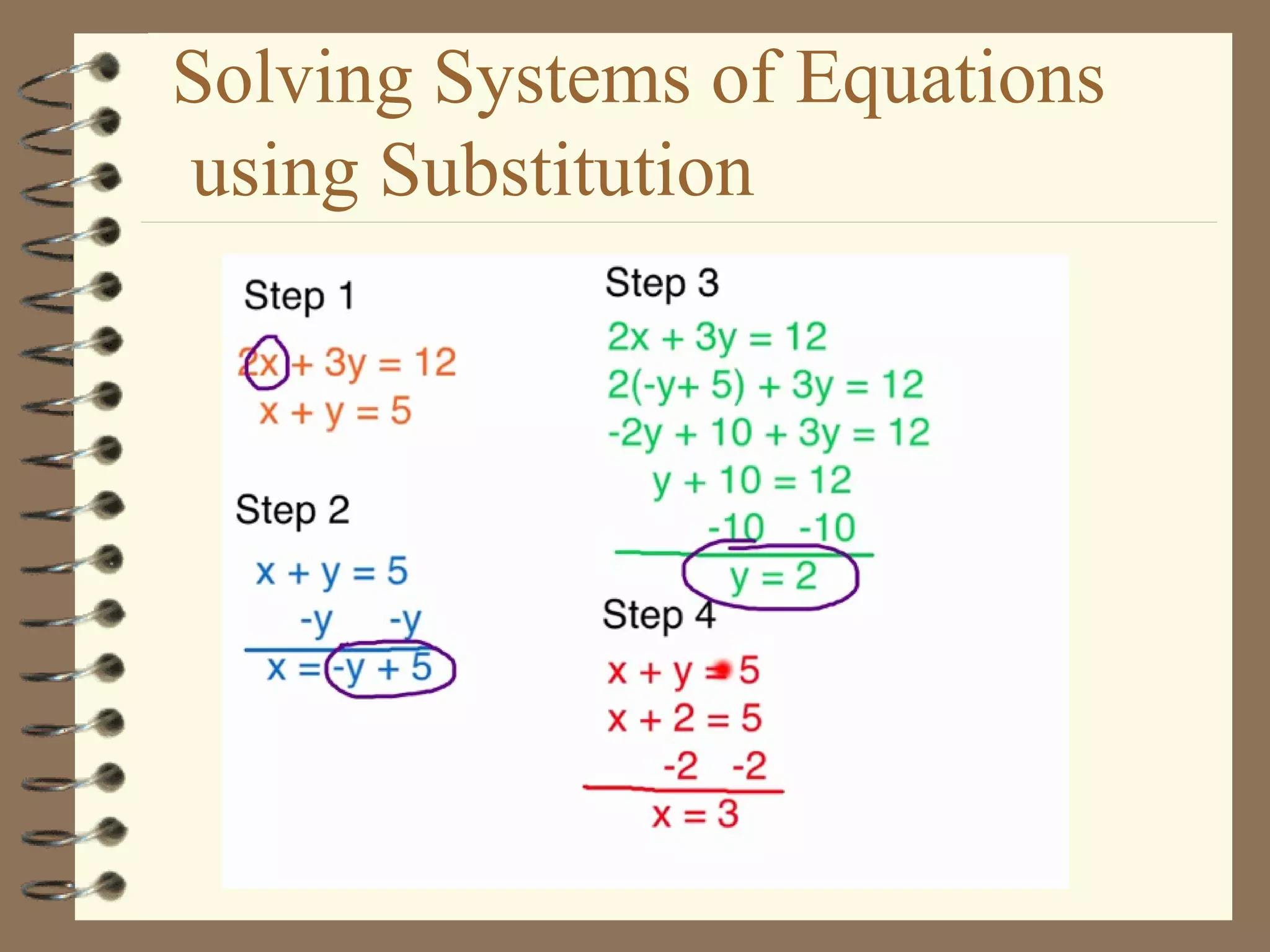
Solving Systems of Equations
using Substitution
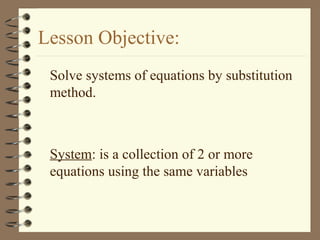
Lesson Objective:
Solve systems of equations by substitution
method.
System: is a collection of 2 or more
equations using the same variables
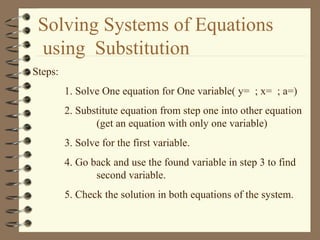
Solving Systems of Equations
using Substitution
Steps:
1. Solve One equation for One variable( y= ; x= ; a=)
2. Substitute equation from step one into other equation
(get an equation with only one variable)
3. Solve for the first variable.
4. Go back and use the found variable in step 3 to find
second variable.
5. Check the solution in both equations of the system.
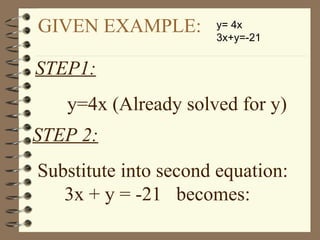
GIVEN EXAMPLE: y= 4x
3x+y=-21
STEP1:
y=4x (Already solved for y)
STEP 2:
Substitute into second equation:
3x + y = -21 becomes:
GIVEN EXAMPLE: y= 4x
3x+y=-21
STEP1:
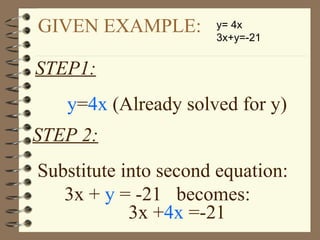
y=4x (Already solved for y)
STEP 2:
Substitute into second equation:
3x + y = -21 becomes:
3x +4x =-21
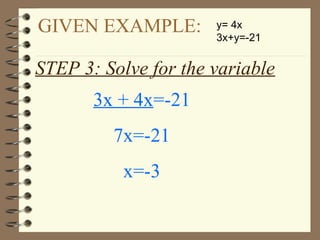
GIVEN EXAMPLE: y= 4x
3x+y=-21
3x + 4x=-21
7x=-21
x=-3
STEP 3: Solve for the variable
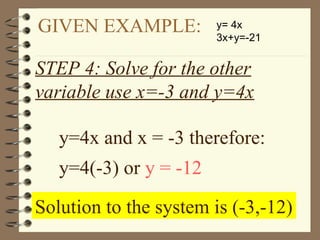
GIVEN EXAMPLE: y= 4x
3x+y=-21
STEP 4: Solve for the other
variable use x=-3 and y=4x
y=4x and x = -3 therefore:
y=4(-3) or y = -12
Solution to the system is (-3,-12)
GIVEN EXAMPLE: y= 4x
3x+y=-21
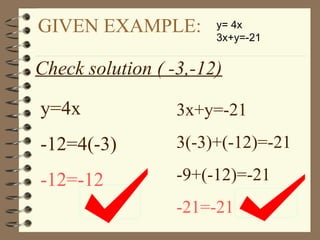
Check solution ( -3,-12)
y=4x
-12=4(-3)
-12=-12
3x+y=-21
3(-3)+(-12)=-21
-9+(-12)=-21
-21=-21
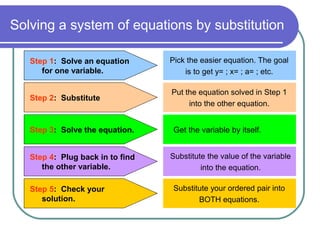
Solving a system of equations by substitution
Step 1: Solve an equation
for one variable.
Step 2: Substitute
Step 3: Solve the equation.
Step 4: Plug back in to find
the other variable.
Step 5: Check your
solution.
Pick the easier equation. The goal
is to get y= ; x= ; a= ; etc.
Put the equation solved in Step 1
into the other equation.
Get the variable by itself.
Substitute the value of the variable
into the equation.
Substitute your ordered pair into
BOTH equations.
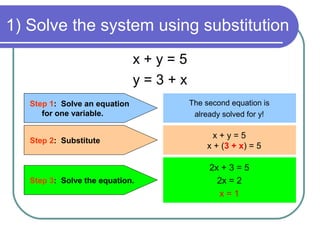
1) Solve the system using substitution
x + y = 5
y = 3 + x
Step 1: Solve an equation
for one variable.
Step 2: Substitute
The second equation is
already solved for y!
x + y = 5
x + (3 + x) = 5
Step 3: Solve the equation.
2x + 3 = 5
2x = 2
x = 1
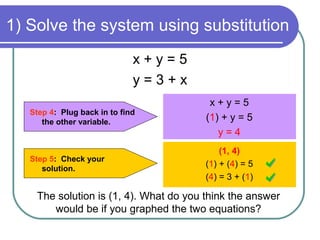
1) Solve the system using substitution
x + y = 5
y = 3 + x
Step 4: Plug back in to find
the other variable.
x + y = 5
(1) + y = 5
y = 4
Step 5: Check your
solution.
(1, 4)
(1) + (4) = 5
(4) = 3 + (1)
The solution is (1, 4). What do you think the answer
would be if you graphed the two equations?
Which answer checks correctly?
3x – y = 4
x = 4y - 17
1. (2, 2)
2. (5, 3)
3. (3, 5)
4. (3, -5)
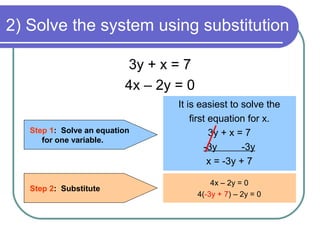
2) Solve the system using substitution
3y + x = 7
4x – 2y = 0
Step 1: Solve an equation
for one variable.
Step 2: Substitute
It is easiest to solve the
first equation for x.
3y + x = 7
-3y -3y
x = -3y + 7
4x – 2y = 0
4(-3y + 7) – 2y = 0
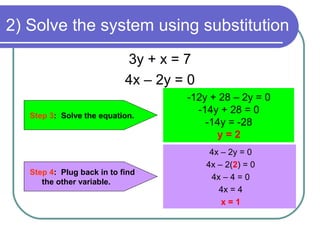
2) Solve the system using substitution
3y + x = 7
4x – 2y = 0
Step 4: Plug back in to find
the other variable.
4x – 2y = 0
4x – 2(2) = 0
4x – 4 = 0
4x = 4
x = 1
Step 3: Solve the equation.
-12y + 28 – 2y = 0
-14y + 28 = 0
-14y = -28
y = 2
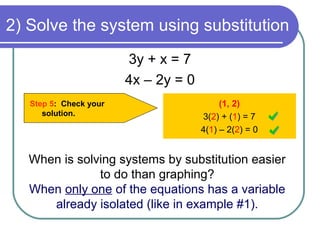
2) Solve the system using substitution
3y + x = 7
4x – 2y = 0
Step 5: Check your
solution.
(1, 2)
3(2) + (1) = 7
4(1) – 2(2) = 0
When is solving systems by substitution easier
to do than graphing?
When only one of the equations has a variable
already isolated (like in example #1).
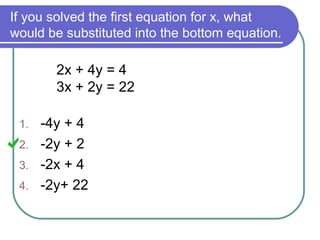
If you solved the first equation for x, what
would be substituted into the bottom equation.
2x + 4y = 4
3x + 2y = 22
1. -4y + 4
2. -2y + 2
3. -2x + 4
4. -2y+ 22
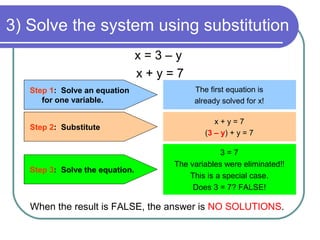
3) Solve the system using substitution
x = 3 – y
x + y = 7
Step 1: Solve an equation
for one variable.
Step 2: Substitute
The first equation is
already solved for x!
x + y = 7
(3 – y) + y = 7
Step 3: Solve the equation.
3 = 7
The variables were eliminated!!
This is a special case.
Does 3 = 7? FALSE!
When the result is FALSE, the answer is NO SOLUTIONS.
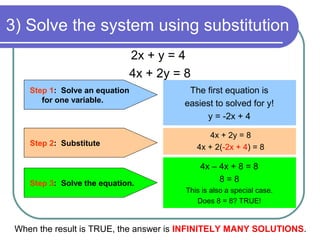
3) Solve the system using substitution
2x + y = 4
4x + 2y = 8
Step 1: Solve an equation
for one variable.
Step 2: Substitute
The first equation is
easiest to solved for y!
y = -2x + 4
4x + 2y = 8
4x + 2(-2x + 4) = 8
Step 3: Solve the equation.
4x – 4x + 8 = 8
8 = 8
This is also a special case.
Does 8 = 8? TRUE!
When the result is TRUE, the answer is INFINITELY MANY SOLUTIONS.

Solving Systems by Substitution

  • 1.
    Solving Systems ofEquations using Substitution
  • 2.
    Lesson Objective: Solve systemsof equations by substitution method. System: is a collection of 2 or more equations using the same variables
  • 3.
    Solving Systems ofEquations using Substitution Steps: 1. Solve One equation for One variable( y= ; x= ; a=) 2. Substitute equation from step one into other equation (get an equation with only one variable) 3. Solve for the first variable. 4. Go back and use the found variable in step 3 to find second variable. 5. Check the solution in both equations of the system.
  • 4.
    GIVEN EXAMPLE: y=4x 3x+y=-21 STEP1: y=4x (Already solved for y) STEP 2: Substitute into second equation: 3x + y = -21 becomes:
  • 5.
    GIVEN EXAMPLE: y=4x 3x+y=-21 STEP1: y=4x (Already solved for y) STEP 2: Substitute into second equation: 3x + y = -21 becomes: 3x +4x =-21
  • 6.
    GIVEN EXAMPLE: y=4x 3x+y=-21 3x + 4x=-21 7x=-21 x=-3 STEP 3: Solve for the variable
  • 7.
    GIVEN EXAMPLE: y=4x 3x+y=-21 STEP 4: Solve for the other variable use x=-3 and y=4x y=4x and x = -3 therefore: y=4(-3) or y = -12 Solution to the system is (-3,-12)
  • 8.
    GIVEN EXAMPLE: y=4x 3x+y=-21 Check solution ( -3,-12) y=4x -12=4(-3) -12=-12 3x+y=-21 3(-3)+(-12)=-21 -9+(-12)=-21 -21=-21
  • 9.
    Solving a systemof equations by substitution Step 1: Solve an equation for one variable. Step 2: Substitute Step 3: Solve the equation. Step 4: Plug back in to find the other variable. Step 5: Check your solution. Pick the easier equation. The goal is to get y= ; x= ; a= ; etc. Put the equation solved in Step 1 into the other equation. Get the variable by itself. Substitute the value of the variable into the equation. Substitute your ordered pair into BOTH equations.
  • 10.
    1) Solve thesystem using substitution x + y = 5 y = 3 + x Step 1: Solve an equation for one variable. Step 2: Substitute The second equation is already solved for y! x + y = 5 x + (3 + x) = 5 Step 3: Solve the equation. 2x + 3 = 5 2x = 2 x = 1
  • 11.
    1) Solve thesystem using substitution x + y = 5 y = 3 + x Step 4: Plug back in to find the other variable. x + y = 5 (1) + y = 5 y = 4 Step 5: Check your solution. (1, 4) (1) + (4) = 5 (4) = 3 + (1) The solution is (1, 4). What do you think the answer would be if you graphed the two equations?
  • 12.
    Which answer checkscorrectly? 3x – y = 4 x = 4y - 17 1. (2, 2) 2. (5, 3) 3. (3, 5) 4. (3, -5)
  • 13.
    2) Solve thesystem using substitution 3y + x = 7 4x – 2y = 0 Step 1: Solve an equation for one variable. Step 2: Substitute It is easiest to solve the first equation for x. 3y + x = 7 -3y -3y x = -3y + 7 4x – 2y = 0 4(-3y + 7) – 2y = 0
  • 14.
    2) Solve thesystem using substitution 3y + x = 7 4x – 2y = 0 Step 4: Plug back in to find the other variable. 4x – 2y = 0 4x – 2(2) = 0 4x – 4 = 0 4x = 4 x = 1 Step 3: Solve the equation. -12y + 28 – 2y = 0 -14y + 28 = 0 -14y = -28 y = 2
  • 15.
    2) Solve thesystem using substitution 3y + x = 7 4x – 2y = 0 Step 5: Check your solution. (1, 2) 3(2) + (1) = 7 4(1) – 2(2) = 0 When is solving systems by substitution easier to do than graphing? When only one of the equations has a variable already isolated (like in example #1).
  • 16.
    If you solvedthe first equation for x, what would be substituted into the bottom equation. 2x + 4y = 4 3x + 2y = 22 1. -4y + 4 2. -2y + 2 3. -2x + 4 4. -2y+ 22
  • 17.
    3) Solve thesystem using substitution x = 3 – y x + y = 7 Step 1: Solve an equation for one variable. Step 2: Substitute The first equation is already solved for x! x + y = 7 (3 – y) + y = 7 Step 3: Solve the equation. 3 = 7 The variables were eliminated!! This is a special case. Does 3 = 7? FALSE! When the result is FALSE, the answer is NO SOLUTIONS.
  • 18.
    3) Solve thesystem using substitution 2x + y = 4 4x + 2y = 8 Step 1: Solve an equation for one variable. Step 2: Substitute The first equation is easiest to solved for y! y = -2x + 4 4x + 2y = 8 4x + 2(-2x + 4) = 8 Step 3: Solve the equation. 4x – 4x + 8 = 8 8 = 8 This is also a special case. Does 8 = 8? TRUE! When the result is TRUE, the answer is INFINITELY MANY SOLUTIONS.