
Social Network
Theory and
Analysis
(…in 14 Easy
Slides with
The A Team)
Susan Fant
www.susanfant.com / www.castlesandsllc.com
/ www.fernweb.org
These Slides are for Educational Purposes Only – The University of Alabama Marketing Department
MKT597: Digital & Social Media Marketing Fall Semester 2013 (Image: Facebook Data Science)
Social Network Theory
• Two types of network theory (we will analyze)
include: tie formation and social capital
• These theories relate to becoming an
“influencer” which is the future of marketing
and advertising’s recommendation culture
• If you understand network theory, you’ll
understand the premise behind social network
platforms (places) like Facebook, LinkedIn.
Patterns & Relations: Silicon Valley
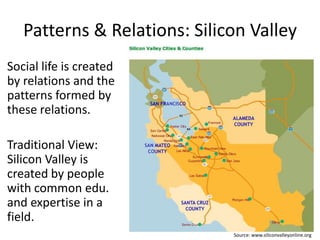
Social life is created
by relations and the
patterns formed by
these relations.
Traditional View:
Silicon Valley is
created by people
with common edu.
and expertise in a
field.
Source: www.siliconvalleyonline.org
Social Network Theory’s Viewpoint
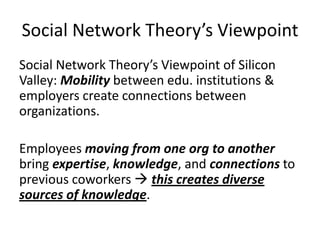
Social Network Theory’s Viewpoint of Silicon
Valley: Mobility between edu. institutions &
employers create connections between
organizations.
Employees moving from one org to another
bring expertise, knowledge, and connections to
previous coworkers  this creates diverse
sources of knowledge.
Three Approaches to Networks
People in networks share common
attributes: co-members, kinship etc.
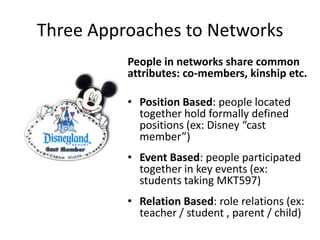
• Position Based: people located
together hold formally defined
positions (ex: Disney “cast
member”)
• Event Based: people participated
together in key events (ex:
students taking MKT597)
• Relation Based: role relations (ex:
teacher / student , parent / child)
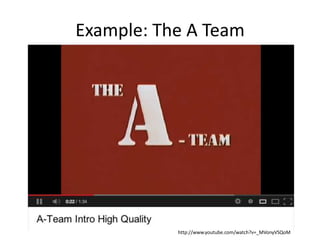
Example: The A Team
http://www.youtube.com/watch?v=_MVonyVSQoM
I Pity the Fool
(who doesn’t understand social network theory)
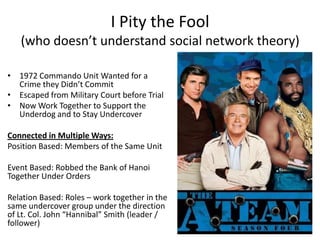
• 1972 Commando Unit Wanted for a
Crime they Didn’t Commit
• Escaped from Military Court before Trial
• Now Work Together to Support the
Underdog and to Stay Undercover
Connected in Multiple Ways:
Position Based: Members of the Same Unit
Event Based: Robbed the Bank of Hanoi
Together Under Orders
Relation Based: Roles – work together in the
same undercover group under the direction
of Lt. Col. John “Hannibal” Smith (leader /
follower)
Social Network Analysis
• Social Network Analysis requires an
understanding of how independent people
relate to each other, how people affect each
other’s views and how they interact together.
Examples: spending patterns, the economy,
perceptions, opportunities, technology, joining
clubs or organizations
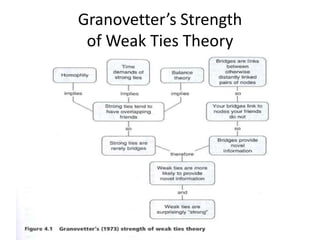
Granovetter’s Strength
of Weak Ties Theory
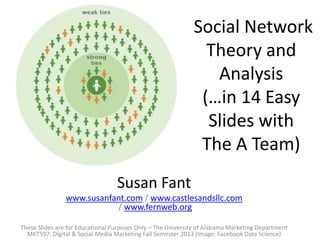
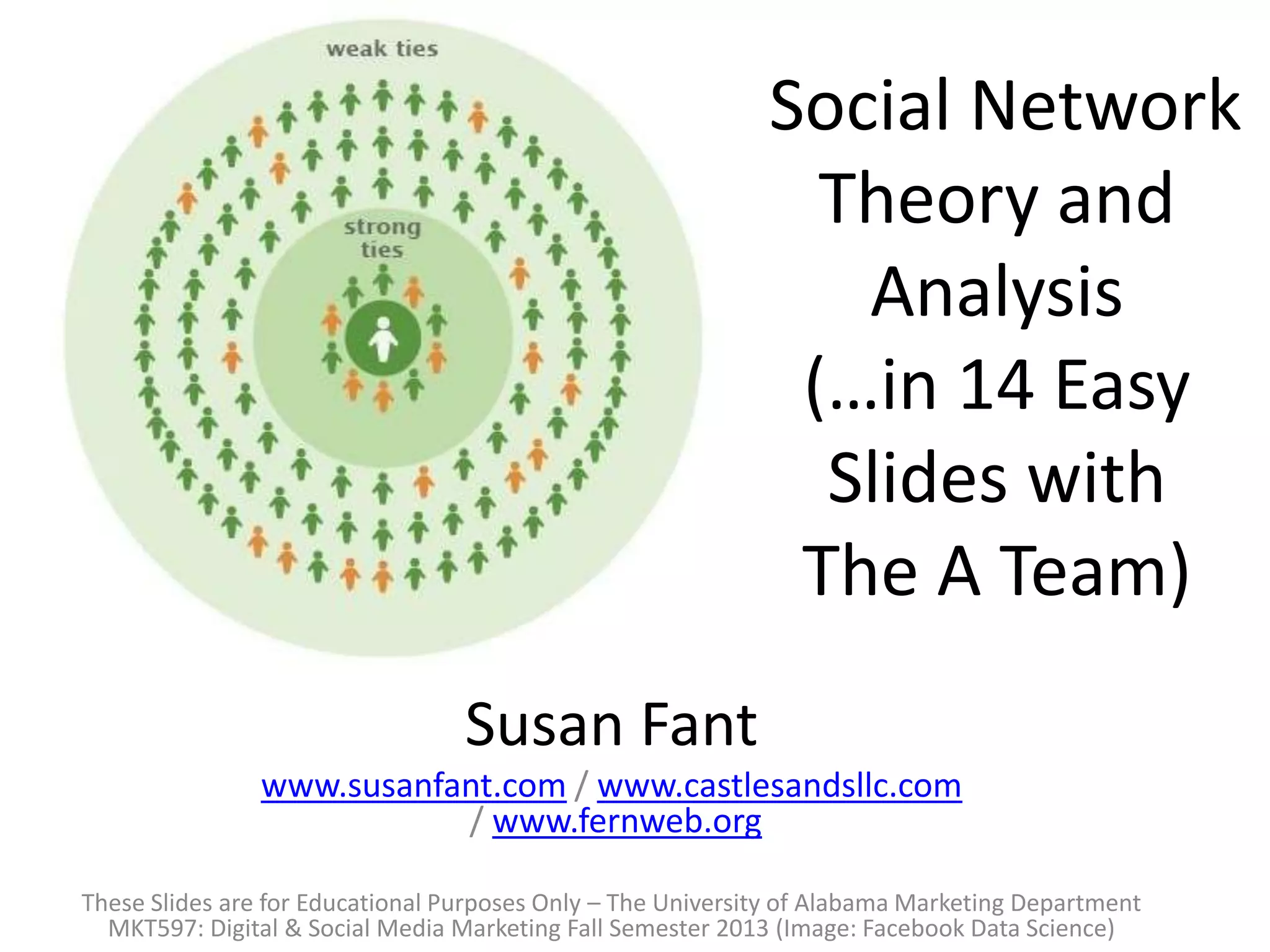
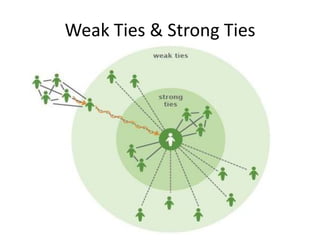
Weak Ties & Strong Ties
To Get a Job, Get in the Industry
• The idea around social networks and clusters is to
get a job in a field, start hanging out around
people in that field.
• People get jobs through acquaintances.
– Join institutional clubs, organizations
– Go to conferences
– Meet people both online and offline
• Individual Social Capital: people with
more weak ties are more successful 
they receive more novel information.
What is Novel Information?
You’re looking for information
from people you interact with
infrequently.
Novel Information = new
ideas, highlighting new
products, and discussing
current events.
Online social network
platforms may increase the
spread of novel information.
Facebook & Social Network Theory
• People are more likely to share information from
their strong ties, but because they have more weak
ties – weak tie information is shared more often.
• Information on Facebook is more diverse and novel.
If your weak tie friend shares a company’s status,
picture etc. you’re more likely to see it on your
newsfeed.
• The Bottom Line (for companies): Companies can
access a follower’s weak ties to disseminate
information to attract new followers and “likes.”
Questions?

Social Network Theory & Analysis

  • 1.
    Social Network Theory and Analysis (…in14 Easy Slides with The A Team) Susan Fant www.susanfant.com / www.castlesandsllc.com / www.fernweb.org These Slides are for Educational Purposes Only – The University of Alabama Marketing Department MKT597: Digital & Social Media Marketing Fall Semester 2013 (Image: Facebook Data Science)
  • 2.
    Social Network Theory •Two types of network theory (we will analyze) include: tie formation and social capital • These theories relate to becoming an “influencer” which is the future of marketing and advertising’s recommendation culture • If you understand network theory, you’ll understand the premise behind social network platforms (places) like Facebook, LinkedIn.
  • 3.
    Patterns & Relations:Silicon Valley Social life is created by relations and the patterns formed by these relations. Traditional View: Silicon Valley is created by people with common edu. and expertise in a field. Source: www.siliconvalleyonline.org
  • 4.
    Social Network Theory’sViewpoint Social Network Theory’s Viewpoint of Silicon Valley: Mobility between edu. institutions & employers create connections between organizations. Employees moving from one org to another bring expertise, knowledge, and connections to previous coworkers  this creates diverse sources of knowledge.
  • 5.
    Three Approaches toNetworks People in networks share common attributes: co-members, kinship etc. • Position Based: people located together hold formally defined positions (ex: Disney “cast member”) • Event Based: people participated together in key events (ex: students taking MKT597) • Relation Based: role relations (ex: teacher / student , parent / child)
  • 6.
    Example: The ATeam http://www.youtube.com/watch?v=_MVonyVSQoM
  • 7.
    I Pity theFool (who doesn’t understand social network theory) • 1972 Commando Unit Wanted for a Crime they Didn’t Commit • Escaped from Military Court before Trial • Now Work Together to Support the Underdog and to Stay Undercover Connected in Multiple Ways: Position Based: Members of the Same Unit Event Based: Robbed the Bank of Hanoi Together Under Orders Relation Based: Roles – work together in the same undercover group under the direction of Lt. Col. John “Hannibal” Smith (leader / follower)
  • 8.
    Social Network Analysis •Social Network Analysis requires an understanding of how independent people relate to each other, how people affect each other’s views and how they interact together. Examples: spending patterns, the economy, perceptions, opportunities, technology, joining clubs or organizations
  • 9.
  • 10.
    Weak Ties &Strong Ties
  • 11.
    To Get aJob, Get in the Industry • The idea around social networks and clusters is to get a job in a field, start hanging out around people in that field. • People get jobs through acquaintances. – Join institutional clubs, organizations – Go to conferences – Meet people both online and offline • Individual Social Capital: people with more weak ties are more successful  they receive more novel information.
  • 12.
    What is NovelInformation? You’re looking for information from people you interact with infrequently. Novel Information = new ideas, highlighting new products, and discussing current events. Online social network platforms may increase the spread of novel information.
  • 13.
    Facebook & SocialNetwork Theory • People are more likely to share information from their strong ties, but because they have more weak ties – weak tie information is shared more often. • Information on Facebook is more diverse and novel. If your weak tie friend shares a company’s status, picture etc. you’re more likely to see it on your newsfeed. • The Bottom Line (for companies): Companies can access a follower’s weak ties to disseminate information to attract new followers and “likes.”
  • 14.