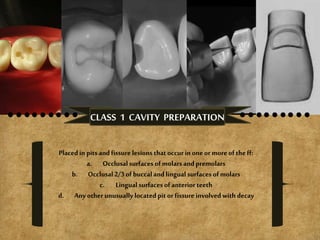
CLASS 1 CAVITY PREPARATION
Placedinpits andfissure lesions thatoccurinoneor moreof theff:
a. Occlusalsurfacesof molarsandpremolars
b. Occlusal2/3of buccalandlingualsurfaces ofmolars
c. Lingualsurfacesof anterior teeth
d. Anyother unusuallylocatedpit or fissure involved with decay
COMMON FEATURES
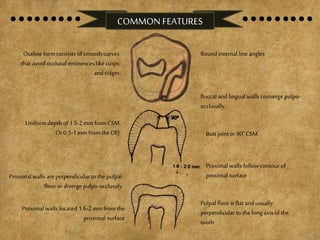
Outline form consists of smooth curves
that avoid occlusal eminenceslikecusps
and ridges
Uniformdepth of 1.5-2mmfrom CSM
Or 0.5-1mm from theDEJ
Proximal walls are perpendicularto the pulpal
floor or diverge pulpo-occlusaly
Proximal walls located 1.6-2mm from the
proximal surface
Roundinternal lineangles
Buccal and lingual walls converge pulpo-
occlusally
Butt joint or 90˚CSM
Proximal walls follow contourof
proximal surface
Pulpal floor is flat and usually
perpendicular to the long axis of the
tooth
DESIGN 1
PROCEDURE
Bucco-lingualcross-section Mesio-distalcross-section
InternalAnatomy
DESIGN 1
Maxillarypremolar
“dumb-bell”-shaped
Mandibular 1st premolar
Circular,resembling snake
eyes
Mandibular 1st premolar
“dumb-bell”-shaped
Mandibular 2ndpremolar
Y-shaped
Mandibular 1st molar
Elongated
Mandibular 2ndmolar
Elongated
Maxillarymolar
Elongated
Maxillarymolar
Mesial “kidney” shaped
Distal “heart” shaped
LOCATION:
Occlusal surfaces of
molars & premolars
INDICATIONS:
•caries penetration into
dentin does not exceed
0.5mm-1mm
•involvement of
enamel or pits and
fissures will not widen
more than ¼intercuspal
distance
•good oral hygiene&
low caries index
•Areas of mouthwith
low cariogenic activity
DESIGN 2
LOCATION:
Occlusal surfaces of
molars & premolars
INDICATIONS:
•caries cone in dentin
extend 1 mmor more
from DEJ
•preparation
involvement is more
than ¼ ICD
•as preventive measure
inpatients with high
plaque &caries index
•for teeth with intact
cusps
Shapes similar to design 1 but thereare
more deviations from shapes and less
curvedoutlineand greater surface
dimensions
Margins similar to design 1 but
closer to cusp tips and crests of
ridges
Bucco-lingualcross-section
Pulpal floor may have
different levels
If cavity margins are
located in occlusal 1/3of
inclined planes of cusps,
the buccal and lingualwalls
will havetwo planes
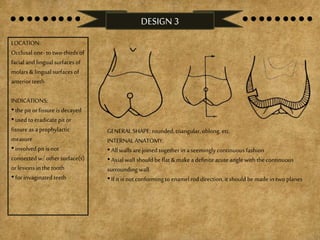
DESIGN 3
LOCATION:
Occlusal one-to two-thirds of
facial and lingual surfaces of
molars & lingual surfaces of
anterior teeth
INDICATIONS:
•the pit orfissure is decayed
•used to eradicate pit or
fissure as a prophylactic
measure
•involved pit is not
connected w/ other surface(s)
or lesions inthe tooth
•for invaginated teeth
GENERALSHAPE: rounded, triangular,oblong, etc.
INTERNALANATOMY:
•All walls are joined together in a seemingly continuous fashion
•Axial wall should be flat &makea definite acuteangle with the continuous
surroundingwall
•If it is not conformingto enamelrod direction, it should bemade intwo planes
DESIGN 4
LOCATION:
Occlusal surfaces of molars
and grooved part of their
facial/lingual surface
INDICATIONS:
•caries lesions at
facial/lingual pits are
connected to the occlusal
surface
•decay undermines
facial/lingual marginal
ridges
•cariescones confined to
the concavity of their
grooves
•cusps not underminedby
backward decay
GENERALSHAPE:
same with design 1 &2
facial/lingual part -parallelogram
INTERNALANATOMY
Mesio-distal cross-section
Bucco-lingualcross-section
DESIGN 5
LOCATION:
Occlusal and facial and/or
lingual surfaces of molars
INDICATIONS:
•facial/lingual cusps
underminedby backward
decay
•outline is not conducive
to retention of restoration
•caries cones in dentin
exceed 1 mmfrom DEJ
•foundation for cast
restoration is needed
GENERALSHAPE:
same with design 2
facial/lingual part – parallelogram (larger)
INTERNALANATOMY
Mesio-distal cross-section
Bucco-lingualcross-section
DESIGN 6
LOCATION:
Occlusal surfaces of molars &premolars as well as portion of facial, proximal or lingualsurface in theform of a “table” of
an entirecusp ora section of a cusp
INDICATIONS:
•Portions or an entirecusp underminedby backward decay
•cariesleaves a cusp with a length-width ratio of 3:1infunctional cuspor 4:1innon-functionalcusp, and thereis no
interruption in the continuityof surroundingwalls
•caries leaves a cusp with a length-width ratio of 3:1 infunctional cusp or 4:1 innon-functionalcusp, and there is
interruption in the continuityof surroundingwalls
•marginalridge is crossed by a fissure to facial/lingual embrasures
•foundation for a futurecast restoration is needed
•Class I occlusal lesion is continuous with a Class VIlesion
DESIGN 7
LOCATION:
Occlusal, facial,and/orlingual surfacesof molars& premolars
INDICATIONS:
•class1lesions withextensivecariousinvolvement
•Placementof internalboxesin thefloorofpreparationis
impossible.
•Pin/Post-RetainedRestoration
DESIGN 8
LOCATION:
Occlusal surfaces of molars &premolars, sometimes lingualsurface of anterior teeth
INDICATIONS:
•for endodontically treated teeth
FOR AMALGAM
CAVITYPREPARATIONs

Cavity preparation class 1

  • 1.
    CLASS 1 CAVITYPREPARATION Placedinpits andfissure lesions thatoccurinoneor moreof theff: a. Occlusalsurfacesof molarsandpremolars b. Occlusal2/3of buccalandlingualsurfaces ofmolars c. Lingualsurfacesof anterior teeth d. Anyother unusuallylocatedpit or fissure involved with decay
  • 2.
    COMMON FEATURES Outline formconsists of smooth curves that avoid occlusal eminenceslikecusps and ridges Uniformdepth of 1.5-2mmfrom CSM Or 0.5-1mm from theDEJ Proximal walls are perpendicularto the pulpal floor or diverge pulpo-occlusaly Proximal walls located 1.6-2mm from the proximal surface Roundinternal lineangles Buccal and lingual walls converge pulpo- occlusally Butt joint or 90˚CSM Proximal walls follow contourof proximal surface Pulpal floor is flat and usually perpendicular to the long axis of the tooth
  • 3.
  • 4.
    DESIGN 1 Maxillarypremolar “dumb-bell”-shaped Mandibular 1stpremolar Circular,resembling snake eyes Mandibular 1st premolar “dumb-bell”-shaped Mandibular 2ndpremolar Y-shaped Mandibular 1st molar Elongated Mandibular 2ndmolar Elongated Maxillarymolar Elongated Maxillarymolar Mesial “kidney” shaped Distal “heart” shaped LOCATION: Occlusal surfaces of molars & premolars INDICATIONS: •caries penetration into dentin does not exceed 0.5mm-1mm •involvement of enamel or pits and fissures will not widen more than ¼intercuspal distance •good oral hygiene& low caries index •Areas of mouthwith low cariogenic activity
  • 5.
    DESIGN 2 LOCATION: Occlusal surfacesof molars & premolars INDICATIONS: •caries cone in dentin extend 1 mmor more from DEJ •preparation involvement is more than ¼ ICD •as preventive measure inpatients with high plaque &caries index •for teeth with intact cusps Shapes similar to design 1 but thereare more deviations from shapes and less curvedoutlineand greater surface dimensions Margins similar to design 1 but closer to cusp tips and crests of ridges Bucco-lingualcross-section Pulpal floor may have different levels If cavity margins are located in occlusal 1/3of inclined planes of cusps, the buccal and lingualwalls will havetwo planes
  • 6.
    DESIGN 3 LOCATION: Occlusal one-totwo-thirds of facial and lingual surfaces of molars & lingual surfaces of anterior teeth INDICATIONS: •the pit orfissure is decayed •used to eradicate pit or fissure as a prophylactic measure •involved pit is not connected w/ other surface(s) or lesions inthe tooth •for invaginated teeth GENERALSHAPE: rounded, triangular,oblong, etc. INTERNALANATOMY: •All walls are joined together in a seemingly continuous fashion •Axial wall should be flat &makea definite acuteangle with the continuous surroundingwall •If it is not conformingto enamelrod direction, it should bemade intwo planes
  • 7.
    DESIGN 4 LOCATION: Occlusal surfacesof molars and grooved part of their facial/lingual surface INDICATIONS: •caries lesions at facial/lingual pits are connected to the occlusal surface •decay undermines facial/lingual marginal ridges •cariescones confined to the concavity of their grooves •cusps not underminedby backward decay GENERALSHAPE: same with design 1 &2 facial/lingual part -parallelogram INTERNALANATOMY Mesio-distal cross-section Bucco-lingualcross-section
  • 8.
    DESIGN 5 LOCATION: Occlusal andfacial and/or lingual surfaces of molars INDICATIONS: •facial/lingual cusps underminedby backward decay •outline is not conducive to retention of restoration •caries cones in dentin exceed 1 mmfrom DEJ •foundation for cast restoration is needed GENERALSHAPE: same with design 2 facial/lingual part – parallelogram (larger) INTERNALANATOMY Mesio-distal cross-section Bucco-lingualcross-section
  • 9.
    DESIGN 6 LOCATION: Occlusal surfacesof molars &premolars as well as portion of facial, proximal or lingualsurface in theform of a “table” of an entirecusp ora section of a cusp INDICATIONS: •Portions or an entirecusp underminedby backward decay •cariesleaves a cusp with a length-width ratio of 3:1infunctional cuspor 4:1innon-functionalcusp, and thereis no interruption in the continuityof surroundingwalls •caries leaves a cusp with a length-width ratio of 3:1 infunctional cusp or 4:1 innon-functionalcusp, and there is interruption in the continuityof surroundingwalls •marginalridge is crossed by a fissure to facial/lingual embrasures •foundation for a futurecast restoration is needed •Class I occlusal lesion is continuous with a Class VIlesion
  • 10.
    DESIGN 7 LOCATION: Occlusal, facial,and/orlingualsurfacesof molars& premolars INDICATIONS: •class1lesions withextensivecariousinvolvement •Placementof internalboxesin thefloorofpreparationis impossible. •Pin/Post-RetainedRestoration
  • 11.
    DESIGN 8 LOCATION: Occlusal surfacesof molars &premolars, sometimes lingualsurface of anterior teeth INDICATIONS: •for endodontically treated teeth
  • 12.