PRESENTED BY:
Ms. Sahoo Sumita Gopal
Quality Assurance Techniques
semester II
GUIDED BY:
Prof. Arun Maruti Kashid
Pharmaceutical Chemistry
Sinhgad Technical Education Society,
Sinhgad Institute Of Pharmacy, Narhe,pune.
Process validation of Solid Dosage form
(Anti- Tuberculosis)
1
OUTLINE
INTRODUCTION
STAGES OF PROCESS VALIDATION
PLAN OF WORK
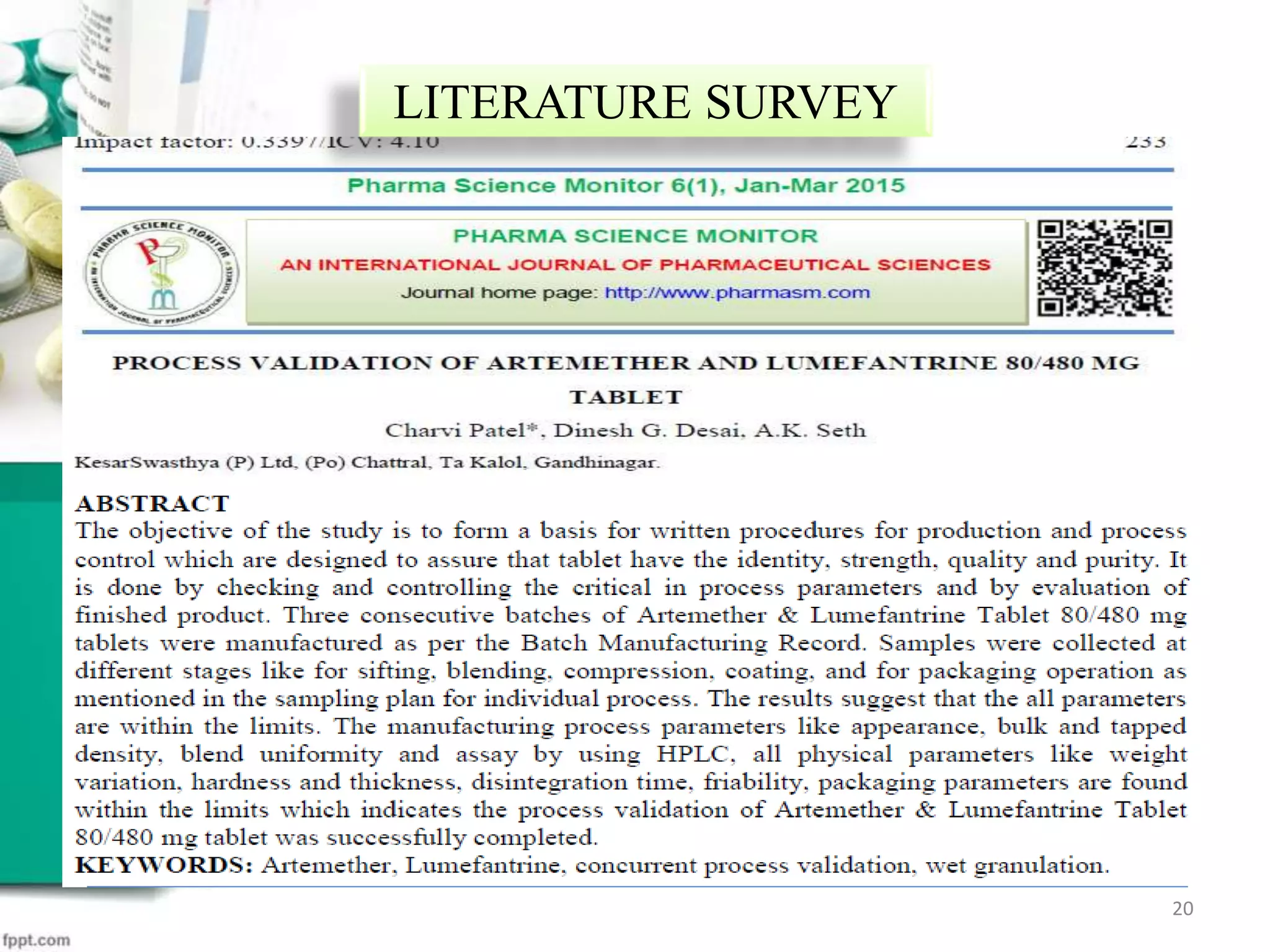
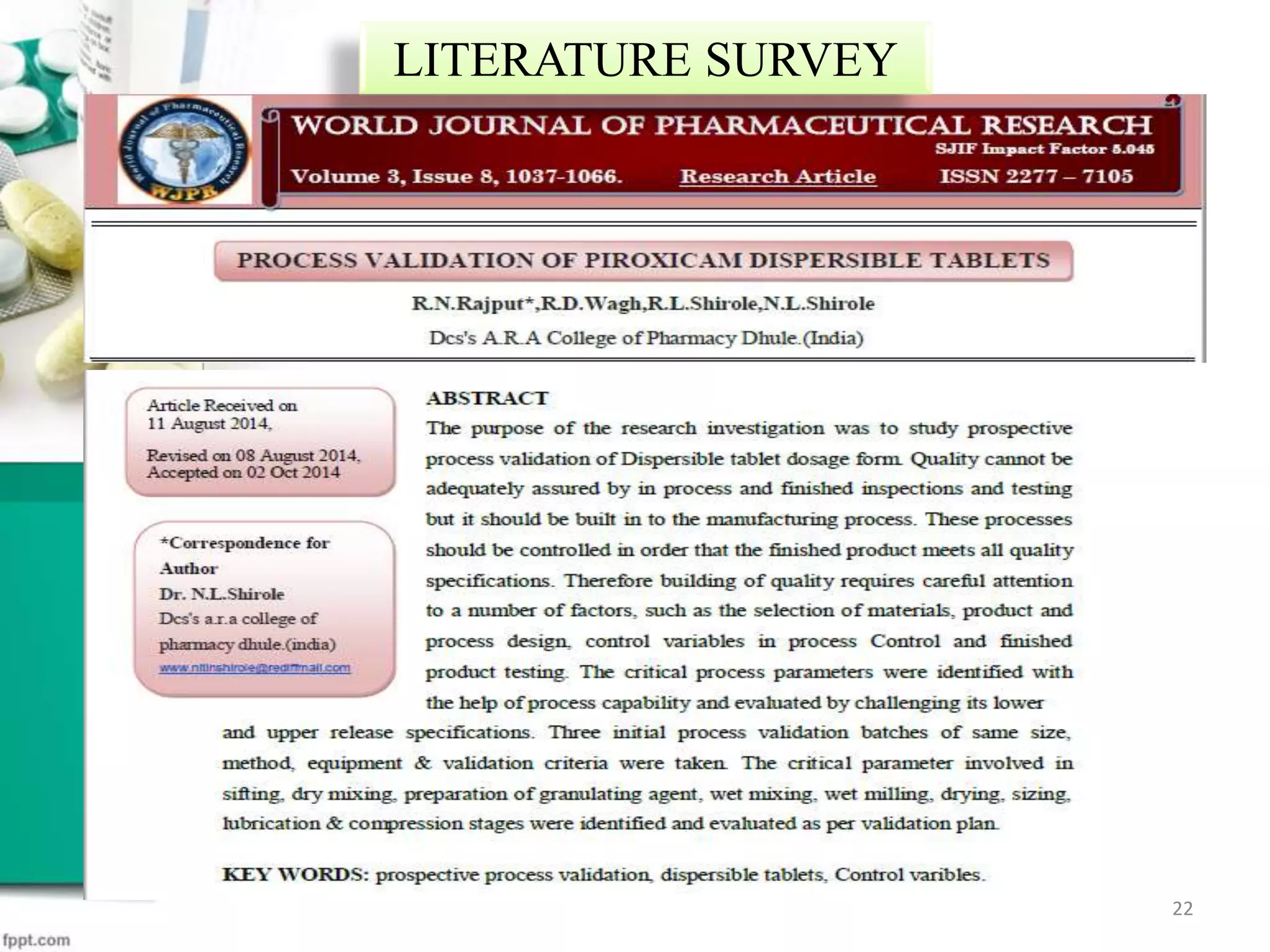
LITERATURE SURVEY
KEY REFERENCES
2
• Do I have confidence in my manufacturing
process? Or more specifically what scientific
evidence assure me that my process is
capable of consistently delivering quality
product?
• How do I demonstrated that my process
works as intended?
• How do I know my process remain in
control?
3
What Is Process Validation ??
4
Reason of
Process
Validation
Change in
manufacturing site
Change in batch
size
Change in
Equipment
Change in Process
Specification
Change in
Composition and
Component
Change in critical
Control Parameter
Change in trend of
OOT and OOS in
consecutive
5
Process validation is
intended to establish that
the proposed
manufacturing process is
suitable one and yield
consistently a product of
a desired quality
To reduce risk to safety
via the highest assurance
of acceptable and
consistent quality of the
product and its
components
i.e. That the process is
suitable and under control
Purpose of Process Validation
6
Validation conducted
prior to the
distribution of either
a new product or a
product made under a
revised
manufacturing
process
A process where
current production
batches are used to
monitor processing
parameter
Retrospective
validation is the
validation of a process
based on accumulated
historical data
PROSPECTIVE
VALIDATION
CONCURRENT
VALIDATION
RETROSPECTIVE
VALIDATION
TYPES OF PROCESS VALIDATION (1984 USFDA) [4]
7
8
Continuous
process
verification
Continuous
Process
Verification
[1]
INTENT TYPICAL ACTIVITIES
 To define the commercial process
on knowledge gained through
development and scale up
activities .
 The outcome is the design of a
process suitable for routine
manufacture that will consistently
deliver product that meets its
critical quality attributes
 A combination of product and
process design (quality by design)
 Product development activities
 Experiment to determine process
parameters, variability, and
necessary controls
 Risk assessments
 Other activities required to define
the commercial process
 Design of experiment testing
STAGE 1: PROCESS DESIGN [1]
9
 To confirm the process design as
capable of reproducibility
 Commercial manufacturing
 Facilities design
 Equipment and utilities
qualification
 Performance qualification (PQ)
 Strong emphasis on the use of
statistical analysis of process data
to understand process consistency
and performance.
INTENT TYPICAL ACTIVITIES
STAGE 2 : PROCESS QUALIFICATION [1]
10
Installation
Qualification
Establish by objective evidence that all key
aspect of the process equipment and ancillary
system are adhere to manufacturing
specification
Operational
Qualification
Establish by objective evidence process control
limit and the action levels which result in
product that all predetermine requirement
Performance
Qualification
Establish by objective evidence that the process
,under anticipated conditions, consistently
produces product which meets all predetermine
requirement
STAGE 2: PROCESS QUALIFICATION [4]
11
 To provide ongoing assurance that
the process remains in the state of
control during routine production
through procedure
 Continuous improvement
initiatives
 Proceduralised data collection
from every batch
 Data trending and statistical
analysis
 Product review
 Equipment and facilities
maintenance
 Calibration
 Improvement initiatives through
process experience
INTENT TYPICAL ACTIVITIES
STAGE 3:CONTINUED PROCESS VERIFICATION [1]
12
STAGE 1
PROCESS DESIGN
STAGE 2
PROCESS QUALIFICATION
(PQ)
DESIGN OF
FACILITIES &
QUALIFICATION
OF EQUIPMENT
AND UTILITIES
PROCESS
PERFORMANCE
QUALIFICATION
(PQR)
EVALUATE/ CONFIRM
STAGE 3
CONTINUED PROCESS VERIFICATION
(CPV)DISTRIBUTE
Three model of process validation according to FDA guidance for
industry [5]
distribute
13
14
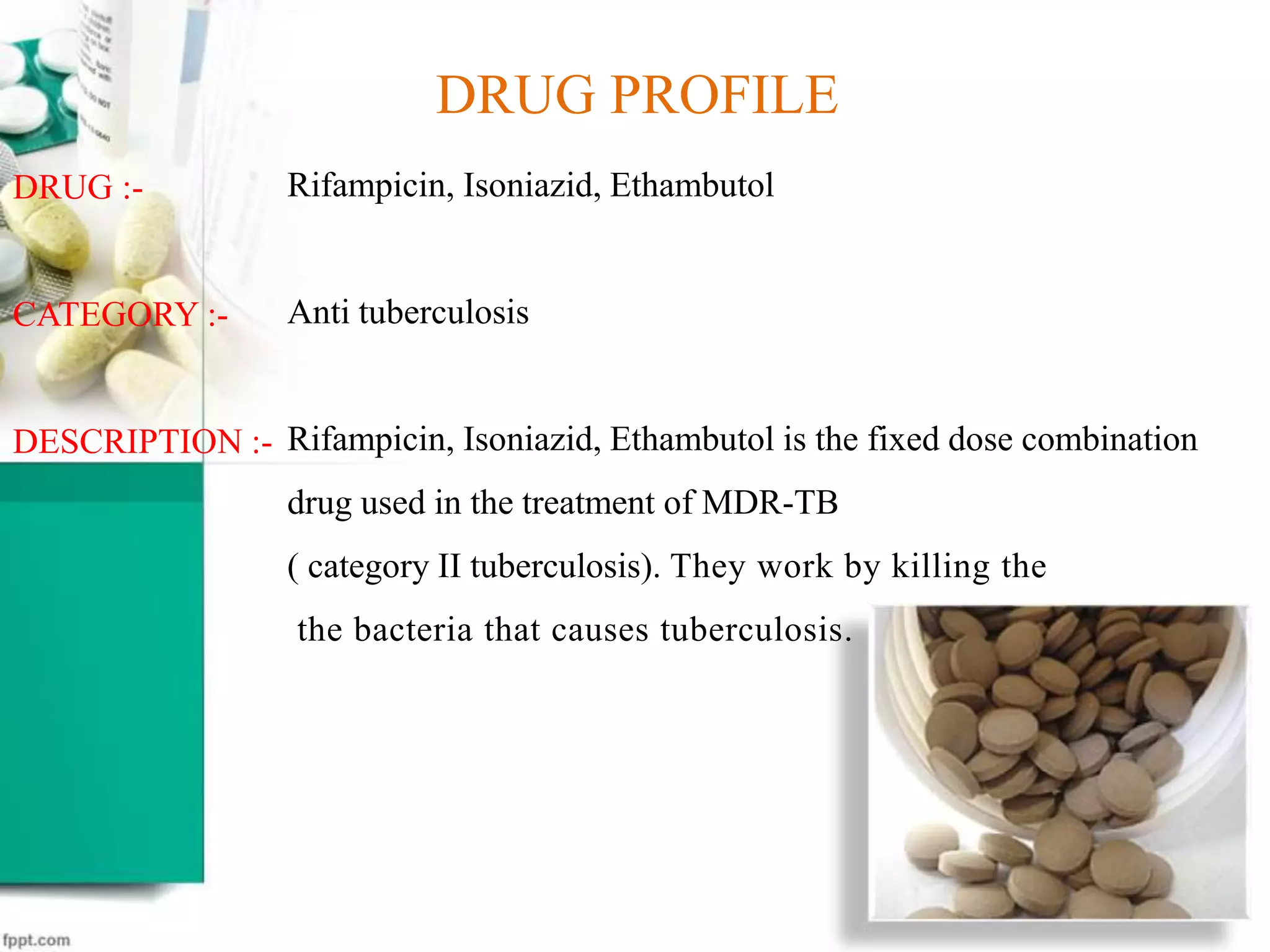
Rifampicin, Isoniazid, Ethambutol
Anti tuberculosis
Rifampicin, Isoniazid, Ethambutol is the fixed dose combination
drug used in the treatment of MDR-TB
( category II tuberculosis). They work by killing the
the bacteria that causes tuberculosis.
DRUG PROFILE
DRUG :-
CATEGORY :-
DESCRIPTION :-
15
PARAMETER DESCRIPTION
IUPAC NAME
(7S,9E,11S,12R,13S,14R,15R,16R,17S,18S,19E,21Z)-
2,15,17,27,29-pentahydroxy-11-methoxy-3,7,12,14,16,18,22-
heptamethyl-26-[(1E)-[(4-methylpiperazin-1-yl)imino]methyl]-
6,23-dioxo-8,30-dioxa-24-
azatetracyclo[23.3.1.1⁴,⁷.0⁵,²⁸]triaconta-1(29),2,4,9,19,21,25,27-
octaen-13-yl acetate
MOLECULAR WEIGHT 822.9402
MOLECULAR FORMULA C43H58N4O12
MECHANISM OF ACTION
Rifampin acts via the inhibition of DNA-dependent RNA
polymerase, leading to a suppression of RNA synthesis and cell
death.
RIFAMPICIN :-
16
PARAMETER DESCRIPTION
IUPAC NAME pyridine-4-carbohydrazide
MOLECULAR WEIGHT 137.1393
MOLECULAR FORMULA C6H7N3O
MECHANISM OF ACTION Isoniazid kills actively growing tubercle bacilli by inhibiting
the biosynthesis of mycolic acids which are major
components of the cell wall of M. tuberculosis
ISONIAZIDE:-
17
PARAMETER DESCRIPTION
IUPAC NAME
(2S)-2-[(2-{[(2S)-1-hydroxybutan-2-
yl]amino}ethyl)amino]butan-1-ol
MOLECULAR WEIGHT 204.3098
MOLECULAR FORMULA C10H24N2O2
MECHANISM OF ACTION
Ethambutol inhibits arabinosyl transferases which is involved
in cell wall biosynthesis. By inhibiting this enzyme, the
bacterial cell wall complex production is inhibited. This leads
to an increase in cell wall permeability.
ETHAMBUTOL :-
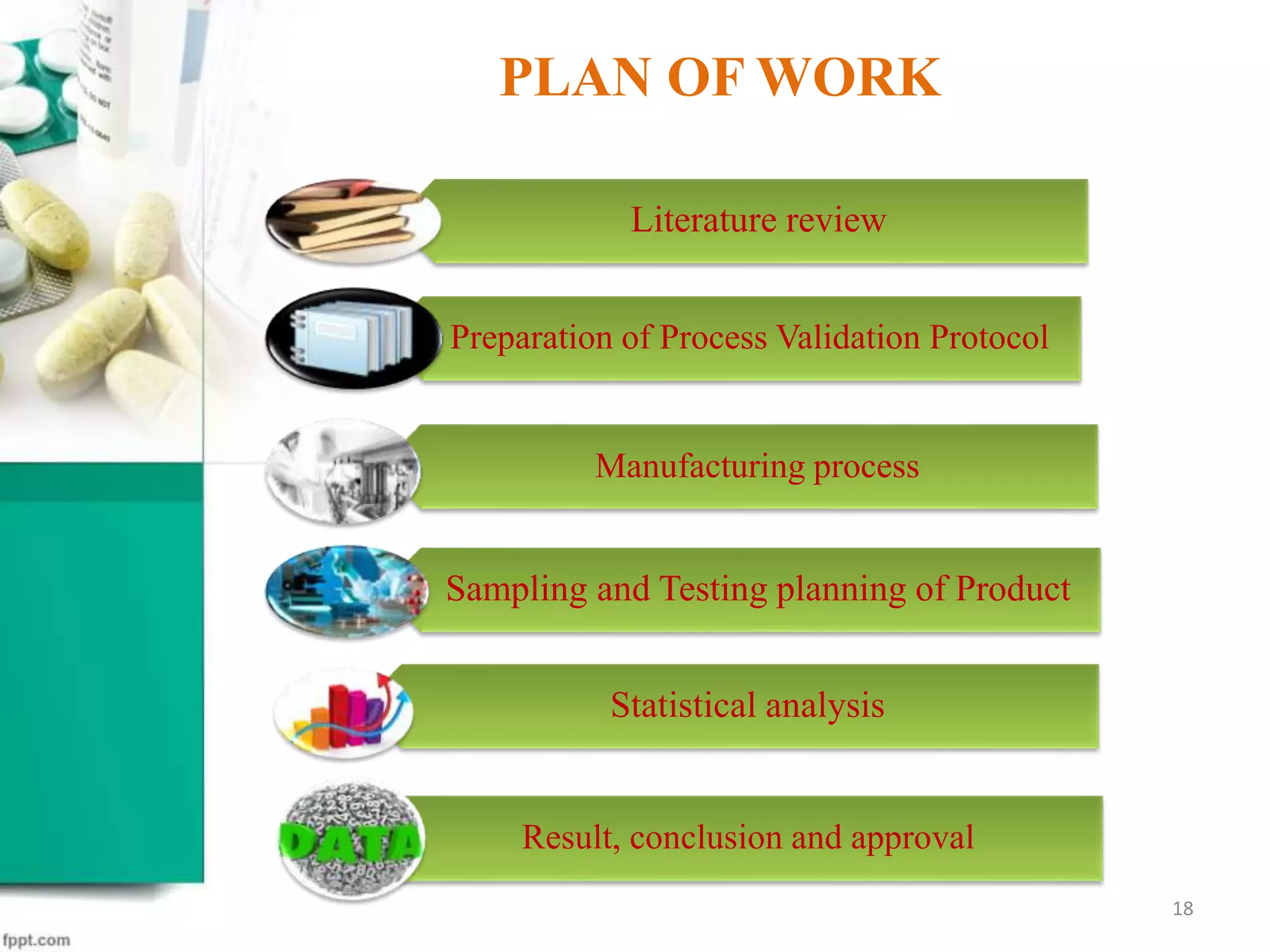
Literature review
Preparation of Process Validation Protocol
Manufacturing process
Sampling and Testing planning of Product
Statistical analysis
Result, conclusion and approval
PLAN OF WORK
18
19
LITERATURE SURVEY
20
LITERATURE SURVEY
21
LITERATURE SURVEY
22
LITERATURE SURVEY
AIM AND OBJECTIVE
AIM - To performed the process validation of solid unit dosage form
(Anti Tuberculosis )
OBJECTIVE:-
 To assured that all manufacturing unit will meet specification and
have uniform quality
 To reduce yield of scrap or rework ,resulting in increased output.
 To provide consistent conformance to specification which result in
fewer complain and recall.
23
VALIDATION PROTOCOL [5]
Process validation protocols should include the following elements:
• Requirements for calibration of all measuring devices.
24
• Objectives, scope of coverage of the validation study.
• A list of all equipment to be used; their normal and worst case operating
parameters.
• Sampling points, stages of sampling, methods of sampling, sampling plans.
• Statistical tools to be used in the analysis of data.
• Training requirements for the processing operators.
• Validated test methods to be used in in process testing and for the finished
product
• Specifications for raw and packaging materials and test methods.
• Forms and charts to be used for documenting results.
25
• Critical process parameters and their respective tolerances.
• Process variables and attributes with probable risk and prevention shall be
captured.
• Description of the processing steps: copy of the master documents for the
product.
Raw material dispensing
Sifting
Dry mixing
Binder preparation
Wet granulation
Drying
Sizing
Blend uniformity
% LOD
GENERAL MANUFAGTURING PROCESS OF TABLET [6,7,8]
26
Shifting and lubrication
Blending
Lubrication
Compression
Film coating
Bulk density, tapped
density, hausner’s
ratio, particle size
distribution, blend
uniformity
Individual weight
variation, hardness,
Thickness,
friability,
disintegration,
dissolution, content
uniformity
Assay,
Related substance test
individual weight
variation, hardness,
Thickness, friability,
disintegration,
dissolution, content
uniformity
27
Manufacturing
Process Stage
Process Parameter
Critical/
Non-
critical
Justification
Sifting Sieve used for sifting (mesh size)
Non-
critical
Sifting has been
incorporate to break the
lump to remove foreign
particle if any.
Dry mixing
1. Dry mixing time
2. Impeller speed
Critical
It may have impact on
uniform distribution of
active material and
excipient
Wet granulation
Binder
addition
1. Add time
2. Impeller speed
Critical
Have impact on
homogeneity of
granulation process,
dissolution and physical
properties of granules
such as particle size
distribution and
followability
Kneading
1. Mix time
2. Impeller speed
3. Chopper sped
CRITICALAND NON-CRITICAL PARAMETER [6]
28
Manufacturing
Process Stage
Process Parameter Critical/Non-
critical
Justification
Drying of
granules
1. Air drying time
2. Inlet temperature
3. Out let air
temperature
4. Air flow
Critical May have impact on %LOD
Sizing of dried
granules
1. Screen used for
sizing
2. Speed of quadro
mill
Critical
It may have impact on the
bulk density, tapped density,
compressibility index,
hausner’s ratio, particle size
distribution of blend and
physical parameter
Blending and
lubrication
1. Blend time
2. Blend speed
3. Time of lubrication
4. Speed
Critical
This stage influence on
blend uniformity, particle
size, distribution of blend
and physical parameter of
tablet
29
Manufacturing
Process Stage
Process Parameter
Critical/Non-
critical
Justification
Compression
1. Compression machine
2. Force feeder
3. Compaction
Critical
Physical attribute,
assay and uniform
of dosage unit of the
tablet
Coating
1. Pan speed
2. Inlet temperature
3. Out let temperature
4. Atomizing air pressure
5. Spray rate
6. Peristaltic pump speed
7. Distance between gun
and product bed
Critical
This may effect
coating efficiency
and dissolution as
coated tablet
30
• A detailed plan of sampling procedure of samples which shall be
analyzed/monitored during validation run shall be outline systematically
• The sampling plan including sampling points number of sample and the
frequency of sampling for each stage operation shall be decided based on
characteristic of the product or critical point of equipment
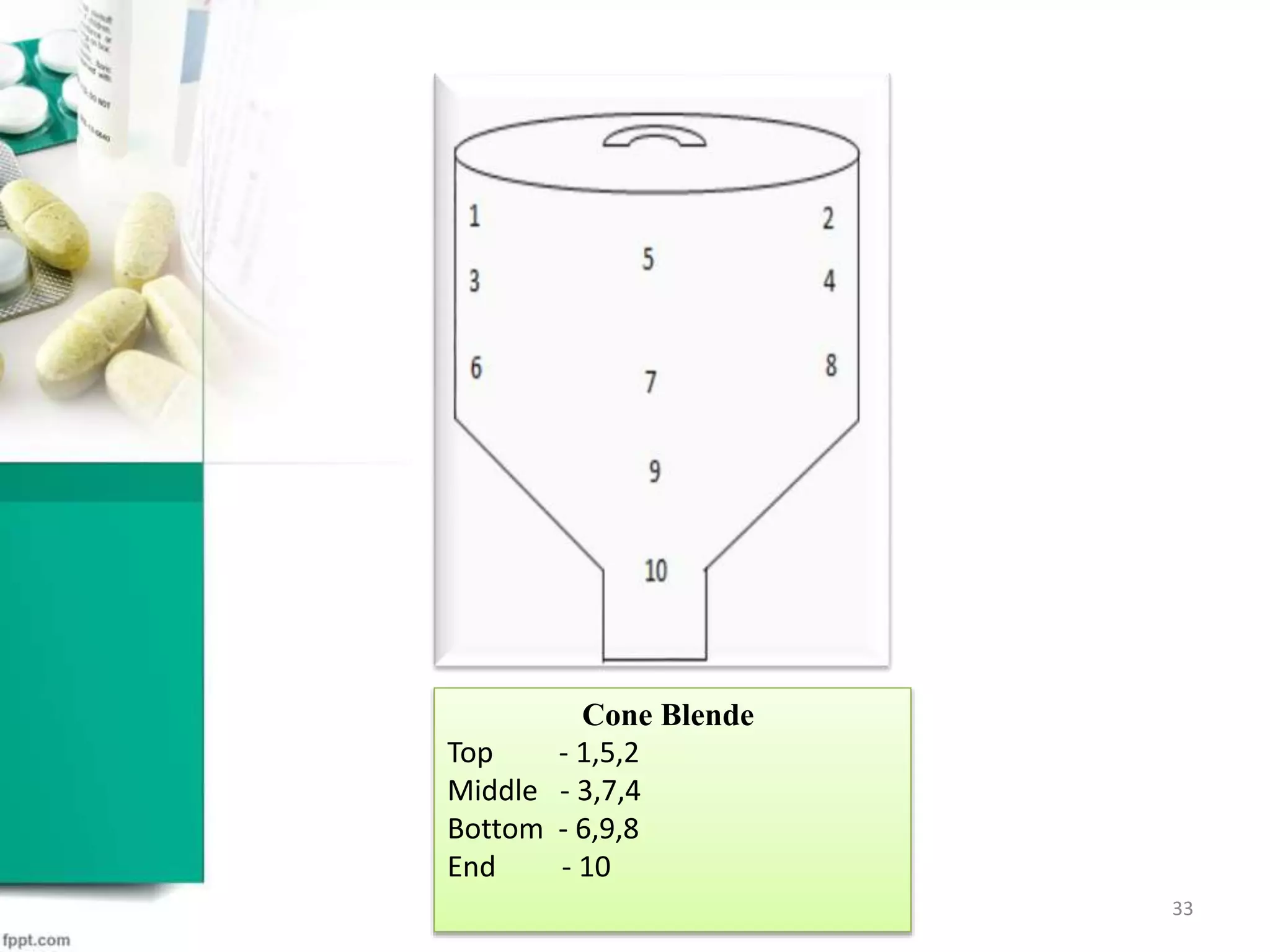
• Sampling location are to clearly indicate by diagram for any equipment from
which the sample are withdraw.
SAMPLING [7,8,10]
31
Rapid Mix Granulator
T- top M- middle B-bottom
FBD Bowl
Four corner 1,2,3,4
SAMPLING TECHNIQUE [7,8]
32
Cone Blende
Top - 1,5,2
Middle - 3,7,4
Bottom - 6,9,8
End - 10
33
Stage Sampling Location Test To Be Performed
Dry mixing
3 point from top,3 point from
middle, 3 point from bottom of
bed from RMG
Blend uniformity
Drying Four corner of FBD and middle % LOD
Lubrication and
Blending
3 samples from top, middle,
bottom
Assay for BU, tapped density
Bulk density, angle of repose
Compression
Draw tablets from initial middle ,
and near end stage of compression
Description, assay, hardness,
thickness, diameter,
friability, weight variation,
CU, disintegration,
dissolution
Coating
Draw a tablets from coating pan at
the end of each lot
Same as above and related
substance test
SAMPLING AND ANALYSIS [6,7]
34
STATISTICS IN VALIDATION [8,9]
 “When you can measure what you are speaking about, and express
it in numbers, then you know something about it.”[8]
 Statistical process control (SPC), also called statistical quality
control and process validation (PV), represents two sides of the
same coin. [8] 35
 The collection and evaluation of information and data about performance of
the process will allow detection of undesired process variability
 Evaluating the performance of the process identifies problem and
determine weather action must be taken to correct anticipate and prevent
problem so that the process remain in control
PROCESS VARIABILITY [9]
36
STATISTICAL TOOL IN VALIDATION
 Process Capability [9,10]
37
 Capability studies are performed to evaluate the ability of a process to
consistently meet a specification.
 Capability studies are frequently used towards the end of the validation to
demonstrate that the outputs consistently meet the specifications. However,
they can also be used to study the behavior of the inputs in order to perform a
tolerance analysis.
38
 Control charts are used to detect changes in the process.
 Control charts help to identify key input variables causing the process to shift
and aid in the reduction of the variation. Control charts are also used as part of
a capability study to demonstrate that the process is stable or consistent.
 Control Chart [9,10]
39
40
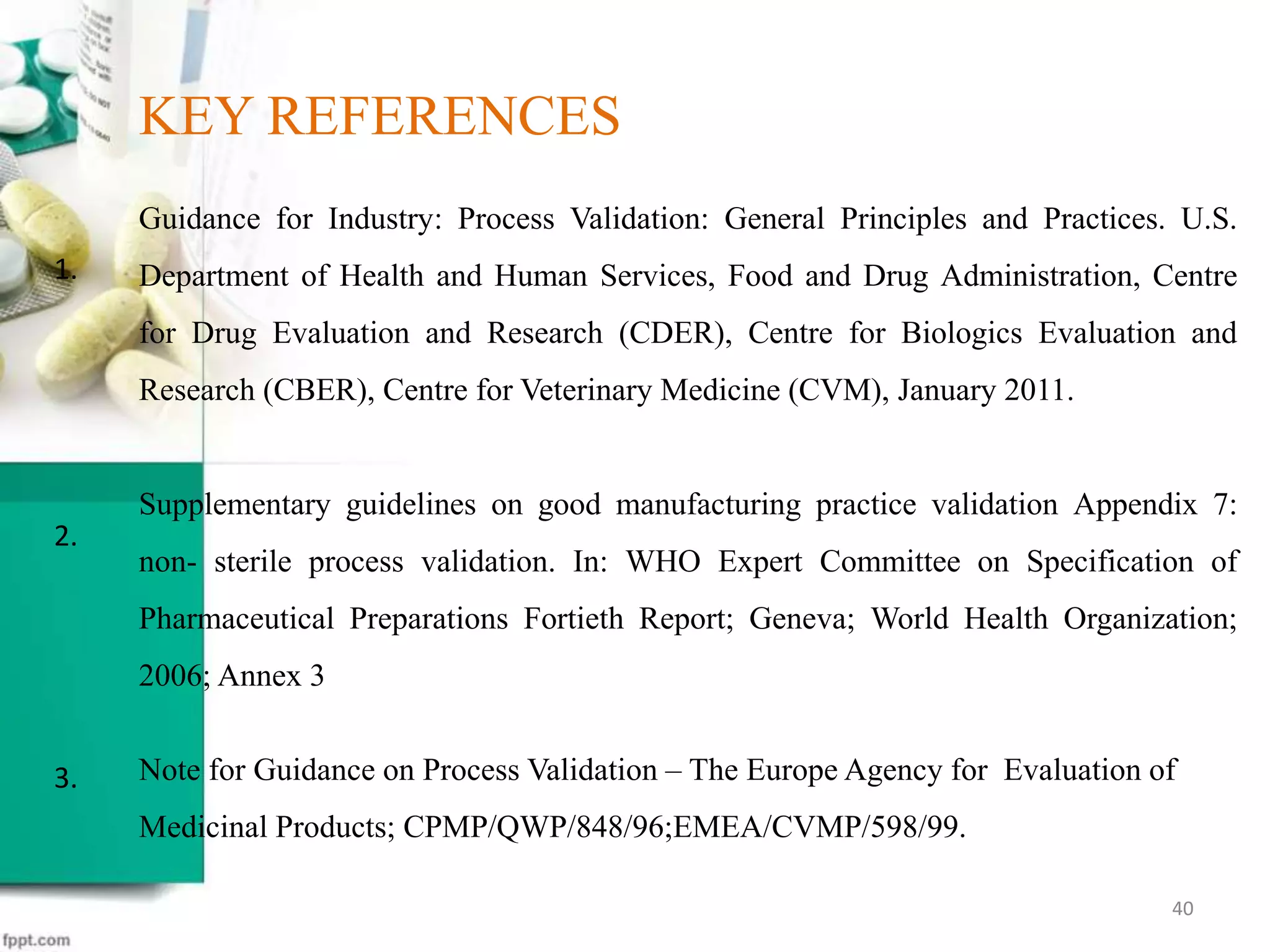
Guidance for Industry: Process Validation: General Principles and Practices. U.S.
Department of Health and Human Services, Food and Drug Administration, Centre
for Drug Evaluation and Research (CDER), Centre for Biologics Evaluation and
Research (CBER), Centre for Veterinary Medicine (CVM), January 2011.
Supplementary guidelines on good manufacturing practice validation Appendix 7:
non- sterile process validation. In: WHO Expert Committee on Specification of
Pharmaceutical Preparations Fortieth Report; Geneva; World Health Organization;
2006; Annex 3
Note for Guidance on Process Validation – The Europe Agency for Evaluation of
Medicinal Products; CPMP/QWP/848/96;EMEA/CVMP/598/99.
1.
2.
3.
KEY REFERENCES
41
Guideline On General Principles Of Process Validation U.S. Department of Health
and Human Services, Food and Drug Administration, Centre for Drug Evaluation
and Research (CDER), Centre for Biologics Evaluation and Research (CBER),
Centre for Veterinary Medicine (CVM), May 1987.
Kathiresan K, Moorthi C, Prathyusha Y, Gade B.R, Reddy B. K, Manavalan R, ; An
overview of pharmaceutical validation; Research Journal of Pharmaceutical,
Biological and Chemical Sciences; ISSN: 0975-8585; 2010; 10-26.
Venkatesh. D, Rao. U, Process Validation of valcyclovir tablet by optimizing
process parameter; International Journal of Pharmaceutical Development and
technology; ISSN 2248-9096; IJPDT 2(1); 2012; 6-10.
4.
5.
6.
42
Gupta. S, Saini. S, Sing. G, Rana. A,; An overview of industrial process validation of
tablet dosage form; International Research Journal of Pharmacy ISSN 2230-8407;
2012; IRJP 3(3) ; 48-56.
Quality Management Systems Process Validation Guidance – January 2004
GHTF/SG3/N99-10:2004 (Edition 2); 1-36.
Thaduvai. R, Rao. B; Process Validation of Pantoprazole 40 mg Tablets; The
Pharma Innovation; ISSN 2277-7695; 2012; 47-62.
Nash R. A and Wachter A. H, Pharmaceutical Process Validation an International
Third Edition. Revised and Expended, Marcel Dekkar, Inc., New York, 2003; 17 -
40.
7.
9.
8.
10.

process validation

  • 1.
    PRESENTED BY: Ms. SahooSumita Gopal Quality Assurance Techniques semester II GUIDED BY: Prof. Arun Maruti Kashid Pharmaceutical Chemistry Sinhgad Technical Education Society, Sinhgad Institute Of Pharmacy, Narhe,pune. Process validation of Solid Dosage form (Anti- Tuberculosis) 1
  • 2.
    OUTLINE INTRODUCTION STAGES OF PROCESSVALIDATION PLAN OF WORK LITERATURE SURVEY KEY REFERENCES 2
  • 3.
    • Do Ihave confidence in my manufacturing process? Or more specifically what scientific evidence assure me that my process is capable of consistently delivering quality product? • How do I demonstrated that my process works as intended? • How do I know my process remain in control? 3
  • 4.
    What Is ProcessValidation ?? 4
  • 5.
    Reason of Process Validation Change in manufacturingsite Change in batch size Change in Equipment Change in Process Specification Change in Composition and Component Change in critical Control Parameter Change in trend of OOT and OOS in consecutive 5
  • 6.
    Process validation is intendedto establish that the proposed manufacturing process is suitable one and yield consistently a product of a desired quality To reduce risk to safety via the highest assurance of acceptable and consistent quality of the product and its components i.e. That the process is suitable and under control Purpose of Process Validation 6
  • 7.
    Validation conducted prior tothe distribution of either a new product or a product made under a revised manufacturing process A process where current production batches are used to monitor processing parameter Retrospective validation is the validation of a process based on accumulated historical data PROSPECTIVE VALIDATION CONCURRENT VALIDATION RETROSPECTIVE VALIDATION TYPES OF PROCESS VALIDATION (1984 USFDA) [4] 7
  • 8.
  • 9.
    INTENT TYPICAL ACTIVITIES To define the commercial process on knowledge gained through development and scale up activities .  The outcome is the design of a process suitable for routine manufacture that will consistently deliver product that meets its critical quality attributes  A combination of product and process design (quality by design)  Product development activities  Experiment to determine process parameters, variability, and necessary controls  Risk assessments  Other activities required to define the commercial process  Design of experiment testing STAGE 1: PROCESS DESIGN [1] 9
  • 10.
     To confirmthe process design as capable of reproducibility  Commercial manufacturing  Facilities design  Equipment and utilities qualification  Performance qualification (PQ)  Strong emphasis on the use of statistical analysis of process data to understand process consistency and performance. INTENT TYPICAL ACTIVITIES STAGE 2 : PROCESS QUALIFICATION [1] 10
  • 11.
    Installation Qualification Establish by objectiveevidence that all key aspect of the process equipment and ancillary system are adhere to manufacturing specification Operational Qualification Establish by objective evidence process control limit and the action levels which result in product that all predetermine requirement Performance Qualification Establish by objective evidence that the process ,under anticipated conditions, consistently produces product which meets all predetermine requirement STAGE 2: PROCESS QUALIFICATION [4] 11
  • 12.
     To provideongoing assurance that the process remains in the state of control during routine production through procedure  Continuous improvement initiatives  Proceduralised data collection from every batch  Data trending and statistical analysis  Product review  Equipment and facilities maintenance  Calibration  Improvement initiatives through process experience INTENT TYPICAL ACTIVITIES STAGE 3:CONTINUED PROCESS VERIFICATION [1] 12
  • 13.
    STAGE 1 PROCESS DESIGN STAGE2 PROCESS QUALIFICATION (PQ) DESIGN OF FACILITIES & QUALIFICATION OF EQUIPMENT AND UTILITIES PROCESS PERFORMANCE QUALIFICATION (PQR) EVALUATE/ CONFIRM STAGE 3 CONTINUED PROCESS VERIFICATION (CPV)DISTRIBUTE Three model of process validation according to FDA guidance for industry [5] distribute 13
  • 14.
    14 Rifampicin, Isoniazid, Ethambutol Antituberculosis Rifampicin, Isoniazid, Ethambutol is the fixed dose combination drug used in the treatment of MDR-TB ( category II tuberculosis). They work by killing the the bacteria that causes tuberculosis. DRUG PROFILE DRUG :- CATEGORY :- DESCRIPTION :-
  • 15.
    15 PARAMETER DESCRIPTION IUPAC NAME (7S,9E,11S,12R,13S,14R,15R,16R,17S,18S,19E,21Z)- 2,15,17,27,29-pentahydroxy-11-methoxy-3,7,12,14,16,18,22- heptamethyl-26-[(1E)-[(4-methylpiperazin-1-yl)imino]methyl]- 6,23-dioxo-8,30-dioxa-24- azatetracyclo[23.3.1.1⁴,⁷.0⁵,²⁸]triaconta-1(29),2,4,9,19,21,25,27- octaen-13-ylacetate MOLECULAR WEIGHT 822.9402 MOLECULAR FORMULA C43H58N4O12 MECHANISM OF ACTION Rifampin acts via the inhibition of DNA-dependent RNA polymerase, leading to a suppression of RNA synthesis and cell death. RIFAMPICIN :-
  • 16.
    16 PARAMETER DESCRIPTION IUPAC NAMEpyridine-4-carbohydrazide MOLECULAR WEIGHT 137.1393 MOLECULAR FORMULA C6H7N3O MECHANISM OF ACTION Isoniazid kills actively growing tubercle bacilli by inhibiting the biosynthesis of mycolic acids which are major components of the cell wall of M. tuberculosis ISONIAZIDE:-
  • 17.
    17 PARAMETER DESCRIPTION IUPAC NAME (2S)-2-[(2-{[(2S)-1-hydroxybutan-2- yl]amino}ethyl)amino]butan-1-ol MOLECULARWEIGHT 204.3098 MOLECULAR FORMULA C10H24N2O2 MECHANISM OF ACTION Ethambutol inhibits arabinosyl transferases which is involved in cell wall biosynthesis. By inhibiting this enzyme, the bacterial cell wall complex production is inhibited. This leads to an increase in cell wall permeability. ETHAMBUTOL :-
  • 18.
    Literature review Preparation ofProcess Validation Protocol Manufacturing process Sampling and Testing planning of Product Statistical analysis Result, conclusion and approval PLAN OF WORK 18
  • 19.
  • 20.
  • 21.
  • 22.
  • 23.
    AIM AND OBJECTIVE AIM- To performed the process validation of solid unit dosage form (Anti Tuberculosis ) OBJECTIVE:-  To assured that all manufacturing unit will meet specification and have uniform quality  To reduce yield of scrap or rework ,resulting in increased output.  To provide consistent conformance to specification which result in fewer complain and recall. 23
  • 24.
    VALIDATION PROTOCOL [5] Processvalidation protocols should include the following elements: • Requirements for calibration of all measuring devices. 24 • Objectives, scope of coverage of the validation study. • A list of all equipment to be used; their normal and worst case operating parameters.
  • 25.
    • Sampling points,stages of sampling, methods of sampling, sampling plans. • Statistical tools to be used in the analysis of data. • Training requirements for the processing operators. • Validated test methods to be used in in process testing and for the finished product • Specifications for raw and packaging materials and test methods. • Forms and charts to be used for documenting results. 25 • Critical process parameters and their respective tolerances. • Process variables and attributes with probable risk and prevention shall be captured. • Description of the processing steps: copy of the master documents for the product.
  • 26.
    Raw material dispensing Sifting Drymixing Binder preparation Wet granulation Drying Sizing Blend uniformity % LOD GENERAL MANUFAGTURING PROCESS OF TABLET [6,7,8] 26
  • 27.
    Shifting and lubrication Blending Lubrication Compression Filmcoating Bulk density, tapped density, hausner’s ratio, particle size distribution, blend uniformity Individual weight variation, hardness, Thickness, friability, disintegration, dissolution, content uniformity Assay, Related substance test individual weight variation, hardness, Thickness, friability, disintegration, dissolution, content uniformity 27
  • 28.
    Manufacturing Process Stage Process Parameter Critical/ Non- critical Justification SiftingSieve used for sifting (mesh size) Non- critical Sifting has been incorporate to break the lump to remove foreign particle if any. Dry mixing 1. Dry mixing time 2. Impeller speed Critical It may have impact on uniform distribution of active material and excipient Wet granulation Binder addition 1. Add time 2. Impeller speed Critical Have impact on homogeneity of granulation process, dissolution and physical properties of granules such as particle size distribution and followability Kneading 1. Mix time 2. Impeller speed 3. Chopper sped CRITICALAND NON-CRITICAL PARAMETER [6] 28
  • 29.
    Manufacturing Process Stage Process ParameterCritical/Non- critical Justification Drying of granules 1. Air drying time 2. Inlet temperature 3. Out let air temperature 4. Air flow Critical May have impact on %LOD Sizing of dried granules 1. Screen used for sizing 2. Speed of quadro mill Critical It may have impact on the bulk density, tapped density, compressibility index, hausner’s ratio, particle size distribution of blend and physical parameter Blending and lubrication 1. Blend time 2. Blend speed 3. Time of lubrication 4. Speed Critical This stage influence on blend uniformity, particle size, distribution of blend and physical parameter of tablet 29
  • 30.
    Manufacturing Process Stage Process Parameter Critical/Non- critical Justification Compression 1.Compression machine 2. Force feeder 3. Compaction Critical Physical attribute, assay and uniform of dosage unit of the tablet Coating 1. Pan speed 2. Inlet temperature 3. Out let temperature 4. Atomizing air pressure 5. Spray rate 6. Peristaltic pump speed 7. Distance between gun and product bed Critical This may effect coating efficiency and dissolution as coated tablet 30
  • 31.
    • A detailedplan of sampling procedure of samples which shall be analyzed/monitored during validation run shall be outline systematically • The sampling plan including sampling points number of sample and the frequency of sampling for each stage operation shall be decided based on characteristic of the product or critical point of equipment • Sampling location are to clearly indicate by diagram for any equipment from which the sample are withdraw. SAMPLING [7,8,10] 31
  • 32.
    Rapid Mix Granulator T-top M- middle B-bottom FBD Bowl Four corner 1,2,3,4 SAMPLING TECHNIQUE [7,8] 32
  • 33.
    Cone Blende Top -1,5,2 Middle - 3,7,4 Bottom - 6,9,8 End - 10 33
  • 34.
    Stage Sampling LocationTest To Be Performed Dry mixing 3 point from top,3 point from middle, 3 point from bottom of bed from RMG Blend uniformity Drying Four corner of FBD and middle % LOD Lubrication and Blending 3 samples from top, middle, bottom Assay for BU, tapped density Bulk density, angle of repose Compression Draw tablets from initial middle , and near end stage of compression Description, assay, hardness, thickness, diameter, friability, weight variation, CU, disintegration, dissolution Coating Draw a tablets from coating pan at the end of each lot Same as above and related substance test SAMPLING AND ANALYSIS [6,7] 34
  • 35.
    STATISTICS IN VALIDATION[8,9]  “When you can measure what you are speaking about, and express it in numbers, then you know something about it.”[8]  Statistical process control (SPC), also called statistical quality control and process validation (PV), represents two sides of the same coin. [8] 35
  • 36.
     The collectionand evaluation of information and data about performance of the process will allow detection of undesired process variability  Evaluating the performance of the process identifies problem and determine weather action must be taken to correct anticipate and prevent problem so that the process remain in control PROCESS VARIABILITY [9] 36
  • 37.
    STATISTICAL TOOL INVALIDATION  Process Capability [9,10] 37
  • 38.
     Capability studiesare performed to evaluate the ability of a process to consistently meet a specification.  Capability studies are frequently used towards the end of the validation to demonstrate that the outputs consistently meet the specifications. However, they can also be used to study the behavior of the inputs in order to perform a tolerance analysis. 38
  • 39.
     Control chartsare used to detect changes in the process.  Control charts help to identify key input variables causing the process to shift and aid in the reduction of the variation. Control charts are also used as part of a capability study to demonstrate that the process is stable or consistent.  Control Chart [9,10] 39
  • 40.
    40 Guidance for Industry:Process Validation: General Principles and Practices. U.S. Department of Health and Human Services, Food and Drug Administration, Centre for Drug Evaluation and Research (CDER), Centre for Biologics Evaluation and Research (CBER), Centre for Veterinary Medicine (CVM), January 2011. Supplementary guidelines on good manufacturing practice validation Appendix 7: non- sterile process validation. In: WHO Expert Committee on Specification of Pharmaceutical Preparations Fortieth Report; Geneva; World Health Organization; 2006; Annex 3 Note for Guidance on Process Validation – The Europe Agency for Evaluation of Medicinal Products; CPMP/QWP/848/96;EMEA/CVMP/598/99. 1. 2. 3. KEY REFERENCES
  • 41.
    41 Guideline On GeneralPrinciples Of Process Validation U.S. Department of Health and Human Services, Food and Drug Administration, Centre for Drug Evaluation and Research (CDER), Centre for Biologics Evaluation and Research (CBER), Centre for Veterinary Medicine (CVM), May 1987. Kathiresan K, Moorthi C, Prathyusha Y, Gade B.R, Reddy B. K, Manavalan R, ; An overview of pharmaceutical validation; Research Journal of Pharmaceutical, Biological and Chemical Sciences; ISSN: 0975-8585; 2010; 10-26. Venkatesh. D, Rao. U, Process Validation of valcyclovir tablet by optimizing process parameter; International Journal of Pharmaceutical Development and technology; ISSN 2248-9096; IJPDT 2(1); 2012; 6-10. 4. 5. 6.
  • 42.
    42 Gupta. S, Saini.S, Sing. G, Rana. A,; An overview of industrial process validation of tablet dosage form; International Research Journal of Pharmacy ISSN 2230-8407; 2012; IRJP 3(3) ; 48-56. Quality Management Systems Process Validation Guidance – January 2004 GHTF/SG3/N99-10:2004 (Edition 2); 1-36. Thaduvai. R, Rao. B; Process Validation of Pantoprazole 40 mg Tablets; The Pharma Innovation; ISSN 2277-7695; 2012; 47-62. Nash R. A and Wachter A. H, Pharmaceutical Process Validation an International Third Edition. Revised and Expended, Marcel Dekkar, Inc., New York, 2003; 17 - 40. 7. 9. 8. 10.