



Aseptic Technique: Sue Larsen, CNS- Auckland
• Acknowledgment - St Mark’s Intestinal Course
Introduction
 Discuss what is meant by an
aseptic technique and how it
should be performed
 Present the evidence base
surrounding key aspects of an
aseptic technique for the care of
central venous catheters
What is an aseptic
technique?
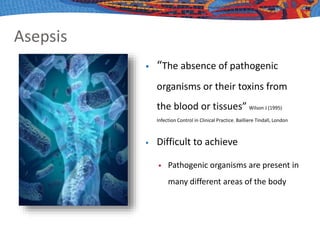
Asepsis
 “The absence of pathogenic
organisms or their toxins from
the blood or tissues” Wilson J (1995)
Infection Control in Clinical Practice. Bailliere Tindall, London
 Difficult to achieve
 Pathogenic organisms are present in
many different areas of the body
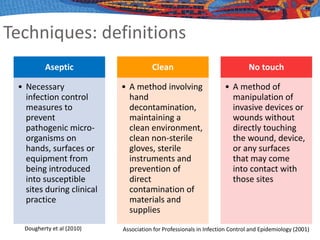
Techniques: definitions
Aseptic
• Necessary
infection control
measures to
prevent
pathogenic micro-
organisms on
hands, surfaces or
equipment from
being introduced
into susceptible
sites during clinical
practice
Clean
• A method involving
hand
decontamination,
maintaining a
clean environment,
clean non-sterile
gloves, sterile
instruments and
prevention of
direct
contamination of
materials and
supplies
No touch
• A method of
manipulation of
invasive devices or
wounds without
directly touching
the wound, device,
or any surfaces
that may come
into contact with
those sites
Dougherty et al (2010) Association for Professionals in Infection Control and Epidemiology (2001)
Aseptic Non Touch Technique
Peer reviewed & tested clinical guidelines
 Basic infection prevention & control principles
Aim to standardize & improve the efficacy of the aseptic technique
thereby reducing healthcare associated infections
 Standard or Surgical depending on length & complexity of procedure
Rowley (1994, 2004)
Aseptic technique: The evidence base
 No clinical or economic evidence
that any one approach is more
clinically or cost-effective than
another
 All recommendations are Class
D/GPP Loveday et al (2014)
Loveday et al (2014) UK Department of Health epic3: National Evidence-based guidelines for
preventing healthcare-associated infections. J Hosp Infect;86:S1–70
What technique would you
recommend for parenteral
nutrition?
Standard ANTT
 Technically uncomplicated
procedures
 < 20 minutes in length
 Involves small key sites
 Minimal key parts
Surgical ANTT
 Technically complicated
procedures
 > 20 minutes in length
 Involves large open key sites
 Large or numerous key sites
Principles are the same. The main difference is the
complexity of the aseptic field and how it is managed
Rowley & Clare (2011)
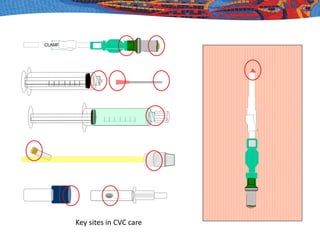
Key sites in CVC care
Should the technique be
standardised?
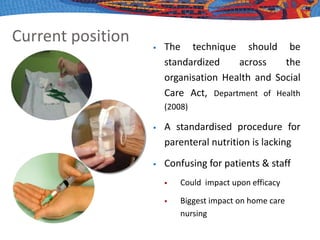
Current position  The technique should be
standardized across the
organisation Health and Social
Care Act, Department of Health
(2008)
 A standardised procedure for
parenteral nutrition is lacking
 Confusing for patients & staff
 Could impact upon efficacy
 Biggest impact on home care
nursing
Which elements of
central venous catheter
care are evidence-
based?
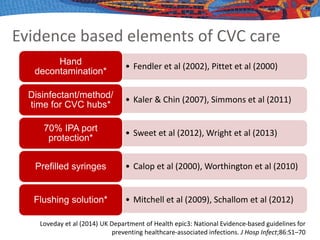
• Fendler et al (2002), Pittet et al (2000)Hand
decontamination*
• Kaler & Chin (2007), Simmons et al (2011)Disinfectant/method/
time for CVC hubs*
• Sweet et al (2012), Wright et al (2013)70% IPA port
protection*
• Calop et al (2000), Worthington et al (2010)Prefilled syringes
• Mitchell et al (2009), Schallom et al (2012)Flushing solution*
Evidence based elements of CVC care
Loveday et al (2014) UK Department of Health epic3: National Evidence-based guidelines for
preventing healthcare-associated infections. J Hosp Infect;86:S1–70
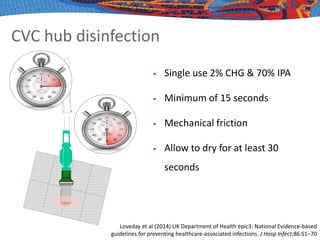
CVC hub disinfection
 Single use 2% CHG & 70% IPA
 Minimum of 15 seconds
 Mechanical friction
 Allow to dry for at least 30
seconds
Loveday et al (2014) UK Department of Health epic3: National Evidence-based
guidelines for preventing healthcare-associated infections. J Hosp Infect;86:S1–70
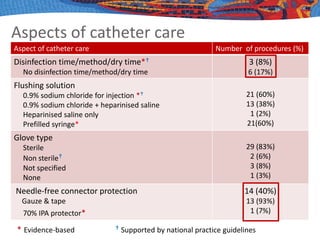
Aspects of catheter care
Aspect of catheter care Number of procedures (%)
Disinfection time/method/dry time*
No disinfection time/method/dry time
3 (8%)
6 (17%)
Flushing solution
0.9% sodium chloride for injection *
0.9% sodium chloride + heparinised saline
Heparinised saline only
Prefilled syringe*
21 (60%)
13 (38%)
1 (2%)
21(60%)
Glove type
Sterile
Non sterile
Not specified
None
29 (83%)
2 (6%)
3 (8%)
1 (3%)
Needle-free connector protection
Gauze & tape
70% IPA protector*
14 (40%)
13 (93%)
1 (7%)
* Evidence-based  Supported by national practice guidelines
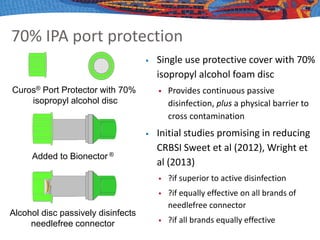
70% IPA port protection
 Single use protective cover with 70%
isopropyl alcohol foam disc
 Provides continuous passive
disinfection, plus a physical barrier to
cross contamination
 Initial studies promising in reducing
CRBSI Sweet et al (2012), Wright et
al (2013)
 ?if superior to active disinfection
 ?if equally effective on all brands of
needlefree connector
 ?if all brands equally effective
Added to Bionector ®
Curos® Port Protector with 70%
isopropyl alcohol disc
Alcohol disc passively disinfects
needlefree connector
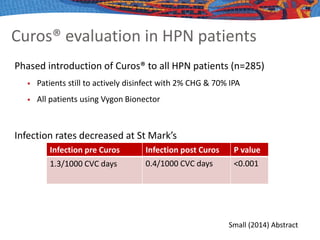
Curos® evaluation in HPN patients
Phased introduction of Curos® to all HPN patients (n=285)
 Patients still to actively disinfect with 2% CHG & 70% IPA
 All patients using Vygon Bionector
Infection rates decreased at St Mark’s
Small (2014) Abstract
Infection pre Curos Infection post Curos P value
1.3/1000 CVC days 0.4/1000 CVC days <0.001
How can the efficacy of
an aseptic technique be
assessed?
Catheter related infection
 Monitoring catheter related infection is
an important outcome measure
 Differences in classifying infection
 Specifically catheter related bloodstream
infection (CRBSI) & central line associated
bloodstream infection (CLABSI)
 Availability of culturing methods, &
whether catheter tips are available for
analysis make direct comparison of
infection rates difficult
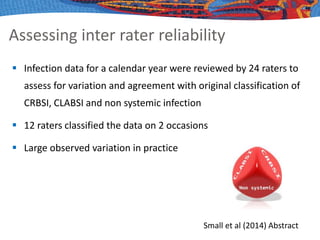
Assessing inter rater reliability
 Infection data for a calendar year were reviewed by 24 raters to
assess for variation and agreement with original classification of
CRBSI, CLABSI and non systemic infection
 12 raters classified the data on 2 occasions
 Large observed variation in practice
Small et al (2014) Abstract
The ideal procedure…
Focus on the principles of
asepsis rather than a step by
step list of instructions
Hospitals should incorporate
evidence based
recommendations into their
procedures

Aseptic Technique

  • 1.
    Aseptic Technique: SueLarsen, CNS- Auckland • Acknowledgment - St Mark’s Intestinal Course
  • 2.
    Introduction  Discuss whatis meant by an aseptic technique and how it should be performed  Present the evidence base surrounding key aspects of an aseptic technique for the care of central venous catheters
  • 3.
    What is anaseptic technique?
  • 4.
    Asepsis  “The absenceof pathogenic organisms or their toxins from the blood or tissues” Wilson J (1995) Infection Control in Clinical Practice. Bailliere Tindall, London  Difficult to achieve  Pathogenic organisms are present in many different areas of the body
  • 5.
    Techniques: definitions Aseptic • Necessary infectioncontrol measures to prevent pathogenic micro- organisms on hands, surfaces or equipment from being introduced into susceptible sites during clinical practice Clean • A method involving hand decontamination, maintaining a clean environment, clean non-sterile gloves, sterile instruments and prevention of direct contamination of materials and supplies No touch • A method of manipulation of invasive devices or wounds without directly touching the wound, device, or any surfaces that may come into contact with those sites Dougherty et al (2010) Association for Professionals in Infection Control and Epidemiology (2001)
  • 6.
    Aseptic Non TouchTechnique Peer reviewed & tested clinical guidelines  Basic infection prevention & control principles Aim to standardize & improve the efficacy of the aseptic technique thereby reducing healthcare associated infections  Standard or Surgical depending on length & complexity of procedure Rowley (1994, 2004)
  • 7.
    Aseptic technique: Theevidence base  No clinical or economic evidence that any one approach is more clinically or cost-effective than another  All recommendations are Class D/GPP Loveday et al (2014) Loveday et al (2014) UK Department of Health epic3: National Evidence-based guidelines for preventing healthcare-associated infections. J Hosp Infect;86:S1–70
  • 8.
    What technique wouldyou recommend for parenteral nutrition?
  • 9.
    Standard ANTT  Technicallyuncomplicated procedures  < 20 minutes in length  Involves small key sites  Minimal key parts Surgical ANTT  Technically complicated procedures  > 20 minutes in length  Involves large open key sites  Large or numerous key sites Principles are the same. The main difference is the complexity of the aseptic field and how it is managed Rowley & Clare (2011)
  • 10.
    Key sites inCVC care
  • 11.
    Should the techniquebe standardised?
  • 12.
    Current position The technique should be standardized across the organisation Health and Social Care Act, Department of Health (2008)  A standardised procedure for parenteral nutrition is lacking  Confusing for patients & staff  Could impact upon efficacy  Biggest impact on home care nursing
  • 14.
    Which elements of centralvenous catheter care are evidence- based?
  • 15.
    • Fendler etal (2002), Pittet et al (2000)Hand decontamination* • Kaler & Chin (2007), Simmons et al (2011)Disinfectant/method/ time for CVC hubs* • Sweet et al (2012), Wright et al (2013)70% IPA port protection* • Calop et al (2000), Worthington et al (2010)Prefilled syringes • Mitchell et al (2009), Schallom et al (2012)Flushing solution* Evidence based elements of CVC care Loveday et al (2014) UK Department of Health epic3: National Evidence-based guidelines for preventing healthcare-associated infections. J Hosp Infect;86:S1–70
  • 16.
    CVC hub disinfection Single use 2% CHG & 70% IPA  Minimum of 15 seconds  Mechanical friction  Allow to dry for at least 30 seconds Loveday et al (2014) UK Department of Health epic3: National Evidence-based guidelines for preventing healthcare-associated infections. J Hosp Infect;86:S1–70
  • 17.
    Aspects of cathetercare Aspect of catheter care Number of procedures (%) Disinfection time/method/dry time* No disinfection time/method/dry time 3 (8%) 6 (17%) Flushing solution 0.9% sodium chloride for injection * 0.9% sodium chloride + heparinised saline Heparinised saline only Prefilled syringe* 21 (60%) 13 (38%) 1 (2%) 21(60%) Glove type Sterile Non sterile Not specified None 29 (83%) 2 (6%) 3 (8%) 1 (3%) Needle-free connector protection Gauze & tape 70% IPA protector* 14 (40%) 13 (93%) 1 (7%) * Evidence-based  Supported by national practice guidelines
  • 18.
    70% IPA portprotection  Single use protective cover with 70% isopropyl alcohol foam disc  Provides continuous passive disinfection, plus a physical barrier to cross contamination  Initial studies promising in reducing CRBSI Sweet et al (2012), Wright et al (2013)  ?if superior to active disinfection  ?if equally effective on all brands of needlefree connector  ?if all brands equally effective Added to Bionector ® Curos® Port Protector with 70% isopropyl alcohol disc Alcohol disc passively disinfects needlefree connector
  • 19.
    Curos® evaluation inHPN patients Phased introduction of Curos® to all HPN patients (n=285)  Patients still to actively disinfect with 2% CHG & 70% IPA  All patients using Vygon Bionector Infection rates decreased at St Mark’s Small (2014) Abstract Infection pre Curos Infection post Curos P value 1.3/1000 CVC days 0.4/1000 CVC days <0.001
  • 20.
    How can theefficacy of an aseptic technique be assessed?
  • 21.
    Catheter related infection Monitoring catheter related infection is an important outcome measure  Differences in classifying infection  Specifically catheter related bloodstream infection (CRBSI) & central line associated bloodstream infection (CLABSI)  Availability of culturing methods, & whether catheter tips are available for analysis make direct comparison of infection rates difficult
  • 22.
    Assessing inter raterreliability  Infection data for a calendar year were reviewed by 24 raters to assess for variation and agreement with original classification of CRBSI, CLABSI and non systemic infection  12 raters classified the data on 2 occasions  Large observed variation in practice Small et al (2014) Abstract
  • 23.
    The ideal procedure… Focuson the principles of asepsis rather than a step by step list of instructions Hospitals should incorporate evidence based recommendations into their procedures

Editor's Notes

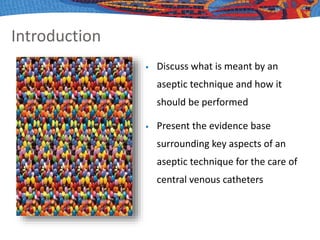
  • #3 I have changed the picture here as Alison mentioned you didn’t understand the Emperor’s new clothes reference. I agree it probably doesn’t translate well. This is a magic eye picture. I use it to illustrate the point that although the term aseptic technique is used widely it means different things to people and is not viewed the same by all. The solution to the magic eye picture is that there are 8 balls.
  • #13 These photos highlight some differences in practice. The top photo illustrates one HPN centre’s current practice (not St Mark’s) and the middle photo is how they perform catheter care in Poland. They immerse the CVC in alcohol for 30 seconds. They don’t have access to disinfection wipes. Their infection rates are impressively low. The bottom picture was found on the Internet on a company’s website – I usually highlight the fact that there are no gloves worn which isn’t necessarily bad, but the key parts ar being touched.
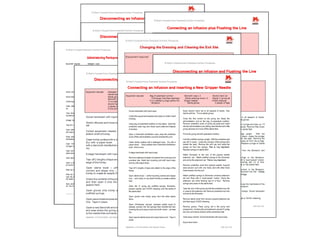
  • #14 These are just a selection of our CVC care protocols. We currently have around 60 to reflect the many different combinations, ie disconnecting an open ended CVC, disconnecting a port (leaving gripper in), disconnecting a port (taking gripper out), disconnecting a valved CVC, disconnecting any of the previous and installing Taurolock, disconnecting any of the previous and installing pantoprazole, disconnecting any of the previous and installing Taurolock and pantoprazole etc. If people understand the principles of asepsis we shouldn’t need to do this. I will send you our basic connection and disconnection procedures for reference.
  • #15 This is the slide I usually use to demonstrate the point of the need to standardise (which Simon cut from the talk). I have replaced it but hidden it, but feel it needs to be included. I will also send you the poster of the abstract which essentially evaluated the differences between 35 different PN procedures. This slide shows some of the differences.
  • #19 This slide is from the study I conducted looking into the variation between 35 different hospitals aseptic techniques. The point I highlight here is that only 3 of the 35 procedures included the specific elements of mentioning disinfection time, method of disinfection and dry time, and that 6 of the 35 procedures failed to mention all 3 of these key aspects.
  • #24 I have enclosed some additional slides which emphasise the differences observed which also didn’t make Simon’s cut! I will also send you the posters for the 2 abstracts.