Very Warm
Welcome to All
Contents
 Introduction
 Spread of infection in Hospital
 Infection control Practices
 Environmental Management of Infection
  Control
 Decontamination, Sterilization and
  Disinfection
 Application of Nursing Process in
  Infection Control
Introduction
   Infection may be transferred
    ◦   patient-to-patient,
    ◦   patients to staff
    ◦   staff to patients,
    ◦   or among-staff.
   Infection control includes
    ◦ prevention (via hand hygiene/hand
      washing, cleaning/disinfection/sterilization, vaccination,
      surveillance),
    ◦ monitoring/investigation of demonstrated or suspected
      spread of infection within a particular health-care setting
      (surveillance and outbreak investigation),
    ◦ and management (interruption of outbreaks).
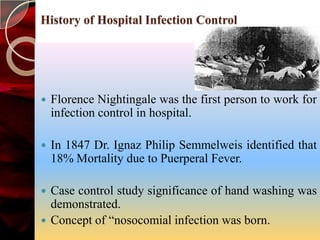
History of Hospital Infection Control


   Florence Nightingale was the first person to work for
    infection control in hospital.

   In 1847 Dr. Ignaz Philip Semmelweis identified that
    18% Mortality due to Puerperal Fever.

 Case control study significance of hand washing was
  demonstrated.
 Concept of “nosocomial infection was born.
Background
   Infection rate in developing countries was 15.5 per 100
    patients, compared to “.1 [per 100 patients] in Europe
    and in the U.S., 4.5- BBC

   ICU infection - developing countries: 47.9 per 1,000
    patient, compared to 13.6 in the U.S.

 In countries like India and Nepal, hospital infection data
  not reliably estimated.
 Surgical infection at BPKIHS -1339 (7.3%) among
  18325 total surgeries.
 Estimates vary from 10 to 30%, the least being about
  3% in the best of hospitals

   Wound sepsis alone affects 20% of post-operative cases
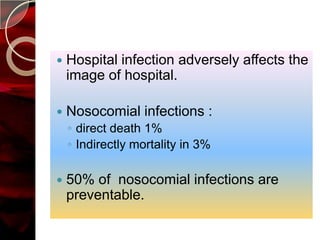
   Hospital infection adversely affects the
    image of hospital.

   Nosocomial infections :
    ◦ direct death 1%
    ◦ Indirectly mortality in 3%

   50% of nosocomial infections are
    preventable.
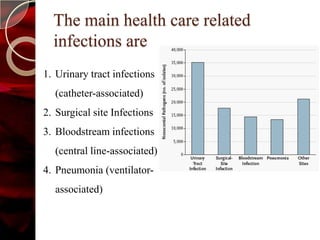
The main health care related
  infections are
1. Urinary tract infections
  (catheter-associated)
2. Surgical site Infections
3. Bloodstream infections
  (central line-associated)
4. Pneumonia (ventilator-
  associated)
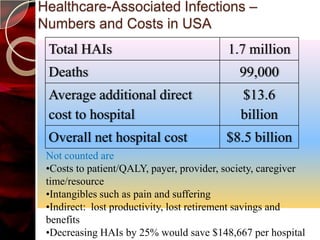
Healthcare-Associated Infections –
Numbers and Costs in USA
 Total HAIs                               1.7 million
 Deaths                                      99,000
 Average additional direct                   $13.6
 cost to hospital                            billion
 Overall net hospital cost                $8.5 billion
 Not counted are
 •Costs to patient/QALY, payer, provider, society, caregiver
 time/resource
 •Intangibles such as pain and suffering
 •Indirect: lost productivity, lost retirement savings and
 benefits
 •Decreasing HAIs by 25% would save $148,667 per hospital
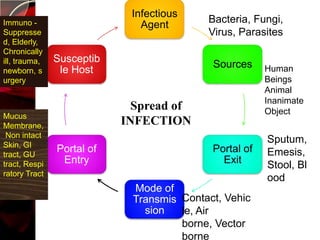
Infectious
Immuno -                                  Bacteria, Fungi,
                              Agent
Suppresse                                 Virus, Parasites
d, Elderly,
Chronically
ill, trauma,   Susceptib
                                           Sources     Human
newborn, s      le Host
urgery                                                 Beings
                                                       Animal
                                                       Inanimate
                             Spread of                 Object
Mucus
Membrane,                  INFECTION
 Non intact
Skin, GI
                                                       Sputum,
tract, GU
               Portal of                   Portal of   Emesis,
tract, Respi    Entry                        Exit      Stool, Bl
ratory Tract
                                                       ood
                            Mode of
                            Transmis Contact, Vehic
                              sion   le, Air
                                     borne, Vector
                                     borne
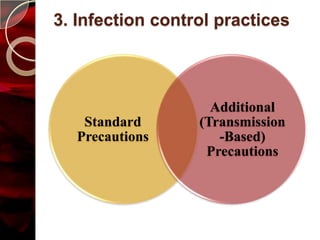
3. Infection control practices


                    Additional
   Standard       (Transmission
  Precautions        -Based)
                   Precautions
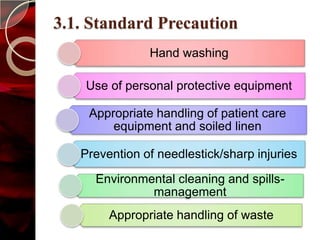
3.1. Standard Precaution
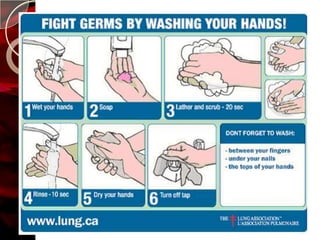
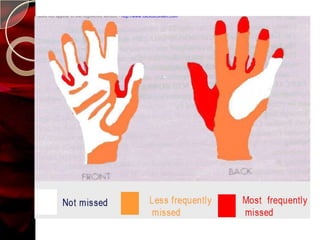
               Hand washing

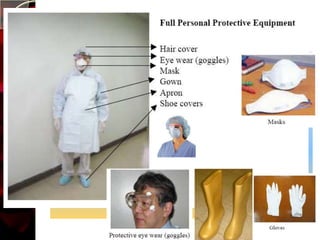
    Use of personal protective equipment

    Appropriate handling of patient care
        equipment and soiled linen

   Prevention of needlestick/sharp injuries

     Environmental cleaning and spills-
              management
        Appropriate handling of waste
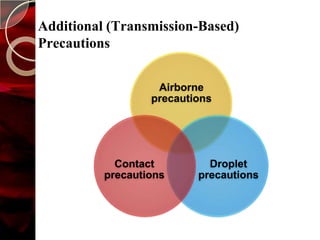
Additional (Transmission-Based)
Precautions


                   Airborne
                  precautions


            Contact         Droplet
          precautions     precautions
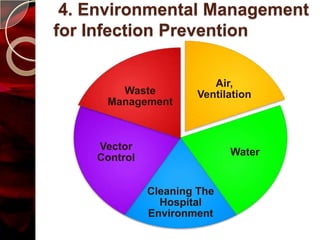
4. Environmental Management
for Infection Prevention

                         Air,
       Waste          Ventilation
     Management


    Vector
                             Water
    Control


              Cleaning The
                Hospital
              Environment
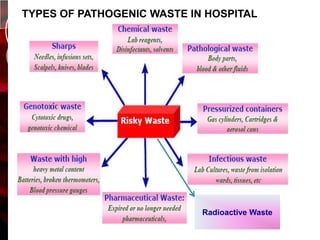
TYPES OF PATHOGENIC WASTE IN HOSPITAL


                            Radioactive Waste
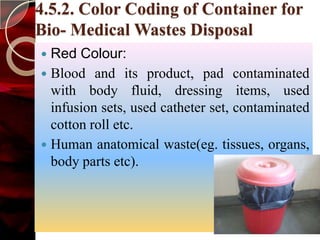
4.5.2. Color Coding of Container for
Bio- Medical Wastes Disposal
 Red Colour:
 Blood and its product, pad contaminated
  with body fluid, dressing items, used
  infusion sets, used catheter set, contaminated
  cotton roll etc.
 Human anatomical waste(eg. tissues, organs,
  body parts etc).
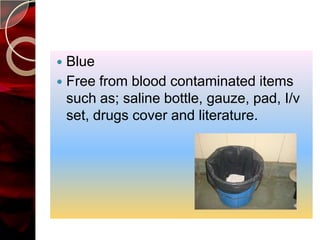
 Blue
 Free from blood contaminated items
  such as; saline bottle, gauze, pad, I/v
  set, drugs cover and literature.
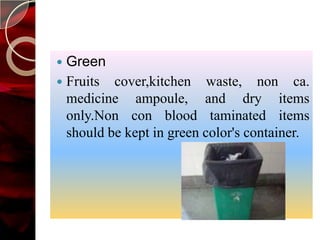
 Green
 Fruits cover,kitchen waste, non ca.
  medicine ampoule, and dry items
  only.Non con blood taminated items
  should be kept in green color's container.
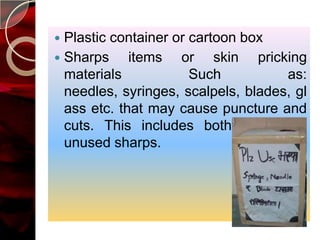
 Plastic container or cartoon box
 Sharps     items or skin pricking
  materials            Such          as:
  needles, syringes, scalpels, blades, gl
  ass etc. that may cause puncture and
  cuts. This includes both used and
  unused sharps.
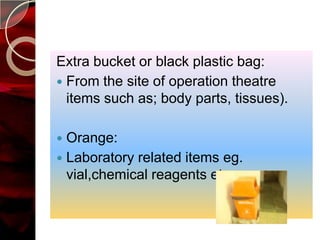
Extra bucket or black plastic bag:
 From the site of operation theatre
  items such as; body parts, tissues).

 Orange:
 Laboratory related items eg.
  vial,chemical reagents etc.
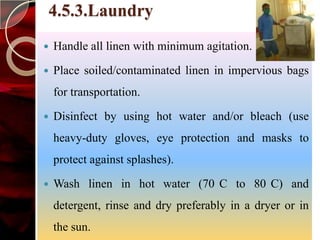
4.5.3.Laundry
   Handle all linen with minimum agitation.

   Place soiled/contaminated linen in impervious bags
    for transportation.

   Disinfect by using hot water and/or bleach (use
    heavy-duty gloves, eye protection and masks to
    protect against splashes).

   Wash linen in hot water (70 C to 80 C) and
    detergent, rinse and dry preferably in a dryer or in
    the sun.
   Wash woollen blankets in warm water and dry in
    the sun.

   Bed Cover: Change weekly or whenever soiled and
    on discharge.

   Bed sheet: Change on alternate day or whenever
    soiled and on discharge.

   Mattresses and pillows: Cover with inpervious
    plastic. They can be cleaned by wiping with a
    housekeeping disinfectant- detergent.

   Blood stained linen: Soak in 1% sodium
    hypochloride for 30 min. and send to laundry.
Decontamination, Sterilization,
Disinfection
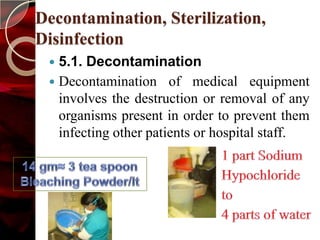
  5.1. Decontamination
  Decontamination of medical equipment
   involves the destruction or removal of any
   organisms present in order to prevent them
   infecting other patients or hospital staff.
Sterilization
 Sterilization is the destruction of all
  micro-organisms.
1. Autoclave (Steam Under Pressure)
2. Flamming
3. Chemical Sterilization
     i. Glutaraldehyde
     ii. Alcohol
     iii. Formalin
4.        Gas Sterlization
     i.    Ethylene Oxide
5.        Iradiation
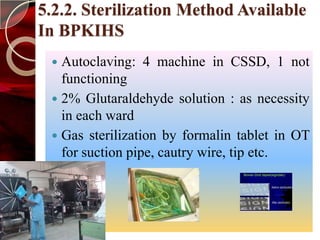
5.2.2. Sterilization Method Available
In BPKIHS
  Autoclaving: 4 machine in CSSD, 1 not
   functioning
  2% Glutaraldehyde solution : as necessity
   in each ward
  Gas sterilization by formalin tablet in OT
   for suction pipe, cautry wire, tip etc.
5.2.2. Storage of Sterile Equipment
   Keep the storage area clean, dry, dust-free and lint-free.
   Control temperature and humidity (approximate
    temperature 240C and relative humidity <70%) when
    possible.


   Packs and containers with sterile (or high-level disinfected)
    items should be stored 20–25 cm (8–10 inches) off the
    floor, 45–50 cm (18–20 inches) from the ceiling and 15–20
    cm (6–8 inches) from an outside wall.
   Do not use cardboard boxes for storage.
   Date and rotate the supplies (first in/first out).
   Change the cydex solution in each 28th day
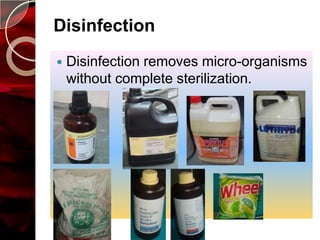
Disinfection
   Disinfection removes micro-organisms
    without complete sterilization.
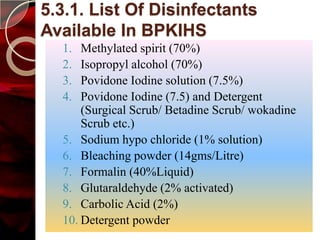
5.3.1. List Of Disinfectants
Available In BPKIHS
  1.  Methylated spirit (70%)
  2.  Isopropyl alcohol (70%)
  3.  Povidone Iodine solution (7.5%)
  4.  Povidone Iodine (7.5) and Detergent
      (Surgical Scrub/ Betadine Scrub/ wokadine
      Scrub etc.)
  5. Sodium hypo chloride (1% solution)
  6. Bleaching powder (14gms/Litre)
  7. Formalin (40%Liquid)
  8. Glutaraldehyde (2% activated)
  9. Carbolic Acid (2%)
  10. Detergent powder
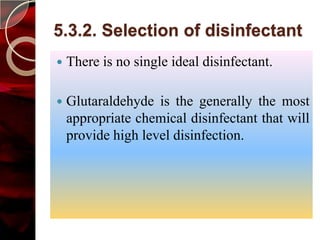
5.3.2. Selection of disinfectant
   There is no single ideal disinfectant.

   Glutaraldehyde is the generally the most
    appropriate chemical disinfectant that will
    provide high level disinfection.
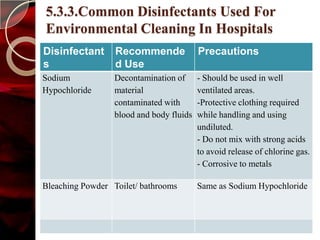
5.3.3.Common Disinfectants Used For
Environmental Cleaning In Hospitals
Disinfectant      Recommende              Precautions
s                 d Use
Sodium            Decontamination of      - Should be used in well
Hypochloride      material                ventilated areas.
                  contaminated with       -Protective clothing required
                  blood and body fluids   while handling and using
                                          undiluted.
                                          - Do not mix with strong acids
                                          to avoid release of chlorine gas.
                                          - Corrosive to metals

Bleaching Powder Toilet/ bathrooms        Same as Sodium Hypochloride
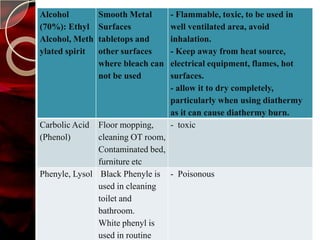
Alcohol         Smooth Metal       - Flammable, toxic, to be used in
(70%): Ethyl    Surfaces           well ventilated area, avoid
Alcohol, Meth   tabletops and      inhalation.
ylated spirit   other surfaces     - Keep away from heat source,
                where bleach can   electrical equipment, flames, hot
                not be used        surfaces.
                                   - allow it to dry completely,
                                   particularly when using diathermy
                                   as it can cause diathermy burn.
Carbolic Acid  Floor mopping,      - toxic
(Phenol)       cleaning OT room,
               Contaminated bed,
               furniture etc
Phenyle, Lysol Black Phenyle is - Poisonous
               used in cleaning
               toilet and
               bathroom.
               White phenyl is
               used in routine
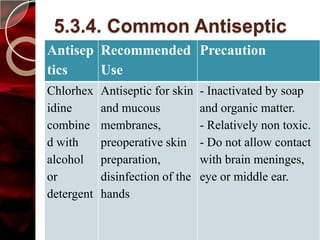
5.3.4. Common Antiseptic
Antisep Recommended Precaution
tics    Use
Chlorhex    Antiseptic for skin   - Inactivated by soap
idine       and mucous            and organic matter.
combine     membranes,            - Relatively non toxic.
d with      preoperative skin     - Do not allow contact
alcohol     preparation,          with brain meninges,
or          disinfection of the   eye or middle ear.
detergent   hands
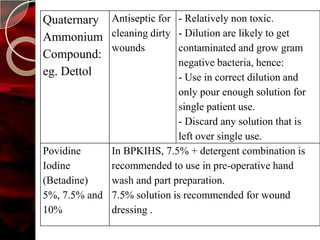
Quaternary Antiseptic for   - Relatively non toxic.
Ammonium cleaning dirty     - Dilution are likely to get
           wounds           contaminated and grow gram
Compound:
                            negative bacteria, hence:
eg. Dettol                  - Use in correct dilution and
                            only pour enough solution for
                            single patient use.
                            - Discard any solution that is
                            left over single use.
Povidine     In BPKIHS, 7.5% + detergent combination is
Iodine       recommended to use in pre-operative hand
(Betadine)   wash and part preparation.
5%, 7.5% and 7.5% solution is recommended for wound
10%          dressing .
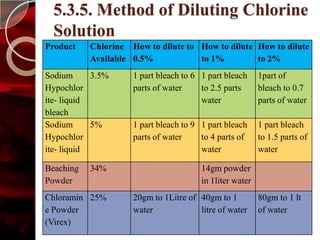
5.3.5. Method of Diluting Chlorine
  Solution
Product    Chlorine How to dilute to How to dilute How to dilute
           Available 0.5%            to 1%         to 2%
Sodium      3.5%     1 part bleach to 6 1 part bleach     1part of
Hypochlor            parts of water     to 2.5 parts      bleach to 0.7
ite- liquid                             water             parts of water
bleach
Sodium      5%       1 part bleach to 9 1 part bleach     1 part bleach
Hypochlor            parts of water     to 4 parts of     to 1.5 parts of
ite- liquid                             water             water

Beaching   34%                          14gm powder
Powder                                  in 1liter water
Chloramin 25%        20gm to 1Litre of 40gm to 1          80gm to 1 lt
e Powder             water             litre of water     of water
(Virex)
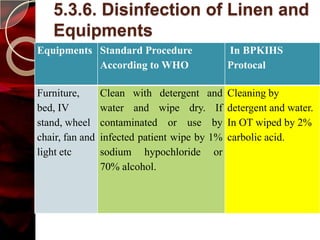
5.3.6. Disinfection of Linen and
   Equipments
Equipments Standard Procedure                  In BPKIHS
           According to WHO                    Protocal

Furniture,       Clean with detergent and      Cleaning by
bed, IV          water and wipe dry. If        detergent and water.
stand, wheel     contaminated or use by        In OT wiped by 2%
chair, fan and   infected patient wipe by 1%   carbolic acid.
light etc        sodium hypochloride or
                 70% alcohol.
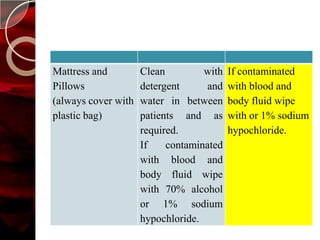
Mattress and         Clean         with   If contaminated
Pillows              detergent     and    with blood and
(always cover with   water in between     body fluid wipe
plastic bag)         patients and as      with or 1% sodium
                     required.            hypochloride.
                     If    contaminated
                     with blood and
                     body fluid wipe
                     with 70% alcohol
                     or 1% sodium
                     hypochloride.
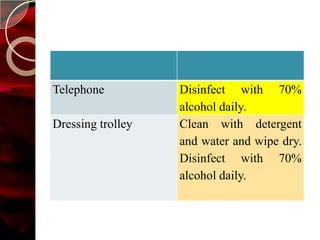
Telephone          Disinfect with 70%
                   alcohol daily.
Dressing trolley   Clean with detergent
                   and water and wipe dry.
                   Disinfect with 70%
                   alcohol daily.
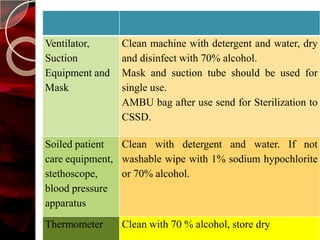
Ventilator,     Clean machine with detergent and water, dry
Suction         and disinfect with 70% alcohol.
Equipment and   Mask and suction tube should be used for
Mask            single use.
                AMBU bag after use send for Sterilization to
                CSSD.

Soiled patient  Clean with detergent and water. If not
care equipment, washable wipe with 1% sodium hypochlorite
stethoscope,    or 70% alcohol.
blood pressure
apparatus
Thermometer     Clean with 70 % alcohol, store dry
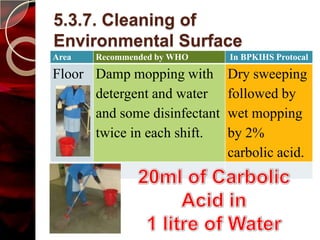
5.3.7. Cleaning of
Environmental Surface
Area   Recommended by WHO     In BPKIHS Protocal

Floor Damp mopping with       Dry sweeping
      detergent and water     followed by
      and some disinfectant   wet mopping
      twice in each shift.    by 2%
                              carbolic acid.
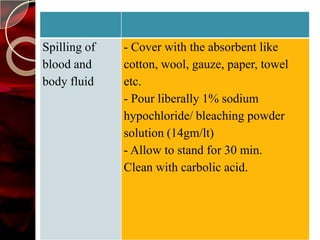
Spilling of   - Cover with the absorbent like
blood and     cotton, wool, gauze, paper, towel
body fluid    etc.
              - Pour liberally 1% sodium
              hypochloride/ bleaching powder
              solution (14gm/lt)
              - Allow to stand for 30 min.
              Clean with carbolic acid.
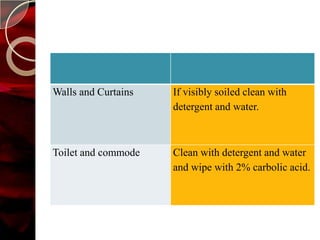
Walls and Curtains   If visibly soiled clean with
                     detergent and water.


Toilet and commode   Clean with detergent and water
                     and wipe with 2% carbolic acid.
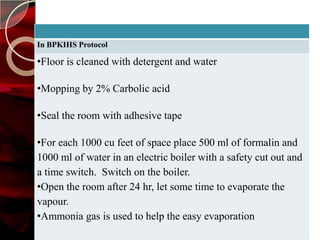
In BPKIHS Protocol

•Floor is cleaned with detergent and water

•Mopping by 2% Carbolic acid

•Seal the room with adhesive tape

•For each 1000 cu feet of space place 500 ml of formalin and
1000 ml of water in an electric boiler with a safety cut out and
a time switch. Switch on the boiler.
•Open the room after 24 hr, let some time to evaporate the
vapour.
•Ammonia gas is used to help the easy evaporation
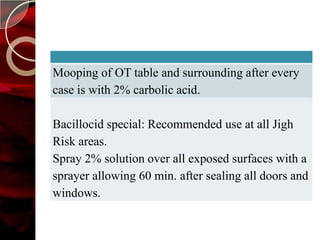
Mooping of OT table and surrounding after every
case is with 2% carbolic acid.

Bacillocid special: Recommended use at all Jigh
Risk areas.
Spray 2% solution over all exposed surfaces with a
sprayer allowing 60 min. after sealing all doors and
windows.
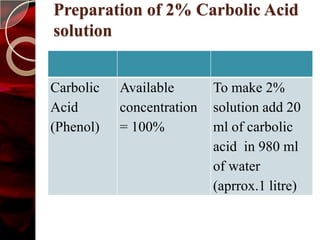
Preparation of 2% Carbolic Acid
solution


Carbolic   Available       To make 2%
Acid       concentration   solution add 20
(Phenol)   = 100%          ml of carbolic
                           acid in 980 ml
                           of water
                           (aprrox.1 litre)
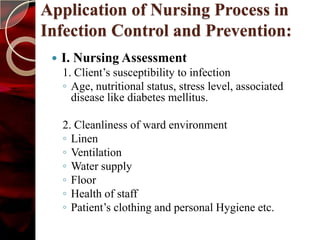
Application of Nursing Process in
Infection Control and Prevention:
    I. Nursing Assessment
     1. Client’s susceptibility to infection
     ◦ Age, nutritional status, stress level, associated
       disease like diabetes mellitus.

     2. Cleanliness of ward environment
     ◦ Linen
     ◦ Ventilation
     ◦ Water supply
     ◦ Floor
     ◦ Health of staff
     ◦ Patient’s clothing and personal Hygiene etc.
   Decontamination, Disinfection and
    Sterilization

   Procedure

   Dressing

   Hand washing

   IV insertion

   Catheterization etc.
   Isolation of Infected case

   Standard Precaution

   Availability of Personnel Protective Equipment
    eg. Gloves, mask, gown etc.

   Stock of sterile items

   Waste disposal

   Adherence of health personnel to IP guideline

   Familiarity of staff about IP guidelines
II. Nursing Diagnosis
1. Risk for infection related to
 Improper technique while inserting cannula
 Using same syringes, cannula, IV set for prolonged time
 Failure to recognize early sign of infection and infiltration
 Indwelling catheter
 Unsterile technique while inserting catheter
 Touching the connection tubing with contaminated hands
 Back flow of urine from the tubing and uro bag.
 Failure to follow aseptic technique during change of dressing
 Contamination of opened wound with soiled linen, cloths and
   hands
 Cross infection with other patient or health personnel.
 Transmission of disease from patient to patient, patient to staff
   and staff to staff.
   Knowledge deficit among nursing and
    cleaning staff about the procedure of
    making disinfect solution of different
    concentration

   Risk for impair skin integrity

   Social Isolation
III. Nursing Goal
   Prevention of exposure to infectious
    organism.

   Controlling and reducing the extent of
    infection

   Maintaining resistance to infection

   Educating the clients and family about
    infection control technique.
Expected Outcome
   The overall goal of IP program is the reduction of nosocomial
    infection in the ward

   Client will remain free of infection as evidenced by

   Client will remain afebrile

   Client will develop no signs and symptoms of local infection (eg.
    Remain free of cough, purulent drainage from wound or normal body
    opening)

   Client will become knowledgeable of infection risk.

   Client will identify routine to follow in the hospital as well as in
    hospital that reduce transmission of micro organism.

   Client will identify signs and symptoms to report health care provider
    indicating infection.
IV. Nursing Intervention
   Monitor client’s body temperature routinely, inspect oral cavity
    for lesions, inspect urethral and vaginal orifice for drainage or
    discharge, assess IV assess site for sign of infection and observe
    the client for evidence of cough.

   Practice hand hygiene routinely before caring for client,
    between clients, and before any invasive procedure.

   Supervision and education of cleaning staff in preparation of
    solution for floor mopping, carbolization, decontamination etc.

   Use aseptic technique perfoming all surgical procedure like
    dressing, catheterization, ET tube suctioning etc.
   Use aseptic technique while inserting IV cannula,
    change cannula, IV set in 72 hrs, Change labeled
    syringe for IV injection in every 24 hours.

   Teach the patients’ relative about the way of
    emptying urobag.

   Provide catheter care to the patient.

   Change foley’s catheter in every 7 days.

   Follow standard precautions.

   Provide education to the patient and relatives about
    importance and process of deep breathing and
    coughing.
   Proper disposal of waste in color coded bucket,
    monitor and supervise the use by all staff, patients
    and patient’s relatives.

   Controlling of visitors.

   Change dressing that become wet and soiled.

   Adequate supplies of clean and sterile gloves,
    gown, mask, detergent, disinfectants should be
    there in the ward.

   Monitoring of use of antibiotics.
   Change Gltutareldehyde solution in every 28th days
   Monitoring of the shelf life of sterile equipment, if not used
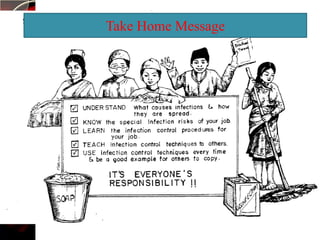
                 Take Home Message
    within 7 days send to CSSD for resterilization without
    reopening the pack.
   Supervise the cleaning of equipment like AMBU bag, mask,
    O2 mask, tubing, Nebulizer set etc.
   Wipe the thermometer with 70%alcohol after using each
    patient.
   Send periodic culture of different sites like dressing, treatment
    trolley, cydex container, tap water etc.
    Appropriate use of isolation procedure for infected case.
   Maintain the ventilation of the ward.
   Stay healthy, take nutritious food.
   Use available protective device and also encourage others to
    use.
Person to Contact if any
confusion about Infection Control
References
1.    Deb M. hospital-acquired Infections: Guidelines for Control, BP
      Koirala Institute of Health Sciences, Dharan, Nepal.
2.    Wenzel, Brewer, Butzler. A Guide to Infection Control in the Hospital.
      International Society of Infection Control. Hamilton. Ontario. BC
      Decker Inc; 2nd Edition; 2002.
3.    Sakarkar BM. Principles of Hospital Administration and Planning.New
      Delhi. Jaypee Brothers Medical Publishers P. Ltd; first Edition; 1998.
4.    WHO. Practical Guidelines for Infection Control in Health care
      Facilities. WHO; 2003.
5.    WHO. A manual on Infection Control in Health Facilities. WHO
      Regional Office for South East Asia. New Delhi; 1990.
6.    Hospital Infection Society. Department of Health, England. Third
      Prevalence Survey in HCAI in England. Wilington House. Waterloo
      Road. London 2006.
7.    Poudyal P.Simkhada P. Bruce J. Infection control knowledge, attitude
      and practice among Nepalese health care workers. American Journal
      of Infection Control; October 2008; 36(8) : 595-597.
8.    Potter PA, Perry AG. Fundamental of Nursing. St. Louis. Missouri.
      Mosby; 6th Edition; 2005

Infection control

  • 2.
  • 3.
    Contents  Introduction  Spreadof infection in Hospital  Infection control Practices  Environmental Management of Infection Control  Decontamination, Sterilization and Disinfection  Application of Nursing Process in Infection Control
  • 4.
    Introduction  Infection may be transferred ◦ patient-to-patient, ◦ patients to staff ◦ staff to patients, ◦ or among-staff.  Infection control includes ◦ prevention (via hand hygiene/hand washing, cleaning/disinfection/sterilization, vaccination, surveillance), ◦ monitoring/investigation of demonstrated or suspected spread of infection within a particular health-care setting (surveillance and outbreak investigation), ◦ and management (interruption of outbreaks).
  • 5.
    History of HospitalInfection Control  Florence Nightingale was the first person to work for infection control in hospital.  In 1847 Dr. Ignaz Philip Semmelweis identified that 18% Mortality due to Puerperal Fever.  Case control study significance of hand washing was demonstrated.  Concept of “nosocomial infection was born.
  • 6.
    Background  Infection rate in developing countries was 15.5 per 100 patients, compared to “.1 [per 100 patients] in Europe and in the U.S., 4.5- BBC  ICU infection - developing countries: 47.9 per 1,000 patient, compared to 13.6 in the U.S.  In countries like India and Nepal, hospital infection data not reliably estimated.  Surgical infection at BPKIHS -1339 (7.3%) among 18325 total surgeries.  Estimates vary from 10 to 30%, the least being about 3% in the best of hospitals  Wound sepsis alone affects 20% of post-operative cases
  • 7.
    Hospital infection adversely affects the image of hospital.  Nosocomial infections : ◦ direct death 1% ◦ Indirectly mortality in 3%  50% of nosocomial infections are preventable.
  • 8.
    The main healthcare related infections are 1. Urinary tract infections (catheter-associated) 2. Surgical site Infections 3. Bloodstream infections (central line-associated) 4. Pneumonia (ventilator- associated)
  • 9.
    Healthcare-Associated Infections – Numbersand Costs in USA Total HAIs 1.7 million Deaths 99,000 Average additional direct $13.6 cost to hospital billion Overall net hospital cost $8.5 billion Not counted are •Costs to patient/QALY, payer, provider, society, caregiver time/resource •Intangibles such as pain and suffering •Indirect: lost productivity, lost retirement savings and benefits •Decreasing HAIs by 25% would save $148,667 per hospital
  • 10.
    Infectious Immuno - Bacteria, Fungi, Agent Suppresse Virus, Parasites d, Elderly, Chronically ill, trauma, Susceptib Sources Human newborn, s le Host urgery Beings Animal Inanimate Spread of Object Mucus Membrane, INFECTION Non intact Skin, GI Sputum, tract, GU Portal of Portal of Emesis, tract, Respi Entry Exit Stool, Bl ratory Tract ood Mode of Transmis Contact, Vehic sion le, Air borne, Vector borne
  • 11.
    3. Infection controlpractices Additional Standard (Transmission Precautions -Based) Precautions
  • 12.
    3.1. Standard Precaution Hand washing Use of personal protective equipment Appropriate handling of patient care equipment and soiled linen Prevention of needlestick/sharp injuries Environmental cleaning and spills- management Appropriate handling of waste
  • 16.
    Additional (Transmission-Based) Precautions Airborne precautions Contact Droplet precautions precautions
  • 17.
    4. Environmental Management forInfection Prevention Air, Waste Ventilation Management Vector Water Control Cleaning The Hospital Environment
  • 18.
    TYPES OF PATHOGENICWASTE IN HOSPITAL Radioactive Waste
  • 19.
    4.5.2. Color Codingof Container for Bio- Medical Wastes Disposal  Red Colour:  Blood and its product, pad contaminated with body fluid, dressing items, used infusion sets, used catheter set, contaminated cotton roll etc.  Human anatomical waste(eg. tissues, organs, body parts etc).
  • 20.
     Blue  Freefrom blood contaminated items such as; saline bottle, gauze, pad, I/v set, drugs cover and literature.
  • 21.
     Green  Fruitscover,kitchen waste, non ca. medicine ampoule, and dry items only.Non con blood taminated items should be kept in green color's container.
  • 22.
     Plastic containeror cartoon box  Sharps items or skin pricking materials Such as: needles, syringes, scalpels, blades, gl ass etc. that may cause puncture and cuts. This includes both used and unused sharps.
  • 23.
    Extra bucket orblack plastic bag:  From the site of operation theatre items such as; body parts, tissues).  Orange:  Laboratory related items eg. vial,chemical reagents etc.
  • 24.
    4.5.3.Laundry  Handle all linen with minimum agitation.  Place soiled/contaminated linen in impervious bags for transportation.  Disinfect by using hot water and/or bleach (use heavy-duty gloves, eye protection and masks to protect against splashes).  Wash linen in hot water (70 C to 80 C) and detergent, rinse and dry preferably in a dryer or in the sun.
  • 25.
    Wash woollen blankets in warm water and dry in the sun.  Bed Cover: Change weekly or whenever soiled and on discharge.  Bed sheet: Change on alternate day or whenever soiled and on discharge.  Mattresses and pillows: Cover with inpervious plastic. They can be cleaned by wiping with a housekeeping disinfectant- detergent.  Blood stained linen: Soak in 1% sodium hypochloride for 30 min. and send to laundry.
  • 26.
    Decontamination, Sterilization, Disinfection 5.1. Decontamination  Decontamination of medical equipment involves the destruction or removal of any organisms present in order to prevent them infecting other patients or hospital staff.
  • 27.
    Sterilization  Sterilization isthe destruction of all micro-organisms. 1. Autoclave (Steam Under Pressure) 2. Flamming 3. Chemical Sterilization i. Glutaraldehyde ii. Alcohol iii. Formalin 4. Gas Sterlization i. Ethylene Oxide 5. Iradiation
  • 28.
    5.2.2. Sterilization MethodAvailable In BPKIHS  Autoclaving: 4 machine in CSSD, 1 not functioning  2% Glutaraldehyde solution : as necessity in each ward  Gas sterilization by formalin tablet in OT for suction pipe, cautry wire, tip etc.
  • 29.
    5.2.2. Storage ofSterile Equipment  Keep the storage area clean, dry, dust-free and lint-free.  Control temperature and humidity (approximate temperature 240C and relative humidity <70%) when possible.  Packs and containers with sterile (or high-level disinfected) items should be stored 20–25 cm (8–10 inches) off the floor, 45–50 cm (18–20 inches) from the ceiling and 15–20 cm (6–8 inches) from an outside wall.  Do not use cardboard boxes for storage.  Date and rotate the supplies (first in/first out).  Change the cydex solution in each 28th day
  • 30.
    Disinfection  Disinfection removes micro-organisms without complete sterilization.
  • 31.
    5.3.1. List OfDisinfectants Available In BPKIHS 1. Methylated spirit (70%) 2. Isopropyl alcohol (70%) 3. Povidone Iodine solution (7.5%) 4. Povidone Iodine (7.5) and Detergent (Surgical Scrub/ Betadine Scrub/ wokadine Scrub etc.) 5. Sodium hypo chloride (1% solution) 6. Bleaching powder (14gms/Litre) 7. Formalin (40%Liquid) 8. Glutaraldehyde (2% activated) 9. Carbolic Acid (2%) 10. Detergent powder
  • 32.
    5.3.2. Selection ofdisinfectant  There is no single ideal disinfectant.  Glutaraldehyde is the generally the most appropriate chemical disinfectant that will provide high level disinfection.
  • 33.
    5.3.3.Common Disinfectants UsedFor Environmental Cleaning In Hospitals Disinfectant Recommende Precautions s d Use Sodium Decontamination of - Should be used in well Hypochloride material ventilated areas. contaminated with -Protective clothing required blood and body fluids while handling and using undiluted. - Do not mix with strong acids to avoid release of chlorine gas. - Corrosive to metals Bleaching Powder Toilet/ bathrooms Same as Sodium Hypochloride
  • 34.
    Alcohol Smooth Metal - Flammable, toxic, to be used in (70%): Ethyl Surfaces well ventilated area, avoid Alcohol, Meth tabletops and inhalation. ylated spirit other surfaces - Keep away from heat source, where bleach can electrical equipment, flames, hot not be used surfaces. - allow it to dry completely, particularly when using diathermy as it can cause diathermy burn. Carbolic Acid Floor mopping, - toxic (Phenol) cleaning OT room, Contaminated bed, furniture etc Phenyle, Lysol Black Phenyle is - Poisonous used in cleaning toilet and bathroom. White phenyl is used in routine
  • 35.
    5.3.4. Common Antiseptic AntisepRecommended Precaution tics Use Chlorhex Antiseptic for skin - Inactivated by soap idine and mucous and organic matter. combine membranes, - Relatively non toxic. d with preoperative skin - Do not allow contact alcohol preparation, with brain meninges, or disinfection of the eye or middle ear. detergent hands
  • 36.
    Quaternary Antiseptic for - Relatively non toxic. Ammonium cleaning dirty - Dilution are likely to get wounds contaminated and grow gram Compound: negative bacteria, hence: eg. Dettol - Use in correct dilution and only pour enough solution for single patient use. - Discard any solution that is left over single use. Povidine In BPKIHS, 7.5% + detergent combination is Iodine recommended to use in pre-operative hand (Betadine) wash and part preparation. 5%, 7.5% and 7.5% solution is recommended for wound 10% dressing .
  • 37.
    5.3.5. Method ofDiluting Chlorine Solution Product Chlorine How to dilute to How to dilute How to dilute Available 0.5% to 1% to 2% Sodium 3.5% 1 part bleach to 6 1 part bleach 1part of Hypochlor parts of water to 2.5 parts bleach to 0.7 ite- liquid water parts of water bleach Sodium 5% 1 part bleach to 9 1 part bleach 1 part bleach Hypochlor parts of water to 4 parts of to 1.5 parts of ite- liquid water water Beaching 34% 14gm powder Powder in 1liter water Chloramin 25% 20gm to 1Litre of 40gm to 1 80gm to 1 lt e Powder water litre of water of water (Virex)
  • 38.
    5.3.6. Disinfection ofLinen and Equipments Equipments Standard Procedure In BPKIHS According to WHO Protocal Furniture, Clean with detergent and Cleaning by bed, IV water and wipe dry. If detergent and water. stand, wheel contaminated or use by In OT wiped by 2% chair, fan and infected patient wipe by 1% carbolic acid. light etc sodium hypochloride or 70% alcohol.
  • 39.
    Mattress and Clean with If contaminated Pillows detergent and with blood and (always cover with water in between body fluid wipe plastic bag) patients and as with or 1% sodium required. hypochloride. If contaminated with blood and body fluid wipe with 70% alcohol or 1% sodium hypochloride.
  • 40.
    Telephone Disinfect with 70% alcohol daily. Dressing trolley Clean with detergent and water and wipe dry. Disinfect with 70% alcohol daily.
  • 41.
    Ventilator, Clean machine with detergent and water, dry Suction and disinfect with 70% alcohol. Equipment and Mask and suction tube should be used for Mask single use. AMBU bag after use send for Sterilization to CSSD. Soiled patient Clean with detergent and water. If not care equipment, washable wipe with 1% sodium hypochlorite stethoscope, or 70% alcohol. blood pressure apparatus Thermometer Clean with 70 % alcohol, store dry
  • 42.
    5.3.7. Cleaning of EnvironmentalSurface Area Recommended by WHO In BPKIHS Protocal Floor Damp mopping with Dry sweeping detergent and water followed by and some disinfectant wet mopping twice in each shift. by 2% carbolic acid.
  • 43.
    Spilling of - Cover with the absorbent like blood and cotton, wool, gauze, paper, towel body fluid etc. - Pour liberally 1% sodium hypochloride/ bleaching powder solution (14gm/lt) - Allow to stand for 30 min. Clean with carbolic acid.
  • 44.
    Walls and Curtains If visibly soiled clean with detergent and water. Toilet and commode Clean with detergent and water and wipe with 2% carbolic acid.
  • 45.
    In BPKIHS Protocol •Flooris cleaned with detergent and water •Mopping by 2% Carbolic acid •Seal the room with adhesive tape •For each 1000 cu feet of space place 500 ml of formalin and 1000 ml of water in an electric boiler with a safety cut out and a time switch. Switch on the boiler. •Open the room after 24 hr, let some time to evaporate the vapour. •Ammonia gas is used to help the easy evaporation
  • 46.
    Mooping of OTtable and surrounding after every case is with 2% carbolic acid. Bacillocid special: Recommended use at all Jigh Risk areas. Spray 2% solution over all exposed surfaces with a sprayer allowing 60 min. after sealing all doors and windows.
  • 47.
    Preparation of 2%Carbolic Acid solution Carbolic Available To make 2% Acid concentration solution add 20 (Phenol) = 100% ml of carbolic acid in 980 ml of water (aprrox.1 litre)
  • 48.
    Application of NursingProcess in Infection Control and Prevention:  I. Nursing Assessment 1. Client’s susceptibility to infection ◦ Age, nutritional status, stress level, associated disease like diabetes mellitus. 2. Cleanliness of ward environment ◦ Linen ◦ Ventilation ◦ Water supply ◦ Floor ◦ Health of staff ◦ Patient’s clothing and personal Hygiene etc.
  • 49.
    Decontamination, Disinfection and Sterilization  Procedure  Dressing  Hand washing  IV insertion  Catheterization etc.
  • 50.
    Isolation of Infected case  Standard Precaution  Availability of Personnel Protective Equipment eg. Gloves, mask, gown etc.  Stock of sterile items  Waste disposal  Adherence of health personnel to IP guideline  Familiarity of staff about IP guidelines
  • 51.
    II. Nursing Diagnosis 1.Risk for infection related to  Improper technique while inserting cannula  Using same syringes, cannula, IV set for prolonged time  Failure to recognize early sign of infection and infiltration  Indwelling catheter  Unsterile technique while inserting catheter  Touching the connection tubing with contaminated hands  Back flow of urine from the tubing and uro bag.  Failure to follow aseptic technique during change of dressing  Contamination of opened wound with soiled linen, cloths and hands  Cross infection with other patient or health personnel.  Transmission of disease from patient to patient, patient to staff and staff to staff.
  • 52.
    Knowledge deficit among nursing and cleaning staff about the procedure of making disinfect solution of different concentration  Risk for impair skin integrity  Social Isolation
  • 53.
    III. Nursing Goal  Prevention of exposure to infectious organism.  Controlling and reducing the extent of infection  Maintaining resistance to infection  Educating the clients and family about infection control technique.
  • 54.
    Expected Outcome  The overall goal of IP program is the reduction of nosocomial infection in the ward  Client will remain free of infection as evidenced by  Client will remain afebrile  Client will develop no signs and symptoms of local infection (eg. Remain free of cough, purulent drainage from wound or normal body opening)  Client will become knowledgeable of infection risk.  Client will identify routine to follow in the hospital as well as in hospital that reduce transmission of micro organism.  Client will identify signs and symptoms to report health care provider indicating infection.
  • 55.
    IV. Nursing Intervention  Monitor client’s body temperature routinely, inspect oral cavity for lesions, inspect urethral and vaginal orifice for drainage or discharge, assess IV assess site for sign of infection and observe the client for evidence of cough.  Practice hand hygiene routinely before caring for client, between clients, and before any invasive procedure.  Supervision and education of cleaning staff in preparation of solution for floor mopping, carbolization, decontamination etc.  Use aseptic technique perfoming all surgical procedure like dressing, catheterization, ET tube suctioning etc.
  • 56.
    Use aseptic technique while inserting IV cannula, change cannula, IV set in 72 hrs, Change labeled syringe for IV injection in every 24 hours.  Teach the patients’ relative about the way of emptying urobag.  Provide catheter care to the patient.  Change foley’s catheter in every 7 days.  Follow standard precautions.  Provide education to the patient and relatives about importance and process of deep breathing and coughing.
  • 57.
    Proper disposal of waste in color coded bucket, monitor and supervise the use by all staff, patients and patient’s relatives.  Controlling of visitors.  Change dressing that become wet and soiled.  Adequate supplies of clean and sterile gloves, gown, mask, detergent, disinfectants should be there in the ward.  Monitoring of use of antibiotics.  Change Gltutareldehyde solution in every 28th days
  • 58.
    Monitoring of the shelf life of sterile equipment, if not used Take Home Message within 7 days send to CSSD for resterilization without reopening the pack.  Supervise the cleaning of equipment like AMBU bag, mask, O2 mask, tubing, Nebulizer set etc.  Wipe the thermometer with 70%alcohol after using each patient.  Send periodic culture of different sites like dressing, treatment trolley, cydex container, tap water etc.  Appropriate use of isolation procedure for infected case.  Maintain the ventilation of the ward.  Stay healthy, take nutritious food.  Use available protective device and also encourage others to use.
  • 59.
    Person to Contactif any confusion about Infection Control
  • 61.
    References 1. Deb M. hospital-acquired Infections: Guidelines for Control, BP Koirala Institute of Health Sciences, Dharan, Nepal. 2. Wenzel, Brewer, Butzler. A Guide to Infection Control in the Hospital. International Society of Infection Control. Hamilton. Ontario. BC Decker Inc; 2nd Edition; 2002. 3. Sakarkar BM. Principles of Hospital Administration and Planning.New Delhi. Jaypee Brothers Medical Publishers P. Ltd; first Edition; 1998. 4. WHO. Practical Guidelines for Infection Control in Health care Facilities. WHO; 2003. 5. WHO. A manual on Infection Control in Health Facilities. WHO Regional Office for South East Asia. New Delhi; 1990. 6. Hospital Infection Society. Department of Health, England. Third Prevalence Survey in HCAI in England. Wilington House. Waterloo Road. London 2006. 7. Poudyal P.Simkhada P. Bruce J. Infection control knowledge, attitude and practice among Nepalese health care workers. American Journal of Infection Control; October 2008; 36(8) : 595-597. 8. Potter PA, Perry AG. Fundamental of Nursing. St. Louis. Missouri. Mosby; 6th Edition; 2005