Classroom interaction
Dr. Suhail Sarhandi
Patterns of classroom interaction
Initiation-Response-Feedback (IRF)
N.B. Interaction can be between students, or between
student and the material.
Classifying forms of interaction
1 TT A Teacher and students fairly
equally active
2 T B Students very active, teacher only
receptive
3 TS C Teacher active, students mainly
receptive
4 S D Teacher very active, students only
receptive
5 SS E Students active, teacher mainly
receptive
Match the correct definitions with the terms
Classifying forms of interaction
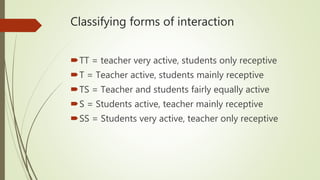
TT = teacher very active, students only receptive
T = Teacher active, students mainly receptive
TS = Teacher and students fairly equally active
S = Students active, teacher mainly receptive
SS = Students very active, teacher only receptive
Match the
interaction
patters with
these
activities
Discussion questions
Was there one particular type of interaction that seemed
to predominate?
Did teacher activity predominate? Or student activity? Or
was the interaction more or less balanced?
How appropriate did you think the chosen interaction
patterns were for the teaching and objectives in different
activities? Perhaps look at one or two specific examples
from your observation.
Interaction patters from the most teacher-
dominated (1) to the most student-active (9).
1. Teacher Talk ( TT )
2. Choral responses (T)
3. Closed-ended teacher questioning (‘IRF’) (T)
4. Open-ended teacher questioning (TS)
5. Student initiates, teacher questioning (TS)
6. Full-class interaction (S)
7. Individual work (S)
8. Collaboration (S)
9. Group work (S)
10.Self-access (SS)

Classroom interaction

  • 1.
  • 2.
    Patterns of classroominteraction Initiation-Response-Feedback (IRF) N.B. Interaction can be between students, or between student and the material.
  • 3.
    Classifying forms ofinteraction 1 TT A Teacher and students fairly equally active 2 T B Students very active, teacher only receptive 3 TS C Teacher active, students mainly receptive 4 S D Teacher very active, students only receptive 5 SS E Students active, teacher mainly receptive Match the correct definitions with the terms
  • 4.
    Classifying forms ofinteraction TT = teacher very active, students only receptive T = Teacher active, students mainly receptive TS = Teacher and students fairly equally active S = Students active, teacher mainly receptive SS = Students very active, teacher only receptive
  • 5.
  • 6.
    Discussion questions Was thereone particular type of interaction that seemed to predominate? Did teacher activity predominate? Or student activity? Or was the interaction more or less balanced? How appropriate did you think the chosen interaction patterns were for the teaching and objectives in different activities? Perhaps look at one or two specific examples from your observation.
  • 7.
    Interaction patters fromthe most teacher- dominated (1) to the most student-active (9). 1. Teacher Talk ( TT ) 2. Choral responses (T) 3. Closed-ended teacher questioning (‘IRF’) (T) 4. Open-ended teacher questioning (TS) 5. Student initiates, teacher questioning (TS) 6. Full-class interaction (S) 7. Individual work (S) 8. Collaboration (S) 9. Group work (S) 10.Self-access (SS)

Editor's Notes

  • #7 Discussion questions: Note down the interaction patters that you have observed or saw.