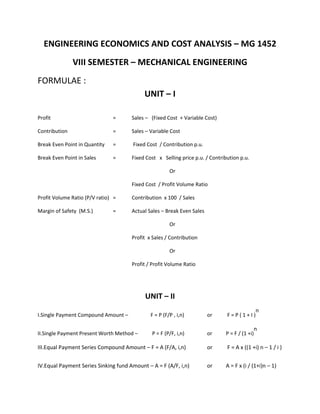
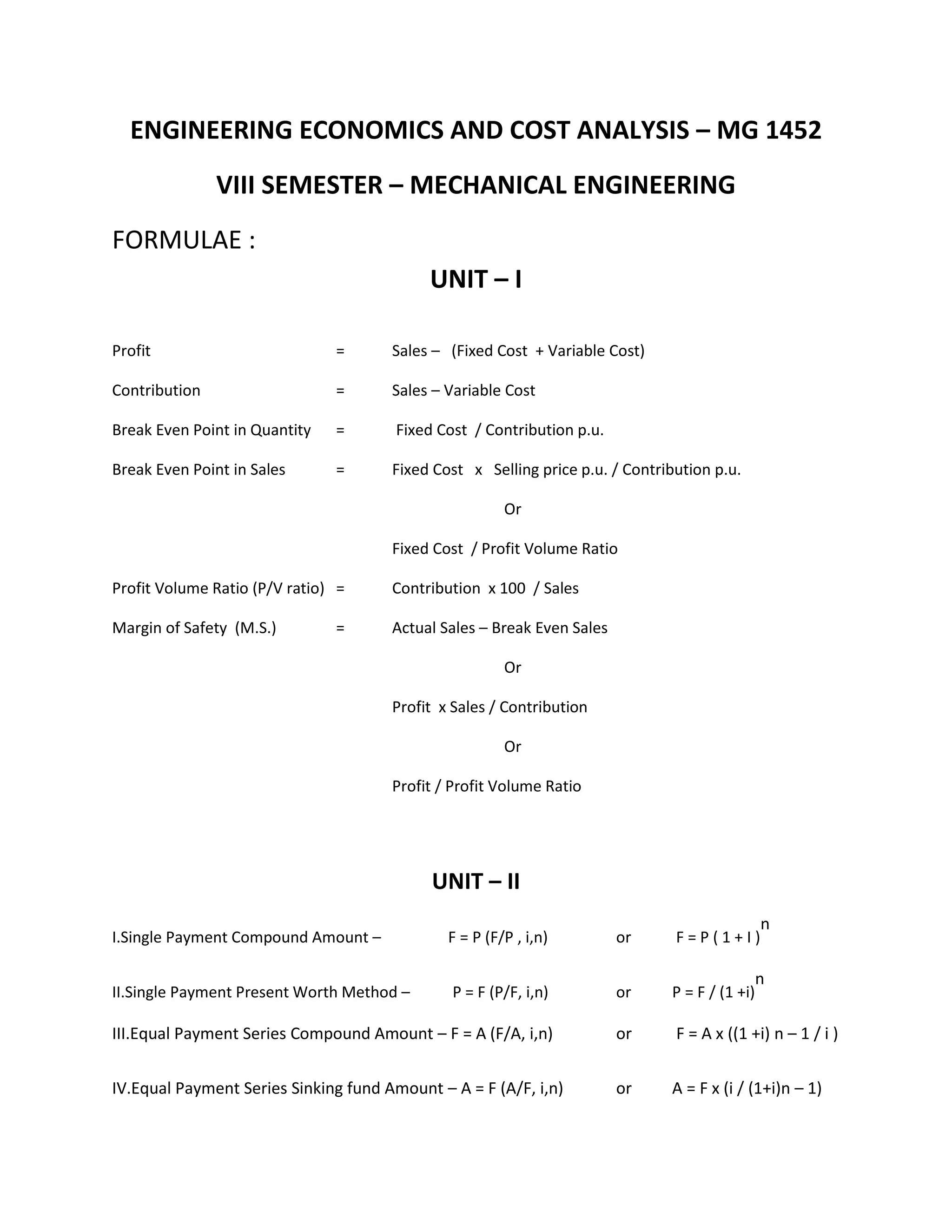
ENGINEERING ECONOMICS AND COST ANALYSIS – MG 1452
VIII SEMESTER – MECHANICAL ENGINEERING
FORMULAE :
UNIT – I
Profit = Sales – (Fixed Cost + Variable Cost)
Contribution = Sales – Variable Cost
Break Even Point in Quantity = Fixed Cost / Contribution p.u.
Break Even Point in Sales = Fixed Cost x Selling price p.u. / Contribution p.u.
Or
Fixed Cost / Profit Volume Ratio
Profit Volume Ratio (P/V ratio) = Contribution x 100 / Sales
Margin of Safety (M.S.) = Actual Sales – Break Even Sales
Or
Profit x Sales / Contribution
Or
Profit / Profit Volume Ratio
UNIT – II
I.Single Payment Compound Amount – F = P (F/P , i,n) or F = P ( 1 + I )
n
II.Single Payment Present Worth Method – P = F (P/F, i,n) or P = F / (1 +i)
n
III.Equal Payment Series Compound Amount – F = A (F/A, i,n) or F = A x ((1 +i) n – 1 / i )
IV.Equal Payment Series Sinking fund Amount – A = F (A/F, i,n) or A = F x (i / (1+i)n – 1)
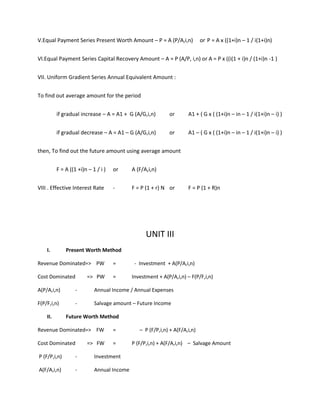
V.Equal Payment Series Present Worth Amount – P = A (P/A,i,n) or P = A x ((1+i)n – 1 / i(1+i)n)
VI.Equal Payment Series Capital Recovery Amount – A = P (A/P, i,n) or A = P x ((i(1 + i)n / (1+i)n -1 )
VII. Uniform Gradient Series Annual Equivalent Amount :
To find out average amount for the period
if gradual increase – A = A1 + G (A/G,i,n) or A1 + ( G x ( (1+i)n – in – 1 / i(1+i)n – i) )
if gradual decrease – A = A1 – G (A/G,i,n) or A1 – ( G x ( (1+i)n – in – 1 / i(1+i)n – i) )
then, To find out the future amount using average amount
F = A ((1 +i)n – 1 / i ) or A (F/A,i,n)
VIII . Effective Interest Rate - F = P (1 + r) N or F = P (1 + R)n
UNIT III
I. Present Worth Method
Revenue Dominated=> PW = - Investment + A(P/A,i,n)
Cost Dominated => PW = Investment + A(P/A,i,n) – F(P/F,i,n)
A(P/A,i,n) - Annual Income / Annual Expenses
F(P/F,i,n) - Salvage amount – Future Income
II. Future Worth Method
Revenue Dominated=> FW = – P (F/P,i,n) + A(F/A,i,n)
Cost Dominated => FW = P (F/P,i,n) + A(F/A,i,n) – Salvage Amount
P (F/P,i,n) - Investment
A(F/A,i,n) - Annual Income
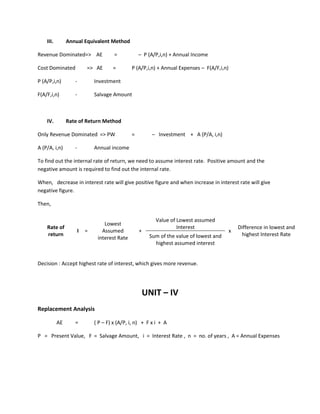
III. Annual Equivalent Method
Revenue Dominated=> AE = – P (A/P,i,n) + Annual Income
Cost Dominated => AE = P (A/P,i,n) + Annual Expenses – F(A/F,i,n)
P (A/P,i,n) - Investment
F(A/F,i,n) - Salvage Amount
IV. Rate of Return Method
Only Revenue Dominated => PW = – Investment + A (P/A, i,n)
A (P/A, i,n) - Annual income
To find out the internal rate of return, we need to assume interest rate. Positive amount and the
negative amount is required to find out the internal rate.
When, decrease in interest rate will give positive figure and when increase in interest rate will give
negative figure.
Then,
Value of Lowest assumed
InterestRate of
return
I =
Lowest
Assumed
interest Rate
+ x
Difference in lowest and
highest Interest RateSum of the value of lowest and
highest assumed interest
Decision : Accept highest rate of interest, which gives more revenue.
UNIT – IV
Replacement Analysis
AE = ( P – F) x (A/P, i, n) + F x i + A
P = Present Value, F = Salvage Amount, i = Interest Rate , n = no. of years , A = Annual Expenses
UNIT – V
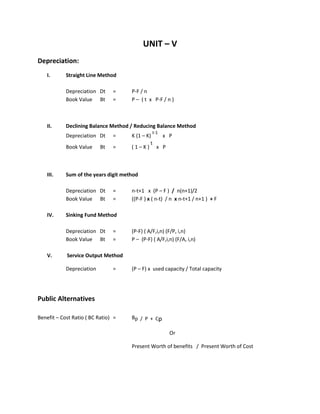
Depreciation:
I. Straight Line Method
Depreciation Dt = P-F / n
Book Value Bt = P – ( t x P-F / n )
II. Declining Balance Method / Reducing Balance Method
Depreciation Dt = K (1 – K)
t-1
x P
Book Value Bt = ( 1 – K )
t
x P
III. Sum of the years digit method
Depreciation Dt = n-t+1 x (P – F ) / n(n+1)/2
Book Value Bt = ((P-F ) x ( n-t) / n x n-t+1 / n+1 ) + F
IV. Sinking Fund Method
Depreciation Dt = (P-F) ( A/F,i,n) (F/P, i,n)
Book Value Bt = P – (P-F) ( A/F,i,n) (F/A, i,n)
V. Service Output Method
Depreciation = (P – F) x used capacity / Total capacity
Public Alternatives
Benefit – Cost Ratio ( BC Ratio) = Bp / P + Cp
Or
Present Worth of benefits / Present Worth of Cost
THEORY
UNIT – I
Economics : It is the science that deals with the production and consumption of goods and
services and the distribution and rendering of these for human welfare.
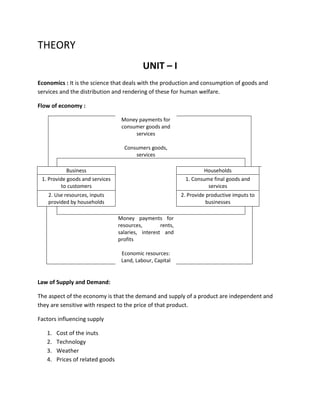
Flow of economy :
Money payments for
consumer goods and
services
Consumers goods,
services
Business Households
1. Provide goods and services
to customers
1. Consume final goods and
services
2. Use resources, inputs
provided by households
2. Provide productive imputs to
businesses
Money payments for
resources, rents,
salaries, interest and
profits
Economic resources:
Land, Labour, Capital
Law of Supply and Demand:
The aspect of the economy is that the demand and supply of a product are independent and
they are sensitive with respect to the price of that product.
Factors influencing supply
1. Cost of the inuts
2. Technology
3. Weather
4. Prices of related goods
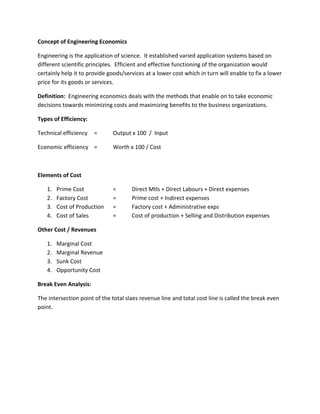
Concept of Engineering Economics
Engineering is the application of science. It established varied application systems based on
different scientific principles. Efficient and effective functioning of the organization would
certainly help it to provide goods/services at a lower cost which in turn will enable to fix a lower
price for its goods or services.
Definition: Engineering economics deals with the methods that enable on to take economic
decisions towards minimizing costs and maximizing benefits to the business organizations.
Types of Efficiency:
Technical efficiency = Output x 100 / Input
Economic efficiency = Worth x 100 / Cost
Elements of Cost
1. Prime Cost = Direct Mtls + Direct Labours + Direct expenses
2. Factory Cost = Prime cost + Indirect expenses
3. Cost of Production = Factory cost + Administrative exps
4. Cost of Sales = Cost of production + Selling and Distribution expenses
Other Cost / Revenues
1. Marginal Cost
2. Marginal Revenue
3. Sunk Cost
4. Opportunity Cost
Break Even Analysis:
The intersection point of the total slaes revenue line and total cost line is called the break even
point.
UNIT – II
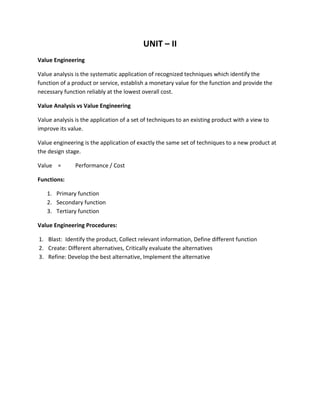
Value Engineering
Value analysis is the systematic application of recognized techniques which identify the
function of a product or service, establish a monetary value for the function and provide the
necessary function reliably at the lowest overall cost.
Value Analysis vs Value Engineering
Value analysis is the application of a set of techniques to an existing product with a view to
improve its value.
Value engineering is the application of exactly the same set of techniques to a new product at
the design stage.
Value = Performance / Cost
Functions:
1. Primary function
2. Secondary function
3. Tertiary function
Value Engineering Procedures:
1. Blast: Identify the product, Collect relevant information, Define different function
2. Create: Different alternatives, Critically evaluate the alternatives
3. Refine: Develop the best alternative, Implement the alternative
UNIT –IV
Replacement and Maintenance Analysis
It is an absolute necessity to maintain the equipment in good operating conditions with
economical cost. Thus, the organization needs an integrated approach to minimize the cost of
maintenance. In certain cases, the equipment will be obsolete over a period of time.
Reasons: a) Physical impairment of the various parts
b) Obsolescence of the equipment
Alternatives: a) Replacement of the existing equipment with a new one
b) Augmenting the existing one with an additional equipment
Types of Maintenance;
i) Preventive Maintenance
ii) Breakdown Maintenance
Types of Replacement
i) Replacement of assets that deteriorate with time
a) Determination of economic life of an asset
b) Replacement of an existing asset with a new asset
ii) Simple probabilistic model for assets which fail completely
a) Individual replacement policy
b) Group replacement policy
Challenger and Defender
If an existing equipment is considered for replacement with a new equipment, then the existing
equipment is known as the defender and the new equipment is known as challenger.
UNIT – V
Evaluation of Public alternatives:
The main objective of the any public alternative is to provide goods/services to the public at the
minimum cost. This is nothing but taking decision based on Benefit-Cost ratio (BC).
BC ratio = Equivalent benefits / Equivalent Costs

Engineering economics and cost analysis

  • 1.
    ENGINEERING ECONOMICS ANDCOST ANALYSIS – MG 1452 VIII SEMESTER – MECHANICAL ENGINEERING FORMULAE : UNIT – I Profit = Sales – (Fixed Cost + Variable Cost) Contribution = Sales – Variable Cost Break Even Point in Quantity = Fixed Cost / Contribution p.u. Break Even Point in Sales = Fixed Cost x Selling price p.u. / Contribution p.u. Or Fixed Cost / Profit Volume Ratio Profit Volume Ratio (P/V ratio) = Contribution x 100 / Sales Margin of Safety (M.S.) = Actual Sales – Break Even Sales Or Profit x Sales / Contribution Or Profit / Profit Volume Ratio UNIT – II I.Single Payment Compound Amount – F = P (F/P , i,n) or F = P ( 1 + I ) n II.Single Payment Present Worth Method – P = F (P/F, i,n) or P = F / (1 +i) n III.Equal Payment Series Compound Amount – F = A (F/A, i,n) or F = A x ((1 +i) n – 1 / i ) IV.Equal Payment Series Sinking fund Amount – A = F (A/F, i,n) or A = F x (i / (1+i)n – 1)
  • 2.
    V.Equal Payment SeriesPresent Worth Amount – P = A (P/A,i,n) or P = A x ((1+i)n – 1 / i(1+i)n) VI.Equal Payment Series Capital Recovery Amount – A = P (A/P, i,n) or A = P x ((i(1 + i)n / (1+i)n -1 ) VII. Uniform Gradient Series Annual Equivalent Amount : To find out average amount for the period if gradual increase – A = A1 + G (A/G,i,n) or A1 + ( G x ( (1+i)n – in – 1 / i(1+i)n – i) ) if gradual decrease – A = A1 – G (A/G,i,n) or A1 – ( G x ( (1+i)n – in – 1 / i(1+i)n – i) ) then, To find out the future amount using average amount F = A ((1 +i)n – 1 / i ) or A (F/A,i,n) VIII . Effective Interest Rate - F = P (1 + r) N or F = P (1 + R)n UNIT III I. Present Worth Method Revenue Dominated=> PW = - Investment + A(P/A,i,n) Cost Dominated => PW = Investment + A(P/A,i,n) – F(P/F,i,n) A(P/A,i,n) - Annual Income / Annual Expenses F(P/F,i,n) - Salvage amount – Future Income II. Future Worth Method Revenue Dominated=> FW = – P (F/P,i,n) + A(F/A,i,n) Cost Dominated => FW = P (F/P,i,n) + A(F/A,i,n) – Salvage Amount P (F/P,i,n) - Investment A(F/A,i,n) - Annual Income
  • 3.
    III. Annual EquivalentMethod Revenue Dominated=> AE = – P (A/P,i,n) + Annual Income Cost Dominated => AE = P (A/P,i,n) + Annual Expenses – F(A/F,i,n) P (A/P,i,n) - Investment F(A/F,i,n) - Salvage Amount IV. Rate of Return Method Only Revenue Dominated => PW = – Investment + A (P/A, i,n) A (P/A, i,n) - Annual income To find out the internal rate of return, we need to assume interest rate. Positive amount and the negative amount is required to find out the internal rate. When, decrease in interest rate will give positive figure and when increase in interest rate will give negative figure. Then, Value of Lowest assumed InterestRate of return I = Lowest Assumed interest Rate + x Difference in lowest and highest Interest RateSum of the value of lowest and highest assumed interest Decision : Accept highest rate of interest, which gives more revenue. UNIT – IV Replacement Analysis AE = ( P – F) x (A/P, i, n) + F x i + A P = Present Value, F = Salvage Amount, i = Interest Rate , n = no. of years , A = Annual Expenses
  • 4.
    UNIT – V Depreciation: I.Straight Line Method Depreciation Dt = P-F / n Book Value Bt = P – ( t x P-F / n ) II. Declining Balance Method / Reducing Balance Method Depreciation Dt = K (1 – K) t-1 x P Book Value Bt = ( 1 – K ) t x P III. Sum of the years digit method Depreciation Dt = n-t+1 x (P – F ) / n(n+1)/2 Book Value Bt = ((P-F ) x ( n-t) / n x n-t+1 / n+1 ) + F IV. Sinking Fund Method Depreciation Dt = (P-F) ( A/F,i,n) (F/P, i,n) Book Value Bt = P – (P-F) ( A/F,i,n) (F/A, i,n) V. Service Output Method Depreciation = (P – F) x used capacity / Total capacity Public Alternatives Benefit – Cost Ratio ( BC Ratio) = Bp / P + Cp Or Present Worth of benefits / Present Worth of Cost
  • 5.
    THEORY UNIT – I Economics: It is the science that deals with the production and consumption of goods and services and the distribution and rendering of these for human welfare. Flow of economy : Money payments for consumer goods and services Consumers goods, services Business Households 1. Provide goods and services to customers 1. Consume final goods and services 2. Use resources, inputs provided by households 2. Provide productive imputs to businesses Money payments for resources, rents, salaries, interest and profits Economic resources: Land, Labour, Capital Law of Supply and Demand: The aspect of the economy is that the demand and supply of a product are independent and they are sensitive with respect to the price of that product. Factors influencing supply 1. Cost of the inuts 2. Technology 3. Weather 4. Prices of related goods
  • 6.
    Concept of EngineeringEconomics Engineering is the application of science. It established varied application systems based on different scientific principles. Efficient and effective functioning of the organization would certainly help it to provide goods/services at a lower cost which in turn will enable to fix a lower price for its goods or services. Definition: Engineering economics deals with the methods that enable on to take economic decisions towards minimizing costs and maximizing benefits to the business organizations. Types of Efficiency: Technical efficiency = Output x 100 / Input Economic efficiency = Worth x 100 / Cost Elements of Cost 1. Prime Cost = Direct Mtls + Direct Labours + Direct expenses 2. Factory Cost = Prime cost + Indirect expenses 3. Cost of Production = Factory cost + Administrative exps 4. Cost of Sales = Cost of production + Selling and Distribution expenses Other Cost / Revenues 1. Marginal Cost 2. Marginal Revenue 3. Sunk Cost 4. Opportunity Cost Break Even Analysis: The intersection point of the total slaes revenue line and total cost line is called the break even point.
  • 7.
    UNIT – II ValueEngineering Value analysis is the systematic application of recognized techniques which identify the function of a product or service, establish a monetary value for the function and provide the necessary function reliably at the lowest overall cost. Value Analysis vs Value Engineering Value analysis is the application of a set of techniques to an existing product with a view to improve its value. Value engineering is the application of exactly the same set of techniques to a new product at the design stage. Value = Performance / Cost Functions: 1. Primary function 2. Secondary function 3. Tertiary function Value Engineering Procedures: 1. Blast: Identify the product, Collect relevant information, Define different function 2. Create: Different alternatives, Critically evaluate the alternatives 3. Refine: Develop the best alternative, Implement the alternative
  • 8.
    UNIT –IV Replacement andMaintenance Analysis It is an absolute necessity to maintain the equipment in good operating conditions with economical cost. Thus, the organization needs an integrated approach to minimize the cost of maintenance. In certain cases, the equipment will be obsolete over a period of time. Reasons: a) Physical impairment of the various parts b) Obsolescence of the equipment Alternatives: a) Replacement of the existing equipment with a new one b) Augmenting the existing one with an additional equipment Types of Maintenance; i) Preventive Maintenance ii) Breakdown Maintenance Types of Replacement i) Replacement of assets that deteriorate with time a) Determination of economic life of an asset b) Replacement of an existing asset with a new asset ii) Simple probabilistic model for assets which fail completely a) Individual replacement policy b) Group replacement policy Challenger and Defender If an existing equipment is considered for replacement with a new equipment, then the existing equipment is known as the defender and the new equipment is known as challenger. UNIT – V Evaluation of Public alternatives: The main objective of the any public alternative is to provide goods/services to the public at the minimum cost. This is nothing but taking decision based on Benefit-Cost ratio (BC). BC ratio = Equivalent benefits / Equivalent Costs