TECHNOLOGY TRANSFER
PRESENTED BY:
SATYA SNIGDHA DAS
SOURABHA RAY
WHAT IS TECHNOLOGY TRANSFER
• Basically in two ways technology can be acquired:
Develop it or Purchase it.
• Simply saying the second way of acquiring new
technology is commonly called as technology
transfer.
• Transfer of technology is a process which is very
essential for the wide application,utilisation and
upgradation of technology which has been
developed.
DEFINITION
• Technology transfer is a process that permits the flow of
technology from a source to a receiver. The source is the
owner or holder of knowledge while the recipient is the
beneficiary of such knowledge.
• Technology transfer is a process by which science and
technology are transferred from one individual or group
to another that incorporates this new knowledge into its
way of doing thgings.(BY :Jain and Triandis)
• It is the process of providing the technology developed
from one organisation for other potentially useful
purposes.(NASA)
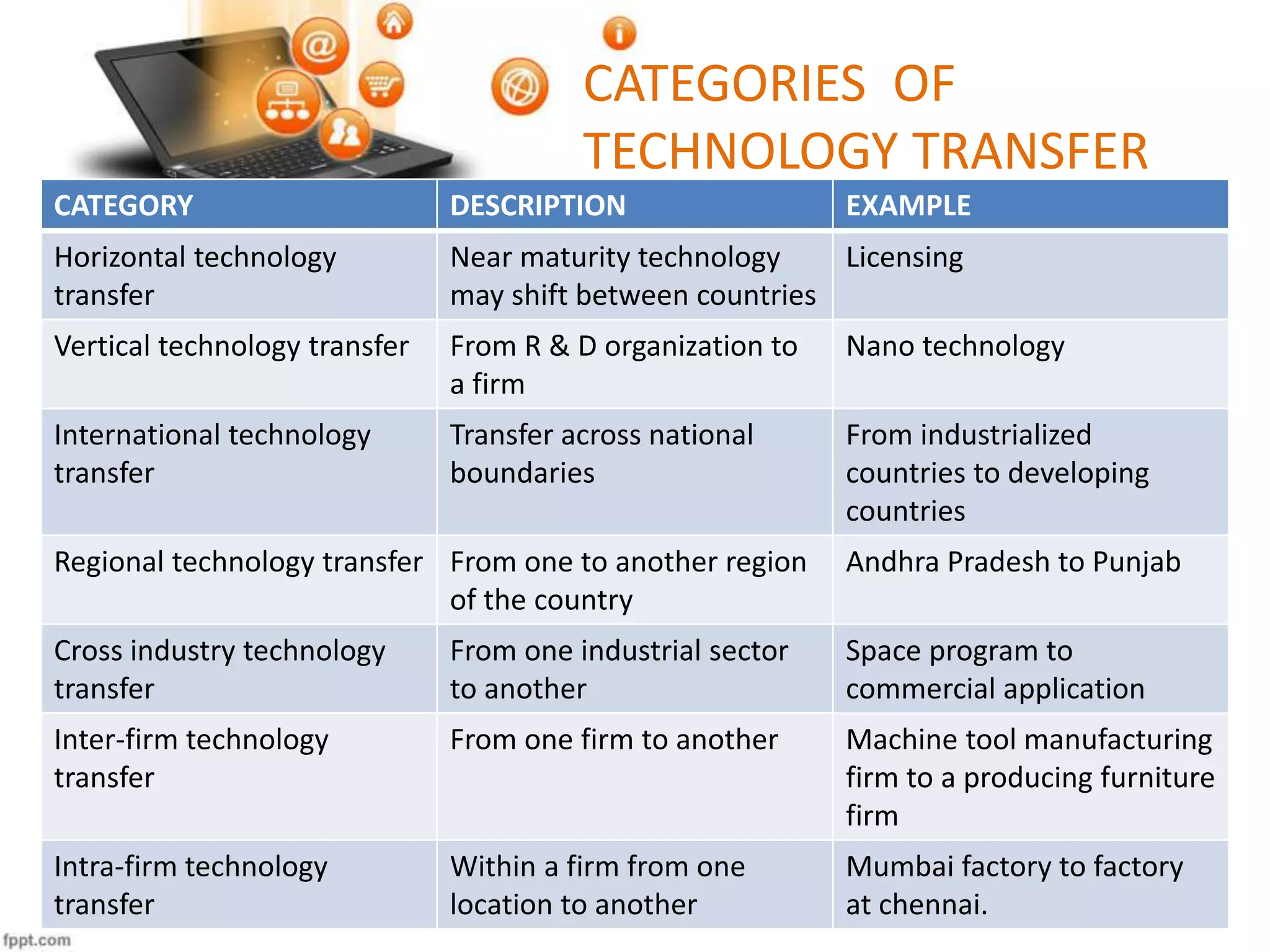
CATEGORIES OF
TECHNOLOGY TRANSFER
CATEGORY DESCRIPTION EXAMPLE
Horizontal technology
transfer
Near maturity technology
may shift between countries
Licensing
Vertical technology transfer From R & D organization to
a firm
Nano technology
International technology
transfer
Transfer across national
boundaries
From industrialized
countries to developing
countries
Regional technology transfer From one to another region
of the country
Andhra Pradesh to Punjab
Cross industry technology
transfer
From one industrial sector
to another
Space program to
commercial application
Inter-firm technology
transfer
From one firm to another Machine tool manufacturing
firm to a producing furniture
firm
Intra-firm technology
transfer
Within a firm from one
location to another
Mumbai factory to factory
at chennai.
MODELS OF TECHNOLOGY TRANSFER
• 1. Through bridging Agencies
BRIDGING
AGENCIES
TECHNOLOGY
SOURCES
TECHNOLOGY
USERS
Bridging agencies : the govt. departments,financial
institutions,industries,technology transfer agencies,consultants,venture
capital companies,research companies,R&D organisations . etc
2.Research And Development
Diffusion Model
DIFFUSION
RESEARCH DEVELOPMENT
ADOPTION
KEY ENTITIES
3.Problem Solver Model
NEED FELT
APPLICATION
OF SOLUTION
ARTICULATED
AS PROBLEM
SEARCH FOR
SOLUTIONS
CHOICE OF
SOLUTION
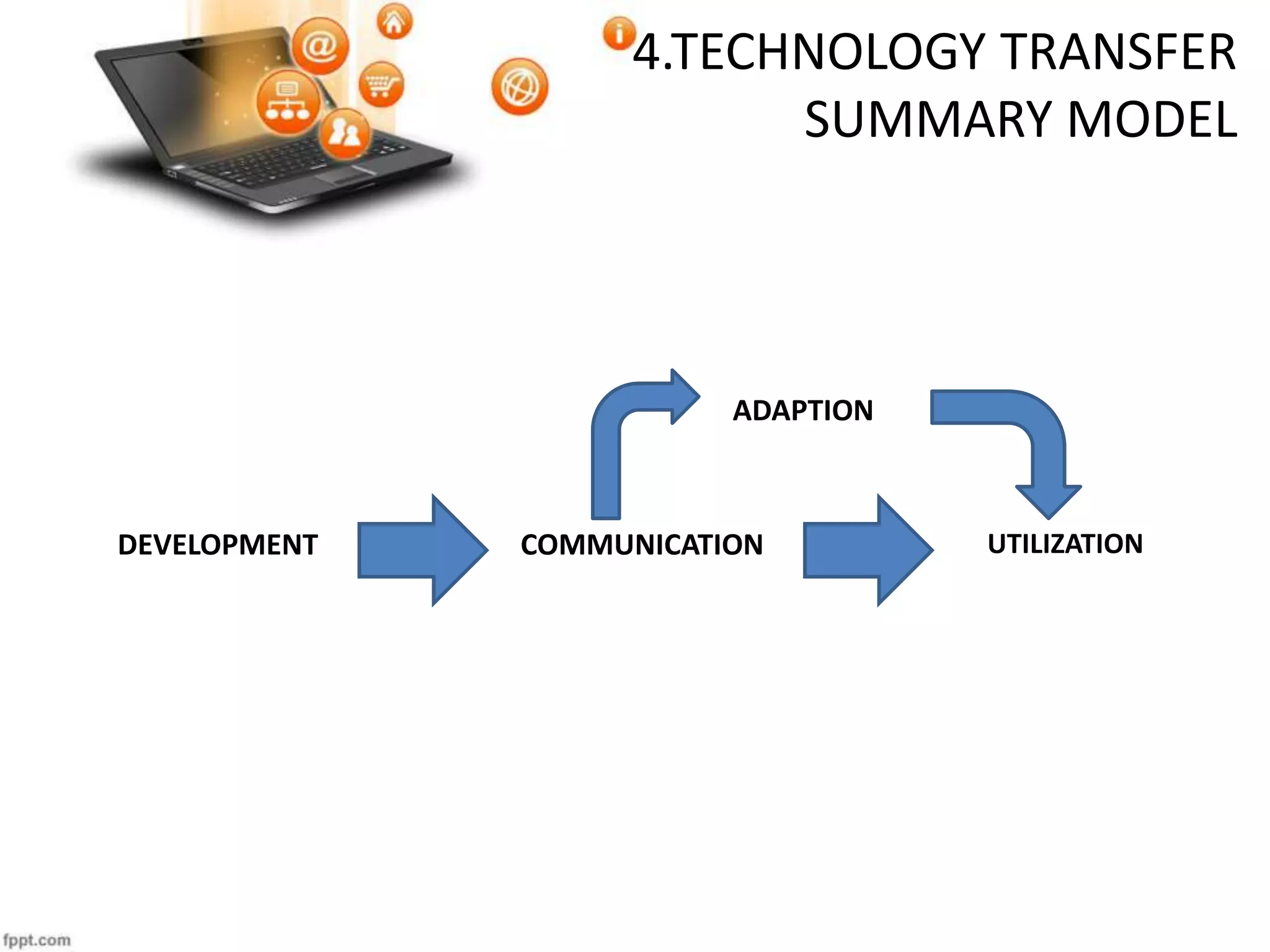
4.TECHNOLOGY TRANSFER
SUMMARY MODEL
ADAPTION
COMMUNICATION UTILIZATIONDEVELOPMENT
MODES OF TECHNOLOGY TRANSFER
1.THE PASSIVE MODE
TECHNOLOGY BASE USERTECHNICAL
INFORMATION
•Publications
•Computerised
Data Base
•Personal
Contacts
•Primary Innovator
for Application of
Technology
2.THE SEMIACTIVE MODE
• Publications
• Computerized
data bases
• Personal Contacts
• Secondary
Innovator for
application
technology
TECHNOLOGY
BASE
USER
TECHNOLOGY
TRANSFER
AGENT
TECHNICAL
INFORMATION
•Primary
Innovator
for
Application
Technology
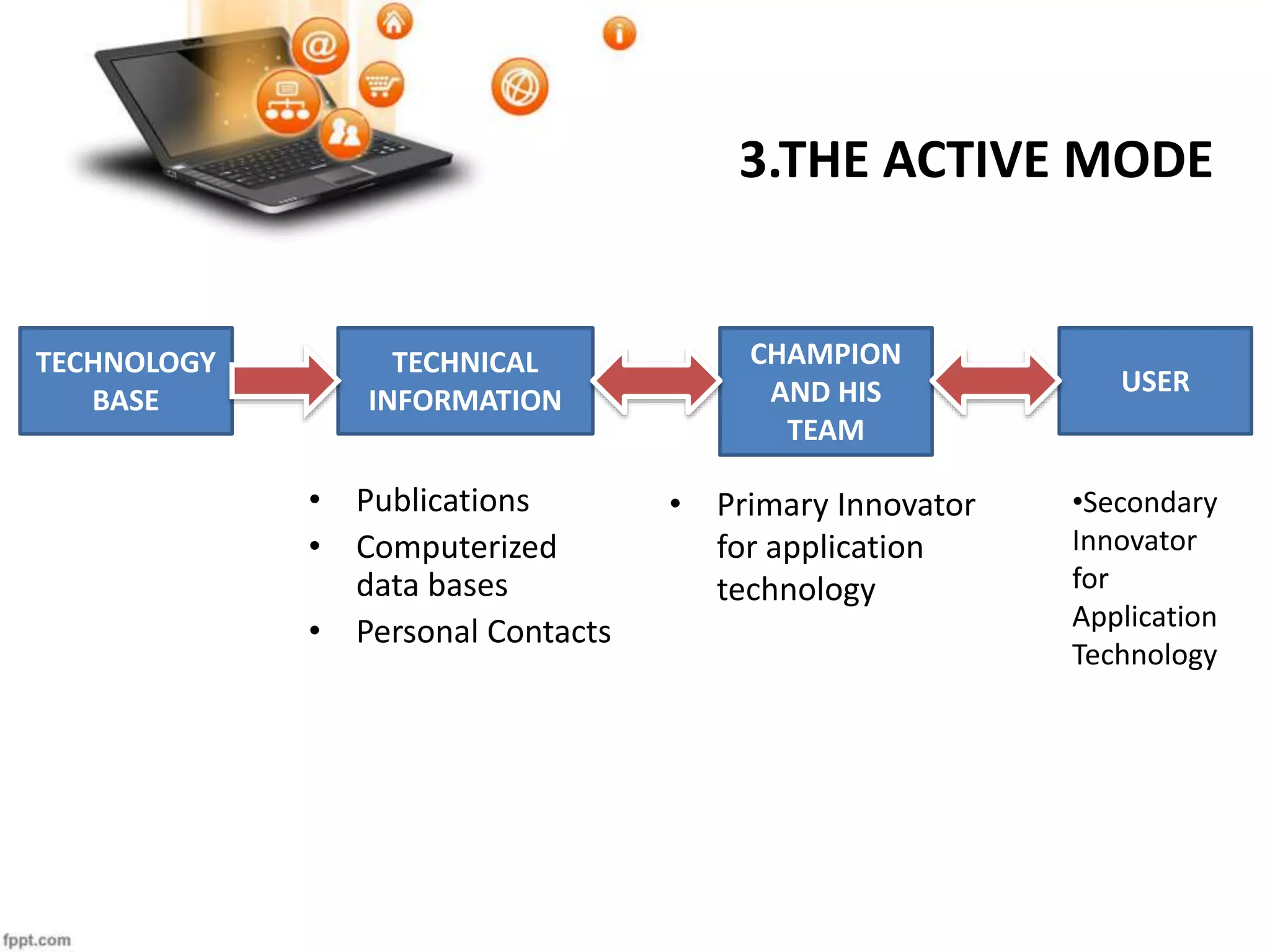
3.THE ACTIVE MODE
• Publications
• Computerized
data bases
• Personal Contacts
• Primary Innovator
for application
technology
TECHNOLOGY
BASE
USER
CHAMPION
AND HIS
TEAM
TECHNICAL
INFORMATION
•Secondary
Innovator
for
Application
Technology
ROUTES OF TECHNOLOGY TRANSFER
1. Suppliers of Material and Parts
2. Equipment Supplier
3. Licensing
4. Franchise
5. Joint Venture
6. Turnkey Project
7. Foreign Direct Investment(FDI)
8. Technical Consortium and Joint R&D Project
CASE OF TECHNOLOGY
TRANSFER IN CHINESE
AUTOMOBILE INDUSTRY
• The Chinese automotive industry :fast growing production and
potential market, which attracts a lot of foreign automakers to
establish strategic alliance in China.
• The automotive industry of China has been rapidly growing since
the year 2000 . The annual vehicle production output of China
increased from 2 million vehicles in 2000 to over 18 million
vehicles in 2011 .
• Despite the fast development of the Chinese automobile
industry, the lack of advanced technologies and independent
research and development innovation is a major challenge for
Chinese automakers.
• Technology transfer is seen as a key factor to help the Chinese
automotive industry to gain access into the global market
• The government has encouraged building joint venture Research
and Development (R&D) centers in Beijing with advantageous tax
policies in order to promote technology and knowledge transfer.
In fact, large amount of global automakers have established joint
ventures with local companies due to the requirement of current
government policies.
• Despite the steady growth of R&D investment in China, the weak
R&D capability still exists. Therefore, Chinese domestic
automakers have started to buy foreign brands to acquire the
advanced technology and access the world auto market
LEAD CHINESE AUTO
COMPANIES AND THEIR
JOINT VENTURES
Chinese Automakers Foreign Joint Ventures
BAIC (Beijing Auto) Beijing Benz, Beijing Hyundai
Brilliance Auto, Huachen Auto Group BMW Brilliance
Chang’an Auto (Chana Auto)
Chang’an-Ford, Chang’an-Mazda,Chang’an-
Suzuki
Changhe Auto, Chang’an Changhe Suzuki
Dongfeng Motor
Dongfeng Nissan, ZhengZhou,Dongfeng Honda,
Dongfeng YuedaKia
FAW (First Automobile Works)
FAW Volkswagen, FAW Audi,FAW GM, FAW
Mazada, FAW Toyota
GAC (Guangzhou Automobile group co.)
GAC-Honda, GAC Toyota, GAC Flat,GAC
Mitsubishi
Geely Auto Volvo Cars
SAIC (Shanghai Automotive Industry Co.) Shanghai GM, Shanghai Volkswagen
THE CASE
• Two case studies were chosen and
analyzed, the first being the technology
transfer between the Swedish firm – Volvo
Cars and the Chinese firm – Geely and the
second being the technology transfer
between the German firm – Volkswagen
and the Chinese firm –First Automobile
work
The Case of Geely and Volvo
Cars
• VOLVO’S PERSPECTIVE
• Chinese automobile industry policy of making JVs with 50%
shares.
• In order to stay competitive in Chinese market, Volvo Cars has to
produce cars in China.
• Volvo’s decision of being going opposite way cause most of
Western companies keep their core technologies in headquarters.
• Volvo want the way to transfer should be transfer to JV company
directly by being in very controlled in intellectual property (IP).
GEELY’S PERSPECTIVE
• To take the benefit of Volvo Car’s complete system such as
advanced platform, well-managed organization structure
and intelligent employees.
• the whole Volvo is a system and it can survive by itself. But
Geely offers them a way to reduce more cost and produce
efficiently
• Volvo cars only had tiny market share in the huge Chinese
market. However, the sales of Volvo cars have increased in
the post JV years.
Technological capability
• Volvo using local engineers to produce cars locally. In Volvo’s
R&D center in Shanghai, the majority of the engineers are local
Chinese engineers
• they have regular seminars as well as training program in both
Geely and Volvo Cars, which can help their employees to
acquire know-how skills and enhance the speed of technology
transfer
• due to the Chinese automobile industry
• are lack of maturity and are in the copy phase at the moment.
It is also a big challenge for Swedish leaders to train people and
develop people.
• , the cultural differences are challenging to both Chinese and
Swedish engineers.
Case of First Automotive
Work and Volkswagen
• The FAW- Volkswagen Automobile was established in 1991, it is a
joint venture passenger carmaker between FAW Group
Corporation (share investments of 60%) and Volkswagen AG
(share investments of 40%). FAW-Volkswagen adopts advanced
technologies and equipment to manufacture some of the world’s
most famous brands
• Automobile industry policy
• There are three major motivations driving Chinese automakers
to start partnership with foreign automakers: 1. Gain profits; 2.
Learn skills and transfer knowledge; 3. Enhance the capability of
the whole industry
• It was realised that Chinese automotive industry can be better
developed through technology transfer.
• It was a big challenge for China to produce their own cars in the
1980s due to the limited capability and high cost. Govt policy
tried to change it.
• Technology transfer
• For FAW-VW the technology of car manufacturing for example to
laser-welding technology has been transferred from foreign
automakers.
• So Lack of diversified technology lead to technology transfer.
• Generally, foreign experts of VW come to FAW-VW’s plants in
China to guide Chinese employees. Especially, every time they are
going to invest in new products, their German partners will come
to china company and work together
• Moreover, sending employees regularly abroad or to their
partner’s company to learn skills, exchange knowledge and
gain experience is also an efficient approach.
• When it comes to the technology transfer difficulties,the
experience and expertise of western industry was not so
easily compatible.
• Environmental and design- related technologies need to
be transferred. Due to FAW aims to reach the
environmental polices that are launched by the Chinese
government and implement the requirements of ISO 9001.
• Additionally, product-related technologies such as
software which is used to improve the production system,
as well as the material and manufacturing.
Technology transfer

Technology transfer

  • 1.
  • 2.
    WHAT IS TECHNOLOGYTRANSFER • Basically in two ways technology can be acquired: Develop it or Purchase it. • Simply saying the second way of acquiring new technology is commonly called as technology transfer. • Transfer of technology is a process which is very essential for the wide application,utilisation and upgradation of technology which has been developed.
  • 3.
    DEFINITION • Technology transferis a process that permits the flow of technology from a source to a receiver. The source is the owner or holder of knowledge while the recipient is the beneficiary of such knowledge. • Technology transfer is a process by which science and technology are transferred from one individual or group to another that incorporates this new knowledge into its way of doing thgings.(BY :Jain and Triandis) • It is the process of providing the technology developed from one organisation for other potentially useful purposes.(NASA)
  • 4.
    CATEGORIES OF TECHNOLOGY TRANSFER CATEGORYDESCRIPTION EXAMPLE Horizontal technology transfer Near maturity technology may shift between countries Licensing Vertical technology transfer From R & D organization to a firm Nano technology International technology transfer Transfer across national boundaries From industrialized countries to developing countries Regional technology transfer From one to another region of the country Andhra Pradesh to Punjab Cross industry technology transfer From one industrial sector to another Space program to commercial application Inter-firm technology transfer From one firm to another Machine tool manufacturing firm to a producing furniture firm Intra-firm technology transfer Within a firm from one location to another Mumbai factory to factory at chennai.
  • 5.
    MODELS OF TECHNOLOGYTRANSFER • 1. Through bridging Agencies BRIDGING AGENCIES TECHNOLOGY SOURCES TECHNOLOGY USERS Bridging agencies : the govt. departments,financial institutions,industries,technology transfer agencies,consultants,venture capital companies,research companies,R&D organisations . etc
  • 6.
    2.Research And Development DiffusionModel DIFFUSION RESEARCH DEVELOPMENT ADOPTION KEY ENTITIES
  • 7.
    3.Problem Solver Model NEEDFELT APPLICATION OF SOLUTION ARTICULATED AS PROBLEM SEARCH FOR SOLUTIONS CHOICE OF SOLUTION
  • 8.
  • 9.
    MODES OF TECHNOLOGYTRANSFER 1.THE PASSIVE MODE TECHNOLOGY BASE USERTECHNICAL INFORMATION •Publications •Computerised Data Base •Personal Contacts •Primary Innovator for Application of Technology
  • 10.
    2.THE SEMIACTIVE MODE •Publications • Computerized data bases • Personal Contacts • Secondary Innovator for application technology TECHNOLOGY BASE USER TECHNOLOGY TRANSFER AGENT TECHNICAL INFORMATION •Primary Innovator for Application Technology
  • 11.
    3.THE ACTIVE MODE •Publications • Computerized data bases • Personal Contacts • Primary Innovator for application technology TECHNOLOGY BASE USER CHAMPION AND HIS TEAM TECHNICAL INFORMATION •Secondary Innovator for Application Technology
  • 12.
    ROUTES OF TECHNOLOGYTRANSFER 1. Suppliers of Material and Parts 2. Equipment Supplier 3. Licensing 4. Franchise 5. Joint Venture 6. Turnkey Project 7. Foreign Direct Investment(FDI) 8. Technical Consortium and Joint R&D Project
  • 13.
    CASE OF TECHNOLOGY TRANSFERIN CHINESE AUTOMOBILE INDUSTRY • The Chinese automotive industry :fast growing production and potential market, which attracts a lot of foreign automakers to establish strategic alliance in China. • The automotive industry of China has been rapidly growing since the year 2000 . The annual vehicle production output of China increased from 2 million vehicles in 2000 to over 18 million vehicles in 2011 . • Despite the fast development of the Chinese automobile industry, the lack of advanced technologies and independent research and development innovation is a major challenge for Chinese automakers. • Technology transfer is seen as a key factor to help the Chinese automotive industry to gain access into the global market
  • 14.
    • The governmenthas encouraged building joint venture Research and Development (R&D) centers in Beijing with advantageous tax policies in order to promote technology and knowledge transfer. In fact, large amount of global automakers have established joint ventures with local companies due to the requirement of current government policies. • Despite the steady growth of R&D investment in China, the weak R&D capability still exists. Therefore, Chinese domestic automakers have started to buy foreign brands to acquire the advanced technology and access the world auto market
  • 15.
    LEAD CHINESE AUTO COMPANIESAND THEIR JOINT VENTURES Chinese Automakers Foreign Joint Ventures BAIC (Beijing Auto) Beijing Benz, Beijing Hyundai Brilliance Auto, Huachen Auto Group BMW Brilliance Chang’an Auto (Chana Auto) Chang’an-Ford, Chang’an-Mazda,Chang’an- Suzuki Changhe Auto, Chang’an Changhe Suzuki Dongfeng Motor Dongfeng Nissan, ZhengZhou,Dongfeng Honda, Dongfeng YuedaKia FAW (First Automobile Works) FAW Volkswagen, FAW Audi,FAW GM, FAW Mazada, FAW Toyota GAC (Guangzhou Automobile group co.) GAC-Honda, GAC Toyota, GAC Flat,GAC Mitsubishi Geely Auto Volvo Cars SAIC (Shanghai Automotive Industry Co.) Shanghai GM, Shanghai Volkswagen
  • 16.
    THE CASE • Twocase studies were chosen and analyzed, the first being the technology transfer between the Swedish firm – Volvo Cars and the Chinese firm – Geely and the second being the technology transfer between the German firm – Volkswagen and the Chinese firm –First Automobile work
  • 17.
    The Case ofGeely and Volvo Cars • VOLVO’S PERSPECTIVE • Chinese automobile industry policy of making JVs with 50% shares. • In order to stay competitive in Chinese market, Volvo Cars has to produce cars in China. • Volvo’s decision of being going opposite way cause most of Western companies keep their core technologies in headquarters. • Volvo want the way to transfer should be transfer to JV company directly by being in very controlled in intellectual property (IP).
  • 18.
    GEELY’S PERSPECTIVE • Totake the benefit of Volvo Car’s complete system such as advanced platform, well-managed organization structure and intelligent employees. • the whole Volvo is a system and it can survive by itself. But Geely offers them a way to reduce more cost and produce efficiently • Volvo cars only had tiny market share in the huge Chinese market. However, the sales of Volvo cars have increased in the post JV years.
  • 19.
    Technological capability • Volvousing local engineers to produce cars locally. In Volvo’s R&D center in Shanghai, the majority of the engineers are local Chinese engineers • they have regular seminars as well as training program in both Geely and Volvo Cars, which can help their employees to acquire know-how skills and enhance the speed of technology transfer • due to the Chinese automobile industry • are lack of maturity and are in the copy phase at the moment. It is also a big challenge for Swedish leaders to train people and develop people. • , the cultural differences are challenging to both Chinese and Swedish engineers.
  • 20.
    Case of FirstAutomotive Work and Volkswagen • The FAW- Volkswagen Automobile was established in 1991, it is a joint venture passenger carmaker between FAW Group Corporation (share investments of 60%) and Volkswagen AG (share investments of 40%). FAW-Volkswagen adopts advanced technologies and equipment to manufacture some of the world’s most famous brands • Automobile industry policy • There are three major motivations driving Chinese automakers to start partnership with foreign automakers: 1. Gain profits; 2. Learn skills and transfer knowledge; 3. Enhance the capability of the whole industry • It was realised that Chinese automotive industry can be better developed through technology transfer.
  • 21.
    • It wasa big challenge for China to produce their own cars in the 1980s due to the limited capability and high cost. Govt policy tried to change it. • Technology transfer • For FAW-VW the technology of car manufacturing for example to laser-welding technology has been transferred from foreign automakers. • So Lack of diversified technology lead to technology transfer. • Generally, foreign experts of VW come to FAW-VW’s plants in China to guide Chinese employees. Especially, every time they are going to invest in new products, their German partners will come to china company and work together
  • 22.
    • Moreover, sendingemployees regularly abroad or to their partner’s company to learn skills, exchange knowledge and gain experience is also an efficient approach. • When it comes to the technology transfer difficulties,the experience and expertise of western industry was not so easily compatible. • Environmental and design- related technologies need to be transferred. Due to FAW aims to reach the environmental polices that are launched by the Chinese government and implement the requirements of ISO 9001. • Additionally, product-related technologies such as software which is used to improve the production system, as well as the material and manufacturing.