+ 
Strategy & Technology Management : 
Chinese Industry Case 
Presentation By : 
Pawandeep Singh Maniktala | Sahil Kapoor | Mayank Lau | Bhushan Kumar 
MBA , DMS I I T Delhi
+ 
Objective 
 To study strategy technology management framework of Chinese 
organizations and extract learning’s for India. Cases considered 
for the study are mentioned below; 
 Nordica telecommunications equipment manufacturer in China 
 DuCheng Aircraft Corporation, established to manufacture jet 
fighters 
 NanBan Engine works, comprises a network of factories making 
engines and components for light trucks, tractors and cars 
 ChangZhong Machinery, A typical case of collaboration with a 
UK firm and its technology transfer learning’s
+ 
Scope and Abstract 
 This Research is aimed to explore how organizations can 
achieve competitiveness via acquisition and development of 
technology and at the same time raising the level of technology 
development in the country. 
 Study of technology transfer cases with respect to China can 
give insights in to strategy technology management framework 
of various Chinese organizations and which can help us in 
extracting learning’s for the Indian organizations. 
 The method would be primarily using secondary research 
material and few interviews with leaders of the organizations 
considered as case studies.
+ 
Chinese Industry 
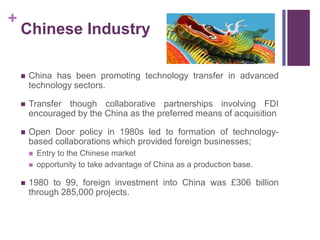
 China has been promoting technology transfer in advanced 
technology sectors. 
 Transfer though collaborative partnerships involving FDI 
encouraged by the China as the preferred means of acquisition 
 Open Door policy in 1980s led to formation of technology-based 
collaborations which provided foreign businesses; 
 Entry to the Chinese market 
 opportunity to take advantage of China as a production base. 
 1980 to 99, foreign investment into China was £306 billion 
through 285,000 projects.
+ 
Nordica HongYing 
Telecommunications 
 Nordica has 12 telecommunications infrastructure manufacturing 
facilities in 5 countries and 10 telephone handset manufacturing 
facilities in 8 countries. 
 Nordica's development within China has been in three phases; 
 Phase 1: market entry 1985-1996 
 Phase 2: local manufacturing 1997-1999 
 Phase 3: integration into the Chinese telecommunications industry 1999 
onwards 
 For Nordica entry in China, a JV named Beijing Nordica HongYing 
Telecommunications Systems Ltd. (NHT) was established. Nordica 
has 70% and HongYing holds 30%of the shares . 
 HongYing already had experience of manufacturing 
telecommunications switching equipment from an earlier co-operation 
with a German telecommunications company to produce 
PABX exchanges.
+ 
Nordica HongYing 
Telecommunications 
 Main target of the technology transfer project in 1998 for mobile 
switching equipment was to transfer manufacturing totally to 
China. 
 The project involved transfer of manufacturing technology, 
establishing logistics procedures and systems to support 
production and supply together with training. 
 NHT's activities are testing and integration so most of the 
production employees are software and systems engineers. 
 Manufacture of the major parts of products is completely 
outsourced to companies that have specialised manufacturing 
capability.
+ 
Nordica HongYing 
Telecommunications 
 Nordica's core competencies are understanding market needs and 
designing new products fast. 
 NHT employs 170 people, more than 90% of whom are Chinese. 
Expatriates only at top-level on rotation basis. 
 The company used the existing Chinese staff. There were many project 
teams comprising both European and Chinese staff. Some were led by 
Europeans and some by Chinese. 
 In china, Nordica is now main suppliers of GSM 900 networks, GSM1800 
networks, mobile telephones, fixed switching and transmission systems to 
operators, railways and oilfields. The NHT case illustrates a number of 
aspects of technology transfer through Sino-foreign equity joint ventures 
 Most important factor is the selection of a suitable partner and the 
objectives of partner.
+ 
DuCheng Aircraft 
Corporation 
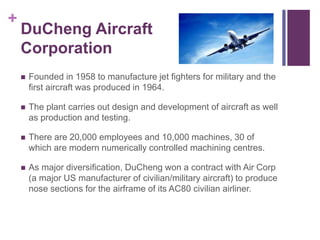
 Founded in 1958 to manufacture jet fighters for military and the 
first aircraft was produced in 1964. 
 The plant carries out design and development of aircraft as well 
as production and testing. 
 There are 20,000 employees and 10,000 machines, 30 of 
which are modern numerically controlled machining centres. 
 As major diversification, DuCheng won a contract with Air Corp 
(a major US manufacturer of civilian/military aircraft) to produce 
nose sections for the airframe of its AC80 civilian airliner.
+ 
DuCheng Aircraft 
Corporation 
 DuCheng was supplied with drawings initially and most of the 
materials and subassemblies by Air Corp 
 The training manuals were provided by Air Corp and training 
was carried out jointly by the two companies. 
 Air Corp quality assurance personnel were stationed 
permanently at the factory. 
 Air Corp wanted a low cost supplier in China and needed to 
make 'offset’ agreements with Chinese companies as part of 
the contracts to sell its aircraft in China.
+ 
DuCheng Aircraft 
Corporation 
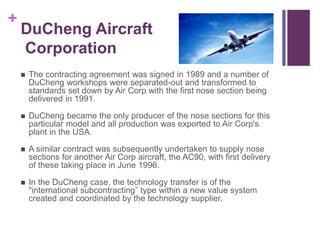
 The contracting agreement was signed in 1989 and a number of 
DuCheng workshops were separated-out and transformed to 
standards set down by Air Corp with the first nose section being 
delivered in 1991. 
 DuCheng became the only producer of the nose sections for this 
particular model and all production was exported to Air Corp's 
plant in the USA. 
 A similar contract was subsequently undertaken to supply nose 
sections for another Air Corp aircraft, the AC90, with first delivery 
of these taking place in June 1996. 
 In the DuCheng case, the technology transfer is of the 
"international subcontracting” type within a new value system 
created and coordinated by the technology supplier.
+ 
NanBan Engine 
Works 
 NanBan Engine works, Beijing, is part of New China Automotive 
Group (NCAG), which has factories making engines and 
components for light trucks, tractors and cars. 
 Over the years product technology has been transferred into the 
group from the former Soviet Union, Germany and Japan. 
 NanBan is largest engine producer in the group, and the group is 
dependent on the sales of engine MN283 used in light trucks and 
jeeps etc. 
 One aim in forming the group in 1988 was to bring together a 
number of plants producing the same or similar engines. 
 The formation of the group has facilitated shared knowledge about 
the production of this engine within the group
+ 
NanBan Engine 
Works 
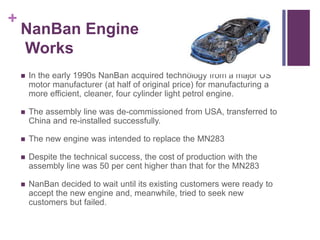
 In the early 1990s NanBan acquired technology from a major US 
motor manufacturer (at half of original price) for manufacturing a 
more efficient, cleaner, four cylinder light petrol engine. 
 The assembly line was de-commissioned from USA, transferred to 
China and re-installed successfully. 
 The new engine was intended to replace the MN283 
 Despite the technical success, the cost of production with the 
assembly line was 50 per cent higher than that for the MN283 
 NanBan decided to wait until its existing customers were ready to 
accept the new engine and, meanwhile, tried to seek new 
customers but failed.
+ 
NanBan Engine 
Works 
 NanBan was a technologically capable company and had 
demonstrated that it was able to transfer and implement both 
the product and process the technology for the new engine. 
 While waiting for new markets to emerge, the production line 
was becoming outdated. 
 NanBan did not properly assess the value of the technology. 
 The price it paid seemed reasonable because it was much 
lower than the original cost of the technology (the production 
line). 
 value and price are not the same thing.
+ 
Midland Tools and 
ChangZhong 
 Midland Tools, UK and ChangZhong Machinery, China, are 
both in the medium size category of machine tool 
manufacturers. 
 The objective for ChangZhong in collaborating with Midlands 
Tools was to acquire the advanced technology. 
 Through the transfer process ChangZhong could learn 
specialist subassembly skills, process programming know-how, 
design know-how and final assembly skills to enable it to 
produce complete CNC turning centres of the type to be 
introduced to local market.
+ 
Midland Tools and 
ChangZhong 
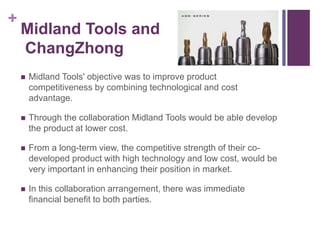
 Midland Tools' objective was to improve product 
competitiveness by combining technological and cost 
advantage. 
 Through the collaboration Midland Tools would be able develop 
the product at lower cost. 
 From a long-term view, the competitive strength of their co-developed 
product with high technology and low cost, would be 
very important in enhancing their position in market. 
 In this collaboration arrangement, there was immediate 
financial benefit to both parties.
+ 
Conclusion : 
Facts and Findings 
 Technology is not just a physical thing but also comprises 
knowledge embedded in hardware and software. 
 Acquisition of technological capability- learning is derived from 
the development and use of technology.
+ 
Thanks 
pawandeep@gmail.com

Strategy & Technology management- China Case Study

  • 1.
    + Strategy &Technology Management : Chinese Industry Case Presentation By : Pawandeep Singh Maniktala | Sahil Kapoor | Mayank Lau | Bhushan Kumar MBA , DMS I I T Delhi
  • 2.
    + Objective To study strategy technology management framework of Chinese organizations and extract learning’s for India. Cases considered for the study are mentioned below;  Nordica telecommunications equipment manufacturer in China  DuCheng Aircraft Corporation, established to manufacture jet fighters  NanBan Engine works, comprises a network of factories making engines and components for light trucks, tractors and cars  ChangZhong Machinery, A typical case of collaboration with a UK firm and its technology transfer learning’s
  • 3.
    + Scope andAbstract  This Research is aimed to explore how organizations can achieve competitiveness via acquisition and development of technology and at the same time raising the level of technology development in the country.  Study of technology transfer cases with respect to China can give insights in to strategy technology management framework of various Chinese organizations and which can help us in extracting learning’s for the Indian organizations.  The method would be primarily using secondary research material and few interviews with leaders of the organizations considered as case studies.
  • 4.
    + Chinese Industry  China has been promoting technology transfer in advanced technology sectors.  Transfer though collaborative partnerships involving FDI encouraged by the China as the preferred means of acquisition  Open Door policy in 1980s led to formation of technology-based collaborations which provided foreign businesses;  Entry to the Chinese market  opportunity to take advantage of China as a production base.  1980 to 99, foreign investment into China was £306 billion through 285,000 projects.
  • 5.
    + Nordica HongYing Telecommunications  Nordica has 12 telecommunications infrastructure manufacturing facilities in 5 countries and 10 telephone handset manufacturing facilities in 8 countries.  Nordica's development within China has been in three phases;  Phase 1: market entry 1985-1996  Phase 2: local manufacturing 1997-1999  Phase 3: integration into the Chinese telecommunications industry 1999 onwards  For Nordica entry in China, a JV named Beijing Nordica HongYing Telecommunications Systems Ltd. (NHT) was established. Nordica has 70% and HongYing holds 30%of the shares .  HongYing already had experience of manufacturing telecommunications switching equipment from an earlier co-operation with a German telecommunications company to produce PABX exchanges.
  • 6.
    + Nordica HongYing Telecommunications  Main target of the technology transfer project in 1998 for mobile switching equipment was to transfer manufacturing totally to China.  The project involved transfer of manufacturing technology, establishing logistics procedures and systems to support production and supply together with training.  NHT's activities are testing and integration so most of the production employees are software and systems engineers.  Manufacture of the major parts of products is completely outsourced to companies that have specialised manufacturing capability.
  • 7.
    + Nordica HongYing Telecommunications  Nordica's core competencies are understanding market needs and designing new products fast.  NHT employs 170 people, more than 90% of whom are Chinese. Expatriates only at top-level on rotation basis.  The company used the existing Chinese staff. There were many project teams comprising both European and Chinese staff. Some were led by Europeans and some by Chinese.  In china, Nordica is now main suppliers of GSM 900 networks, GSM1800 networks, mobile telephones, fixed switching and transmission systems to operators, railways and oilfields. The NHT case illustrates a number of aspects of technology transfer through Sino-foreign equity joint ventures  Most important factor is the selection of a suitable partner and the objectives of partner.
  • 8.
    + DuCheng Aircraft Corporation  Founded in 1958 to manufacture jet fighters for military and the first aircraft was produced in 1964.  The plant carries out design and development of aircraft as well as production and testing.  There are 20,000 employees and 10,000 machines, 30 of which are modern numerically controlled machining centres.  As major diversification, DuCheng won a contract with Air Corp (a major US manufacturer of civilian/military aircraft) to produce nose sections for the airframe of its AC80 civilian airliner.
  • 9.
    + DuCheng Aircraft Corporation  DuCheng was supplied with drawings initially and most of the materials and subassemblies by Air Corp  The training manuals were provided by Air Corp and training was carried out jointly by the two companies.  Air Corp quality assurance personnel were stationed permanently at the factory.  Air Corp wanted a low cost supplier in China and needed to make 'offset’ agreements with Chinese companies as part of the contracts to sell its aircraft in China.
  • 10.
    + DuCheng Aircraft Corporation  The contracting agreement was signed in 1989 and a number of DuCheng workshops were separated-out and transformed to standards set down by Air Corp with the first nose section being delivered in 1991.  DuCheng became the only producer of the nose sections for this particular model and all production was exported to Air Corp's plant in the USA.  A similar contract was subsequently undertaken to supply nose sections for another Air Corp aircraft, the AC90, with first delivery of these taking place in June 1996.  In the DuCheng case, the technology transfer is of the "international subcontracting” type within a new value system created and coordinated by the technology supplier.
  • 11.
    + NanBan Engine Works  NanBan Engine works, Beijing, is part of New China Automotive Group (NCAG), which has factories making engines and components for light trucks, tractors and cars.  Over the years product technology has been transferred into the group from the former Soviet Union, Germany and Japan.  NanBan is largest engine producer in the group, and the group is dependent on the sales of engine MN283 used in light trucks and jeeps etc.  One aim in forming the group in 1988 was to bring together a number of plants producing the same or similar engines.  The formation of the group has facilitated shared knowledge about the production of this engine within the group
  • 12.
    + NanBan Engine Works  In the early 1990s NanBan acquired technology from a major US motor manufacturer (at half of original price) for manufacturing a more efficient, cleaner, four cylinder light petrol engine.  The assembly line was de-commissioned from USA, transferred to China and re-installed successfully.  The new engine was intended to replace the MN283  Despite the technical success, the cost of production with the assembly line was 50 per cent higher than that for the MN283  NanBan decided to wait until its existing customers were ready to accept the new engine and, meanwhile, tried to seek new customers but failed.
  • 13.
    + NanBan Engine Works  NanBan was a technologically capable company and had demonstrated that it was able to transfer and implement both the product and process the technology for the new engine.  While waiting for new markets to emerge, the production line was becoming outdated.  NanBan did not properly assess the value of the technology.  The price it paid seemed reasonable because it was much lower than the original cost of the technology (the production line).  value and price are not the same thing.
  • 14.
    + Midland Toolsand ChangZhong  Midland Tools, UK and ChangZhong Machinery, China, are both in the medium size category of machine tool manufacturers.  The objective for ChangZhong in collaborating with Midlands Tools was to acquire the advanced technology.  Through the transfer process ChangZhong could learn specialist subassembly skills, process programming know-how, design know-how and final assembly skills to enable it to produce complete CNC turning centres of the type to be introduced to local market.
  • 15.
    + Midland Toolsand ChangZhong  Midland Tools' objective was to improve product competitiveness by combining technological and cost advantage.  Through the collaboration Midland Tools would be able develop the product at lower cost.  From a long-term view, the competitive strength of their co-developed product with high technology and low cost, would be very important in enhancing their position in market.  In this collaboration arrangement, there was immediate financial benefit to both parties.
  • 16.
    + Conclusion : Facts and Findings  Technology is not just a physical thing but also comprises knowledge embedded in hardware and software.  Acquisition of technological capability- learning is derived from the development and use of technology.
  • 17.