ZOOM OUT –
FROM INDIVIDUAL TO
SYSTEMS WORK
 What is systems work? What is ecological practice?
 What gets in the way?
 Why we should do it anyway!
 Pivotal opportunities for zooming out:
 Negotiating the referral
 Clarifying your role
*** On a continuum of services to individuals….to services to
systems, where do you place yourself at the moment?
*** Identify one referral you have at the moment, and how it
could look if you ZOOMed out.
IN THIS SESSION:
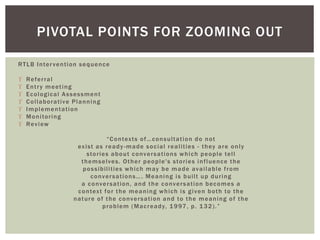
RTLB Intervention sequence
 Referral
 Entry meeting
 Ecological Assessment
 Collaborative Planning
 Implementation
 Monitoring
 Review
“Contexts of…consultation do not
exist as ready -made social realities - they are only
stories about conversations which people tell
themselves. Other people's stories influence the
possibilities which may be made available from
conversations…. Meaning is built up during
a conversation, and the conversation becomes a
context for the meaning which is given both to the
nature of the conversation and to the meaning of the
problem (Macready, 1997, p. 132).”
PIVOTAL POINTS FOR ZOOMING OUT
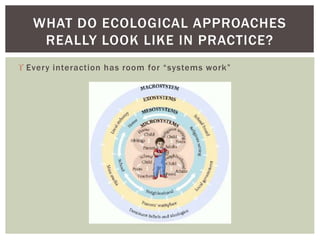
 Every interaction has room for “systems work”
WHAT DO ECOLOGICAL APPROACHES
REALLY LOOK LIKE IN PRACTICE?
Working at the individual level inevitably focuses on
remediation rather than prevention/early intervention
 “No mass disorder has ever been eliminated by treating those
who have it (Albee, 1999).”
 “It is like waiting for Humpty Dumpty to fall of the wall and
splatter on the ground before any action is taken. Rather
than ‘trying to put Humpty Dumpty back together again’ after
the fact, it would make so much more sense to…
 A) prevent Humpty Dumpty from falling off the wall (e.g. wide the
wall, give him balance training)
 B) being ready to catch HD before he hits the ground (e.g. provide a
safety net) or
 C) modify the environment to minimise the damage to HD (e.g.
provide cushions to break his fall. (Gutkin, 2012, p. 4)”
WHY SHIFT TO SYSTEMS WORK?
 Individual services often reflect medical model ways of
thinking
 Disempower the people around the child
“Upon hearing that a student is suffering from neurological deficits…it would
be easy for many crucial adults…to ‘check out,’ assuming that they cannot
possibly be of significant assistance (Gutkin, 2009, p. 481).”
BARRIERS TO SYSTEMS WORK:
***Think for a minute about the external and internal barriers that
you see.
 External variables for sure –
 Referrals generally come in around one child
 The child, not the system, is generally viewed as “the problem”
 But let’s focus on the internal barriers for a moment –
 We are often more comfortable focusing on one student
 Shifting people’s thinking requires difficult conversations
*** Identify one systems level intervention you love doing!
Identify one that scares the heck out of you!
SO WHAT GETS IN THE WAY?
 You do have the skills – the process is the same!!
 Ecological practice reflects our belief that “problems” do not
lie within people, but in the interaction between people and
the layers of their environment.
 Upskilling the people around the child ensures your work will
have flow-on effects for many other children/systems.
 Invariably, there are more resources in any situation than are
currently being used.
WHY YOU SHOULD DO IT ANYWAY!
 If we truly believe that “problems” are actually “mismatches”
that lie in the interaction between a person and the layers of
their environment:
 Our language should reflect that
 “Child experiencing difficulties with reading” versus “Dyslexic child”
 Our assessments should reflect that
 Giving equal scrutiny to each layer of the environment
 The child’s own strengths, needs, dispositions
 Peers, home, school, community
 The interaction between home and school and aspects of the community
 Broader policies that influence our contexts
 Although we believe in ecological approaches, our
conversations still tend to Zoom In.
 Have those difficult conversations!
 You do not need to know the right answers. You need to know the
right questions.
“One of the most impactful things a change agent or practitioner does
is to articulate questions. Instinctively, intuitively and tacitly we all
know that research of any kind can, in a flash, profoundly alter the way
we see ourselves, view reality, and conduct our lives (Cooperrider &
Whitney, n.d. p. 7).”
HOW TO ZOOM OUT
Follow this link to watch Cooperrider’s 4-minute introduction to
Appreciative Inquiry
http://youtu.be/3JDfr6KGV-k
“Leading change is all about strengths – it has nothing to do
with weaknesses (Cooperrider)”
“The task of leadership is to create an alignment of strengths in
ways that make a system’s weaknesses irrelevant (Drucker)”
DAVID COOPERRIDER
“Inquiry and change are a simultaneous moment; the questions
we ask set the stage for what we ‘find’…(Cooperrider & Whitney,
n.d. p. 5)”
 Power of topic choice
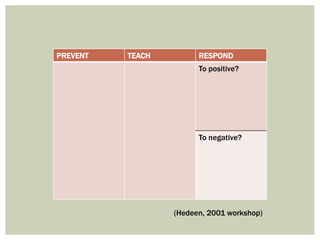
*** With one or two others, develop questions that zoom out to
each layer of the ecology.
QUESTIONS THAT ZOOM OUT
PREVENT TEACH RESPOND
To positive?
To negative?
(Hedeen, 2001 workshop)
“Don’t get me wrong. I’m not advocating mindless happy
talk….We can’t ignore problems – we just need to approach
them from the other side (executive in Cooperrider & Whitney,
n.d., p. 7)”
STRENGTHS-BASED QUESTIONS
 In content:
 Be transparent that we will be looking at every layer
 Veer away from “can’t”
 Assess as a way to identify opportunity for systems work
 Observe for other students who may also benefit
 In process:
 Identify the questions we will be asking as a group
 Identify who will do what to gather information on the answers
 Be creative in getting everyone involved:
 I’ll teach, you sit in the back and look for X…
 I’ll teach, you notice X…
ASSESSMENT THAT ZOOMS OUT
“When managers ask us how many people should be
interviewed, or who should do the interviews, we increasingly
find ourselves saying ‘everyone’….People themselves, not
consultants, generate the…analysis...(Cooperrider & Whitney,
n.d., p. 8).”
Everyone brings their data to the table
FEEDBACK MEETINGS THAT ZOOM OUT
 Take one “A-Ha” that you’ve had in this session and apply it to
one of your cases!
CHALLENGE:

Zoom out shifting to systems work

  • 1.
    ZOOM OUT – FROMINDIVIDUAL TO SYSTEMS WORK
  • 2.
     What issystems work? What is ecological practice?  What gets in the way?  Why we should do it anyway!  Pivotal opportunities for zooming out:  Negotiating the referral  Clarifying your role *** On a continuum of services to individuals….to services to systems, where do you place yourself at the moment? *** Identify one referral you have at the moment, and how it could look if you ZOOMed out. IN THIS SESSION:
  • 3.
    RTLB Intervention sequence Referral  Entry meeting  Ecological Assessment  Collaborative Planning  Implementation  Monitoring  Review “Contexts of…consultation do not exist as ready -made social realities - they are only stories about conversations which people tell themselves. Other people's stories influence the possibilities which may be made available from conversations…. Meaning is built up during a conversation, and the conversation becomes a context for the meaning which is given both to the nature of the conversation and to the meaning of the problem (Macready, 1997, p. 132).” PIVOTAL POINTS FOR ZOOMING OUT
  • 4.
     Every interactionhas room for “systems work” WHAT DO ECOLOGICAL APPROACHES REALLY LOOK LIKE IN PRACTICE?
  • 5.
    Working at theindividual level inevitably focuses on remediation rather than prevention/early intervention  “No mass disorder has ever been eliminated by treating those who have it (Albee, 1999).”  “It is like waiting for Humpty Dumpty to fall of the wall and splatter on the ground before any action is taken. Rather than ‘trying to put Humpty Dumpty back together again’ after the fact, it would make so much more sense to…  A) prevent Humpty Dumpty from falling off the wall (e.g. wide the wall, give him balance training)  B) being ready to catch HD before he hits the ground (e.g. provide a safety net) or  C) modify the environment to minimise the damage to HD (e.g. provide cushions to break his fall. (Gutkin, 2012, p. 4)” WHY SHIFT TO SYSTEMS WORK?
  • 6.
     Individual servicesoften reflect medical model ways of thinking  Disempower the people around the child “Upon hearing that a student is suffering from neurological deficits…it would be easy for many crucial adults…to ‘check out,’ assuming that they cannot possibly be of significant assistance (Gutkin, 2009, p. 481).”
  • 7.
    BARRIERS TO SYSTEMSWORK: ***Think for a minute about the external and internal barriers that you see.  External variables for sure –  Referrals generally come in around one child  The child, not the system, is generally viewed as “the problem”  But let’s focus on the internal barriers for a moment –  We are often more comfortable focusing on one student  Shifting people’s thinking requires difficult conversations *** Identify one systems level intervention you love doing! Identify one that scares the heck out of you! SO WHAT GETS IN THE WAY?
  • 8.
     You dohave the skills – the process is the same!!  Ecological practice reflects our belief that “problems” do not lie within people, but in the interaction between people and the layers of their environment.  Upskilling the people around the child ensures your work will have flow-on effects for many other children/systems.  Invariably, there are more resources in any situation than are currently being used. WHY YOU SHOULD DO IT ANYWAY!
  • 9.
     If wetruly believe that “problems” are actually “mismatches” that lie in the interaction between a person and the layers of their environment:  Our language should reflect that  “Child experiencing difficulties with reading” versus “Dyslexic child”  Our assessments should reflect that  Giving equal scrutiny to each layer of the environment  The child’s own strengths, needs, dispositions  Peers, home, school, community  The interaction between home and school and aspects of the community  Broader policies that influence our contexts
  • 10.
     Although webelieve in ecological approaches, our conversations still tend to Zoom In.  Have those difficult conversations!  You do not need to know the right answers. You need to know the right questions. “One of the most impactful things a change agent or practitioner does is to articulate questions. Instinctively, intuitively and tacitly we all know that research of any kind can, in a flash, profoundly alter the way we see ourselves, view reality, and conduct our lives (Cooperrider & Whitney, n.d. p. 7).” HOW TO ZOOM OUT
  • 11.
    Follow this linkto watch Cooperrider’s 4-minute introduction to Appreciative Inquiry http://youtu.be/3JDfr6KGV-k “Leading change is all about strengths – it has nothing to do with weaknesses (Cooperrider)” “The task of leadership is to create an alignment of strengths in ways that make a system’s weaknesses irrelevant (Drucker)” DAVID COOPERRIDER
  • 12.
    “Inquiry and changeare a simultaneous moment; the questions we ask set the stage for what we ‘find’…(Cooperrider & Whitney, n.d. p. 5)”  Power of topic choice *** With one or two others, develop questions that zoom out to each layer of the ecology. QUESTIONS THAT ZOOM OUT
  • 13.
    PREVENT TEACH RESPOND Topositive? To negative? (Hedeen, 2001 workshop)
  • 14.
    “Don’t get mewrong. I’m not advocating mindless happy talk….We can’t ignore problems – we just need to approach them from the other side (executive in Cooperrider & Whitney, n.d., p. 7)” STRENGTHS-BASED QUESTIONS
  • 15.
     In content: Be transparent that we will be looking at every layer  Veer away from “can’t”  Assess as a way to identify opportunity for systems work  Observe for other students who may also benefit  In process:  Identify the questions we will be asking as a group  Identify who will do what to gather information on the answers  Be creative in getting everyone involved:  I’ll teach, you sit in the back and look for X…  I’ll teach, you notice X… ASSESSMENT THAT ZOOMS OUT
  • 16.
    “When managers askus how many people should be interviewed, or who should do the interviews, we increasingly find ourselves saying ‘everyone’….People themselves, not consultants, generate the…analysis...(Cooperrider & Whitney, n.d., p. 8).” Everyone brings their data to the table FEEDBACK MEETINGS THAT ZOOM OUT
  • 17.
     Take one“A-Ha” that you’ve had in this session and apply it to one of your cases! CHALLENGE:

Editor's Notes

  • #2 I live in New Zealand because of the education system. I really mean that. I also love the pace of life, the diverse and wonderful people, the beaches and tramps… but I am here for the education system. I trained in the US – at the University of Oregon – and worked as a school psychologist. I was so lucky in my first role – based in one decile 1 primary school full-time. My role was a bit of everything, from teaching to school psych to social worker. Alongside all of my educational roles, I was part of Thanksgiving Outreach, where we made sure every family had a turkey and a meal for Thanksgiving. I also had hundreds of shoe vouchers, which I could share with children when their shoes were looking a bit small/tatty. (As an aside, you can imagine how long it took me to get used to kids coming to school barefoot here – I kept wanting to run them all down to the Wherehouse!) But the system was, and still is, medical model driven. Kids were referred to me for ADHD, even though they have been sleeping in a car…and never have breakfast…need eyeglasses…just visited their father in jail etc etc. People knew those things…even blamed those things…but all of our assessments and interventions centred around “But how do we fix the kid?” “What’s wrong with the kid?” After three years I came to NZ and worked as an ed psych for the next 7 years – in Whanganui and then in Nelson. This changed my life and my practice. I got to live ecological practice. I’m not saying it was always easy, but it was possible. And that is why I am still here. Because I believe there is no more powerful role than your role – you are perfectly positioned to make a difference because you can work at every level and every layer of the ecology. And I know you’re thinking, “Well, I can’t…not always….” True. But you can THINK at every layer of the ecology, you can ASK QUESTIONS about every layer of the ecology…and that makes all the difference.
  • #3 Most of you think of me as a lecturer at a university. But for the 15 years prior to joining Massey last year, I was a practitioner like yourselves…working as an educational psychologist in a role very similar to yours. This session comes from years of reflecting on our role, how to do it more effectively and what gets in the way.
  • #4 For me, negotiating the referral is the most power point in all of this!! In the Macready article I put in Domain 6, he talks about a man who goes to the pharmacist for headache medicine. The pharmacist, holistic guy that he is, asks how the man is doing. How is his marriage? Enjoy his work? What does he do in his spare time? And while these are wonderful ways of finding out what might be going on in this man’s life – giving him headaches – the stage is not set for this. The man pictures the he will go in for medication, and that’s it. Really take the time to share how you see the world, how you work. ECOLOGICAL and STRENGTHS BASED You know how this works: You are in the class observing Johnny, and you notice at least three other students that are doing the same sorts of things. Johnny is beautifully behaved for the entire time you are in the class (so he does indeed have the skills!!) Johnny only gets attention when he is acting out…and is completely ignored when he is doing the right thing. The teacher ignores Johnny’s call outs, but his peers laugh and smirk and give him loads of attention. In general, the teacher ignores positive behaviour and responds to negative behaviour. All of these scenarios lend themselves brilliantly to systems work. But not if the teacher feels blindsided at the meeting, thinking you were coming in to observe Johnny and feeling shocked that you actually looked at him/her/peers/instruction/curriculum. Where SBP really helps. When you focus on what a child can’t do, the teacher often feels lost in terms of how to help…and so looks to you. If you focus on the skill the child does have, teachers often know what the next skill would be. What I have found is a great way to plan
  • #5 We all agree on the need for, and the possibility for, the big systems work – for instance embedding peer tutoring as a school wide approach. What I want to focus in on today is how every case can be a systems level case. Let’s think about enacting an ecological approach, using Humpty Dumpty.
  • #7 The more ‘specialised’ the problem is, the less effective I feel as a mother or teacher in helping. If you talk about the child needing to practice reading to get better at reading, as a parent I feel able to be part of the solution. If you talk about mitochondrial hypothryroid tachycardia (yes, I made that up) all the sudden I’m scared. I don’t know how to help, what if I make it worse…better leave it to the experts.
  • #8 Do not wait for systems referrals! Create them out of everything that comes through the door!! It takes careful wording to shift people’s thinking to help them see their part in a system that is not working for them.
  • #9 Resources: time as well as other adults, peers… Garth Bennie was my service manager when I worked as a psych in Wanganui. He taught me to never justify systems work on time or money. We do not do it to stretch ourselves further, and get more bang for our buck. Although it does these things! We do it because it results in positive and ecological changes for everyone involved and fits with our working paradigms and deepest beliefs.
  • #11  Any of you who have talked to us this year about your own wellness will know this. We were not trying to decide if you were a “weak student” or a “strong student”. We were trying to tap into your personal strengths in deep consideration of everything else going on in your context.
  • #12  Any of you who have talked to us this year about your own wellness will know this. We were not trying to decide if you were a “weak student” or a “strong student”. We were trying to tap into your personal strengths in deep consideration of everything else going on in your context.
  • #13 I want to highlight a few key quotes from the Cooperrider and Whitney article. You see what you focus a light on. What will it look like when our time together is successful? (Johnny will stop hitting.) And what else? (Our classroom will be more cohesive…I will be able to stay more positive…I’ll have more energy after work…Johnny will have friends.)
  • #14 Besides the power of topic choice, I have noticed the power of the template!! I take a blank sheet of paper – or one already done if I’m organised – into meetings. And I let the teacher talk. Because they are often frustrated, and nothing frustrates them more than if I jump into solutions or strengths too quickly. So I listen to them describe “the problem” and I jot down what I am hearing them saying. Especially about what they have already tried – I really want to honor this. Invariably, I see two things. Some teachers do absolutely everything they can to prevent the problem, so they share the ways they have separated the student, paired him with a buddy, let him leave for the next class two minutes before everyone else. OR they have reacted to everything. We’ve tried suspending him, having him spend play time in the office, sent him to the DP. But the column that is missing is the middle column. So as we are filling out this form, and filling up one or two of the columns… I wait. And then I ask what skills we think need to be learnt? And as with every column, there are ways to zoom out. PREVENTION – “So we’re doing this for Johnny…are there any other students who would benefit?” “Have you shared this great idea with your syndicate?” TEACH – “Great, I think we’ve identified several skills Johnny needs to learn. What could we teach the whole class, that would help?” “Anything you as a teacher wish you knew more about?”
  • #17 Feedback meetings are so crucial. One of the best ways to keep everyone invested is that everyone has a role. So I usually get out big pieces of blank paper and we all share what we’ve got as we’re copying it down on the sheet of paper. Everyone can see, not just the person taking notes. Everyone’s voice is equally important, not just the facilitator of the meeting. And once we have a bigger idea of what is going on and what can be done to extend the good… I usually return to my PTR form as the plan. IEPs are wonderful, of course, but multi-page documents get shoved in drawers. And so whether we have a formal meeting, formal plan…or informal… I like everyone to leave with copy of a one-page plan that they can keep close.