
Risk and Resilience:
Towards a More Effective Narrative
Thursday 14 November 2019
Tom Jarman
Senior Transformation Consultant
tom.jarman@waterstons.com, 07936 370 180
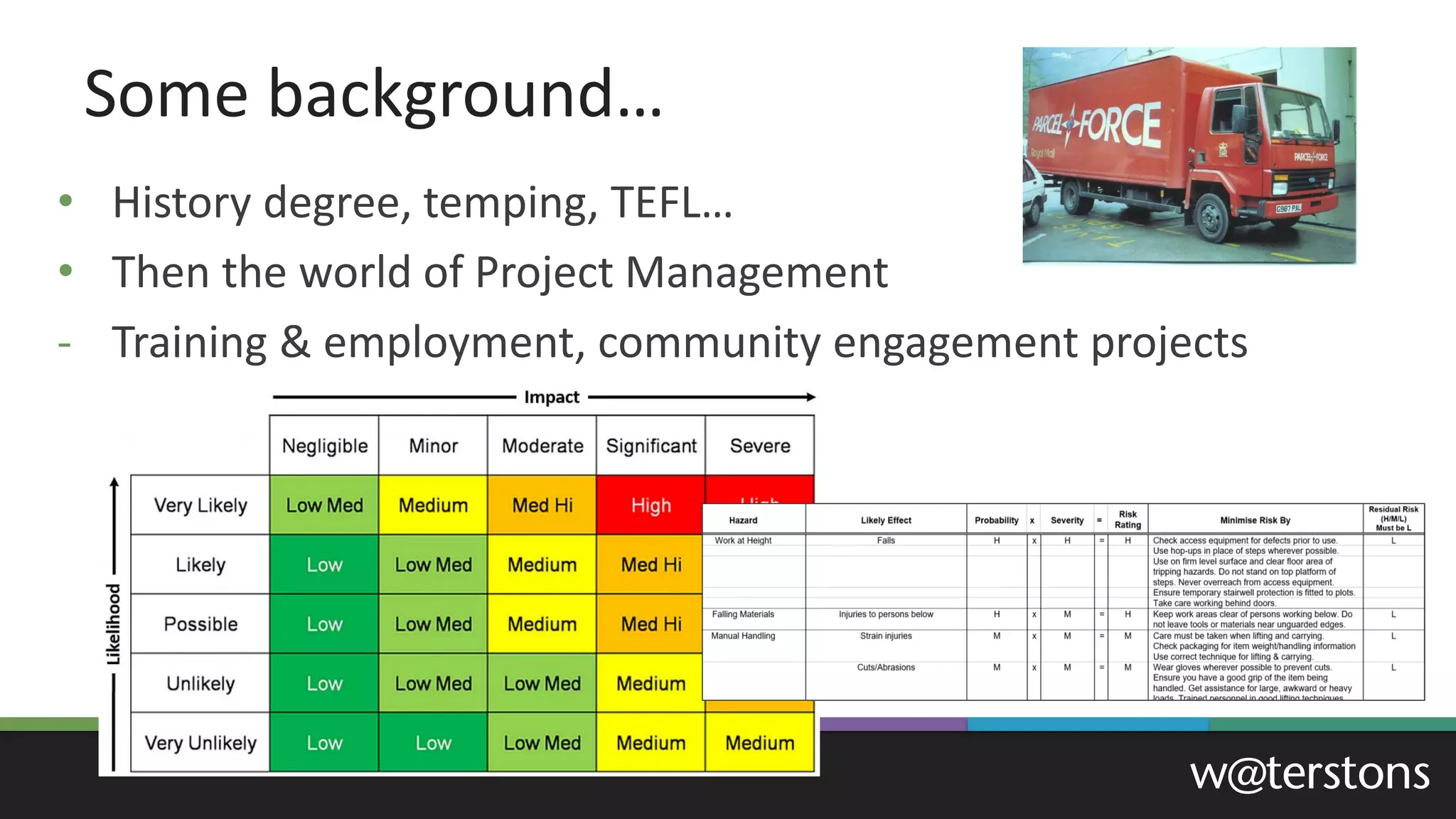
Some background…
• History degree, temping, TEFL…
• Then the world of Project Management
- Training & employment, community engagement projects
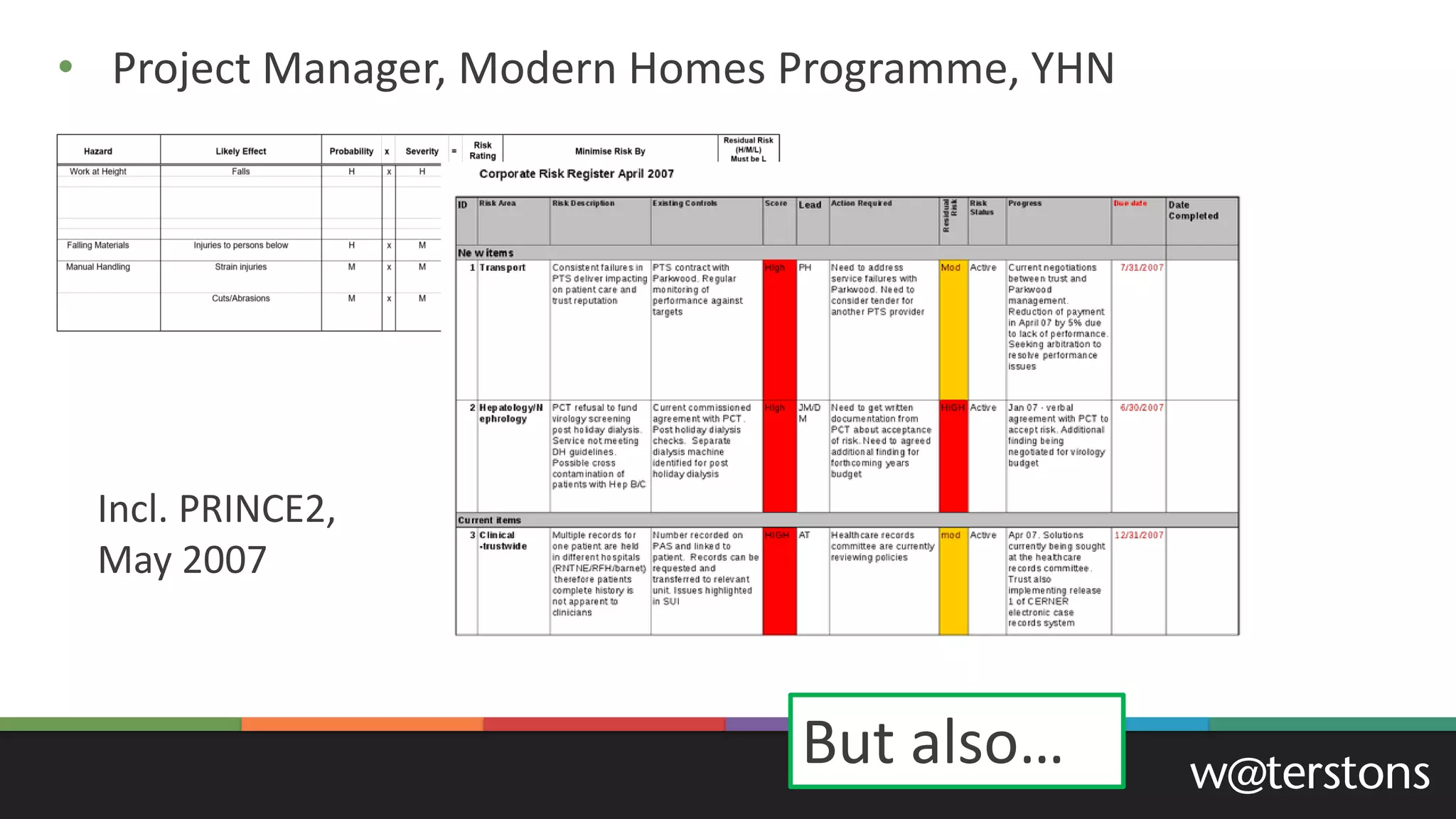
• Project Manager, Modern Homes Programme, YHN
Incl. PRINCE2,
May 2007
But also…
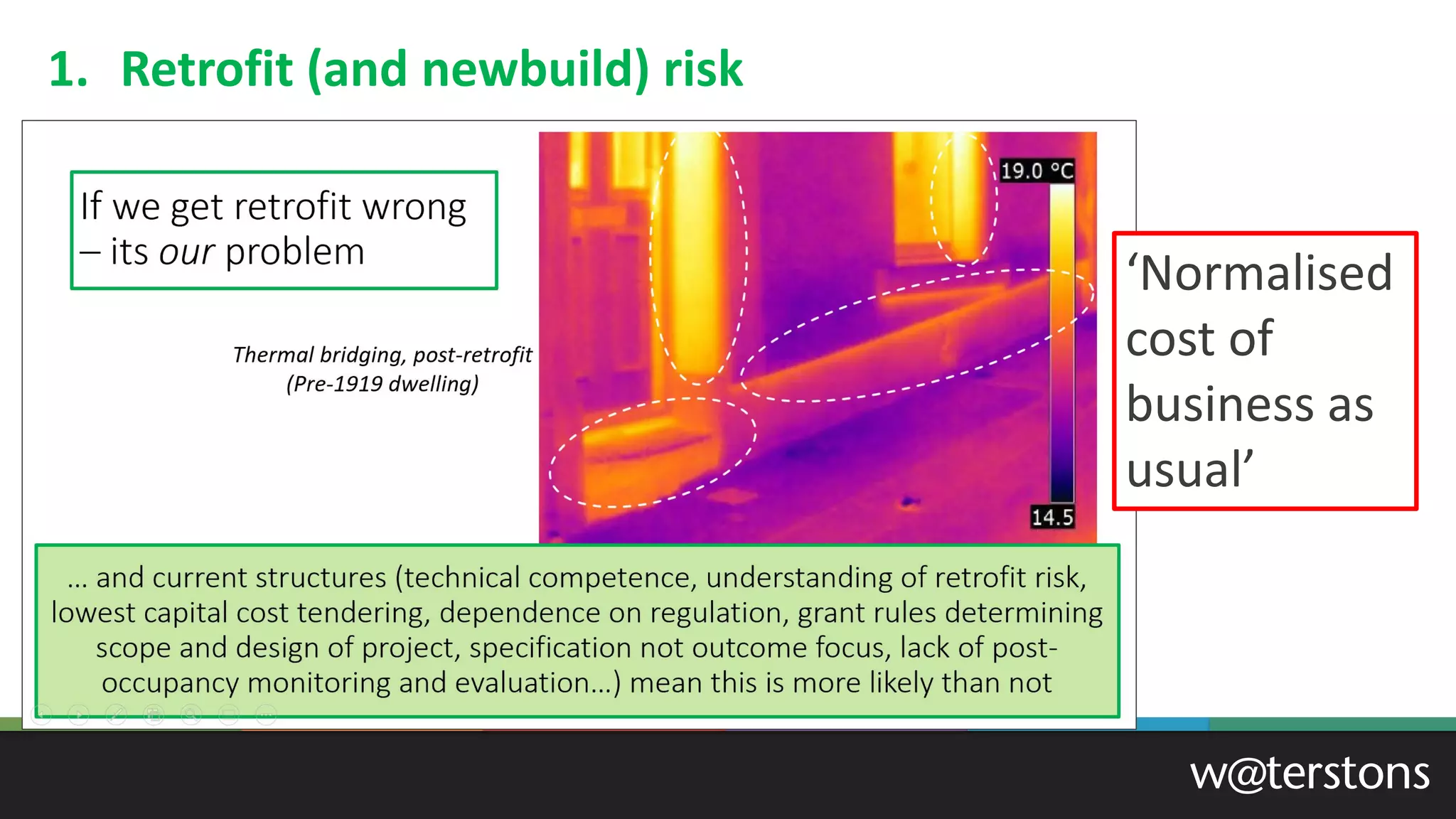
1. Retrofit (and newbuild) risk
‘Normalised
cost of
business as
usual’
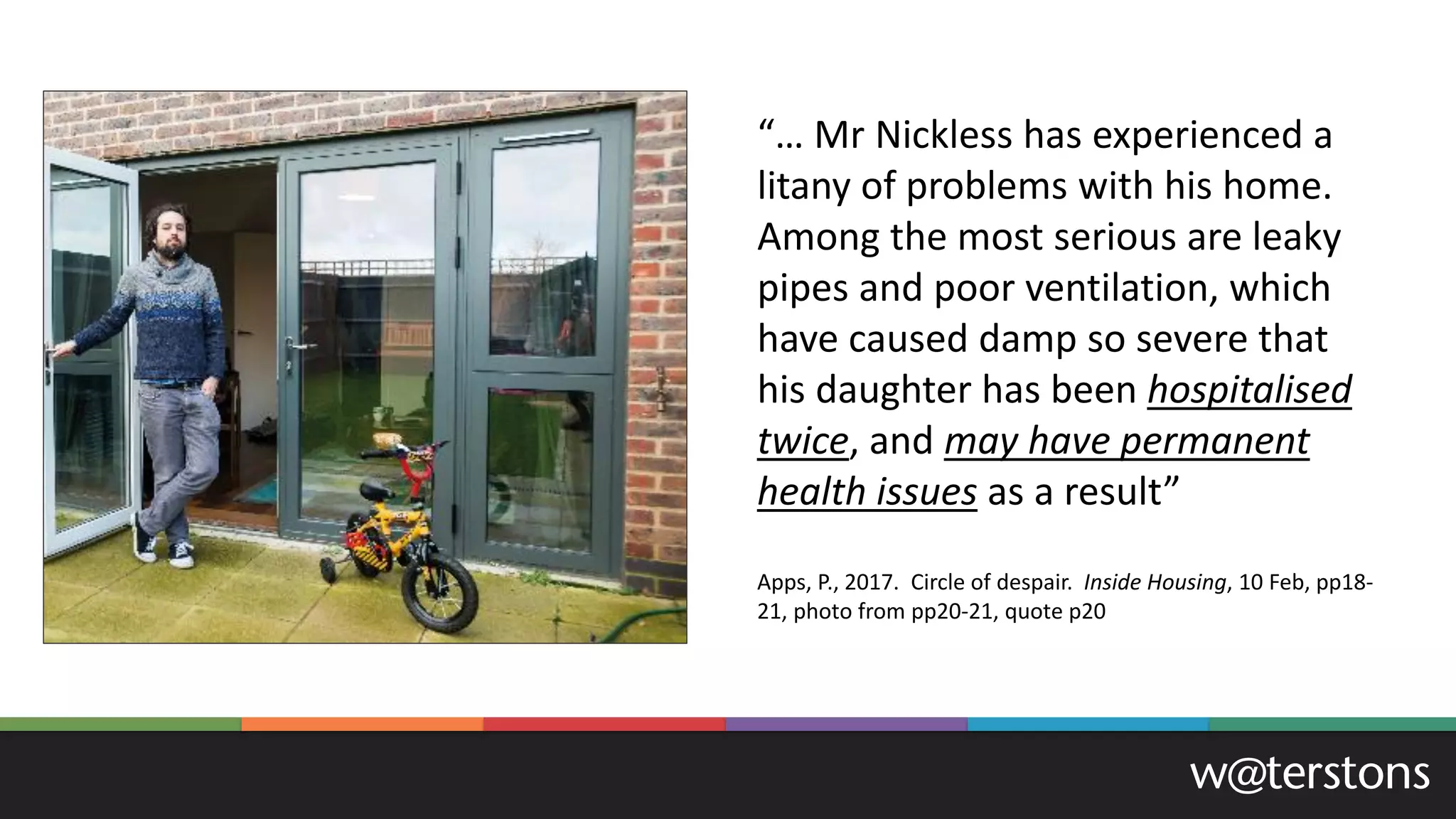
“… Mr Nickless has experienced a
litany of problems with his home.
Among the most serious are leaky
pipes and poor ventilation, which
have caused damp so severe that
his daughter has been hospitalised
twice, and may have permanent
health issues as a result”
Apps, P., 2017. Circle of despair. Inside Housing, 10 Feb, pp18-
21, photo from pp20-21, quote p20
2. Chartered Institute of Housing – certified practitioner
Steve Douglas, Altair; Stress test. Inside Housing, 25.1.2013, p17
“Boards don’t generally set out to be poor at governance and executives
don’t try to make bad decisions”
But…
“Could a board spot a cross default clause in a sale and leaseback deal that
had had an index linked coupon?”
“Our future is risk-laden, income streams uncertain, capital funding reduced
or non-existent, requiring increased commercial activity to compensate.
Merger and acquisition opportunities are rising”
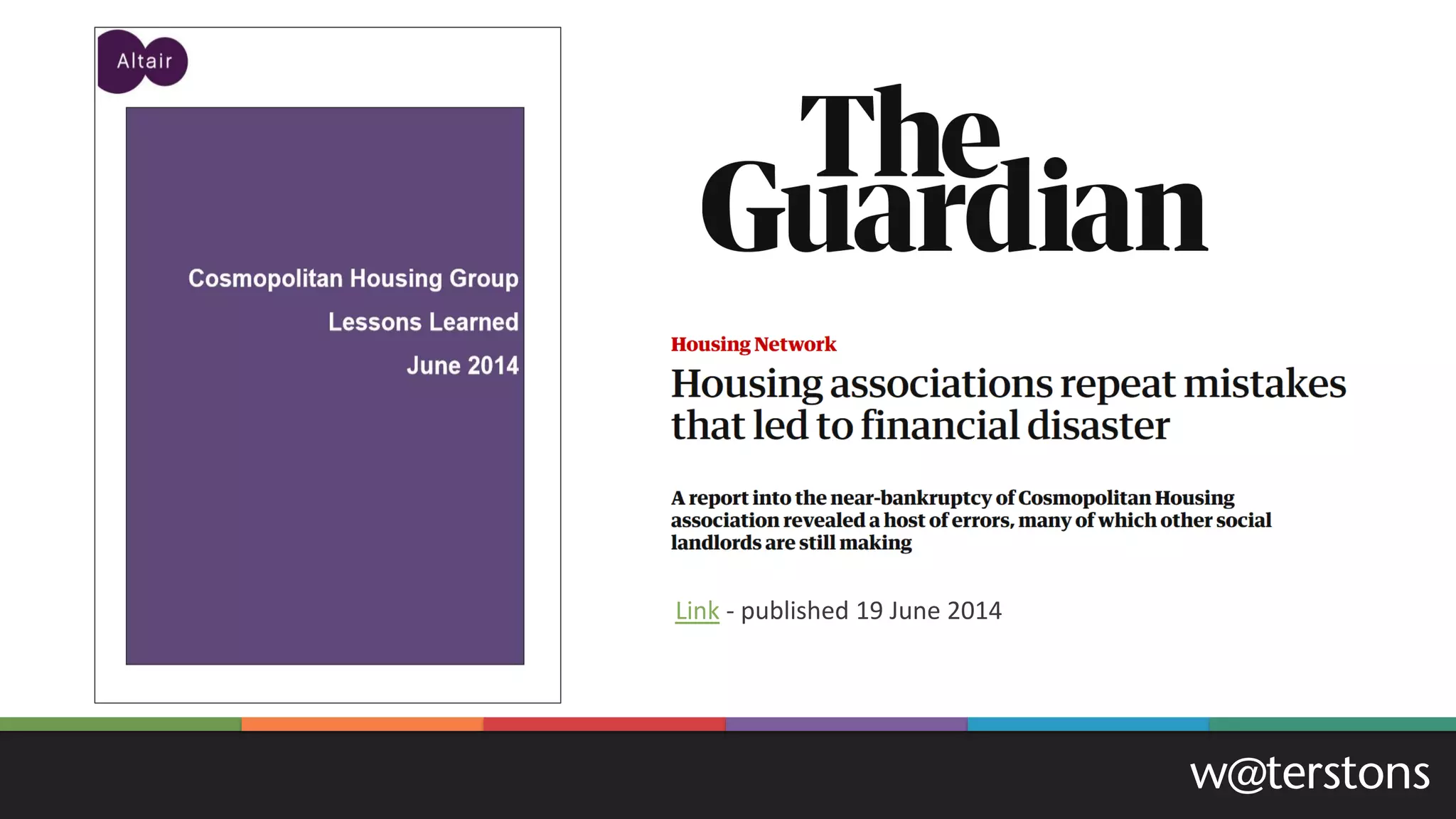
Link - published 19 June 2014
‘… the ability of organisations to
respond to incremental change
and sudden disruptions’
2050:
- Good quality, high performing homes
- Climate ready
- Sustainable neighbourhoods
- Sustainable energy systems
3. Industry engagement
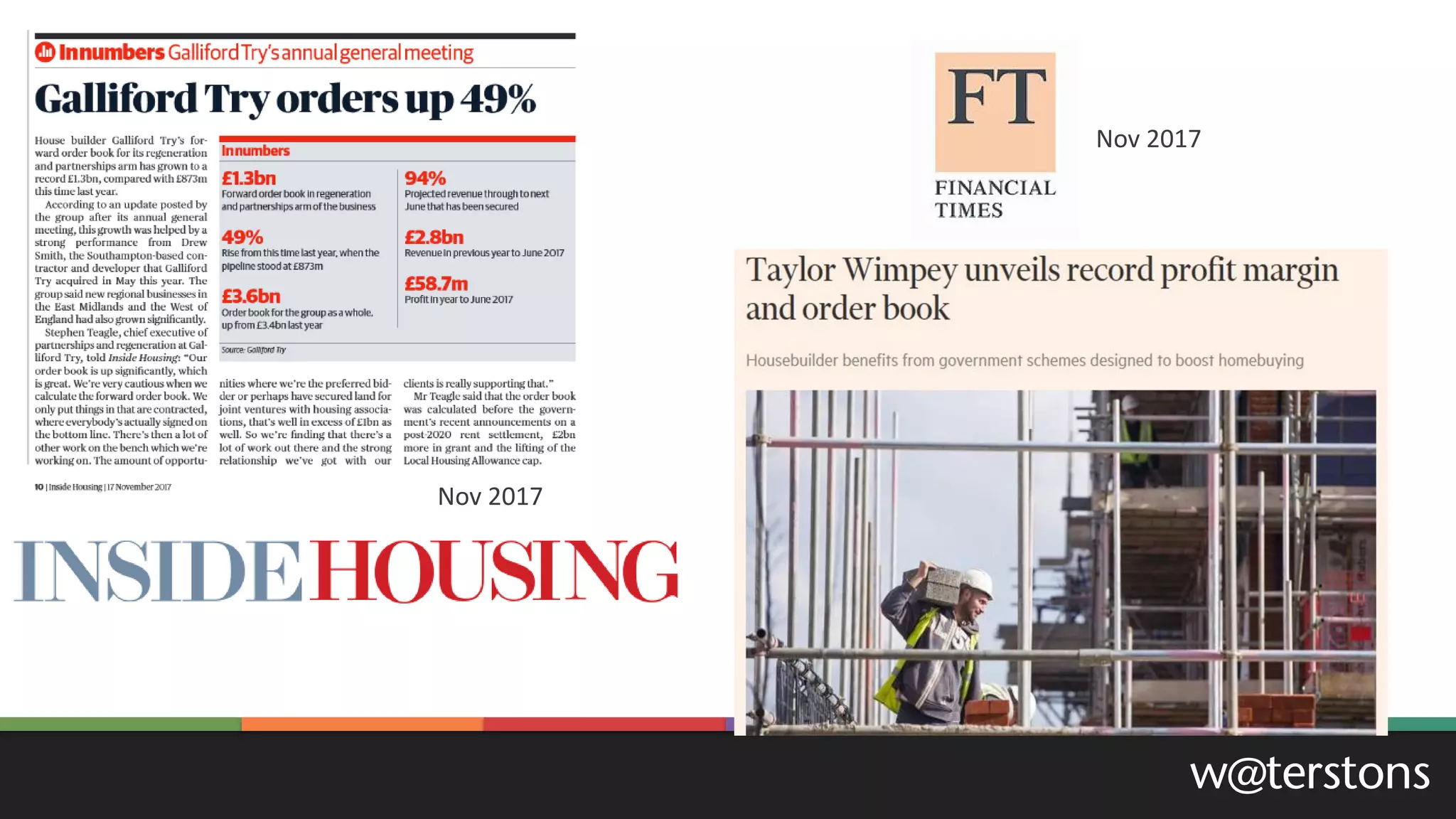
Nov 2017
Nov 2017
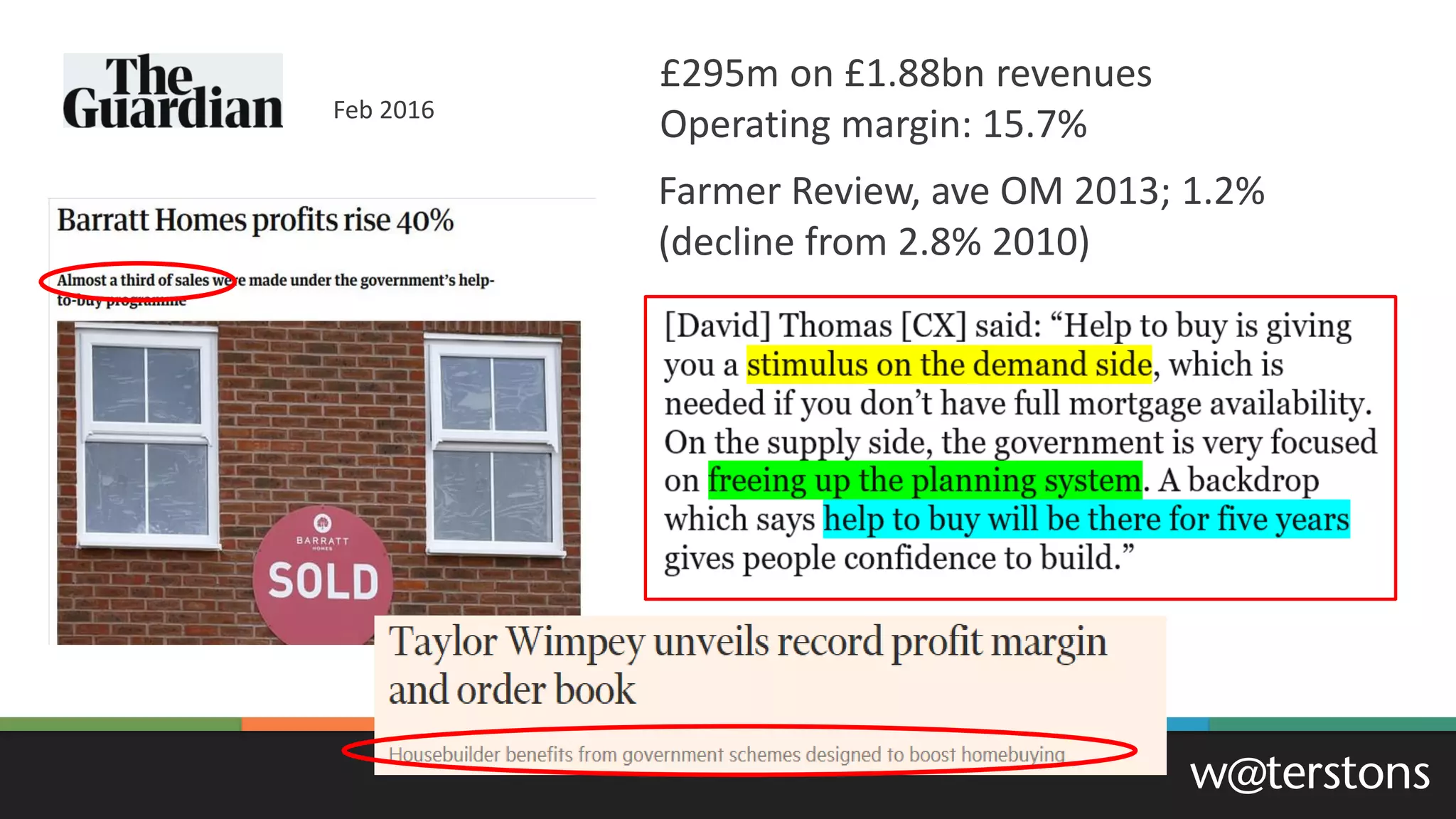
Feb 2016
£295m on £1.88bn revenues
Operating margin: 15.7%
Farmer Review, ave OM 2013; 1.2%
(decline from 2.8% 2010)
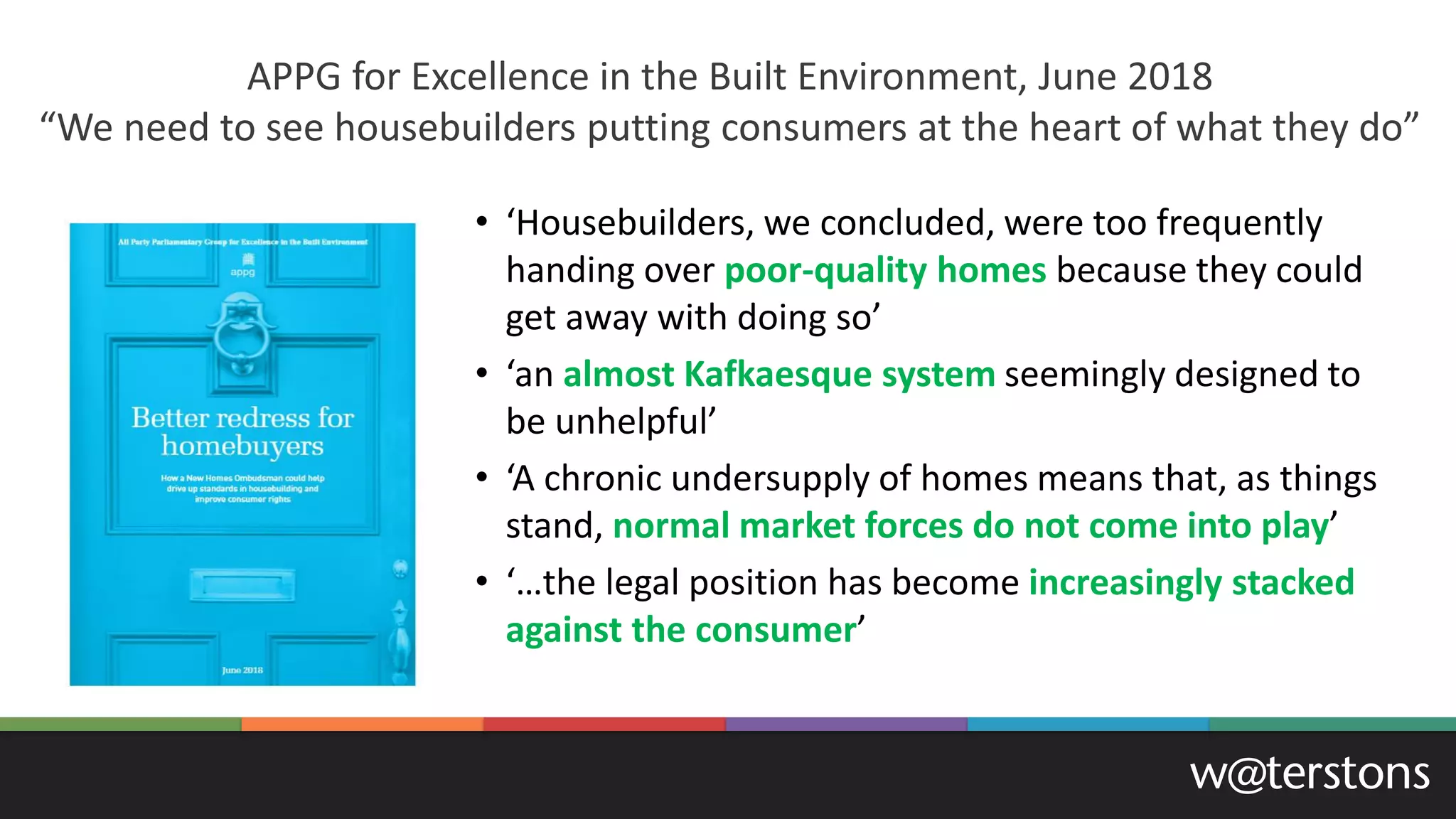
• ‘Housebuilders, we concluded, were too frequently
handing over poor-quality homes because they could
get away with doing so’
• ‘an almost Kafkaesque system seemingly designed to
be unhelpful’
• ‘A chronic undersupply of homes means that, as things
stand, normal market forces do not come into play’
• ‘…the legal position has become increasingly stacked
against the consumer’
APPG for Excellence in the Built Environment, June 2018
“We need to see housebuilders putting consumers at the heart of what they do”
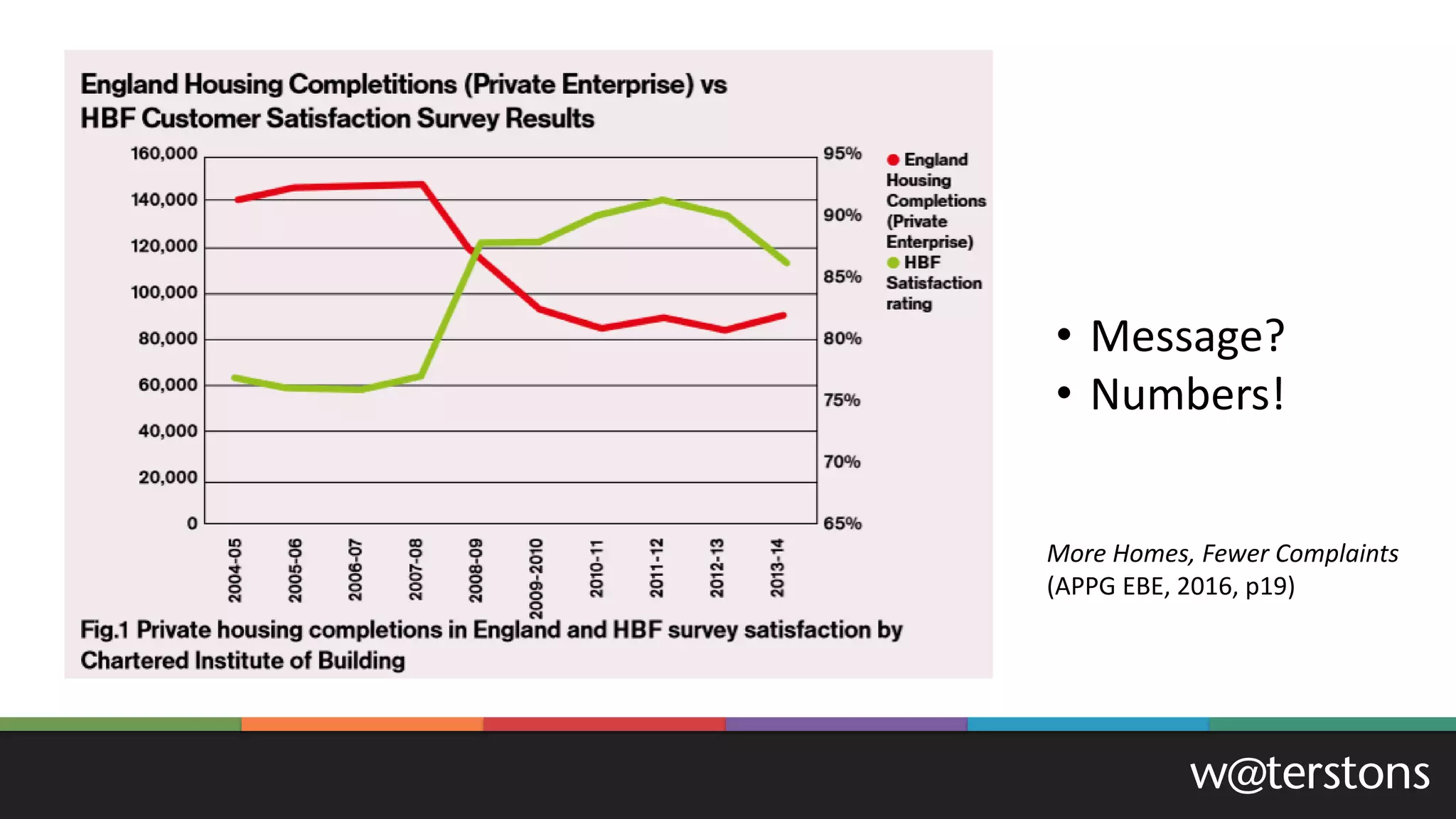
More Homes, Fewer Complaints
(APPG EBE, 2016, p19)
• Message?
• Numbers!
Peter Drucker
“Culture eats strategy
for breakfast”
So I feel like I know what the considerations and questions are…
• Culture in operating environment
• Culture in organisation
… but less sure of the narrative that helps understand a coherent,
resilient response.
Externals: Regulation, and regulators
• Regulation is not there to manage risk for clients
… a point very well made by Mark Elton, Cowan Architects, in the context of
Building Regulations:
“Building Regs sets minimum standards. I like to think of Building Regs as
setting the worst performing building fabric that you can legally get away
with. Don’t think of it as a stretching target to get to. Think of it as
something that people will try to get away with and as the lowest common
standard”
Externals:
Regulation, and
regulators
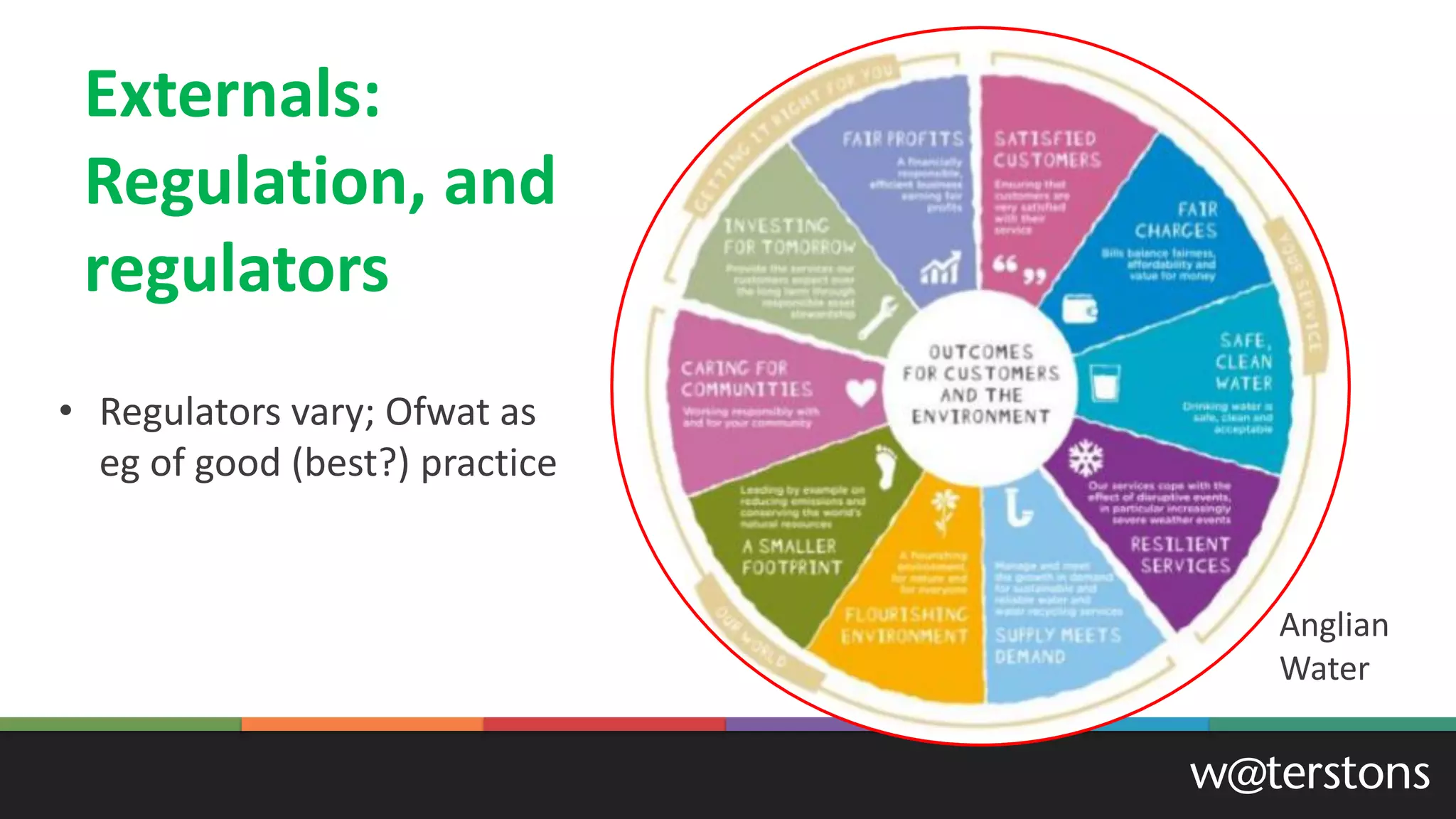
• Regulators vary; Ofwat as
eg of good (best?) practice
Anglian
Water
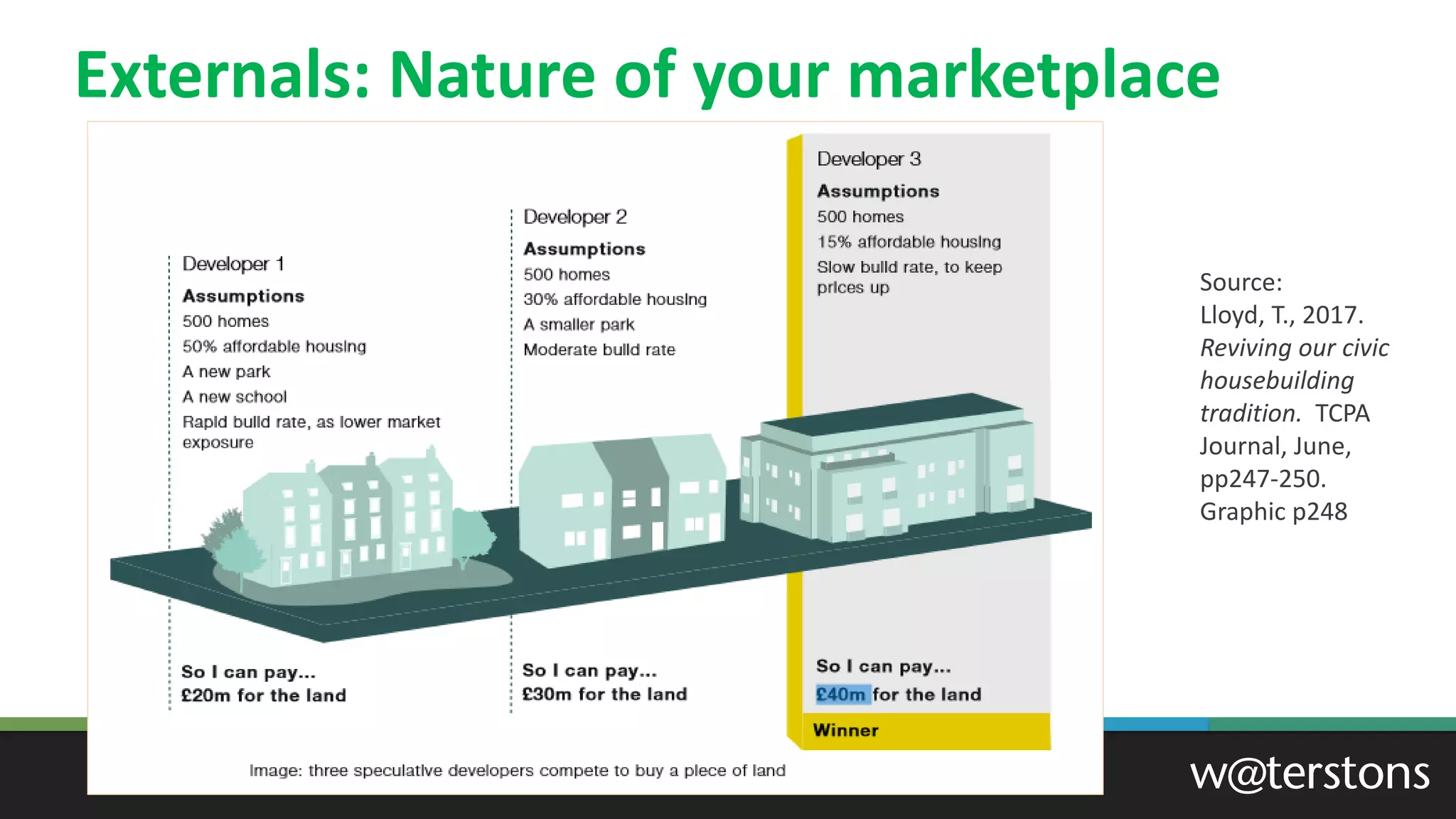
Externals: Nature of your marketplace
Source:
Lloyd, T., 2017.
Reviving our civic
housebuilding
tradition. TCPA
Journal, June,
pp247-250.
Graphic p248
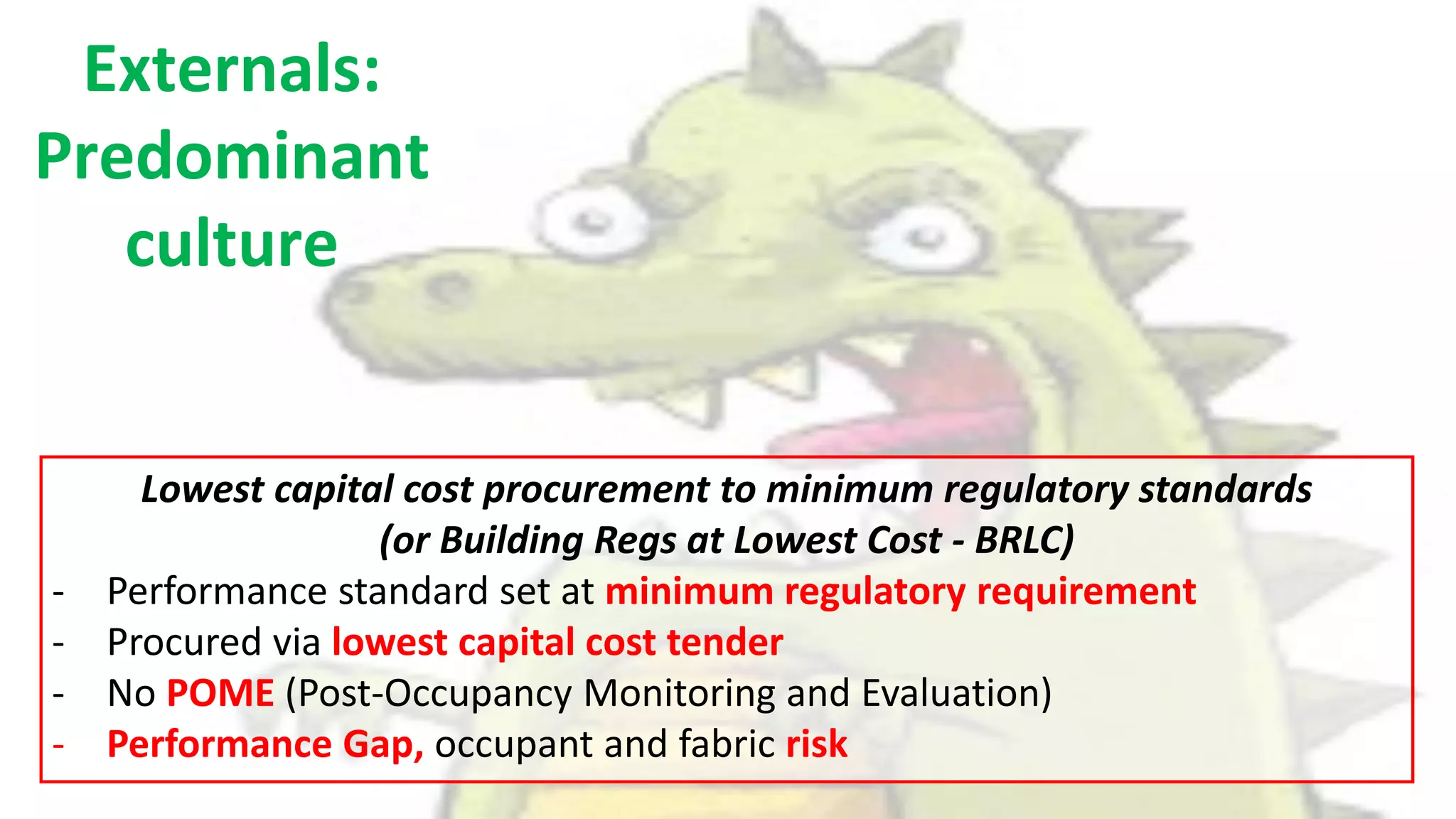
Lowest capital cost procurement to minimum regulatory standards
(or Building Regs at Lowest Cost - BRLC)
- Performance standard set at minimum regulatory requirement
- Procured via lowest capital cost tender
- No POME (Post-Occupancy Monitoring and Evaluation)
- Performance Gap, occupant and fabric risk
Externals:
Predominant
culture
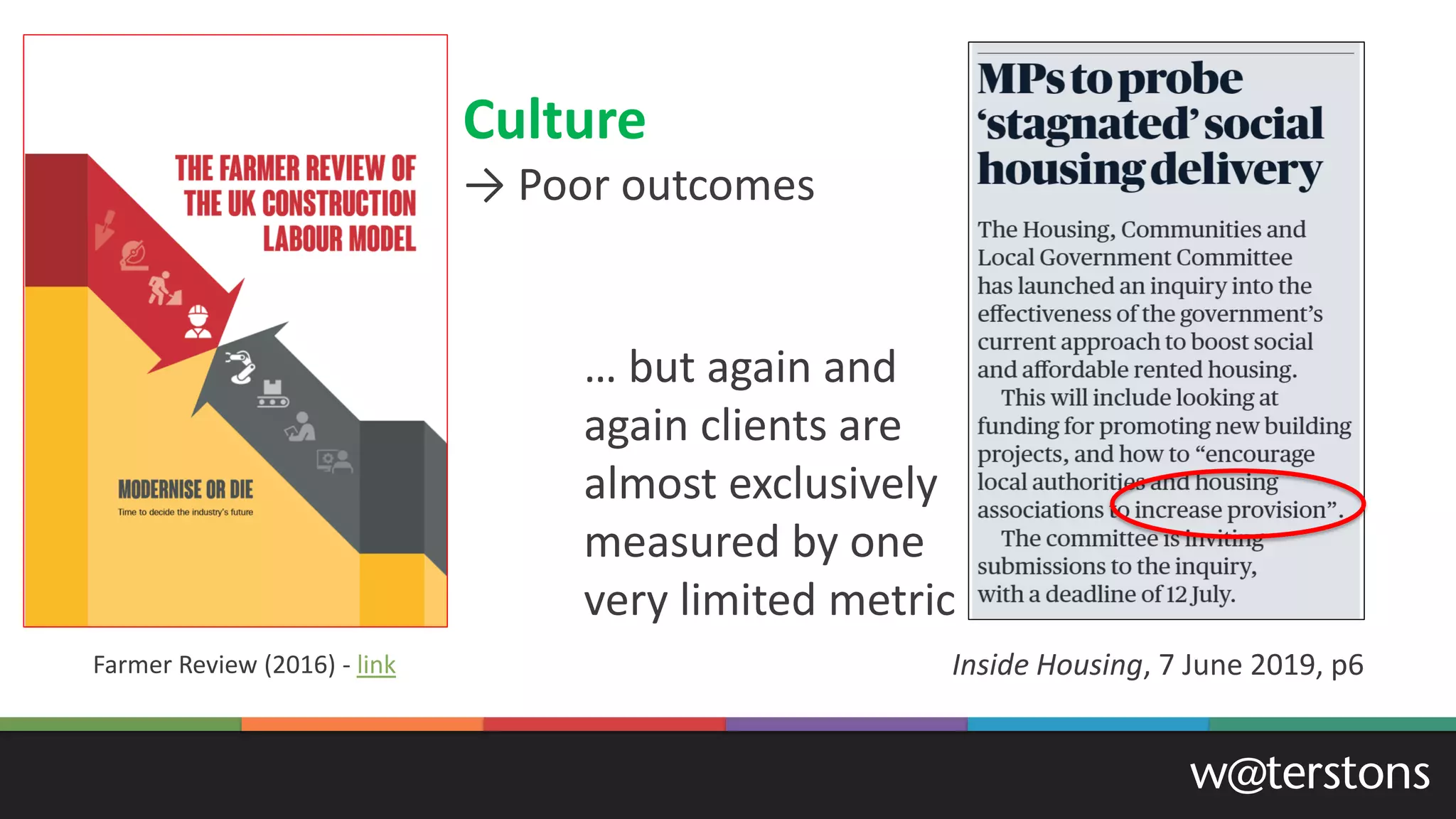
Inside Housing, 7 June 2019, p6
Culture
→ Poor outcomes
… but again and
again clients are
almost exclusively
measured by one
very limited metric
Farmer Review (2016) - link
Externals:
Public opinion
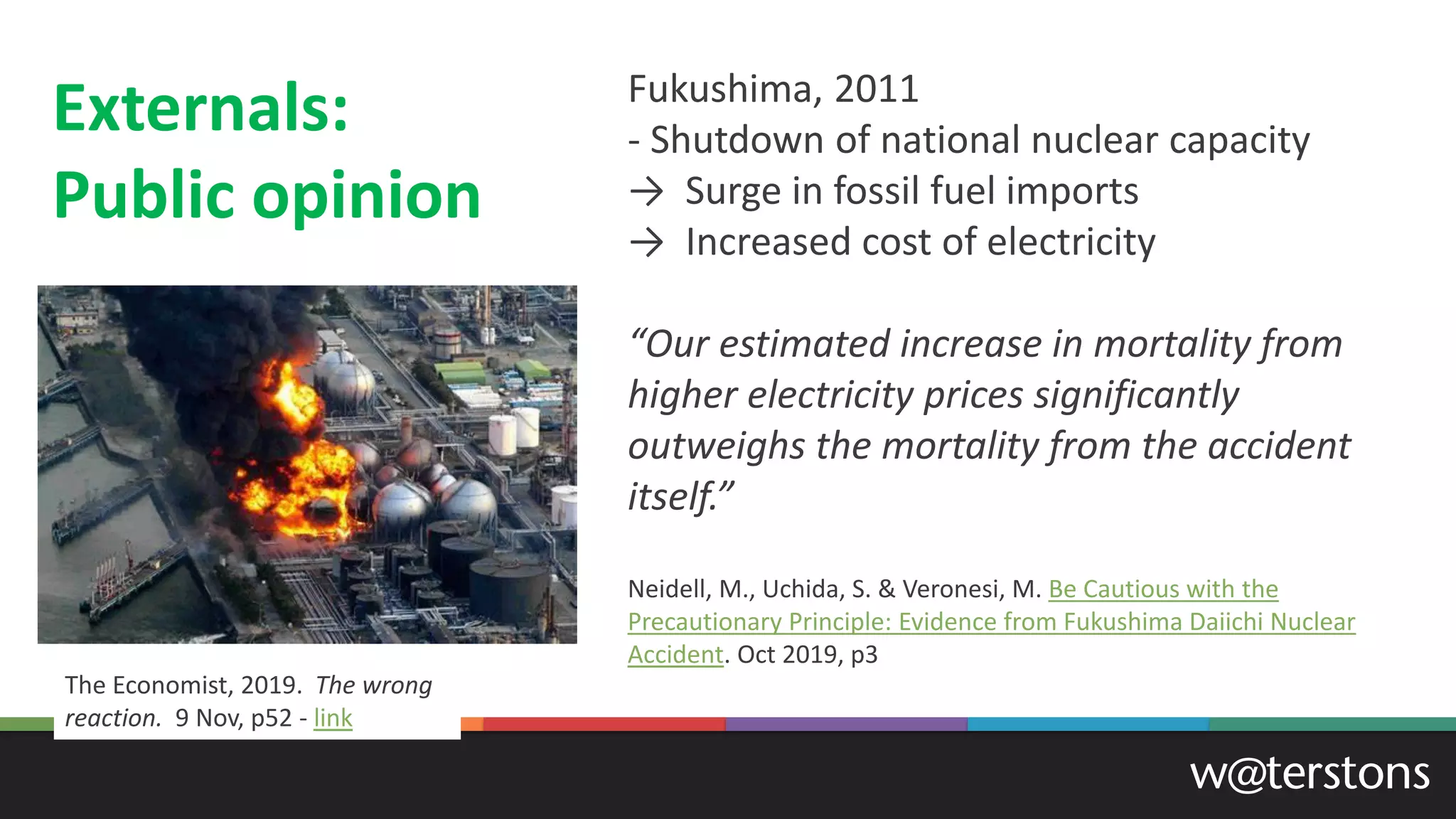
Fukushima, 2011
- Shutdown of national nuclear capacity
→ Surge in fossil fuel imports
→ Increased cost of electricity
“Our estimated increase in mortality from
higher electricity prices significantly
outweighs the mortality from the accident
itself.”
Neidell, M., Uchida, S. & Veronesi, M. Be Cautious with the
Precautionary Principle: Evidence from Fukushima Daiichi Nuclear
Accident. Oct 2019, p3
The Economist, 2019. The wrong
reaction. 9 Nov, p52 - link
Internals: Client choices
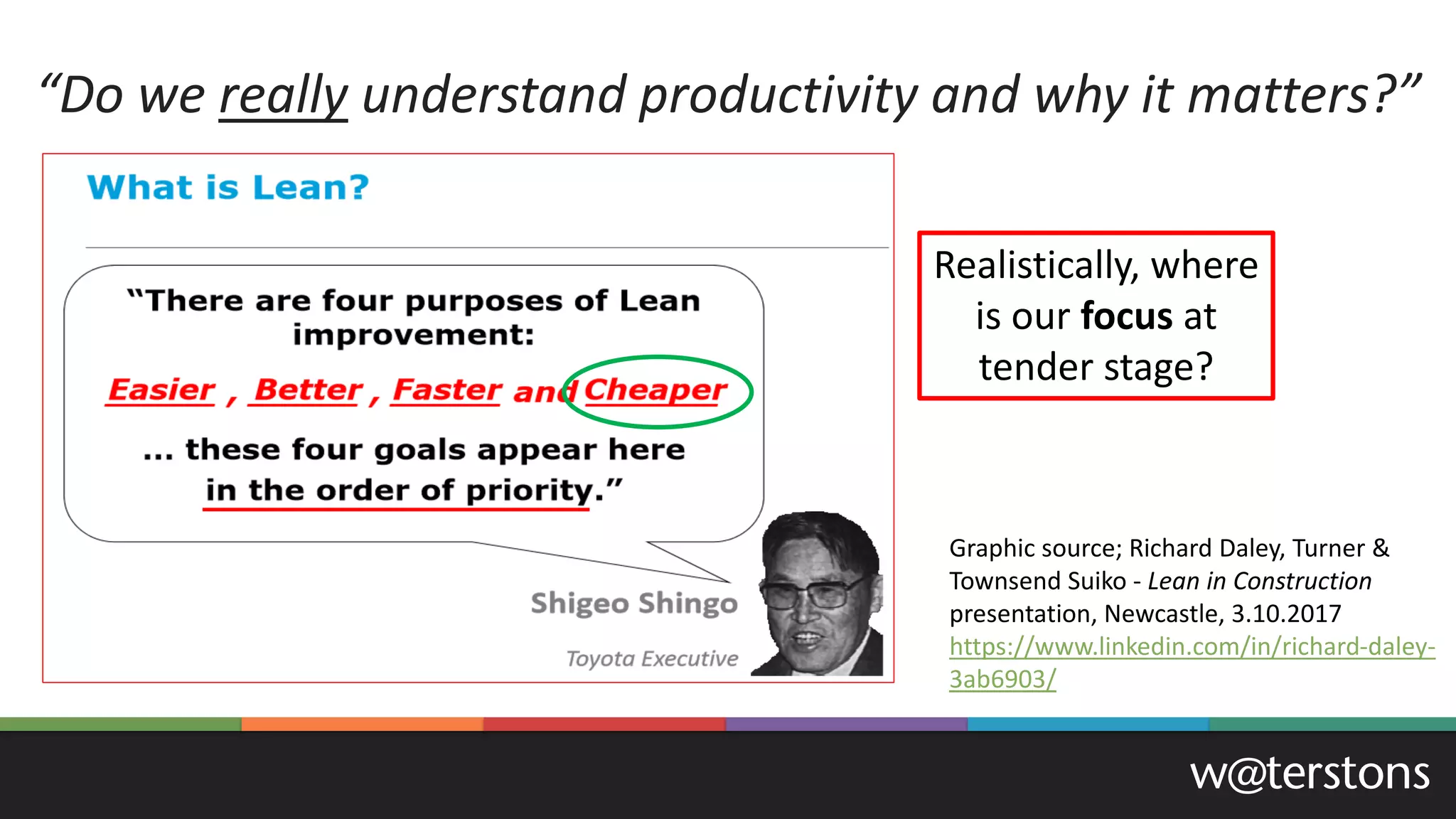
“Do we really understand productivity and why it matters?”
Realistically, where
is our focus at
tender stage?
Graphic source; Richard Daley, Turner &
Townsend Suiko - Lean in Construction
presentation, Newcastle, 3.10.2017
https://www.linkedin.com/in/richard-daley-
3ab6903/
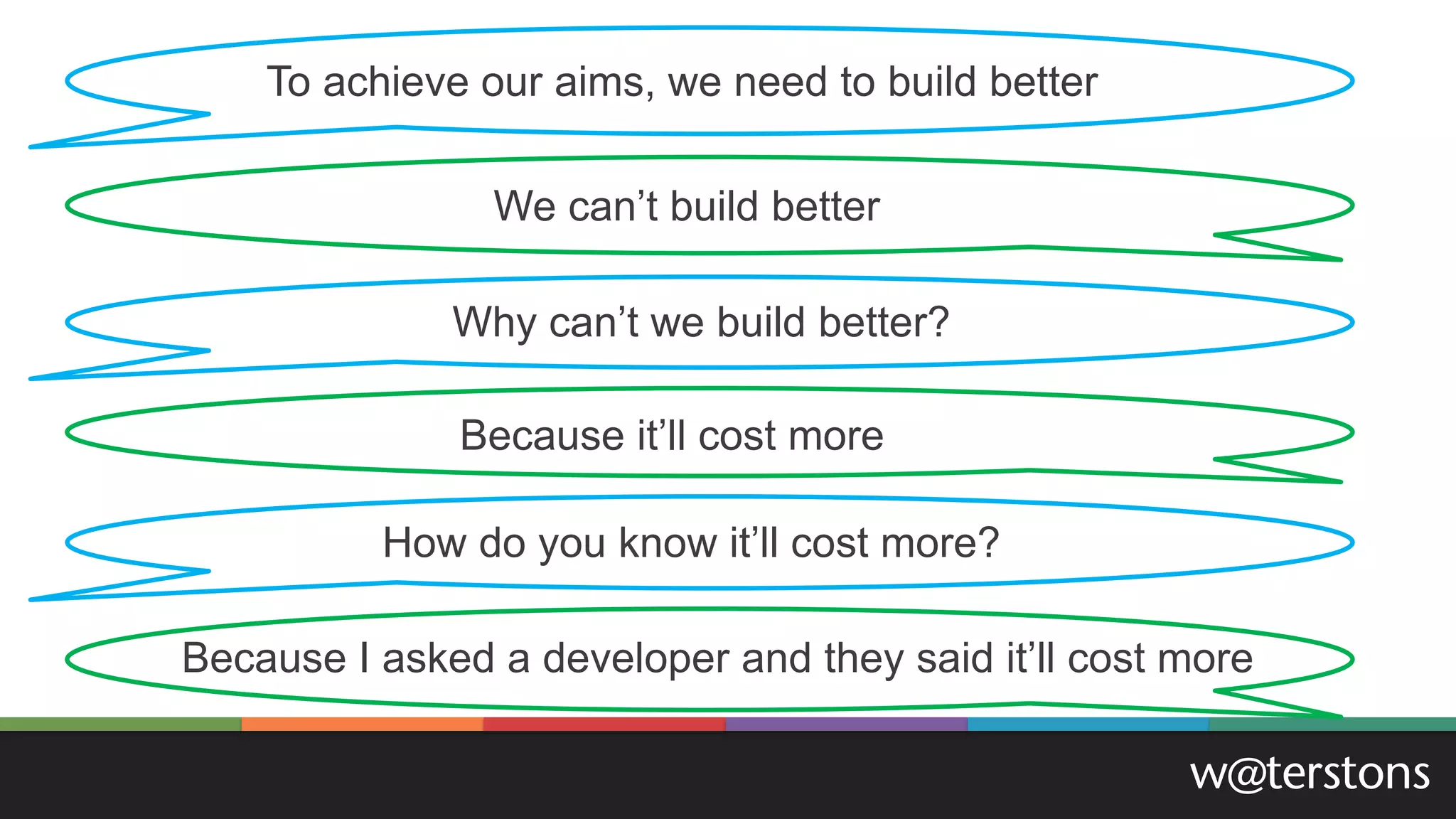
To achieve our aims, we need to build better
Why can’t we build better?
How do you know it’ll cost more?
We can’t build better
Because it’ll cost more
Because I asked a developer and they said it’ll cost more
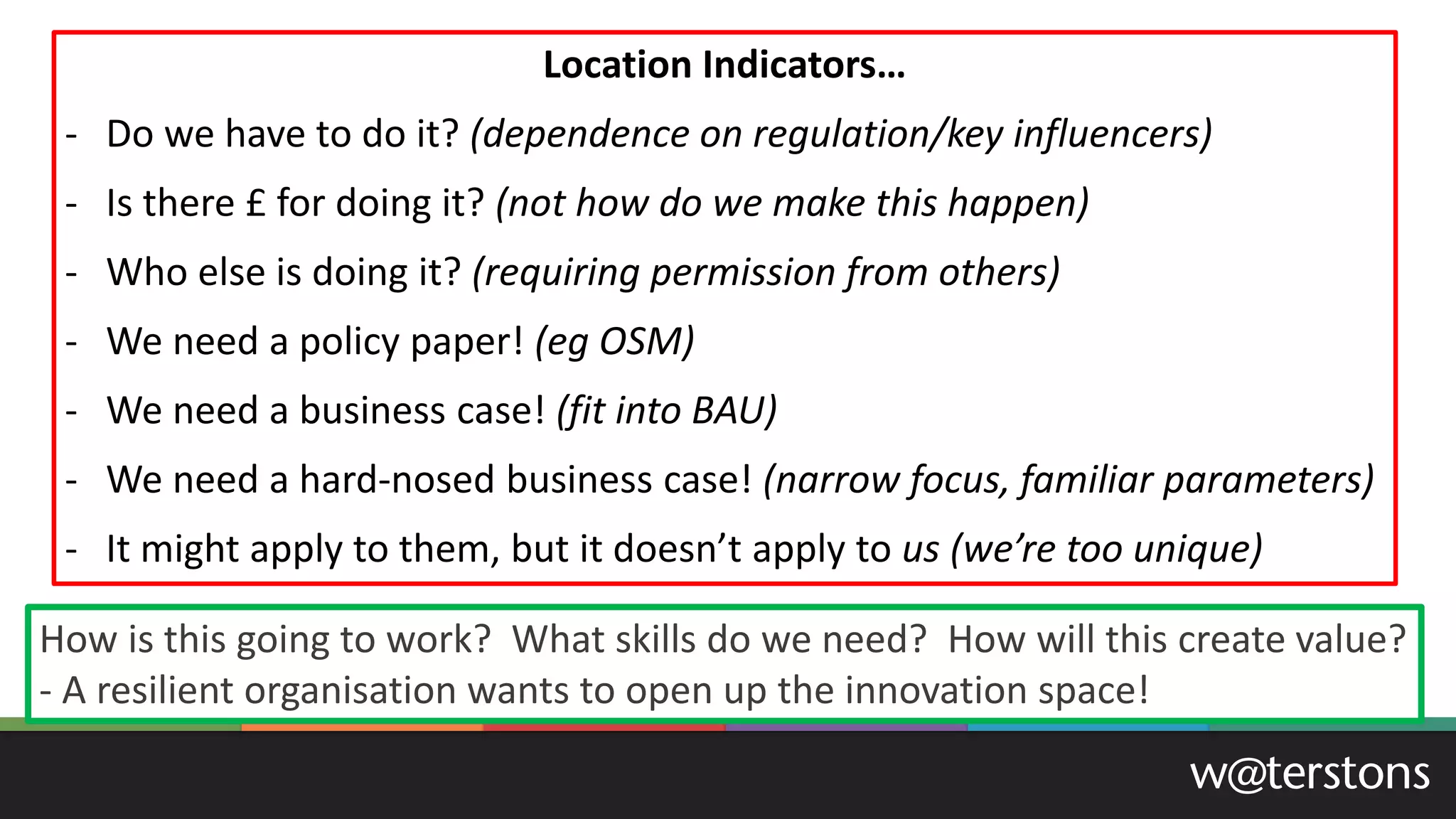
Location Indicators…
- Do we have to do it? (dependence on regulation/key influencers)
- Is there £ for doing it? (not how do we make this happen)
- Who else is doing it? (requiring permission from others)
- We need a policy paper! (eg OSM)
- We need a business case! (fit into BAU)
- We need a hard-nosed business case! (narrow focus, familiar parameters)
- It might apply to them, but it doesn’t apply to us (we’re too unique)
How is this going to work? What skills do we need? How will this create value?
- A resilient organisation wants to open up the innovation space!
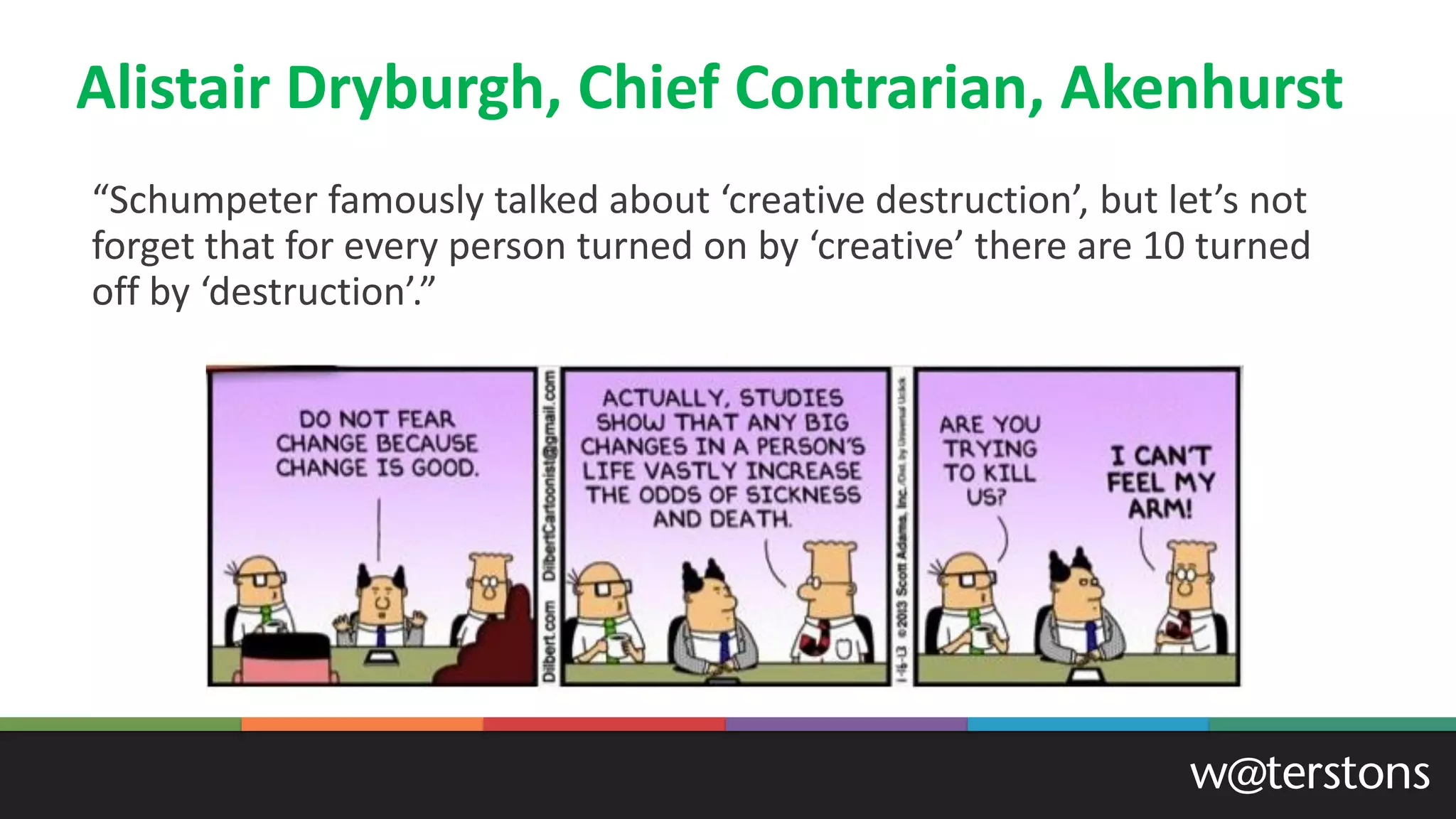
Alistair Dryburgh, Chief Contrarian, Akenhurst
“Schumpeter famously talked about ‘creative destruction’, but let’s not
forget that for every person turned on by ‘creative’ there are 10 turned
off by ‘destruction’.”
Alistair Dryburgh, Chief Contrarian, Akenhurst
“Originality, while more and more necessary to the future of
organisations, is still not often very well-received there”
“When it comes to generating new ideas, quantity matters more than
quality. And in any case, it is idea selection, not generation, that really
matters”
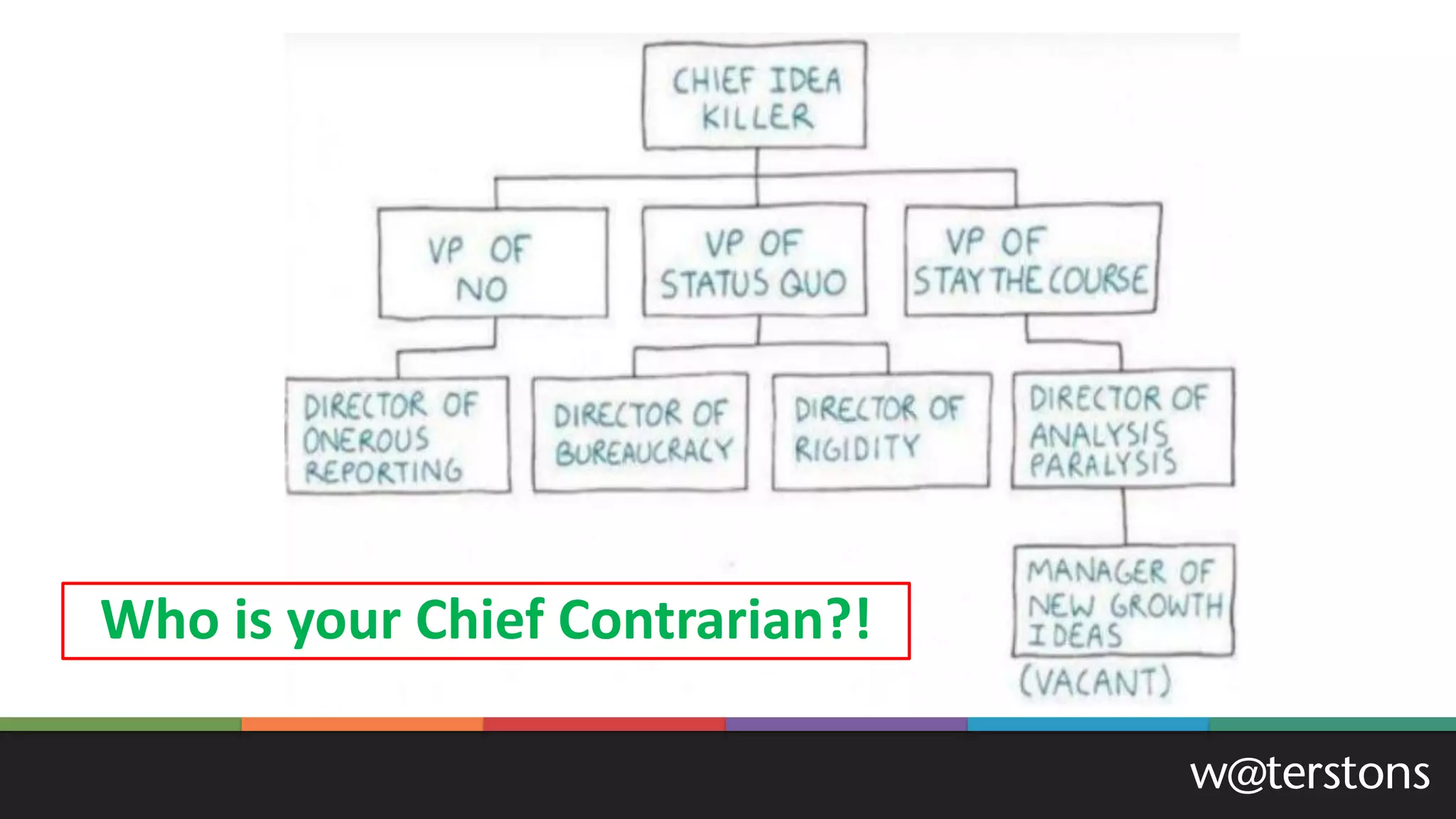
Who is your Chief Contrarian?!
So what do positive, ‘resilience-orientated’
choices look like?
• Client-led, outcome-orientated, long-term, whole-life cost
• Learning loops
• Managing up from compliance
• Understand your ‘carriers for change’
→ Built environment example
So what do positive, ‘resilience-orientated’
choices look like?
• ‘Carriers for change’
- Client Leadership Principles; active and sophisticated clienting
- ‘Procuring for Value’ – Linked In group
• Learning Loops
- Post-occupancy monitoring & evaluation
- Post-project Review
- Sensors, data & visualisation
- Green Building Team; operationalise, train, ensure standards, mentor
➢ Give a forward view of your programme
➢ Focus on outcomes (‘Procuring for Value’)
➢ Be ambitious…
➢ … Consistently
➢ “A great client has a great supply chain”;
→ Engage, enable, bring on future suppliers
➢ Aggregate (you are not as special as you think you are…)
➢ Think DFMA
➢ Think Lean, in the right order – Easier, Better, Faster, Cheaper
(Yes, cheaper is last)
➢ Digital construction & the power of BIM! Information as a Deliverable
Unlocking innovation and outcome: Client leadership principles
Concluding thoughts…
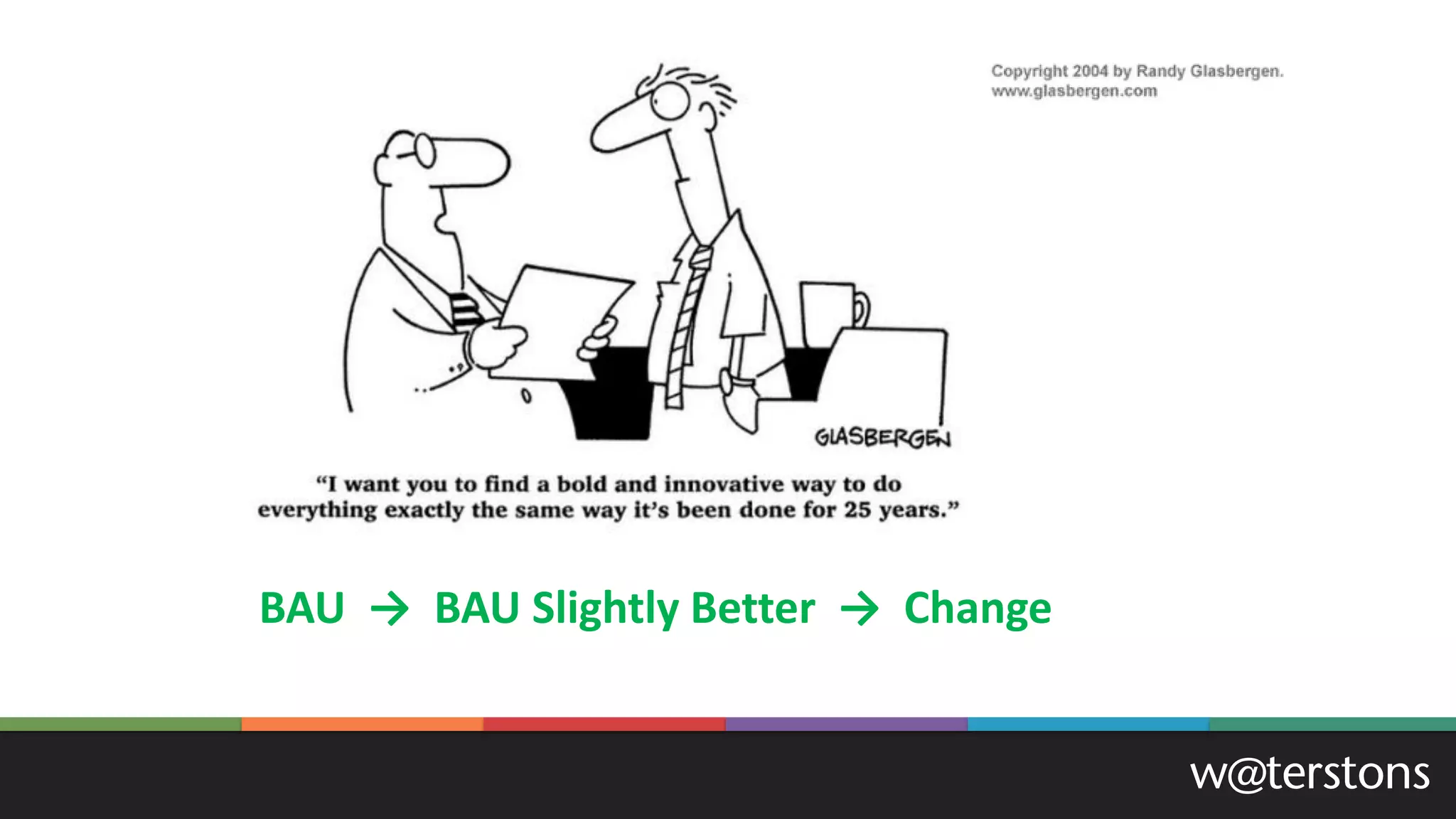
BAU → BAU Slightly Better → Change
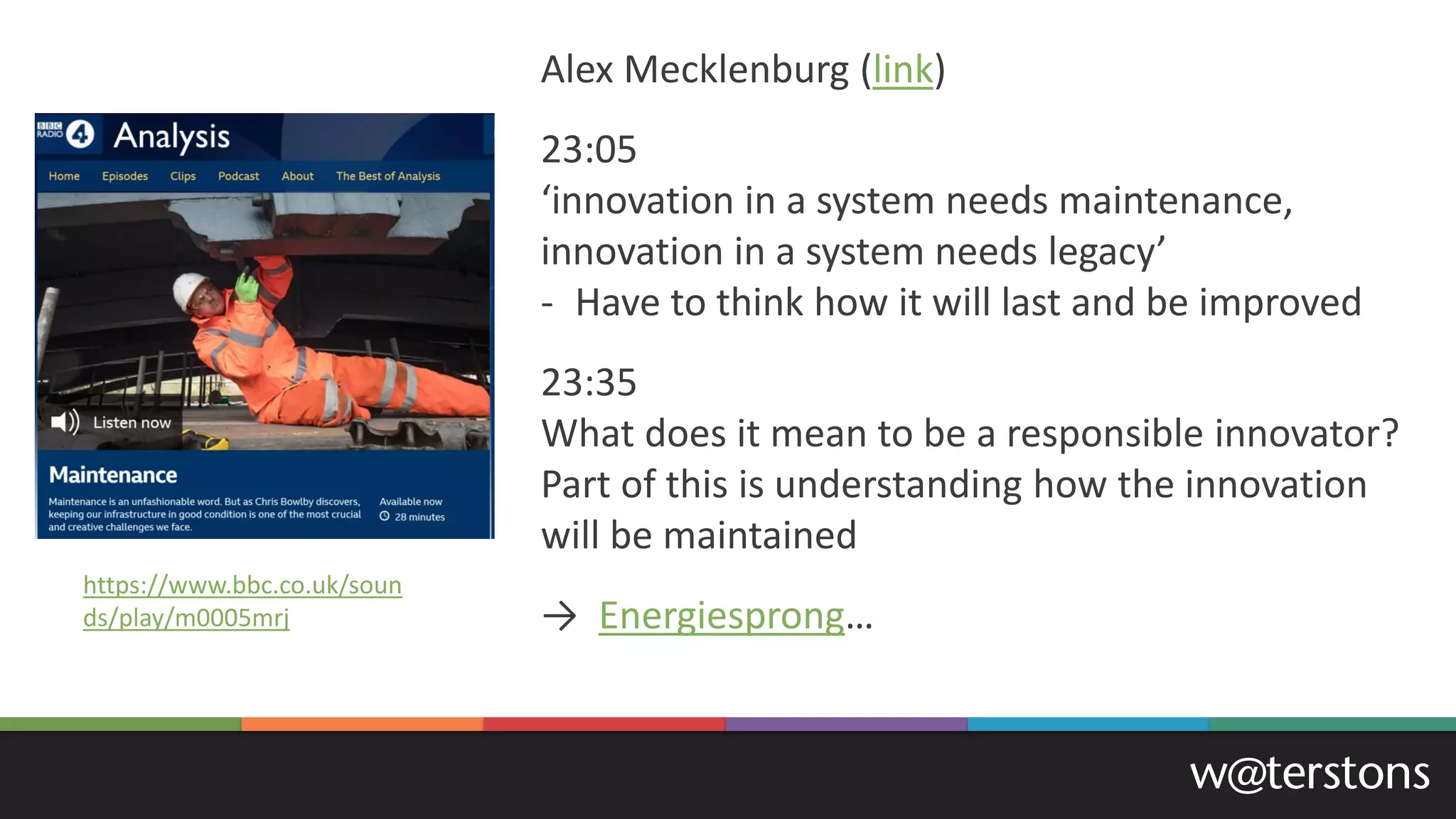
Alex Mecklenburg (link)
23:05
‘innovation in a system needs maintenance,
innovation in a system needs legacy’
- Have to think how it will last and be improved
23:35
What does it mean to be a responsible innovator?
Part of this is understanding how the innovation
will be maintained
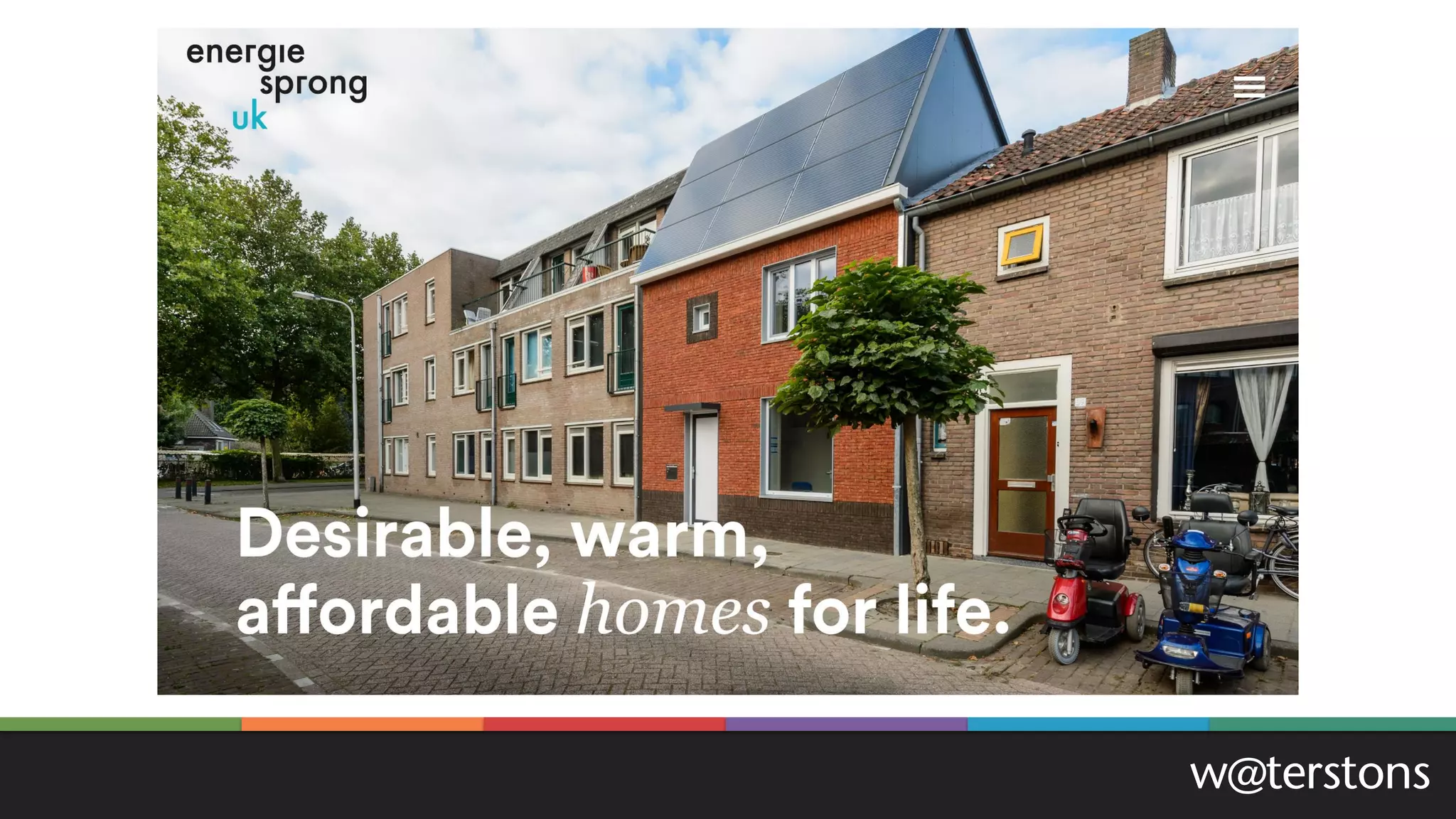
→ Energiesprong…
https://www.bbc.co.uk/soun
ds/play/m0005mrj
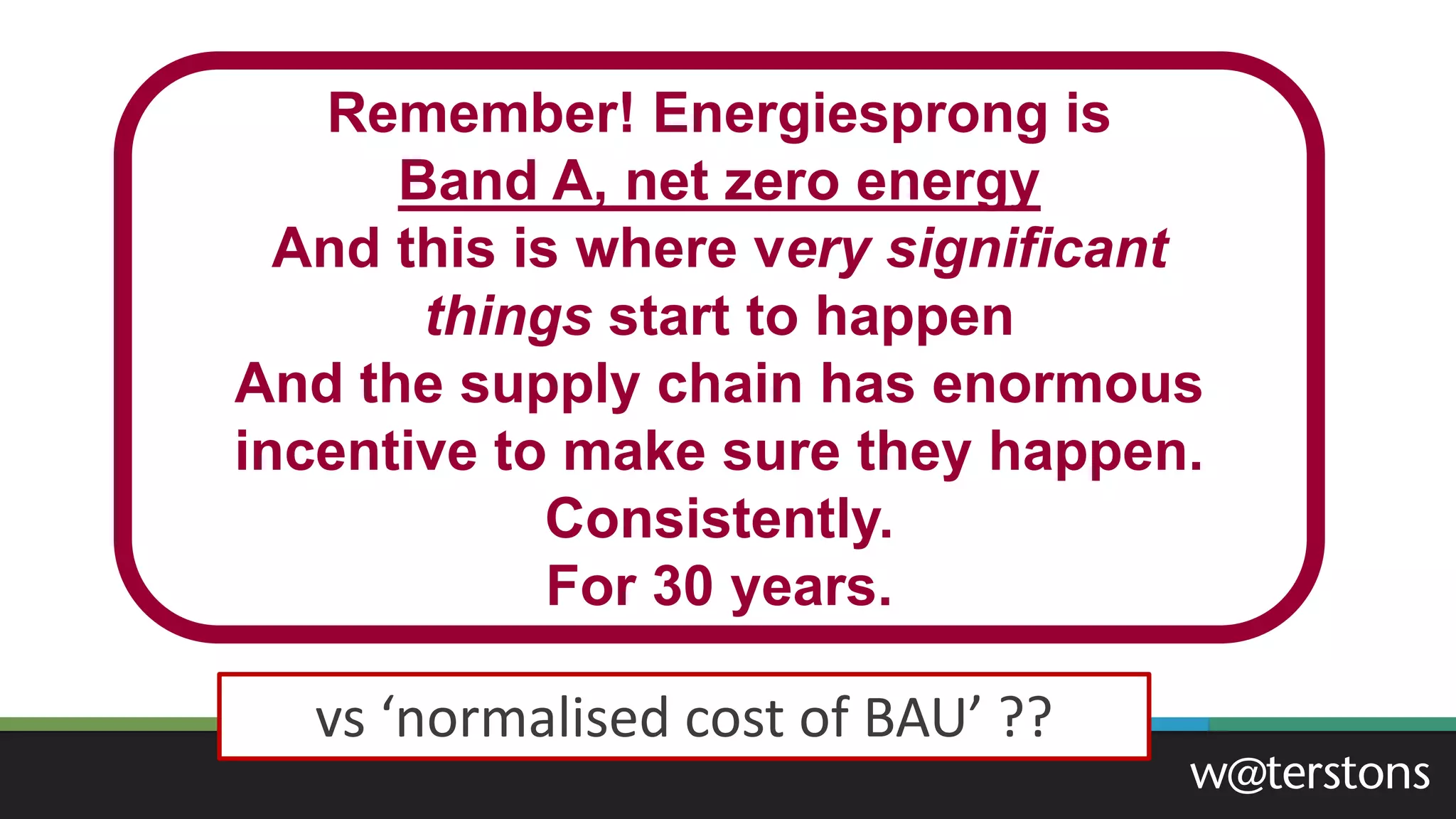
Remember! Energiesprong is
Band A, net zero energy
And this is where very significant
things start to happen
And the supply chain has enormous
incentive to make sure they happen.
Consistently.
For 30 years.
vs ‘normalised cost of BAU’ ??
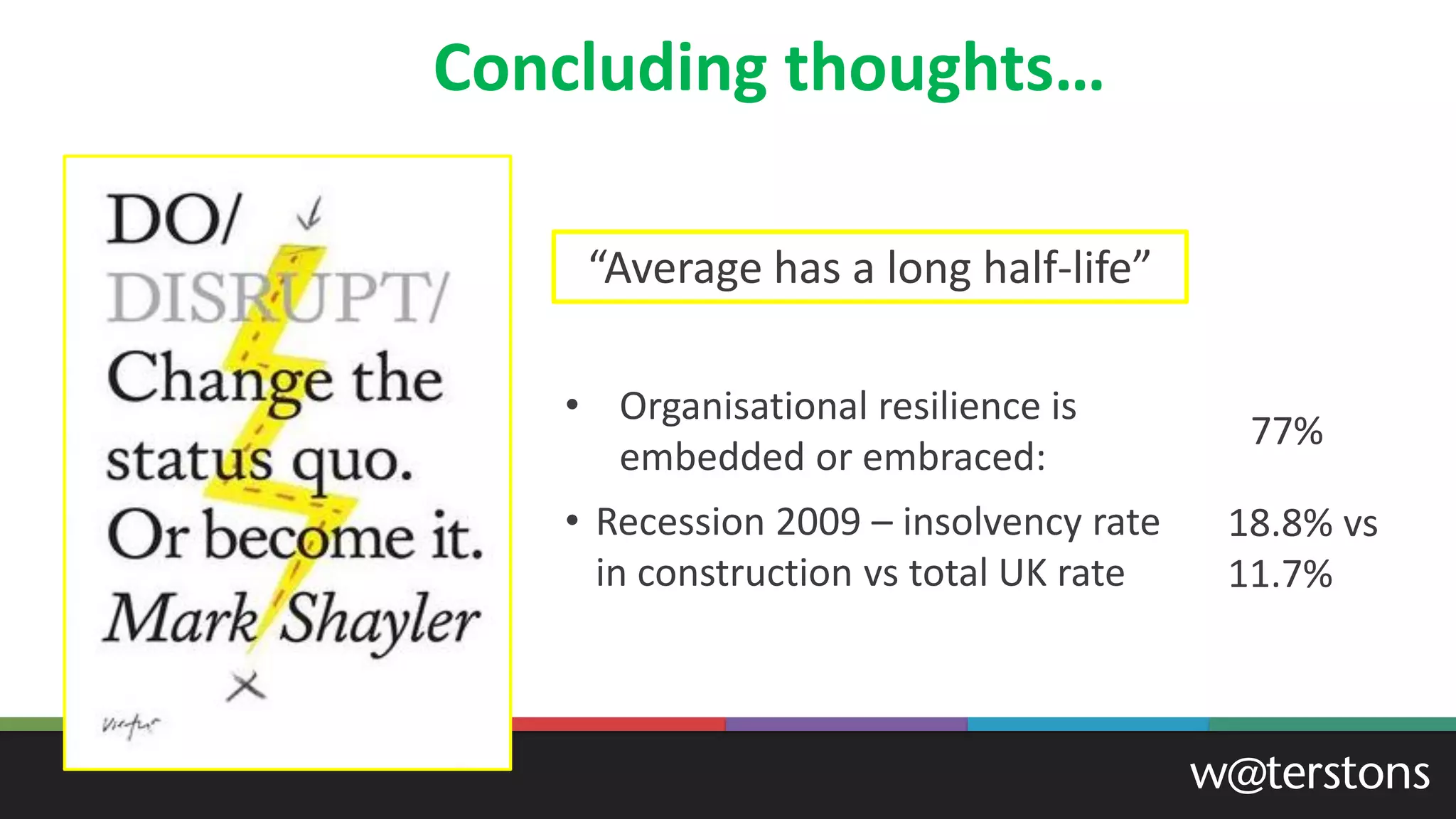
Concluding thoughts…
• Organisational resilience is
embedded or embraced:
“Average has a long half-life”
77%
• Recession 2009 – insolvency rate
in construction vs total UK rate
18.8% vs
11.7%
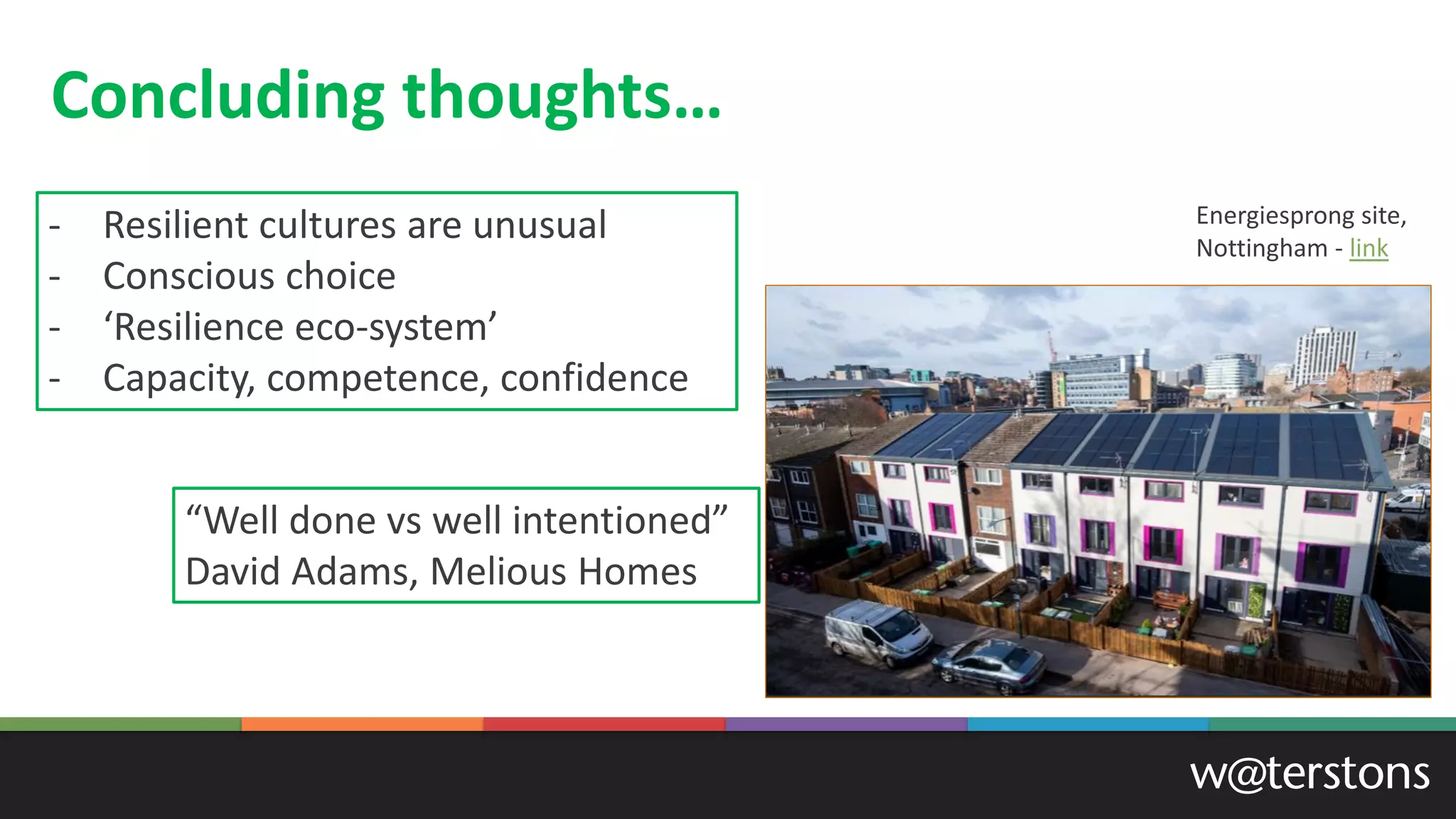
Concluding thoughts…
- Resilient cultures are unusual
- Conscious choice
- ‘Resilience eco-system’
- Capacity, competence, confidence
“Well done vs well intentioned”
David Adams, Melious Homes
Energiesprong site,
Nottingham - link
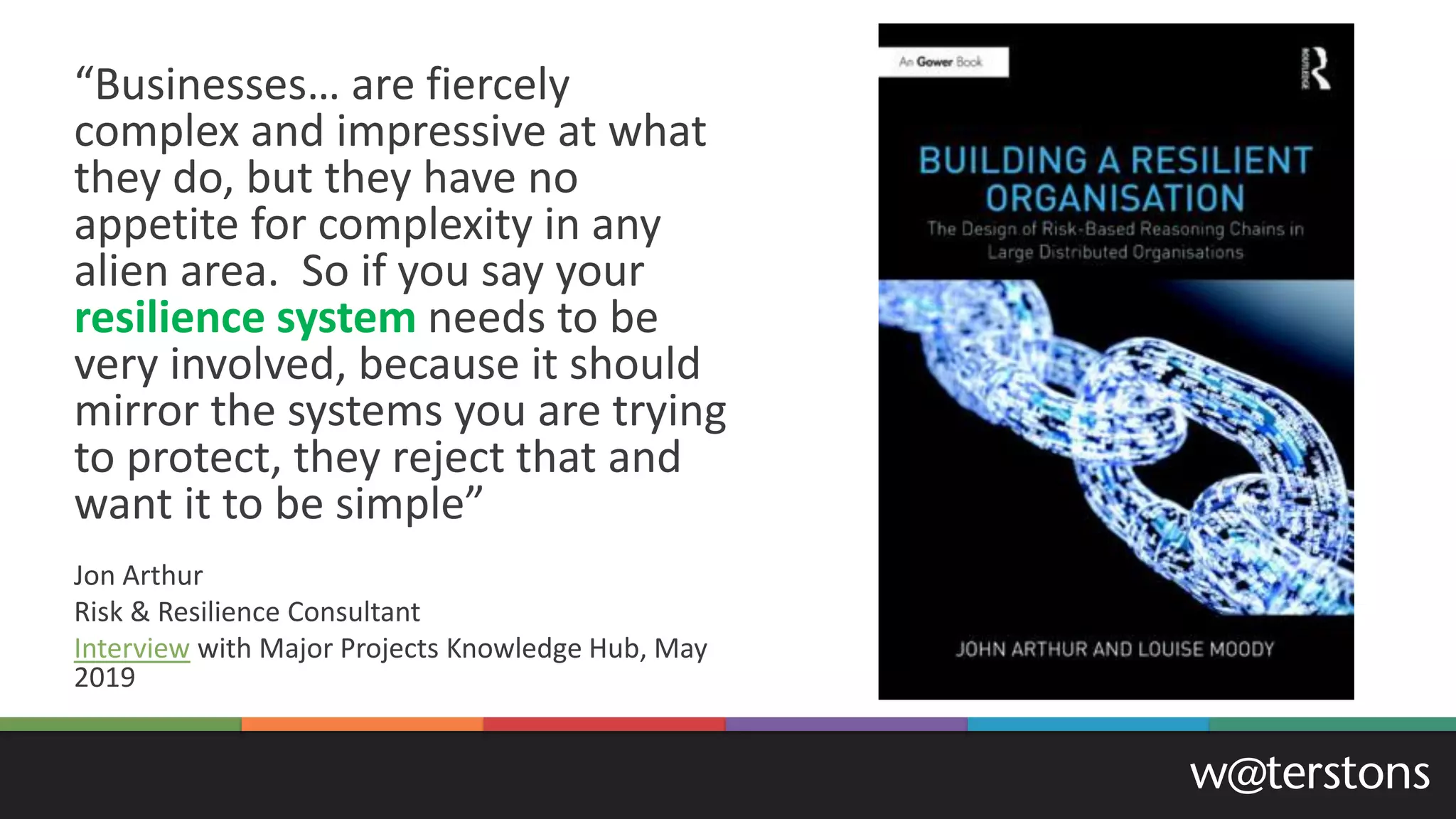
“Businesses… are fiercely
complex and impressive at what
they do, but they have no
appetite for complexity in any
alien area. So if you say your
resilience system needs to be
very involved, because it should
mirror the systems you are trying
to protect, they reject that and
want it to be simple”
Jon Arthur
Risk & Resilience Consultant
Interview with Major Projects Knowledge Hub, May
2019

Risk and Resilience: Towards a more effective narrative

  • 1.
    Risk and Resilience: Towardsa More Effective Narrative Thursday 14 November 2019 Tom Jarman Senior Transformation Consultant tom.jarman@waterstons.com, 07936 370 180
  • 2.
    Some background… • Historydegree, temping, TEFL… • Then the world of Project Management - Training & employment, community engagement projects
  • 3.
    • Project Manager,Modern Homes Programme, YHN Incl. PRINCE2, May 2007 But also…
  • 4.
    1. Retrofit (andnewbuild) risk ‘Normalised cost of business as usual’
  • 5.
    “… Mr Nicklesshas experienced a litany of problems with his home. Among the most serious are leaky pipes and poor ventilation, which have caused damp so severe that his daughter has been hospitalised twice, and may have permanent health issues as a result” Apps, P., 2017. Circle of despair. Inside Housing, 10 Feb, pp18- 21, photo from pp20-21, quote p20
  • 6.
    2. Chartered Instituteof Housing – certified practitioner Steve Douglas, Altair; Stress test. Inside Housing, 25.1.2013, p17 “Boards don’t generally set out to be poor at governance and executives don’t try to make bad decisions” But… “Could a board spot a cross default clause in a sale and leaseback deal that had had an index linked coupon?” “Our future is risk-laden, income streams uncertain, capital funding reduced or non-existent, requiring increased commercial activity to compensate. Merger and acquisition opportunities are rising”
  • 7.
    Link - published19 June 2014
  • 8.
    ‘… the abilityof organisations to respond to incremental change and sudden disruptions’ 2050: - Good quality, high performing homes - Climate ready - Sustainable neighbourhoods - Sustainable energy systems 3. Industry engagement
  • 9.
  • 10.
    Feb 2016 £295m on£1.88bn revenues Operating margin: 15.7% Farmer Review, ave OM 2013; 1.2% (decline from 2.8% 2010)
  • 11.
    • ‘Housebuilders, weconcluded, were too frequently handing over poor-quality homes because they could get away with doing so’ • ‘an almost Kafkaesque system seemingly designed to be unhelpful’ • ‘A chronic undersupply of homes means that, as things stand, normal market forces do not come into play’ • ‘…the legal position has become increasingly stacked against the consumer’ APPG for Excellence in the Built Environment, June 2018 “We need to see housebuilders putting consumers at the heart of what they do”
  • 12.
    More Homes, FewerComplaints (APPG EBE, 2016, p19) • Message? • Numbers!
  • 13.
    Peter Drucker “Culture eatsstrategy for breakfast” So I feel like I know what the considerations and questions are… • Culture in operating environment • Culture in organisation … but less sure of the narrative that helps understand a coherent, resilient response.
  • 14.
    Externals: Regulation, andregulators • Regulation is not there to manage risk for clients … a point very well made by Mark Elton, Cowan Architects, in the context of Building Regulations: “Building Regs sets minimum standards. I like to think of Building Regs as setting the worst performing building fabric that you can legally get away with. Don’t think of it as a stretching target to get to. Think of it as something that people will try to get away with and as the lowest common standard”
  • 15.
    Externals: Regulation, and regulators • Regulatorsvary; Ofwat as eg of good (best?) practice Anglian Water
  • 16.
    Externals: Nature ofyour marketplace Source: Lloyd, T., 2017. Reviving our civic housebuilding tradition. TCPA Journal, June, pp247-250. Graphic p248
  • 17.
    Lowest capital costprocurement to minimum regulatory standards (or Building Regs at Lowest Cost - BRLC) - Performance standard set at minimum regulatory requirement - Procured via lowest capital cost tender - No POME (Post-Occupancy Monitoring and Evaluation) - Performance Gap, occupant and fabric risk Externals: Predominant culture
  • 18.
    Inside Housing, 7June 2019, p6 Culture → Poor outcomes … but again and again clients are almost exclusively measured by one very limited metric Farmer Review (2016) - link
  • 19.
    Externals: Public opinion Fukushima, 2011 -Shutdown of national nuclear capacity → Surge in fossil fuel imports → Increased cost of electricity “Our estimated increase in mortality from higher electricity prices significantly outweighs the mortality from the accident itself.” Neidell, M., Uchida, S. & Veronesi, M. Be Cautious with the Precautionary Principle: Evidence from Fukushima Daiichi Nuclear Accident. Oct 2019, p3 The Economist, 2019. The wrong reaction. 9 Nov, p52 - link
  • 20.
  • 21.
    “Do we reallyunderstand productivity and why it matters?” Realistically, where is our focus at tender stage? Graphic source; Richard Daley, Turner & Townsend Suiko - Lean in Construction presentation, Newcastle, 3.10.2017 https://www.linkedin.com/in/richard-daley- 3ab6903/
  • 22.
    To achieve ouraims, we need to build better Why can’t we build better? How do you know it’ll cost more? We can’t build better Because it’ll cost more Because I asked a developer and they said it’ll cost more
  • 23.
    Location Indicators… - Dowe have to do it? (dependence on regulation/key influencers) - Is there £ for doing it? (not how do we make this happen) - Who else is doing it? (requiring permission from others) - We need a policy paper! (eg OSM) - We need a business case! (fit into BAU) - We need a hard-nosed business case! (narrow focus, familiar parameters) - It might apply to them, but it doesn’t apply to us (we’re too unique) How is this going to work? What skills do we need? How will this create value? - A resilient organisation wants to open up the innovation space!
  • 24.
    Alistair Dryburgh, ChiefContrarian, Akenhurst “Schumpeter famously talked about ‘creative destruction’, but let’s not forget that for every person turned on by ‘creative’ there are 10 turned off by ‘destruction’.”
  • 25.
    Alistair Dryburgh, ChiefContrarian, Akenhurst “Originality, while more and more necessary to the future of organisations, is still not often very well-received there” “When it comes to generating new ideas, quantity matters more than quality. And in any case, it is idea selection, not generation, that really matters”
  • 26.
    Who is yourChief Contrarian?!
  • 27.
    So what dopositive, ‘resilience-orientated’ choices look like? • Client-led, outcome-orientated, long-term, whole-life cost • Learning loops • Managing up from compliance • Understand your ‘carriers for change’ → Built environment example
  • 28.
    So what dopositive, ‘resilience-orientated’ choices look like? • ‘Carriers for change’ - Client Leadership Principles; active and sophisticated clienting - ‘Procuring for Value’ – Linked In group • Learning Loops - Post-occupancy monitoring & evaluation - Post-project Review - Sensors, data & visualisation - Green Building Team; operationalise, train, ensure standards, mentor
  • 29.
    ➢ Give aforward view of your programme ➢ Focus on outcomes (‘Procuring for Value’) ➢ Be ambitious… ➢ … Consistently ➢ “A great client has a great supply chain”; → Engage, enable, bring on future suppliers ➢ Aggregate (you are not as special as you think you are…) ➢ Think DFMA ➢ Think Lean, in the right order – Easier, Better, Faster, Cheaper (Yes, cheaper is last) ➢ Digital construction & the power of BIM! Information as a Deliverable Unlocking innovation and outcome: Client leadership principles
  • 30.
  • 31.
    BAU → BAUSlightly Better → Change
  • 32.
    Alex Mecklenburg (link) 23:05 ‘innovationin a system needs maintenance, innovation in a system needs legacy’ - Have to think how it will last and be improved 23:35 What does it mean to be a responsible innovator? Part of this is understanding how the innovation will be maintained → Energiesprong… https://www.bbc.co.uk/soun ds/play/m0005mrj
  • 34.
    Remember! Energiesprong is BandA, net zero energy And this is where very significant things start to happen And the supply chain has enormous incentive to make sure they happen. Consistently. For 30 years. vs ‘normalised cost of BAU’ ??
  • 35.
    Concluding thoughts… • Organisationalresilience is embedded or embraced: “Average has a long half-life” 77% • Recession 2009 – insolvency rate in construction vs total UK rate 18.8% vs 11.7%
  • 36.
    Concluding thoughts… - Resilientcultures are unusual - Conscious choice - ‘Resilience eco-system’ - Capacity, competence, confidence “Well done vs well intentioned” David Adams, Melious Homes Energiesprong site, Nottingham - link
  • 37.
    “Businesses… are fiercely complexand impressive at what they do, but they have no appetite for complexity in any alien area. So if you say your resilience system needs to be very involved, because it should mirror the systems you are trying to protect, they reject that and want it to be simple” Jon Arthur Risk & Resilience Consultant Interview with Major Projects Knowledge Hub, May 2019