Supply Chain
Mohamed Abdallah
Mohamed Sameh
Salah Gamal
Ihab Mohamed Tarek
INTRODUCTION
• ZARA opened its first store in the coastal town of A Coruña in Spain in
1975. Zara has over 2,000 stores strategically located in leading cities
across 88 countries. it belongs to INDITEX, one of the world’s largest
distribution groups.
• INDITEX is one of the world's largest fashion retailers with eight
brands and over 6,460 stores throughout the world. they are inspired
by a responsible passion for fashion and, above all, by their
customers.
INDITEX'S HISTORY
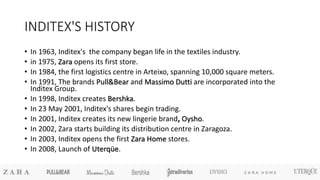
• In 1963, Inditex's the company began life in the textiles industry.
• in 1975, Zara opens its first store.
• In 1984, the first logistics centre in Arteixo, spanning 10,000 square meters.
• In 1991, The brands Pull&Bear and Massimo Dutti are incorporated into the
Inditex Group.
• In 1998, Inditex creates Bershka.
• In 23 May 2001, Inditex's shares begin trading.
• In 2001, Inditex creates its new lingerie brand, Oysho.
• In 2002, Zara starts building its distribution centre in Zaragoza.
• In 2003, Inditex opens the first Zara Home stores.
• In 2008, Launch of Uterqüe.
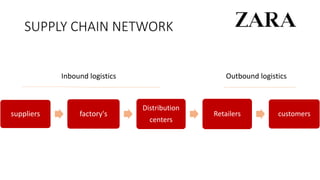
SUPPLY CHAIN NETWORK
suppliers factory's
Distribution
centers
Retailers customers
Inbound logistics Outbound logistics
INBOUND LOGISTICS
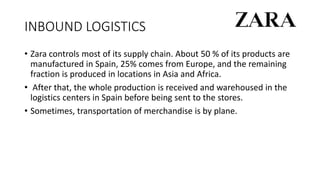
• Zara controls most of its supply chain. About 50 % of its products are
manufactured in Spain, 25% comes from Europe, and the remaining
fraction is produced in locations in Asia and Africa.
• After that, the whole production is received and warehoused in the
logistics centers in Spain before being sent to the stores.
• Sometimes, transportation of merchandise is by plane.
OPERATIONS
• Market specialists are intermediaries between designers and store
managers, who can quickly provide feedback to their colleagues in
design and procurement.
• Zara has power on operations, such as dying, labeling and packaging,
all other manufacturing processes.
• Zara has three product lines: one for children, women and men. All
product lines go parallel with each other, but in an operational
different way.
DISTRIBUTION CENTER
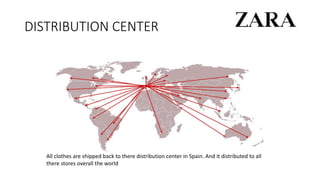
All clothes are shipped back to there distribution center in Spain. And it distributed to all
there stores overall the world
OUT BOUND LOGISTICS
• When the production reaches the stores, managers are responsible for the
order replenishments. It is their responsibility to decide how many units of
each item to order and to do that, they are taking into consideration
various data (forecasts of customer demand, how many of that product the
store had and already sold and etc.)
• European stores are receiving their deliveries within 24 hours; in Asia and
America receiving deliveries take 40 hours. Usually deliveries are done by
trucks or planes. Each week, stores are receiving about 12,000 units.
• Sometimes it happens that they did not receive the whole order, because
inventory at the logistics centers are limited. Also, there were some
improvements in time saving process. This improvement puts some value
on faster delivery of the production to the customer
Marketing
• Zara’s unique selling proposition is to produce the latest trend
products within very short time (few weeks) and at affordable prices.
Moreover, products are on the store shelves no longer than one
month.
• People are more or less forced to buy the product, which they like
due to the fear that next week it can be sold out. Products, which are
not sold out are afterwards discounted.
Thanks…
The End.

zara SCM

  • 1.
    Supply Chain Mohamed Abdallah MohamedSameh Salah Gamal Ihab Mohamed Tarek
  • 2.
    INTRODUCTION • ZARA openedits first store in the coastal town of A Coruña in Spain in 1975. Zara has over 2,000 stores strategically located in leading cities across 88 countries. it belongs to INDITEX, one of the world’s largest distribution groups. • INDITEX is one of the world's largest fashion retailers with eight brands and over 6,460 stores throughout the world. they are inspired by a responsible passion for fashion and, above all, by their customers.
  • 3.
    INDITEX'S HISTORY • In1963, Inditex's the company began life in the textiles industry. • in 1975, Zara opens its first store. • In 1984, the first logistics centre in Arteixo, spanning 10,000 square meters. • In 1991, The brands Pull&Bear and Massimo Dutti are incorporated into the Inditex Group. • In 1998, Inditex creates Bershka. • In 23 May 2001, Inditex's shares begin trading. • In 2001, Inditex creates its new lingerie brand, Oysho. • In 2002, Zara starts building its distribution centre in Zaragoza. • In 2003, Inditex opens the first Zara Home stores. • In 2008, Launch of Uterqüe.
  • 4.
    SUPPLY CHAIN NETWORK suppliersfactory's Distribution centers Retailers customers Inbound logistics Outbound logistics
  • 5.
    INBOUND LOGISTICS • Zaracontrols most of its supply chain. About 50 % of its products are manufactured in Spain, 25% comes from Europe, and the remaining fraction is produced in locations in Asia and Africa. • After that, the whole production is received and warehoused in the logistics centers in Spain before being sent to the stores. • Sometimes, transportation of merchandise is by plane.
  • 6.
    OPERATIONS • Market specialistsare intermediaries between designers and store managers, who can quickly provide feedback to their colleagues in design and procurement. • Zara has power on operations, such as dying, labeling and packaging, all other manufacturing processes. • Zara has three product lines: one for children, women and men. All product lines go parallel with each other, but in an operational different way.
  • 7.
    DISTRIBUTION CENTER All clothesare shipped back to there distribution center in Spain. And it distributed to all there stores overall the world
  • 8.
    OUT BOUND LOGISTICS •When the production reaches the stores, managers are responsible for the order replenishments. It is their responsibility to decide how many units of each item to order and to do that, they are taking into consideration various data (forecasts of customer demand, how many of that product the store had and already sold and etc.) • European stores are receiving their deliveries within 24 hours; in Asia and America receiving deliveries take 40 hours. Usually deliveries are done by trucks or planes. Each week, stores are receiving about 12,000 units. • Sometimes it happens that they did not receive the whole order, because inventory at the logistics centers are limited. Also, there were some improvements in time saving process. This improvement puts some value on faster delivery of the production to the customer
  • 9.
    Marketing • Zara’s uniqueselling proposition is to produce the latest trend products within very short time (few weeks) and at affordable prices. Moreover, products are on the store shelves no longer than one month. • People are more or less forced to buy the product, which they like due to the fear that next week it can be sold out. Products, which are not sold out are afterwards discounted.
  • 10.