SUPPLY CHAIN MANAGEMENT
Zara Business Model
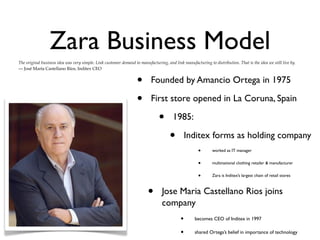
The original business idea was very simple. Link customer demand to manufacturing, and link manufacturing to distribution. That is the idea we still live by.
— José María Castellano Ríos, Inditex CEO


                                                                   •       Founded by Amancio Ortega in 1975

                                                                   •       First store opened in La Coruna, Spain

                                                                               •       1985:

                                                                                     •         Inditex forms as holding company
                                                                                                     •       worked as IT manager


                                                                                                     •       multinational clothing retailer & manufacturer


                                                                                                     •       Zara is Inditex’s largest chain of retail stores


                                                                         •       Jose Maria Castellano Rios joins
                                                                                 company
                                                                                           •       becomes CEO of Inditex in 1997

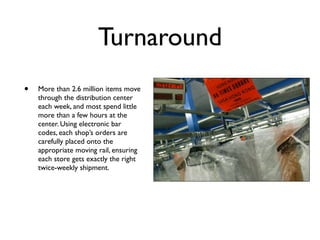
                                                                                           •       shared Ortega’s belief in importance of technology
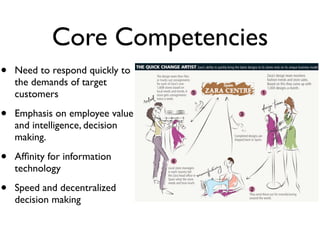
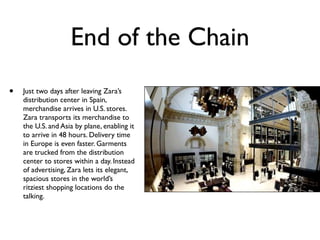
Core Competencies
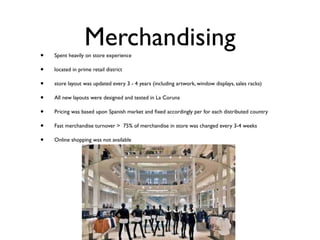
•   Need to respond quickly to
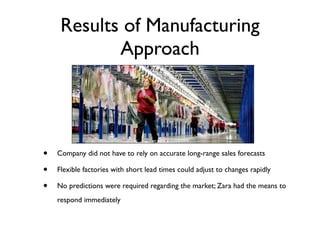
    the demands of target
    customers

•   Emphasis on employee value
    and intelligence, decision
    making.

•   Affinity for information
    technology

•   Speed and decentralized
    decision making
Design & Distribution
•   Collections were created, then extended and modified over time

•   Seasons and continuous introductions

•    In a typical year, Zara introduced approximately 11,000 new items;
    competitors averaged 2,000–4,000.

•   Short lead time & flexibility was enabled by a vertically integrated supply
    chain

•   Using this network, Zara could consistently move a new design from
    conception through production and into the DC in as little as three weeks.
    Two days after that, the garment could be on sales racks in stores around
    the world.
ORDERING

• each department (Mens, Womens,
  Children)-placed an order twice a week
• Replenishment orders made by physical
  shelf count and employee survey
• Digital order forms and “offers” were all
  completed on hand held devices
FULFILLMENT
•   commercials were responsible for matching orders to each store

•   if demand was greater then supply, commericals had to make decisions
    through past sales about order fulfillment

•   commercials would also ship items that stores did NOT order

•   fulfillment was subjective and inaccurate based on production and
    forecasting system

•   orders were usually fulfilled within 2 days by truck or air

•   little inventory was left over, no emergency stock
Commercials :
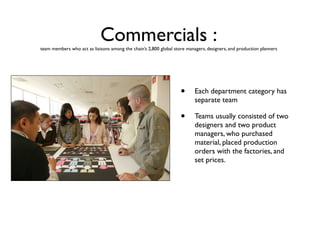
team members who act as liaisons among the chain’s 2,800 global store managers, designers, and production planners


                                                                   •      Each department category has
                                                                          separate team

                                                                   •      Teams usually consisted of two
                                                                          designers and two product
                                                                          managers, who purchased
                                                                          material, placed production
                                                                          orders with the factories, and
                                                                          set prices.
Commercial Roles
• Store product managers work closely with
  product teams
• Traveled extensively & observed target
  market fashion trends
• Initiated store-to-store transfers
• Made decisions about product selection
  and orders
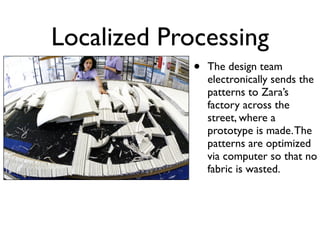
Localized Processing
             •   The design team
                 electronically sends the
                 patterns to Zara’s
                 factory across the
                 street, where a
                 prototype is made. The
                 patterns are optimized
                 via computer so that no
                 fabric is wasted.
Cutting
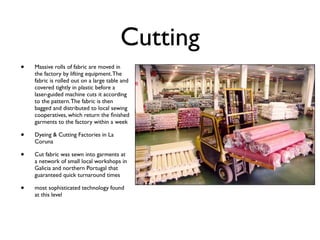
•   Massive rolls of fabric are moved in
    the factory by lifting equipment. The
    fabric is rolled out on a large table and
    covered tightly in plastic before a
    laser-guided machine cuts it according
    to the pattern. The fabric is then
    bagged and distributed to local sewing
    cooperatives, which return the finished
    garments to the factory within a week

•   Dyeing & Cutting Factories in La
    Coruna

•   Cut fabric was sewn into garments at
    a network of small local workshops in
    Galicia and northern Portugal that
    guaranteed quick turnaround times

•   most sophisticated technology found
    at this level
Quality Check

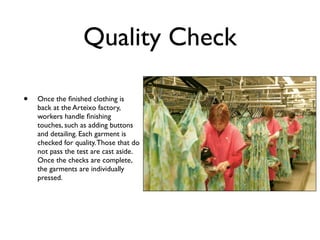
•   Once the finished clothing is
    back at the Arteixo factory,
    workers handle finishing
    touches, such as adding buttons
    and detailing. Each garment is
    checked for quality. Those that do
    not pass the test are cast aside.
    Once the checks are complete,
    the garments are individually
    pressed.
Time Management & Efficiency

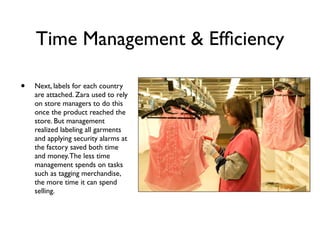
•   Next, labels for each country
    are attached. Zara used to rely
    on store managers to do this
    once the product reached the
    store. But management
    realized labeling all garments
    and applying security alarms at
    the factory saved both time
    and money. The less time
    management spends on tasks
    such as tagging merchandise,
    the more time it can spend
    selling.
Distribution Center

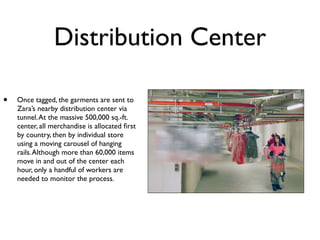
•   Once tagged, the garments are sent to
    Zara’s nearby distribution center via
    tunnel. At the massive 500,000 sq.-ft.
    center, all merchandise is allocated first
    by country, then by individual store
    using a moving carousel of hanging
    rails. Although more than 60,000 items
    move in and out of the center each
    hour, only a handful of workers are
    needed to monitor the process.
Turnaround
•   More than 2.6 million items move
    through the distribution center
    each week, and most spend little
    more than a few hours at the
    center. Using electronic bar
    codes, each shop’s orders are
    carefully placed onto the
    appropriate moving rail, ensuring
    each store gets exactly the right
    twice-weekly shipment.
End of the Chain
•   Just two days after leaving Zara’s
    distribution center in Spain,
    merchandise arrives in U.S. stores.
    Zara transports its merchandise to
    the U.S. and Asia by plane, enabling it
    to arrive in 48 hours. Delivery time
    in Europe is even faster. Garments
    are trucked from the distribution
    center to stores within a day. Instead
    of advertising, Zara lets its elegant,
    spacious stores in the world’s
    ritziest shopping locations do the
    talking.
Merchandising
•   Spent heavily on store experience

•   located in prime retail district

•   store layout was updated every 3 - 4 years (including artwork, window displays, sales racks)

•   All new layouts were designed and tested in La Coruna

•   Pricing was based upon Spanish market and fixed accordingly per for each distributed country

•   Fast merchandise turnover > 75% of merchandise in store was changed every 3-4 weeks

•   Online shopping was not available
Results of Manufacturing
            Approach


•   Company did not have to rely on accurate long-range sales forecasts

•   Flexible factories with short lead times could adjust to changes rapidly

•   No predictions were required regarding the market; Zara had the means to
    respond immediately
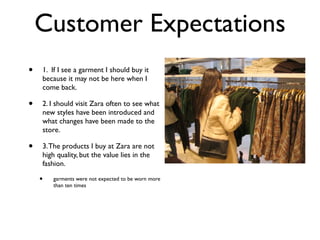
Customer Expectations
•   1. If I see a garment I should buy it
    because it may not be here when I
    come back.

•   2. I should visit Zara often to see what
    new styles have been introduced and
    what changes have been made to the
    store.

•   3. The products I buy at Zara are not
    high quality, but the value lies in the
    fashion.

    •   garments were not expected to be worn more
        than ten times
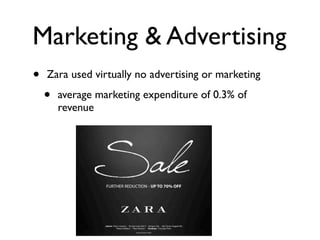
Marketing & Advertising
•   Zara used virtually no advertising or marketing

    •   average marketing expenditure of 0.3% of
        revenue
Information Technology
•   Zara has practiced many of the same strategies since they were developed

          •    small IT department

          •    using same computer application they used years ago

          •    Decision: Upgrade IT systems or don’t change what is broken??

•   President and colleagues chose to write their own software systems for
    their specific needs

•   There was little or no formal justification for IT efforts, nor were cost/
    benefit analyses typically conducted for a proposed effort

•   Accounting applications that supported ordering, fulfillment, and
    manufacturing were largely developed internally
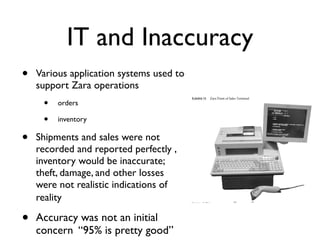
IT and Inaccuracy
•   Various application systems used to
    support Zara operations               604-081                                                   ZARA: IT for Fa


     •
                                          Exhibit 11      Zara Point of Sales Terminal
         orders

     •   inventory


                                                                                                   rP
•   Shipments and sales were not
    recorded and reported perfectly ,


                                                                                       o
    inventory would be inaccurate;


                                                                                    py
    theft, damage, and other losses
    were not realistic indications of


                                                                    Co
    reality                               Source:   Inditex.


•   Accuracy was not an initial
                                          Exhibit 12


                                                     ot   Inditex Distribution Center (interior)


    concern “95% is pretty good”
IT ISSUES


                                                                              r
                                                                           yo
                                                                         op
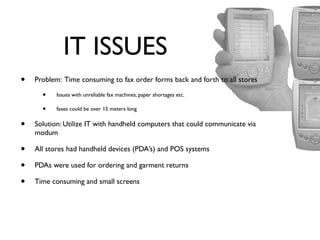
•   Problem: Time consuming to fax order forms back and forth to all stores

      •    Issues with unreliable fax machines, paper shortages etc.


                                                                         tC
      •    faxes could be over 15 meters long


•   Solution: Utilize IT with handheld computers that could communicate via


                                                                       No
    modum

•   All stores had handheld devices (PDA’s) and POS systems

•

                                                                  Do
    PDAs were used for ordering and garment returns

•   Time consuming and small screens
Issues Continued
• Still utilized DOS system which was no
  longer supported by Microsoft
     •   Cons:

     •   outdated and unsupported

     •   POS and PDA’s were not connected to other stores or headquarters (used floppy disk
         system)

     •   no internal sharing within store between POS and PDAs

     •   disabled SKU inventory accuracy (used telephones)

     •   Pro:

     •   Stable and efficient for opening new stores
STRENGTHS
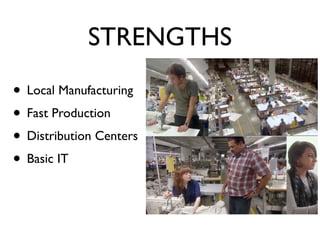
• Local Manufacturing
• Fast Production
• Distribution Centers
• Basic IT
Weaknesses
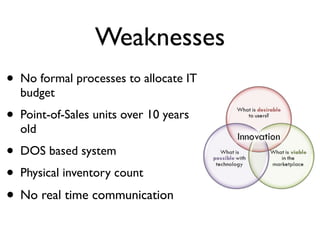
•   No formal processes to allocate IT
    budget
•   Point-of-Sales units over 10 years
    old
• DOS based system
• Physical inventory count
• No real time communication
Opportunities

• Communication with potential buyers
• Online Sales
• Expansion
Threats
•   Only company using “ancient operating system”

•   Refusal to go online

•   Zara is not updating operating systems

•   DOS is incompatible with industry, unsupported,
    and outdated

•   Other retail chains have real-time communication

•   May lose market share to competitors
Conclusion &
            Suggestions
•   By upgrading IT system, Zara will keep up with
    competitors
•   Share inventory information via network
•   Set IT budgets off of individual needs rather
    than industry standards
•   Appoint an Innovative CIO
•   Global markets are changing & upgrading
    quickly
       •   Zara must keep up or will be left behind

Zara

  • 1.
  • 2.
    Zara Business Model Theoriginal business idea was very simple. Link customer demand to manufacturing, and link manufacturing to distribution. That is the idea we still live by. — José María Castellano Ríos, Inditex CEO • Founded by Amancio Ortega in 1975 • First store opened in La Coruna, Spain • 1985: • Inditex forms as holding company • worked as IT manager • multinational clothing retailer & manufacturer • Zara is Inditex’s largest chain of retail stores • Jose Maria Castellano Rios joins company • becomes CEO of Inditex in 1997 • shared Ortega’s belief in importance of technology
  • 3.
    Core Competencies • Need to respond quickly to the demands of target customers • Emphasis on employee value and intelligence, decision making. • Affinity for information technology • Speed and decentralized decision making
  • 4.
    Design & Distribution • Collections were created, then extended and modified over time • Seasons and continuous introductions • In a typical year, Zara introduced approximately 11,000 new items; competitors averaged 2,000–4,000. • Short lead time & flexibility was enabled by a vertically integrated supply chain • Using this network, Zara could consistently move a new design from conception through production and into the DC in as little as three weeks. Two days after that, the garment could be on sales racks in stores around the world.
  • 5.
    ORDERING • each department(Mens, Womens, Children)-placed an order twice a week • Replenishment orders made by physical shelf count and employee survey • Digital order forms and “offers” were all completed on hand held devices
  • 6.
    FULFILLMENT • commercials were responsible for matching orders to each store • if demand was greater then supply, commericals had to make decisions through past sales about order fulfillment • commercials would also ship items that stores did NOT order • fulfillment was subjective and inaccurate based on production and forecasting system • orders were usually fulfilled within 2 days by truck or air • little inventory was left over, no emergency stock
  • 7.
    Commercials : team memberswho act as liaisons among the chain’s 2,800 global store managers, designers, and production planners • Each department category has separate team • Teams usually consisted of two designers and two product managers, who purchased material, placed production orders with the factories, and set prices.
  • 8.
    Commercial Roles • Storeproduct managers work closely with product teams • Traveled extensively & observed target market fashion trends • Initiated store-to-store transfers • Made decisions about product selection and orders
  • 9.
    Localized Processing • The design team electronically sends the patterns to Zara’s factory across the street, where a prototype is made. The patterns are optimized via computer so that no fabric is wasted.
  • 10.
    Cutting • Massive rolls of fabric are moved in the factory by lifting equipment. The fabric is rolled out on a large table and covered tightly in plastic before a laser-guided machine cuts it according to the pattern. The fabric is then bagged and distributed to local sewing cooperatives, which return the finished garments to the factory within a week • Dyeing & Cutting Factories in La Coruna • Cut fabric was sewn into garments at a network of small local workshops in Galicia and northern Portugal that guaranteed quick turnaround times • most sophisticated technology found at this level
  • 11.
    Quality Check • Once the finished clothing is back at the Arteixo factory, workers handle finishing touches, such as adding buttons and detailing. Each garment is checked for quality. Those that do not pass the test are cast aside. Once the checks are complete, the garments are individually pressed.
  • 12.
    Time Management &Efficiency • Next, labels for each country are attached. Zara used to rely on store managers to do this once the product reached the store. But management realized labeling all garments and applying security alarms at the factory saved both time and money. The less time management spends on tasks such as tagging merchandise, the more time it can spend selling.
  • 13.
    Distribution Center • Once tagged, the garments are sent to Zara’s nearby distribution center via tunnel. At the massive 500,000 sq.-ft. center, all merchandise is allocated first by country, then by individual store using a moving carousel of hanging rails. Although more than 60,000 items move in and out of the center each hour, only a handful of workers are needed to monitor the process.
  • 14.
    Turnaround • More than 2.6 million items move through the distribution center each week, and most spend little more than a few hours at the center. Using electronic bar codes, each shop’s orders are carefully placed onto the appropriate moving rail, ensuring each store gets exactly the right twice-weekly shipment.
  • 15.
    End of theChain • Just two days after leaving Zara’s distribution center in Spain, merchandise arrives in U.S. stores. Zara transports its merchandise to the U.S. and Asia by plane, enabling it to arrive in 48 hours. Delivery time in Europe is even faster. Garments are trucked from the distribution center to stores within a day. Instead of advertising, Zara lets its elegant, spacious stores in the world’s ritziest shopping locations do the talking.
  • 16.
    Merchandising • Spent heavily on store experience • located in prime retail district • store layout was updated every 3 - 4 years (including artwork, window displays, sales racks) • All new layouts were designed and tested in La Coruna • Pricing was based upon Spanish market and fixed accordingly per for each distributed country • Fast merchandise turnover > 75% of merchandise in store was changed every 3-4 weeks • Online shopping was not available
  • 17.
    Results of Manufacturing Approach • Company did not have to rely on accurate long-range sales forecasts • Flexible factories with short lead times could adjust to changes rapidly • No predictions were required regarding the market; Zara had the means to respond immediately
  • 18.
    Customer Expectations • 1. If I see a garment I should buy it because it may not be here when I come back. • 2. I should visit Zara often to see what new styles have been introduced and what changes have been made to the store. • 3. The products I buy at Zara are not high quality, but the value lies in the fashion. • garments were not expected to be worn more than ten times
  • 19.
    Marketing & Advertising • Zara used virtually no advertising or marketing • average marketing expenditure of 0.3% of revenue
  • 20.
    Information Technology • Zara has practiced many of the same strategies since they were developed • small IT department • using same computer application they used years ago • Decision: Upgrade IT systems or don’t change what is broken?? • President and colleagues chose to write their own software systems for their specific needs • There was little or no formal justification for IT efforts, nor were cost/ benefit analyses typically conducted for a proposed effort • Accounting applications that supported ordering, fulfillment, and manufacturing were largely developed internally
  • 21.
    IT and Inaccuracy • Various application systems used to support Zara operations 604-081 ZARA: IT for Fa • Exhibit 11 Zara Point of Sales Terminal orders • inventory rP • Shipments and sales were not recorded and reported perfectly , o inventory would be inaccurate; py theft, damage, and other losses were not realistic indications of Co reality Source: Inditex. • Accuracy was not an initial Exhibit 12 ot Inditex Distribution Center (interior) concern “95% is pretty good”
  • 22.
    IT ISSUES r yo op • Problem: Time consuming to fax order forms back and forth to all stores • Issues with unreliable fax machines, paper shortages etc. tC • faxes could be over 15 meters long • Solution: Utilize IT with handheld computers that could communicate via No modum • All stores had handheld devices (PDA’s) and POS systems • Do PDAs were used for ordering and garment returns • Time consuming and small screens
  • 23.
    Issues Continued • Stillutilized DOS system which was no longer supported by Microsoft • Cons: • outdated and unsupported • POS and PDA’s were not connected to other stores or headquarters (used floppy disk system) • no internal sharing within store between POS and PDAs • disabled SKU inventory accuracy (used telephones) • Pro: • Stable and efficient for opening new stores
  • 24.
    STRENGTHS • Local Manufacturing •Fast Production • Distribution Centers • Basic IT
  • 25.
    Weaknesses • No formal processes to allocate IT budget • Point-of-Sales units over 10 years old • DOS based system • Physical inventory count • No real time communication
  • 26.
    Opportunities • Communication withpotential buyers • Online Sales • Expansion
  • 27.
    Threats • Only company using “ancient operating system” • Refusal to go online • Zara is not updating operating systems • DOS is incompatible with industry, unsupported, and outdated • Other retail chains have real-time communication • May lose market share to competitors
  • 28.
    Conclusion & Suggestions • By upgrading IT system, Zara will keep up with competitors • Share inventory information via network • Set IT budgets off of individual needs rather than industry standards • Appoint an Innovative CIO • Global markets are changing & upgrading quickly • Zara must keep up or will be left behind