The Spanish-based company,
is Europe’s leading apparel retailer,
providing customer with high-
fashion styles The company was founded in 1975
by Amancio Ortega and Rosalia Mera.
It is the main brand of the
Inditex group,
the world's largest apparel retailer.
The fashion group also owns brands such as
Massimo Dutti, Pull and bear, Bershka,
Stradivarius, Oysho, Zara Home and
Uterque
Topics to
Discuss:
Design &
production
Logistics Stores Customers
SWOT
Analysis
Question &
Answers
Design &
production
.
Zara is in a market segment called "Fast fashion", which means it
emphasizes the transition between couture and catwalk fashion to
ready-to-wear. Therefore, the strategic focus boils down to two factors,
speed and price.
The faster a company can put new trends into stores, the greater first
move advantage they have, and the cheaper they can do it, the larger
their margins. Hence, these brands typically operate with very capable
and active management and technological support.
If a certain style or design becomes the new must-have on the street,
Zara gets to work. Designers churn out the new styles and they're fast-
tracked to stores while the trend is still going strong.
.
Zara has created the ultimate Trinity of fashion. Their designers, textile
manufacturers (under parent company Inditex), and labourers are all combined at
one location. Between the designer's office and the factory is only a 20 minute car
ride, from Aretino to A Coruna in Spain
This strategy, made with the help of Toyota, is now called "Just-In-Time",
and is one implementation of a vertically integrated supply chain strategy.
So far, no other company has been able to match this speed,
because it requires a tremendous amount of infrastructural investment,
backed by solid management to be able to pull off.
This is a competitive advantage that is at its best, one that is hard to imitate.
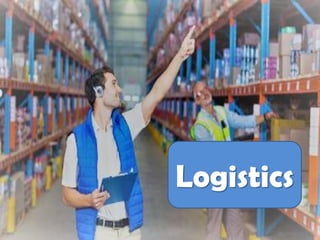
Logistics
You'll be hard pressed to find any excess inventory or dead stock in a
Zara warehouse. Throughout the supply chain, lean is word, all the way
from raw materials to the finished garments on the shelves.
Inventory optimization models are put in place to help the company to
determine the quantity that should be delivered to every single one of
its retail stores via shipments that go out twice every week. The stock
delivered is strictly limited, ensuring that each store only receives just
want they need. This goes towards the brand image of being exclusive
while avoiding the build up of unpopular stock.
Zara was designed to be responsive from its inception. Rather than
subcontracting manufacturing to Asia, Zara built 14 highly automated
Spanish factories, where robots work around the clock cutting and
dyeing fabrics and creating unfinished “gray goods,” the foundations of
their final products.
Zara has also created a partner network of more than 300 small shops in
Portugal and Galacia to handle the finishing work; here, the gray goods
are transformed into dresses and suits. By following this approach, if an
item looks like a winner, Zara can quickly ramp up manufacturing and
get items to their stores in a matter of days
Zara’s strong distribution network enables the company to deliver goods
to its European stores within 24 hours, and to its American and Asian
outlets in less than 40 hours
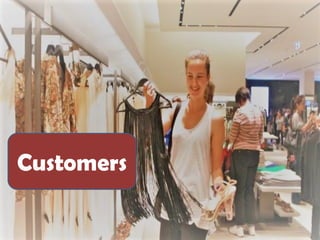
Customers
Spanish apparel company Zara has built its strategy around consumer trends,
embracing the fast-changing tastes of its customers.
Zara delivers new products twice each week to its 1,670 stores around the
world. This adds up to more than 10,000 new designs each year! It takes the
company only 10 to 15 days to go from the design stage to the sales floor.
Zara’s designers don’t have to predict what fashion trends will be in future.
They react to the customer feedback- good and bad- if an idea fails, the line is
withdrawn immediately.
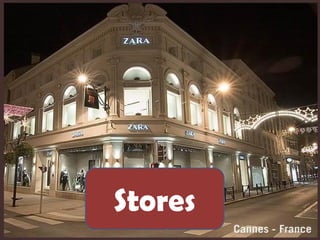
Stores
Zara does not run advertising campaigns. The retailer’s stores, in
prestigious high-traffic locations around the world, are its key advertising
element, featuring stylish and constantly changing window displays.
Other retailers spend 3 % to 4 % of revenues on big brand-building
campaigns, while Zara spends just 0.3 %.
The company has said it would rather use a percentage of revenue to open
new stores than to advertise.
SWOT
Analysis
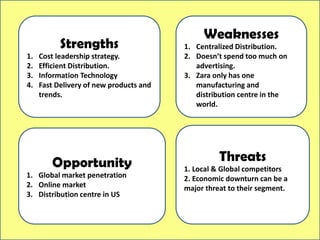
Strengths
1. Cost leadership strategy.
2. Efficient Distribution.
3. Information Technology
4. Fast Delivery of new products and
trends.
Weaknesses
1. Centralized Distribution.
2. Doesn’t spend too much on
advertising.
3. Zara only has one
manufacturing and
distribution centre in the
world.
Opportunity
1. Global market penetration
2. Online market
3. Distribution centre in US
Threats
1. Local & Global competitors
2. Economic downturn can be a
major threat to their segment.
Questions
& Answers
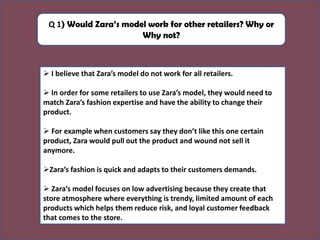
Q 1) Would Zara’s model work for other retailers? Why or
Why not?
➢ I believe that Zara’s model do not work for all retailers.
➢ In order for some retailers to use Zara’s model, they would need to
match Zara’s fashion expertise and have the ability to change their
product.
➢ For example when customers say they don’t like this one certain
product, Zara would pull out the product and wound not sell it
anymore.
➢Zara’s fashion is quick and adapts to their customers demands.
➢ Zara’s model focuses on low advertising because they create that
store atmosphere where everything is trendy, limited amount of each
products which helps them reduce risk, and loyal customer feedback
that comes to the store.
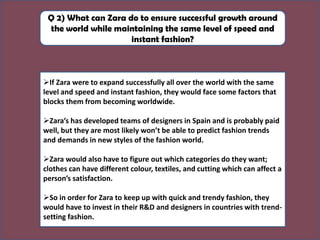
Q 2) What can Zara do to ensure successful growth around
the world while maintaining the same level of speed and
instant fashion?
➢If Zara were to expand successfully all over the world with the same
level and speed and instant fashion, they would face some factors that
blocks them from becoming worldwide.
➢Zara’s has developed teams of designers in Spain and is probably paid
well, but they are most likely won’t be able to predict fashion trends
and demands in new styles of the fashion world.
➢Zara would also have to figure out which categories do they want;
clothes can have different colour, textiles, and cutting which can affect a
person’s satisfaction.
➢So in order for Zara to keep up with quick and trendy fashion, they
would have to invest in their R&D and designers in countries with trend-
setting fashion.
Recap
Disclaimer
• Created by Shreya Jasani, Nirma
University, during a marketing internship
by Prof. Sameer Mathur, IIM Lucknow.

Zara mini case

  • 2.
    The Spanish-based company, isEurope’s leading apparel retailer, providing customer with high- fashion styles The company was founded in 1975 by Amancio Ortega and Rosalia Mera. It is the main brand of the Inditex group, the world's largest apparel retailer. The fashion group also owns brands such as Massimo Dutti, Pull and bear, Bershka, Stradivarius, Oysho, Zara Home and Uterque
  • 3.
    Topics to Discuss: Design & production LogisticsStores Customers SWOT Analysis Question & Answers
  • 4.
  • 5.
    . Zara is ina market segment called "Fast fashion", which means it emphasizes the transition between couture and catwalk fashion to ready-to-wear. Therefore, the strategic focus boils down to two factors, speed and price. The faster a company can put new trends into stores, the greater first move advantage they have, and the cheaper they can do it, the larger their margins. Hence, these brands typically operate with very capable and active management and technological support. If a certain style or design becomes the new must-have on the street, Zara gets to work. Designers churn out the new styles and they're fast- tracked to stores while the trend is still going strong.
  • 6.
    . Zara has createdthe ultimate Trinity of fashion. Their designers, textile manufacturers (under parent company Inditex), and labourers are all combined at one location. Between the designer's office and the factory is only a 20 minute car ride, from Aretino to A Coruna in Spain This strategy, made with the help of Toyota, is now called "Just-In-Time", and is one implementation of a vertically integrated supply chain strategy. So far, no other company has been able to match this speed, because it requires a tremendous amount of infrastructural investment, backed by solid management to be able to pull off. This is a competitive advantage that is at its best, one that is hard to imitate.
  • 7.
  • 8.
    You'll be hardpressed to find any excess inventory or dead stock in a Zara warehouse. Throughout the supply chain, lean is word, all the way from raw materials to the finished garments on the shelves. Inventory optimization models are put in place to help the company to determine the quantity that should be delivered to every single one of its retail stores via shipments that go out twice every week. The stock delivered is strictly limited, ensuring that each store only receives just want they need. This goes towards the brand image of being exclusive while avoiding the build up of unpopular stock.
  • 9.
    Zara was designedto be responsive from its inception. Rather than subcontracting manufacturing to Asia, Zara built 14 highly automated Spanish factories, where robots work around the clock cutting and dyeing fabrics and creating unfinished “gray goods,” the foundations of their final products. Zara has also created a partner network of more than 300 small shops in Portugal and Galacia to handle the finishing work; here, the gray goods are transformed into dresses and suits. By following this approach, if an item looks like a winner, Zara can quickly ramp up manufacturing and get items to their stores in a matter of days Zara’s strong distribution network enables the company to deliver goods to its European stores within 24 hours, and to its American and Asian outlets in less than 40 hours
  • 10.
  • 11.
    Spanish apparel companyZara has built its strategy around consumer trends, embracing the fast-changing tastes of its customers. Zara delivers new products twice each week to its 1,670 stores around the world. This adds up to more than 10,000 new designs each year! It takes the company only 10 to 15 days to go from the design stage to the sales floor. Zara’s designers don’t have to predict what fashion trends will be in future. They react to the customer feedback- good and bad- if an idea fails, the line is withdrawn immediately.
  • 12.
  • 13.
    Zara does notrun advertising campaigns. The retailer’s stores, in prestigious high-traffic locations around the world, are its key advertising element, featuring stylish and constantly changing window displays. Other retailers spend 3 % to 4 % of revenues on big brand-building campaigns, while Zara spends just 0.3 %. The company has said it would rather use a percentage of revenue to open new stores than to advertise.
  • 14.
  • 15.
    Strengths 1. Cost leadershipstrategy. 2. Efficient Distribution. 3. Information Technology 4. Fast Delivery of new products and trends. Weaknesses 1. Centralized Distribution. 2. Doesn’t spend too much on advertising. 3. Zara only has one manufacturing and distribution centre in the world. Opportunity 1. Global market penetration 2. Online market 3. Distribution centre in US Threats 1. Local & Global competitors 2. Economic downturn can be a major threat to their segment.
  • 16.
  • 17.
    Q 1) WouldZara’s model work for other retailers? Why or Why not? ➢ I believe that Zara’s model do not work for all retailers. ➢ In order for some retailers to use Zara’s model, they would need to match Zara’s fashion expertise and have the ability to change their product. ➢ For example when customers say they don’t like this one certain product, Zara would pull out the product and wound not sell it anymore. ➢Zara’s fashion is quick and adapts to their customers demands. ➢ Zara’s model focuses on low advertising because they create that store atmosphere where everything is trendy, limited amount of each products which helps them reduce risk, and loyal customer feedback that comes to the store.
  • 18.
    Q 2) Whatcan Zara do to ensure successful growth around the world while maintaining the same level of speed and instant fashion? ➢If Zara were to expand successfully all over the world with the same level and speed and instant fashion, they would face some factors that blocks them from becoming worldwide. ➢Zara’s has developed teams of designers in Spain and is probably paid well, but they are most likely won’t be able to predict fashion trends and demands in new styles of the fashion world. ➢Zara would also have to figure out which categories do they want; clothes can have different colour, textiles, and cutting which can affect a person’s satisfaction. ➢So in order for Zara to keep up with quick and trendy fashion, they would have to invest in their R&D and designers in countries with trend- setting fashion.
  • 19.
  • 21.
    Disclaimer • Created byShreya Jasani, Nirma University, during a marketing internship by Prof. Sameer Mathur, IIM Lucknow.