ABOUT ZARA 
• Zara is a Spanish clothing and accessories 
retailer based in Arteixo, Galicia, and 
founded in 1975 by Amancio Ortega and 
Rosalía Mera. 
• It is the flagship chain store of the Inditex 
group, The world's largest apparel retailer, 
the fashion group also owns brands such as 
Massimo Dutti, Pull and Bear, Uterqüe, 
Stradivarius and Bershka. 
• It is claimed that Zara needs just two weeks 
to develop a new product and get it to stores, 
compared to the six-month industry average, 
and launches around 10,000 new designs 
each year. 
Zara España, S.A. 
Type Sociedad Anónima 
Industry Retail 
Founded Arteixo, Galicia (Spain) 
(May 24, 1974) 
Founder(s) Amancio Ortega 
Rosalía Mera 
Headquarters Arteixo, Spain 
Number of locations 1808 stores[1] 
Area served Worldwide 
Key people Óscar Pérez Marcote, 
Director-general 
Products Clothing 
Revenue €7.071 billion (2009) 
Parent Industria de Diseño 
Textil, S.A 
Divisions •Zara Diseño, S.L. 
•Zara Logística, S.A 
Website zara.com
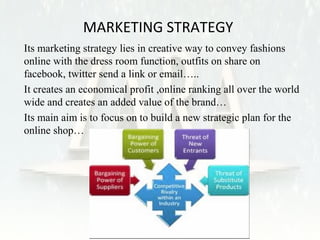
MARKETING STRATEGY 
• Its marketing strategy lies in creative way to convey fashions 
online with the dress room function, outfits on share on 
facebook, twitter send a link or email….. 
• It creates an economical profit ,online ranking all over the world 
wide and creates an added value of the brand… 
• Its main aim is to focus on to build a new strategic plan for the 
online shop…
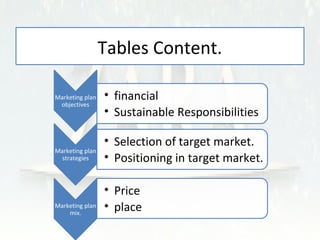
Tables Content. 
Marketing plan 
objectives 
• financial 
• Sustainable Responsibilities 
Marketing plan 
strategies 
• Selection of target market. 
• Positioning in target market. 
Marketing plan 
mix. 
• Price 
• place
MANUFACTURING OF ZARA PRODUCTS 
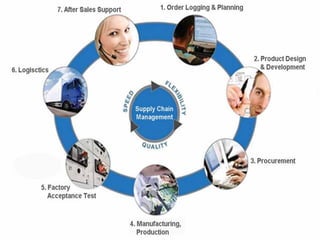
• Zara is a vertically integrated retailer. Unlike similar apparel 
retailers, Zara controls most of the steps on the supply-chain, 
designing, manufacturing, and distributing its products. 
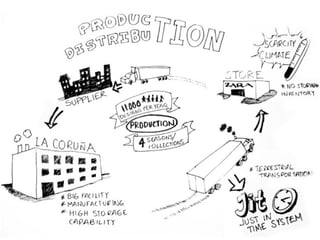
• Zara set up its own factory in La Coruña (a city known for its 
textile industry) in 1980, and upgraded to reverse milk-run-type 
production and distribution facilities in 1990. 
• This approach, designed by Toyota Motor Corp., was called 
the just-in-time (JIT) system. 
• 50% of the products Zara sells are manufactured in Spain, 
26% in the rest of Europe, and 24% in Asian and African 
countries and the rest of the world.
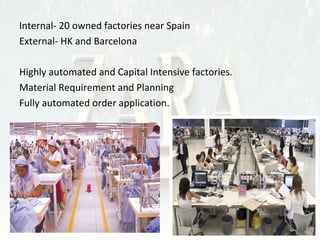
•Internal- 20 owned factories near Spain 
•External- HK and Barcelona 
1.Highly automated and Capital Intensive factories. 
2.Material Requirement and Planning 
3.Fully automated order application.
DISTRIBUTION OF ZARA PRODUCT 
 Centralized Distribution System 
 Mobile tracking Systems 
 PDA 
 Transportation and logistics 
• Route and schedule optimization 
• Queue Management system for turnaround and waiting 
period of the ships at the docks. 
• Inventory Management
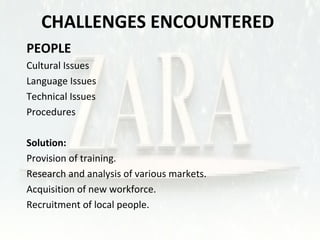
CHALLENGES ENCOUNTERED 
 PEOPLE 
• Cultural Issues 
• Language Issues 
• Technical Issues 
• Procedures 
 Solution: 
• Provision of training. 
• Research and analysis of various markets. 
• Acquisition of new workforce. 
• Recruitment of local people.
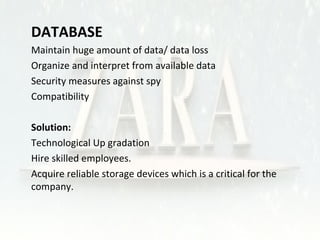
 DATABASE 
• Maintain huge amount of data/ data loss 
• Organize and interpret from available data 
• Security measures against spy 
• Compatibility 
 Solution: 
• Technological Up gradation 
• Hire skilled employees. 
• Acquire reliable storage devices which is a critical for the 
company.
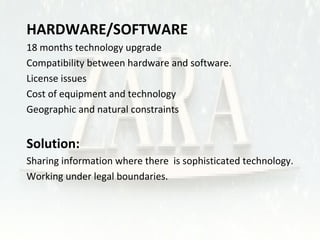
 HARDWARE/SOFTWARE 
• 18 months technology upgrade 
• Compatibility between hardware and software. 
• License issues 
• Cost of equipment and technology 
• Geographic and natural constraints 
 Solution: 
• Sharing information where there is sophisticated technology. 
• Working under legal boundaries.
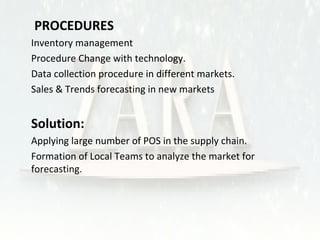
 PROCEDURES 
• Inventory management 
• Procedure Change with technology. 
• Data collection procedure in different markets. 
• Sales & Trends forecasting in new markets 
 Solution: 
• Applying large number of POS in the supply chain. 
• Formation of Local Teams to analyze the market for 
forecasting.
KEY SUCCESS FACTORS FOR ZARA 
Business is built on quick response 
•Production responds to trends. 
•Deliveries are twice weekly, unlike most of the competitors weekly 
schedule. 
KSFs: 
•Market Research 
•Ready raw material base 
•Multi-functional quick decision making 
•Vertical integration to ensure control over supply chain, and proximity 
•Technology 
•Cost Control, despite flexibility 
•Technology and Infrastructure
DESIGN SECTIONS BY ZARA……. 
• It designs for: 
1. Woman 
2. TRF( Under TRF) 
• Outwear, Dresses, Shirts, Trousers, Jeans, Shorts, Skirts, T-shirt 
3. Man 
4. Kids 
5. Mini 
6. Shoes and Bags(for Both Man & Woman)
ZARA STORES IN INDIA 
•DELHI ( 4 showroom) 
2 showroom in Saket , Ambience mall, Vasant Kunj 
•MUMBAI (3 Showroom) 
The Orion Mall, Phoenix Market City Mall, Infinity Mall 
•BANGALORE (2 Showroom) 
The Orion Mall(Malleswaram west), Phoenix Market City Mall 
•GAZIABAD (1 Showroom) 
Pacific Mall,Gaziabad
CONCLUSION 
• Zara would quickly go on to become leader in 
Spanish for young people and the company has 
experienced continuous growth ever since. 
• It began its expansion within the region of Galida 
covering the cities of Vigo Lugo , Santiago and 
Ourense…. 
• The first major growth all occurred during the 
company’s first five year of existence .. 
• Currently it has 335 stores distributed through out 
Spain and it is an Inditex company, as spanish is the 
parent company with the profit of 17 billion dollar in 
a month..
PRESENTED BY: 
KOMALPREET KAUR

Zara ppt

  • 2.
    ABOUT ZARA •Zara is a Spanish clothing and accessories retailer based in Arteixo, Galicia, and founded in 1975 by Amancio Ortega and Rosalía Mera. • It is the flagship chain store of the Inditex group, The world's largest apparel retailer, the fashion group also owns brands such as Massimo Dutti, Pull and Bear, Uterqüe, Stradivarius and Bershka. • It is claimed that Zara needs just two weeks to develop a new product and get it to stores, compared to the six-month industry average, and launches around 10,000 new designs each year. Zara España, S.A. Type Sociedad Anónima Industry Retail Founded Arteixo, Galicia (Spain) (May 24, 1974) Founder(s) Amancio Ortega Rosalía Mera Headquarters Arteixo, Spain Number of locations 1808 stores[1] Area served Worldwide Key people Óscar Pérez Marcote, Director-general Products Clothing Revenue €7.071 billion (2009) Parent Industria de Diseño Textil, S.A Divisions •Zara Diseño, S.L. •Zara Logística, S.A Website zara.com
  • 3.
    MARKETING STRATEGY •Its marketing strategy lies in creative way to convey fashions online with the dress room function, outfits on share on facebook, twitter send a link or email….. • It creates an economical profit ,online ranking all over the world wide and creates an added value of the brand… • Its main aim is to focus on to build a new strategic plan for the online shop…
  • 5.
    Tables Content. Marketingplan objectives • financial • Sustainable Responsibilities Marketing plan strategies • Selection of target market. • Positioning in target market. Marketing plan mix. • Price • place
  • 6.
    MANUFACTURING OF ZARAPRODUCTS • Zara is a vertically integrated retailer. Unlike similar apparel retailers, Zara controls most of the steps on the supply-chain, designing, manufacturing, and distributing its products. • Zara set up its own factory in La Coruña (a city known for its textile industry) in 1980, and upgraded to reverse milk-run-type production and distribution facilities in 1990. • This approach, designed by Toyota Motor Corp., was called the just-in-time (JIT) system. • 50% of the products Zara sells are manufactured in Spain, 26% in the rest of Europe, and 24% in Asian and African countries and the rest of the world.
  • 7.
    •Internal- 20 ownedfactories near Spain •External- HK and Barcelona 1.Highly automated and Capital Intensive factories. 2.Material Requirement and Planning 3.Fully automated order application.
  • 8.
    DISTRIBUTION OF ZARAPRODUCT  Centralized Distribution System  Mobile tracking Systems  PDA  Transportation and logistics • Route and schedule optimization • Queue Management system for turnaround and waiting period of the ships at the docks. • Inventory Management
  • 10.
    CHALLENGES ENCOUNTERED PEOPLE • Cultural Issues • Language Issues • Technical Issues • Procedures  Solution: • Provision of training. • Research and analysis of various markets. • Acquisition of new workforce. • Recruitment of local people.
  • 11.
     DATABASE •Maintain huge amount of data/ data loss • Organize and interpret from available data • Security measures against spy • Compatibility  Solution: • Technological Up gradation • Hire skilled employees. • Acquire reliable storage devices which is a critical for the company.
  • 12.
     HARDWARE/SOFTWARE •18 months technology upgrade • Compatibility between hardware and software. • License issues • Cost of equipment and technology • Geographic and natural constraints  Solution: • Sharing information where there is sophisticated technology. • Working under legal boundaries.
  • 13.
     PROCEDURES •Inventory management • Procedure Change with technology. • Data collection procedure in different markets. • Sales & Trends forecasting in new markets  Solution: • Applying large number of POS in the supply chain. • Formation of Local Teams to analyze the market for forecasting.
  • 14.
    KEY SUCCESS FACTORSFOR ZARA Business is built on quick response •Production responds to trends. •Deliveries are twice weekly, unlike most of the competitors weekly schedule. KSFs: •Market Research •Ready raw material base •Multi-functional quick decision making •Vertical integration to ensure control over supply chain, and proximity •Technology •Cost Control, despite flexibility •Technology and Infrastructure
  • 15.
    DESIGN SECTIONS BYZARA……. • It designs for: 1. Woman 2. TRF( Under TRF) • Outwear, Dresses, Shirts, Trousers, Jeans, Shorts, Skirts, T-shirt 3. Man 4. Kids 5. Mini 6. Shoes and Bags(for Both Man & Woman)
  • 17.
    ZARA STORES ININDIA •DELHI ( 4 showroom) 2 showroom in Saket , Ambience mall, Vasant Kunj •MUMBAI (3 Showroom) The Orion Mall, Phoenix Market City Mall, Infinity Mall •BANGALORE (2 Showroom) The Orion Mall(Malleswaram west), Phoenix Market City Mall •GAZIABAD (1 Showroom) Pacific Mall,Gaziabad
  • 18.
    CONCLUSION • Zarawould quickly go on to become leader in Spanish for young people and the company has experienced continuous growth ever since. • It began its expansion within the region of Galida covering the cities of Vigo Lugo , Santiago and Ourense…. • The first major growth all occurred during the company’s first five year of existence .. • Currently it has 335 stores distributed through out Spain and it is an Inditex company, as spanish is the parent company with the profit of 17 billion dollar in a month..
  • 19.