
ZARA: Fast fashion 
case study 
MIS 석사 3학기 정효경
Contents 
 ZARA overview 
 ZARA’s business system 
 Comparing Zara with competitors 
 International Growth Strategy 
 Summary 
2
1. ZARA overview 
 Inditex 
 Founded in 1963 in Galicia, Spain 
Umbrella group of ZARA and 7 other apparel chains 
 ZARA 
 The most profitable brand Owned by Inditex 
 The first ZARA store was opened in 1975 in La Coruna, Spain 
Till 2014, over 2,000 stores located across 88 countries 
in Europe, the Americans, Asia and Africa. 
 Position: “medium quality fashion clothing at 
affordable prices” 
Main global competitions: the GAP, H&M, Benetton 
3
1. ZARA’s business system 
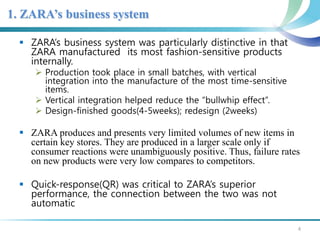
 ZARA’s business system was particularly distinctive in that 
ZARA manufactured its most fashion-sensitive products 
internally. 
 Production took place in small batches, with vertical 
integration into the manufacture of the most time-sensitive 
items. 
 Vertical integration helped reduce the “bullwhip effect”. 
 Design-finished goods(4-5weeks); redesign (2weeks) 
 ZARA produces and presents very limited volumes of new items in 
certain key stores. They are produced in a larger scale only if 
consumer reactions were unambiguously positive. Thus, failure rates 
on new products were very low compares to competitors. 
 Quick-response(QR) was critical to ZARA’s superior 
performance, the connection between the two was not 
automatic 
4
1. ZARA’s business system 
Design 
 Each of ZARA’s three product lines(foe women, men, and children) had a creative team. 
 Work on products for current season by creating constant variation 
 Continue in-season development 
 Select the fabrics and product mix for the following season and year 
 The process of adapting to trends and differences across markets was more 
evolutionary, placed greater reliance on high-frequency information. 
 Frequent conversations with store managers 
 The ZARA’s design teams continuously track consumer preferences and use 
this information about sales potential based on a consumption information 
system to transmit repeat orders and new designs to internal and external 
suppliers. 
 The ZARA’s design teams transcended design, are bridged merchandising 
and the back end of the production process. 
5
2. ZARA’s business system 
Sourcing & Manufacturing 
 ZARA sourced fabric, other inputs, and finished products from 
external suppliers with the help of purchasing offices in Barcelona 
and Hong Kong, as well as the sourcing personnel at headquarters. 
 About one-half of the fabric purchased was “gray” (undyed) to 
facilitate in-season updating with maximum flexibility, and of the 
remainder, approximately two-third in Europe and North Africa, and 
one-third form Asia. 
 Further down the value chain, about 40% of finished garments 
were manufactures internally. 
 Focused on the capital-intensive parts of production process-pattern design, 
cutting, finishing, and inspection. 
 Vertical integration into manufacturing 
 Cut garments were sent out to about 450 workshops with small operations 
specialized by product type. 
6
2. ZARA’s business system 
Distribution 
 own distribution center in Arteixo 
 satellite center in Argentina, Brazil and Mexico 
 center works on a dual-shift basis 
 equipped with mobile tracking system 
 delivery upon Europe takes about 24-36 hours, outside Europe 24- 
48 hours 
 scheduled shipments by time zones 
 establishment of a second distribution center at Zaragoza in 2003 
7
2. ZARA’s business system 
Retailing: 
 Consists of merchandising and store operations 
 Stores placed in premier shopping streets and centers 
 Very low advertising expenditures, no fashion shows 
 Set high value on presentation of store window shows 
 Main retailing-tactic: create a sense of scarcity 
 Aim: reduce inventories at marketed-down prices 
8
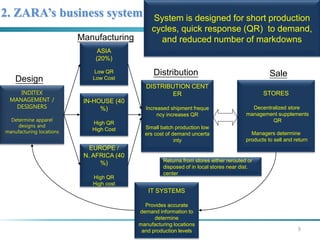
INDITEX 
MANAGEMENT / 
DESIGNERS 
Determine apparel 
designs and 
manufacturing locations 
ASIA 
(20%) 
Low QR 
Low Cost 
IN-HOUSE (40 
%) 
High QR 
High Cost 
EUROPE / 
N. AFRICA (40 
%) 
High QR 
High cost 
System is designed for short production 
cycles, quick response (QR) to demand, 
and reduced number of markdowns 
DISTRIBUTION CENT 
ER 
Increased shipment freque 
ncy increases QR 
Small batch production low 
ers cost of demand uncerta 
inty 
STORES 
Decentralized store 
management supplements 
QR 
Managers determine 
products to sell and return 
IT SYSTEMS 
Provides accurate 
demand information to 
determine 
manufacturing locations 
and production levels 
Manufacturing 
Design 
Distribution Sale 
Returns from stores either rerouted or 
disposed of in local stores near dist. 
center 
9 
2. ZARA’s business system
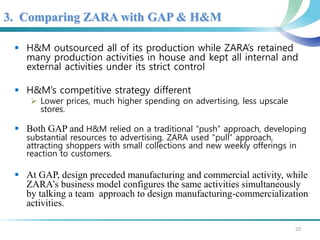
3. Comparing ZARA with GAP & H&M 
 H&M outsourced all of its production while ZARA’s retained 
many production activities in house and kept all internal and 
external activities under its strict control 
 H&M’s competitive strategy different 
 Lower prices, much higher spending on advertising, less upscale 
stores. 
 Both GAP and H&M relied on a traditional “push” approach, developing 
substantial resources to advertising. ZARA used “pull” approach, 
attracting shoppers with small collections and new weekly offerings in 
reaction to customers. 
 At GAP, design preceded manufacturing and commercial activity, while 
ZARA’s business model configures the same activities simultaneously 
by talking a team approach to design manufacturing-commercialization 
activities. 
10
4. International Growth Strategy 
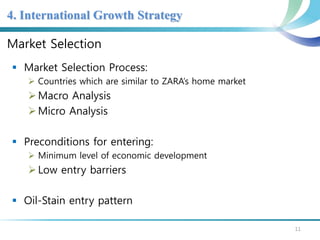
Market Selection 
 Market Selection Process: 
 Countries which are similar to ZARA’s home market 
 Macro Analysis 
Micro Analysis 
 Preconditions for entering: 
 Minimum level of economic development 
 Low entry barriers 
 Oil-Stain entry pattern 
11
4. International Growth Strategy 
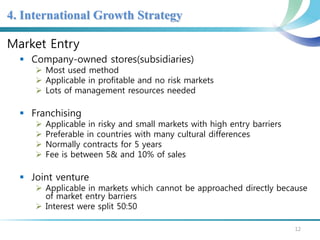
Market Entry 
12 
 Company-owned stores(subsidiaries) 
 Most used method 
 Applicable in profitable and no risk markets 
 Lots of management resources needed 
 Franchising 
 Applicable in risky and small markets with high entry barriers 
 Preferable in countries with many cultural differences 
 Normally contracts for 5 years 
 Fee is between 5& and 10% of sales 
 Joint venture 
 Applicable in markets which cannot be approached directly because 
of market entry barriers 
 Interest were split 50:50
5. Summary 
Key take away form ZARA case 
 Selling “ state-of-the-art” fashion through being a fashion follower 
 Integration upstream to create competitive advantages 
downstream 
 Relation between distribution and production development 
 Evolutionary product development and sourcing 
 Product development and distribution instead of promotion underlies 
brand development 
 Rethink the entire supply chain 
 Reduction in mark-down can more than mark-up for increase in labor 
cost 
 Planned shortages cam induce more future demand 
 Good store location, layout and product display can substitute advertis 
ing 
 Faster response eliminates inventory risks 
13
5. Summary 
Discussion and questions 
 On which way can the fact that ZARA has s single 
distribution center be an advantage ? 
 Centralized control avoid misunderstanding or conflict 
 Manageable time scheduling, focused on one rather than 
managing several different time schedules. 
 On which way can this be an disadvantage? 
 Dis-economic of scale: in long term, the costs is getting higher 
and higher. 
 Because of managing distribution on their own, designing and 
production process might not be in its optimum level. 
 Need culturally diverse management team alone with ZARA’s 
international expansion 
14
15

Zara presentation

  • 1.
    ZARA: Fast fashion case study MIS 석사 3학기 정효경
  • 2.
    Contents  ZARAoverview  ZARA’s business system  Comparing Zara with competitors  International Growth Strategy  Summary 2
  • 3.
    1. ZARA overview  Inditex  Founded in 1963 in Galicia, Spain Umbrella group of ZARA and 7 other apparel chains  ZARA  The most profitable brand Owned by Inditex  The first ZARA store was opened in 1975 in La Coruna, Spain Till 2014, over 2,000 stores located across 88 countries in Europe, the Americans, Asia and Africa.  Position: “medium quality fashion clothing at affordable prices” Main global competitions: the GAP, H&M, Benetton 3
  • 4.
    1. ZARA’s businesssystem  ZARA’s business system was particularly distinctive in that ZARA manufactured its most fashion-sensitive products internally.  Production took place in small batches, with vertical integration into the manufacture of the most time-sensitive items.  Vertical integration helped reduce the “bullwhip effect”.  Design-finished goods(4-5weeks); redesign (2weeks)  ZARA produces and presents very limited volumes of new items in certain key stores. They are produced in a larger scale only if consumer reactions were unambiguously positive. Thus, failure rates on new products were very low compares to competitors.  Quick-response(QR) was critical to ZARA’s superior performance, the connection between the two was not automatic 4
  • 5.
    1. ZARA’s businesssystem Design  Each of ZARA’s three product lines(foe women, men, and children) had a creative team.  Work on products for current season by creating constant variation  Continue in-season development  Select the fabrics and product mix for the following season and year  The process of adapting to trends and differences across markets was more evolutionary, placed greater reliance on high-frequency information.  Frequent conversations with store managers  The ZARA’s design teams continuously track consumer preferences and use this information about sales potential based on a consumption information system to transmit repeat orders and new designs to internal and external suppliers.  The ZARA’s design teams transcended design, are bridged merchandising and the back end of the production process. 5
  • 6.
    2. ZARA’s businesssystem Sourcing & Manufacturing  ZARA sourced fabric, other inputs, and finished products from external suppliers with the help of purchasing offices in Barcelona and Hong Kong, as well as the sourcing personnel at headquarters.  About one-half of the fabric purchased was “gray” (undyed) to facilitate in-season updating with maximum flexibility, and of the remainder, approximately two-third in Europe and North Africa, and one-third form Asia.  Further down the value chain, about 40% of finished garments were manufactures internally.  Focused on the capital-intensive parts of production process-pattern design, cutting, finishing, and inspection.  Vertical integration into manufacturing  Cut garments were sent out to about 450 workshops with small operations specialized by product type. 6
  • 7.
    2. ZARA’s businesssystem Distribution  own distribution center in Arteixo  satellite center in Argentina, Brazil and Mexico  center works on a dual-shift basis  equipped with mobile tracking system  delivery upon Europe takes about 24-36 hours, outside Europe 24- 48 hours  scheduled shipments by time zones  establishment of a second distribution center at Zaragoza in 2003 7
  • 8.
    2. ZARA’s businesssystem Retailing:  Consists of merchandising and store operations  Stores placed in premier shopping streets and centers  Very low advertising expenditures, no fashion shows  Set high value on presentation of store window shows  Main retailing-tactic: create a sense of scarcity  Aim: reduce inventories at marketed-down prices 8
  • 9.
    INDITEX MANAGEMENT / DESIGNERS Determine apparel designs and manufacturing locations ASIA (20%) Low QR Low Cost IN-HOUSE (40 %) High QR High Cost EUROPE / N. AFRICA (40 %) High QR High cost System is designed for short production cycles, quick response (QR) to demand, and reduced number of markdowns DISTRIBUTION CENT ER Increased shipment freque ncy increases QR Small batch production low ers cost of demand uncerta inty STORES Decentralized store management supplements QR Managers determine products to sell and return IT SYSTEMS Provides accurate demand information to determine manufacturing locations and production levels Manufacturing Design Distribution Sale Returns from stores either rerouted or disposed of in local stores near dist. center 9 2. ZARA’s business system
  • 10.
    3. Comparing ZARAwith GAP & H&M  H&M outsourced all of its production while ZARA’s retained many production activities in house and kept all internal and external activities under its strict control  H&M’s competitive strategy different  Lower prices, much higher spending on advertising, less upscale stores.  Both GAP and H&M relied on a traditional “push” approach, developing substantial resources to advertising. ZARA used “pull” approach, attracting shoppers with small collections and new weekly offerings in reaction to customers.  At GAP, design preceded manufacturing and commercial activity, while ZARA’s business model configures the same activities simultaneously by talking a team approach to design manufacturing-commercialization activities. 10
  • 11.
    4. International GrowthStrategy Market Selection  Market Selection Process:  Countries which are similar to ZARA’s home market  Macro Analysis Micro Analysis  Preconditions for entering:  Minimum level of economic development  Low entry barriers  Oil-Stain entry pattern 11
  • 12.
    4. International GrowthStrategy Market Entry 12  Company-owned stores(subsidiaries)  Most used method  Applicable in profitable and no risk markets  Lots of management resources needed  Franchising  Applicable in risky and small markets with high entry barriers  Preferable in countries with many cultural differences  Normally contracts for 5 years  Fee is between 5& and 10% of sales  Joint venture  Applicable in markets which cannot be approached directly because of market entry barriers  Interest were split 50:50
  • 13.
    5. Summary Keytake away form ZARA case  Selling “ state-of-the-art” fashion through being a fashion follower  Integration upstream to create competitive advantages downstream  Relation between distribution and production development  Evolutionary product development and sourcing  Product development and distribution instead of promotion underlies brand development  Rethink the entire supply chain  Reduction in mark-down can more than mark-up for increase in labor cost  Planned shortages cam induce more future demand  Good store location, layout and product display can substitute advertis ing  Faster response eliminates inventory risks 13
  • 14.
    5. Summary Discussionand questions  On which way can the fact that ZARA has s single distribution center be an advantage ?  Centralized control avoid misunderstanding or conflict  Manageable time scheduling, focused on one rather than managing several different time schedules.  On which way can this be an disadvantage?  Dis-economic of scale: in long term, the costs is getting higher and higher.  Because of managing distribution on their own, designing and production process might not be in its optimum level.  Need culturally diverse management team alone with ZARA’s international expansion 14
  • 15.