ZARA
FASHION AND ACCESSORIES
PEOPLE
WILL
STARE.
MAKE IT
WORTH
THEIR
WHILE
About ZARA
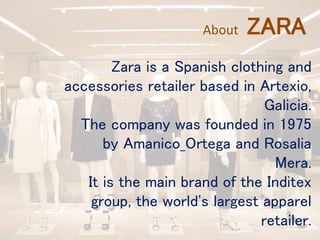
Zara is a Spanish clothing and
accessories retailer based in Artexio,
Galicia.
The company was founded in 1975
by Amanico Ortega and Rosalia
Mera.
It is the main brand of the Inditex
group, the world's largest apparel
retailer.
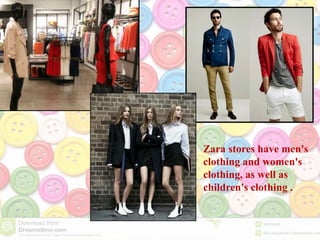
Zara stores have men's
clothing and women's
clothing, as well as
children's clothing .
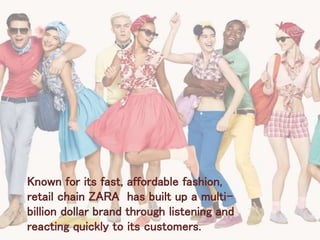
Known for its fast, affordable fashion,
retail chain ZARA has built up a multi-
billion dollar brand through listening and
reacting quickly to its customers.
• The firm tripled in size between
1996 and 2000
• By 2008, sales edged ahead of
Gap
• The fashion group also owns
brands such as Massimo Dutti,
Pull and Bear, Bershka,
Stradivarius, Oysho, Zara Home,
and Uterque.
DESIGN AND
PRODUCTION
Employs hundreds of
designers at its headquarters in
Spain.
New styles are constantly being
created.
The firm enforces the speed at
which it puts
these designs into production.
Produces only a small quantity
of each
collection.
LOGISTICS
Distributes all its merchandise from
Spain.
Process is designed so that the time
from receipt of an order to delivery in
the store averages 1 to 2 days.
Nearby production facilities is key to
success.
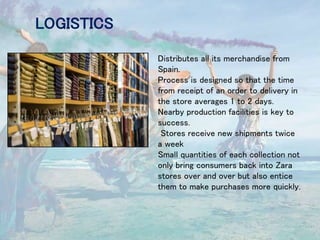
Stores receive new shipments twice
a week
Small quantities of each collection not
only bring consumers back into Zara
stores over and over but also entice
them to make purchases more quickly.
CUSTOMERS
The retailer reacts to
customers’ changing
needs, trends, and tastes.
They react to customer
feedback—good and bad—and if
something fails, the
line is withdrawn immediately.
Zara cuts its losses and the
impact is minimal due to the
low quantities of each style
produced.
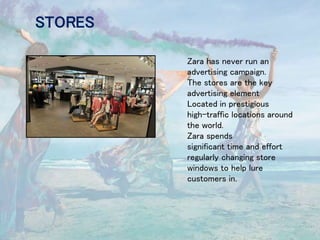
STORES
Zara has never run an
advertising campaign.
The stores are the key
advertising element
Located in prestigious
high-traffic locations around
the world.
Zara spends
significant time and effort
regularly changing store
windows to help lure
customers in.
Zara continues to expand into new markets and
countries, it risks losing some of its speed and will
have to work hard to continue providing the same
newness all over the world that it does so well in
Europe.
ZARA Marketing Mix
PRODUCT: ZARA manufactures and sell
products such as clothes, shoes, cosmetics and
accessories for men, women and children.
PRICE: ZARA provides clothes for people with
lower income so its prices are affordable.
PLACE: ZARA is present in 30 countries in
private locations. There are 600 commercial
stores, and ZARA is selling its service through
out the world.
PROMOTION: ZARA focuses less on
advertisement-based marketing but more on
internet online marketing.
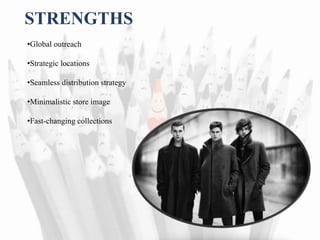
STRENGTHS
•Global outreach
•Strategic locations
•Seamless distribution strategy
•Minimalistic store image
•Fast-changing collections
WEAKNESSES
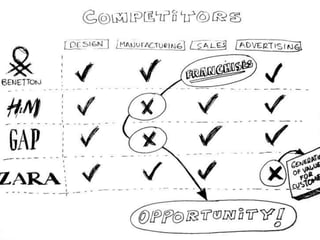
•Brand image closely tagged to competitors
•Limited stocks
•Lack of marketing communications
OPPORTUNITIES
•Demand for high fashion at affordable prices
•Growing Asian market, especially China
•Diverse cultural area
THREATS
•Fierce competition
•Lawsuits related to sweatshops
•Possible imitation of goods
•Dilution of brand equity
SUMMARY
 To be successful an organization must
have a clear competitive strategy
 ZARA has introduced a new, unique
business model into the apparel
manufacturing industry.
They understand the needs of the
customers and tie these to proper
innovation strategies.
ZARA has potential for sustainable
growth because of its capability and
competitive advantage to experience the
challenges of fashion industry.
DISCLAIMER
Created by Vandan Kothari, IIT
Roorkee, during a marketing
internship by Prof. Sameer Mathur,
IIM Lucknow

ZARA-Fashion and Accesories

  • 1.
  • 2.
    About ZARA Zara isa Spanish clothing and accessories retailer based in Artexio, Galicia. The company was founded in 1975 by Amanico Ortega and Rosalia Mera. It is the main brand of the Inditex group, the world's largest apparel retailer.
  • 3.
    Zara stores havemen's clothing and women's clothing, as well as children's clothing .
  • 4.
    Known for itsfast, affordable fashion, retail chain ZARA has built up a multi- billion dollar brand through listening and reacting quickly to its customers.
  • 5.
    • The firmtripled in size between 1996 and 2000 • By 2008, sales edged ahead of Gap • The fashion group also owns brands such as Massimo Dutti, Pull and Bear, Bershka, Stradivarius, Oysho, Zara Home, and Uterque.
  • 6.
    DESIGN AND PRODUCTION Employs hundredsof designers at its headquarters in Spain. New styles are constantly being created. The firm enforces the speed at which it puts these designs into production. Produces only a small quantity of each collection.
  • 7.
    LOGISTICS Distributes all itsmerchandise from Spain. Process is designed so that the time from receipt of an order to delivery in the store averages 1 to 2 days. Nearby production facilities is key to success. Stores receive new shipments twice a week Small quantities of each collection not only bring consumers back into Zara stores over and over but also entice them to make purchases more quickly.
  • 8.
    CUSTOMERS The retailer reactsto customers’ changing needs, trends, and tastes. They react to customer feedback—good and bad—and if something fails, the line is withdrawn immediately. Zara cuts its losses and the impact is minimal due to the low quantities of each style produced.
  • 9.
    STORES Zara has neverrun an advertising campaign. The stores are the key advertising element Located in prestigious high-traffic locations around the world. Zara spends significant time and effort regularly changing store windows to help lure customers in.
  • 12.
    Zara continues toexpand into new markets and countries, it risks losing some of its speed and will have to work hard to continue providing the same newness all over the world that it does so well in Europe.
  • 13.
    ZARA Marketing Mix PRODUCT:ZARA manufactures and sell products such as clothes, shoes, cosmetics and accessories for men, women and children. PRICE: ZARA provides clothes for people with lower income so its prices are affordable. PLACE: ZARA is present in 30 countries in private locations. There are 600 commercial stores, and ZARA is selling its service through out the world. PROMOTION: ZARA focuses less on advertisement-based marketing but more on internet online marketing.
  • 15.
    STRENGTHS •Global outreach •Strategic locations •Seamlessdistribution strategy •Minimalistic store image •Fast-changing collections
  • 16.
    WEAKNESSES •Brand image closelytagged to competitors •Limited stocks •Lack of marketing communications
  • 17.
    OPPORTUNITIES •Demand for highfashion at affordable prices •Growing Asian market, especially China •Diverse cultural area
  • 18.
    THREATS •Fierce competition •Lawsuits relatedto sweatshops •Possible imitation of goods •Dilution of brand equity
  • 19.
    SUMMARY  To besuccessful an organization must have a clear competitive strategy  ZARA has introduced a new, unique business model into the apparel manufacturing industry. They understand the needs of the customers and tie these to proper innovation strategies. ZARA has potential for sustainable growth because of its capability and competitive advantage to experience the challenges of fashion industry.
  • 21.
    DISCLAIMER Created by VandanKothari, IIT Roorkee, during a marketing internship by Prof. Sameer Mathur, IIM Lucknow

Editor's Notes

  • #7 Employs hundreds of designers at its headquarters in Spain. New styles are constantly being created and put into production while others are tweaked with new colors or patterns. The firm enforces the speed at which it puts these designs into production by locating half its production facilities nearby in Spain, Portugal, and Morocco. Zara produces only a small quantity of each collection and is willing to experience occasional shortages to preserve an image of exclusivity. Clothes with a longer shelf life, like T-shirts, are outsourced to lower-cost suppliers in Asia and Turkey. With tight control on its manufacturing process, Zara can move
  • #8 Zara distributes all its merchandise, regardless of origin, from Spain. Its distribution process is designed so that the time from receipt of an order to delivery in the store averages 24 hours in Europe and 48 hours in the United States and Asia. Having 50 percent of its production facilities nearby is key to the success of this model. All Zara stores receive new shipments twice a week, and the small quantities of each collection not only bring consumers back into Zara stores over and over but also entice them to make purchases more quickly. While an average shopper in Spain visits a high street (or main street) store three times a year, shoppers average 17 trips to Zara stores. Some Zara fans know exactly when new shipments arrive and show up early that day to be the first in line for the latest fashions. These practices keep sales strong throughout the year and help the company sell more products at full price—85 percent of its merchandise versus the industry average of 60 percent
  • #9 Everything revolves around Zara’s customers. The retailer reacts to customers’ changing needs, trends, and tastes with daily reports from Zara shop managers about which products and styles have sold and which haven’t. With up to 70 percent of their salaries coming from commission, managers have a strong incentive to stay on top of things. Zara’s designers don’t have to predict what fashion trends will be in the future. They react to customer feedback—good and bad—and if something fails, the line is withdrawn immediately. Zara cuts its losses and the impact is minimal due to the low quantities of each style produced.
  • #10 Zara has never run an advertising campaign. The stores, 90 percent of which it owns, are the key advertising element and are located in prestigious high-traffic locations around the world. Zara spends significant time and effort regularly changing store windows to help lure customers in. In comparison to other retailers, which spend 3 percent to 4 percent of revenues on big brand-building campaigns, Zara spends just 0.3 percent