Smart Application Development
Sungkyunkwan
University
Spring 2012

JuneHyo Ahn
SunHo Lee
Chris Lopez
Contents

 Background Overview

 SPA Brand
 Company Introduction
 Product Concept

 Business Analysis

 Trend & Environment Analysis
 3C Analysis
 SWOT
 STP

 Market Analysis

 Consumer Needs & Wants
 Segmentation & Target
 Consumers’ Journey
 Consumers’ Pain Point

 New Service Concept
1

Background Overview
SPA Brand

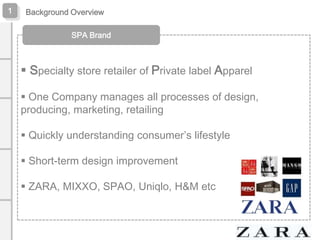
 Specialty store retailer of Private label Apparel
 One Company manages all processes of design,
producing, marketing, retailing
 Quickly understanding consumer’s lifestyle
 Short-term design improvement

 ZARA, MIXXO, SPAO, Uniqlo, H&M etc
1

Background Overview
SPA Brand
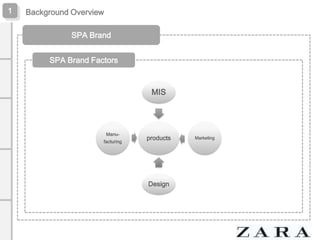
SPA Brand Factors

MIS

Manufacturing

products

Design

Marketing
1

Background Overview
Company Introduction
History of Zara

1963 : founded INDITEX
1975 : opened the 1st ZARA store in Spain
1988 : opened the 1st oversea ZARA store in Portugal
1989 : entered to the Americas in New York

1991 : entered to Asia market opening in Japan
2005 : opened ZARA store in Indonesia
1

Background Overview
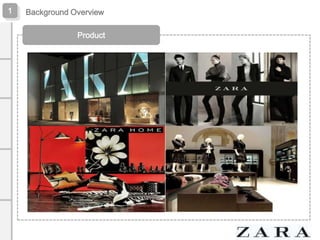
Product
2

Business Analysis
Trend & Environment Analysis

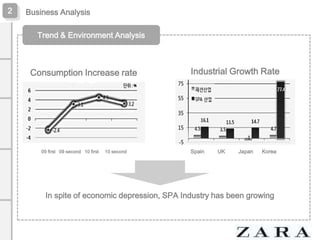
Consumption Increase rate

09 first 09 second 10 first

10 second

Industrial Growth Rate

Spain

UK

Japan

Korea

In spite of economic depression, SPA Industry has been growing
2

Business Analysis
Trend & Environment Analysis

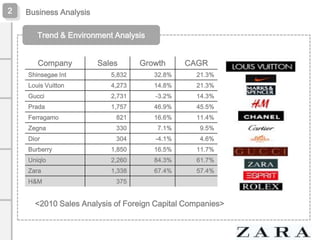
Company

Sales

Growth

CAGR

Shinsegae Int

5,832

32.8%

21.3%

Louis Vuitton

4,273

14.8%

21.3%

Gucci

2,731

-3.2%

14.3%

Prada

1,757

46.9%

45.5%

Ferragamo

821

16.6%

11.4%

Zegna

330

7.1%

9.5%

Dior

304

-4.1%

4.6%

Burberry

1,850

16.5%

11.7%

Uniqlo

2,260

84.3%

61.7%

Zara

1,338

67.4%

57.4%

H&M

375

<2010 Sales Analysis of Foreign Capital Companies>
2

Business Analysis
Trend & Environment Analysis

SPA Brand Awareness

Awareness

SPA Brand Preference

Preference
2

Business Analysis
3C Analysis
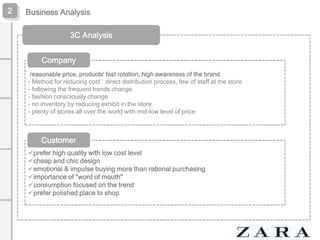
Company
reasonable price, products' fast rotation, high awareness of the brand
- Method for reducing cost : direct distribution process, few of staff at the store
- following the frequent trends change
- fashion consciously change
- no inventory by reducing exhibit in the store
- plenty of stores all over the world with mid-low level of price

Customer
prefer high quality with low cost level
cheap and chic design
emotional & impulse buying more than rational purchasing
importance of "word of mouth"
consumption focused on the trend
prefer polished place to shop
2

Business Analysis
3C Analysis
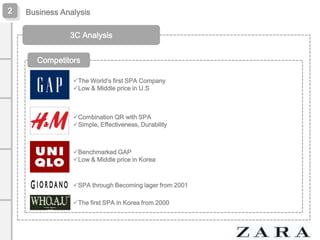
Competitors
The World’s first SPA Company
Low & Middle price in U.S

Combination QR with SPA
Simple, Effectiveness, Durability

Benchmarked GAP
Low & Middle price in Korea

SPA through Becoming lager from 2001
The first SPA in Korea from 2000
Business Analysis

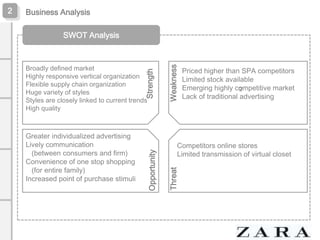
Priced higher than SPA competitors
Limited stock available
Emerging highly competitive market
Lack of traditional advertising

Competitors online stores
Limited transmission of virtual closet

Threat

Greater individualized advertising
Lively communication
(between consumers and firm)
Convenience of one stop shopping
(for entire family)
Increased point of purchase stimuli

Opportunity

Strength

Broadly defined market
Highly responsive vertical organization
Flexible supply chain organization
Huge variety of styles
Styles are closely linked to current trends
High quality

Weakness

SWOT Analysis

z

2
2

Business Analysis
STP Analysis
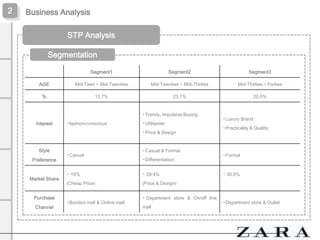
Segmentation
Segment1

Segment2

Segment3

AGE

Mid-Teen ~ Mid-Twenties

Mid-Twenties ~ Mid-Thirties

Mid-Thirties ~ Forties

%

12.7%

23.1%

20.5%

▸Trendy, Impulsive Buying

Interest

▸fashion-conscious

▸Utilitarian
▸Price & Design

Style
Preference

Market Share

Purchase
Channel

▸Casual

▸Casual & Formal
▸Differentiation

▸ 19%

▸ 29.4%

(Cheap Price)

▸Luxury Brand

▸Practicality & Quality

▸Formal

(Price & Design)

▸Bonded mall & Online mall

▸ Department store & On/off line
mall

▸ 30.6%

▸Department store & Outlet
2

Business Analysis
STP Analysis
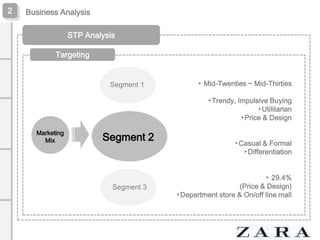
Targeting
▸ Mid-Twenties ~ Mid-Thirties

▸Trendy, Impulsive Buying
▸Utilitarian
▸Price & Design
Marketing
Mix

Segment 2

▸Casual & Formal
▸Differentiation
▸ 29.4%
(Price & Design)
▸Department store & On/off line mall
2

Business Analysis
STP Analysis
Positioning

Zara creates Customer Value with Trendy Items, Reasonable Price

Design
Differentiation

Reasonable
Price

Customer
Value

Fast Trend
2

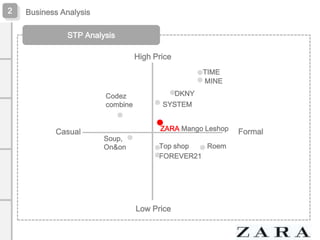
Business Analysis
STP Analysis

High Price
TIME
MINE
Codez
combine

Casual

DKNY

SYSTEM
ZARA Mango Leshop

Soup,
On&on

Top shop
Roem
FOREVER21

Low Price

Formal
3

Market Analysis
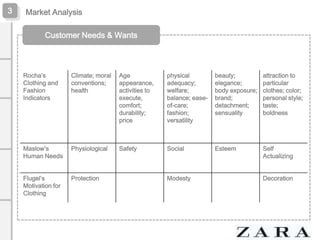
Customer Needs & Wants

Rocha’s
Clothing and
Fashion
Indicators

Climate; moral
conventions;
health

Age
appearance,
activities to
execute,
comfort;
durability;
price

physical
adequacy;
welfare;
balance; easeof-care;
fashion;
versatility

beauty;
elegance;
body exposure;
brand;
detachment;
sensuality

attraction to
particular
clothes; color;
personal style;
taste;
boldness

Maslow’s
Human Needs

Physiological

Safety

Social

Esteem

Self
Actualizing

Flugel’s
Motivation for
Clothing

Protection

Modesty

Decoration
3

Market Analysis
Segmentation & Target
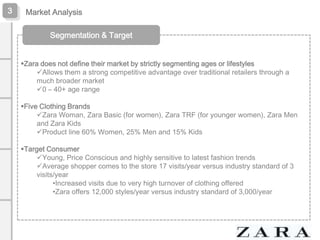
Zara does not define their market by strictly segmenting ages or lifestyles
Allows them a strong competitive advantage over traditional retailers through a
much broader market
0 – 40+ age range
Five Clothing Brands
Zara Woman, Zara Basic (for women), Zara TRF (for younger women), Zara Men
and Zara Kids
Product line 60% Women, 25% Men and 15% Kids
Target Consumer
Young, Price Conscious and highly sensitive to latest fashion trends
Average shopper comes to the store 17 visits/year versus industry standard of 3
visits/year
•Increased visits due to very high turnover of clothing offered
•Zara offers 12,000 styles/year versus industry standard of 3,000/year
3

Market Analysis
Customer’s Journey
Store location
Always located in high traffic, iconic areas that impart a prestigious air to Zara
•Unique external and internal architecture
Lack of advertising
Zara does not use traditional advertising
•Only 0.3% of revenue
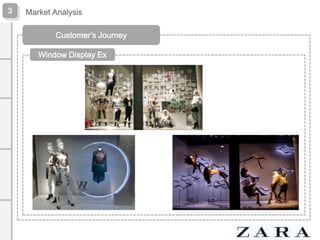
•Window displays are the first thing to greet potential customers
•Meticulously designed to be artistic and attention grabbing, while highlighting
the newest designs
In-store design
Stores are designed to seem airy and light
•Music is played at a muted volume
High turnover of styles removes need for large storage spaces
•Inventories are small, creating a high demand for limited pieces
Highly trained staff
3

Market Analysis
Customer’s Journey
Window Display Ex
3

Market Analysis
Customer’s Journey
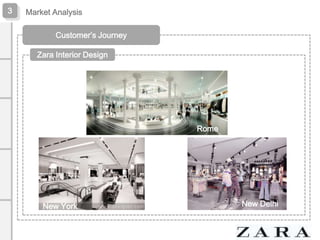
Zara Interior Design

Rome

New York

New Delhi
3

Market Analysis
Consumer Pain Point

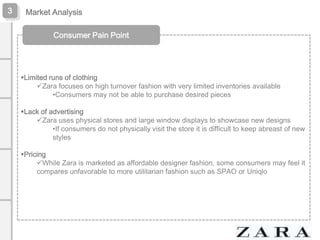
Limited runs of clothing
Zara focuses on high turnover fashion with very limited inventories available
•Consumers may not be able to purchase desired pieces
Lack of advertising
Zara uses physical stores and large window displays to showcase new designs
•If consumers do not physically visit the store it is difficult to keep abreast of new
styles
Pricing
While Zara is marketed as affordable designer fashion, some consumers may feel it
compares unfavorable to more utilitarian fashion such as SPAO or Uniqlo
4

New Service Concept
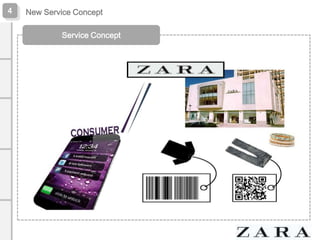
Service Concept
4

New Service Concept
Steps to Use

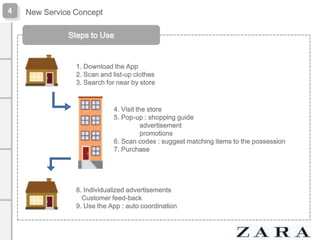
1. Download the App
2. Scan and list-up clothes
3. Search for near by store

4. Visit the store
5. Pop-up : shopping guide
advertisement
promotions
6. Scan codes : suggest matching items to the possession
7. Purchase

8. Individualized advertisements
Customer feed-back
9. Use the App : auto coordination
4

New Service Concept
Consumer Decision Making Process

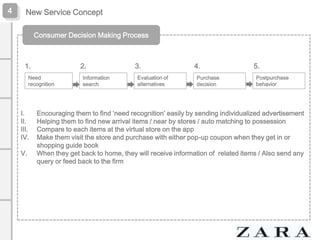
2.

1.
Need
recognition

I.
II.
III.
IV.
V.

Information
search

3.
Evaluation of
alternatives

4.
Purchase
decision

5.
Postpurchase
behavior

Encouraging them to find ‘need recognition’ easily by sending individualized advertisement
Helping them to find new arrival items / near by stores / auto matching to possession
Compare to each items at the virtual store on the app
Make them visit the store and purchase with either pop-up coupon when they get in or
shopping guide book
When they get back to home, they will receive information of related items / Also send any
query or feed back to the firm
4

New Service Concept
App Design
4

New Service Concept
App Design
3

Market Analysis
Consumer Pain Point
Pain Point Solutions

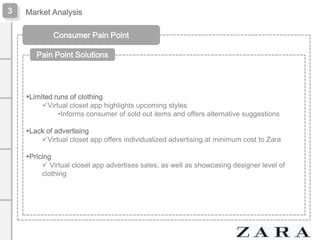
Limited runs of clothing
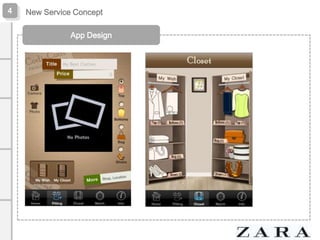
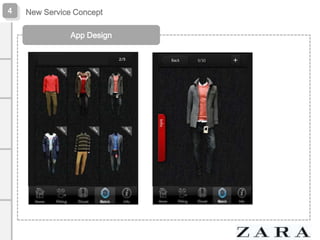
Virtual closet app highlights upcoming styles
•Informs consumer of sold out items and offers alternative suggestions
Lack of advertising
Virtual closet app offers individualized advertising at minimum cost to Zara
Pricing
 Virtual closet app advertises sales, as well as showcasing designer level of
clothing
Q&A

Thank You

ZARA: Smart App Development

  • 1.
  • 2.
    Contents  Background Overview SPA Brand  Company Introduction  Product Concept  Business Analysis  Trend & Environment Analysis  3C Analysis  SWOT  STP  Market Analysis  Consumer Needs & Wants  Segmentation & Target  Consumers’ Journey  Consumers’ Pain Point  New Service Concept
  • 3.
    1 Background Overview SPA Brand Specialty store retailer of Private label Apparel  One Company manages all processes of design, producing, marketing, retailing  Quickly understanding consumer’s lifestyle  Short-term design improvement  ZARA, MIXXO, SPAO, Uniqlo, H&M etc
  • 4.
    1 Background Overview SPA Brand SPABrand Factors MIS Manufacturing products Design Marketing
  • 5.
    1 Background Overview Company Introduction Historyof Zara 1963 : founded INDITEX 1975 : opened the 1st ZARA store in Spain 1988 : opened the 1st oversea ZARA store in Portugal 1989 : entered to the Americas in New York 1991 : entered to Asia market opening in Japan 2005 : opened ZARA store in Indonesia
  • 6.
  • 7.
    2 Business Analysis Trend &Environment Analysis Consumption Increase rate 09 first 09 second 10 first 10 second Industrial Growth Rate Spain UK Japan Korea In spite of economic depression, SPA Industry has been growing
  • 8.
    2 Business Analysis Trend &Environment Analysis Company Sales Growth CAGR Shinsegae Int 5,832 32.8% 21.3% Louis Vuitton 4,273 14.8% 21.3% Gucci 2,731 -3.2% 14.3% Prada 1,757 46.9% 45.5% Ferragamo 821 16.6% 11.4% Zegna 330 7.1% 9.5% Dior 304 -4.1% 4.6% Burberry 1,850 16.5% 11.7% Uniqlo 2,260 84.3% 61.7% Zara 1,338 67.4% 57.4% H&M 375 <2010 Sales Analysis of Foreign Capital Companies>
  • 9.
    2 Business Analysis Trend &Environment Analysis SPA Brand Awareness Awareness SPA Brand Preference Preference
  • 10.
    2 Business Analysis 3C Analysis Company reasonableprice, products' fast rotation, high awareness of the brand - Method for reducing cost : direct distribution process, few of staff at the store - following the frequent trends change - fashion consciously change - no inventory by reducing exhibit in the store - plenty of stores all over the world with mid-low level of price Customer prefer high quality with low cost level cheap and chic design emotional & impulse buying more than rational purchasing importance of "word of mouth" consumption focused on the trend prefer polished place to shop
  • 11.
    2 Business Analysis 3C Analysis Competitors TheWorld’s first SPA Company Low & Middle price in U.S Combination QR with SPA Simple, Effectiveness, Durability Benchmarked GAP Low & Middle price in Korea SPA through Becoming lager from 2001 The first SPA in Korea from 2000
  • 12.
    Business Analysis Priced higherthan SPA competitors Limited stock available Emerging highly competitive market Lack of traditional advertising Competitors online stores Limited transmission of virtual closet Threat Greater individualized advertising Lively communication (between consumers and firm) Convenience of one stop shopping (for entire family) Increased point of purchase stimuli Opportunity Strength Broadly defined market Highly responsive vertical organization Flexible supply chain organization Huge variety of styles Styles are closely linked to current trends High quality Weakness SWOT Analysis z 2
  • 13.
    2 Business Analysis STP Analysis Segmentation Segment1 Segment2 Segment3 AGE Mid-Teen~ Mid-Twenties Mid-Twenties ~ Mid-Thirties Mid-Thirties ~ Forties % 12.7% 23.1% 20.5% ▸Trendy, Impulsive Buying Interest ▸fashion-conscious ▸Utilitarian ▸Price & Design Style Preference Market Share Purchase Channel ▸Casual ▸Casual & Formal ▸Differentiation ▸ 19% ▸ 29.4% (Cheap Price) ▸Luxury Brand ▸Practicality & Quality ▸Formal (Price & Design) ▸Bonded mall & Online mall ▸ Department store & On/off line mall ▸ 30.6% ▸Department store & Outlet
  • 14.
    2 Business Analysis STP Analysis Targeting ▸Mid-Twenties ~ Mid-Thirties ▸Trendy, Impulsive Buying ▸Utilitarian ▸Price & Design Marketing Mix Segment 2 ▸Casual & Formal ▸Differentiation ▸ 29.4% (Price & Design) ▸Department store & On/off line mall
  • 15.
    2 Business Analysis STP Analysis Positioning Zaracreates Customer Value with Trendy Items, Reasonable Price Design Differentiation Reasonable Price Customer Value Fast Trend
  • 16.
    2 Business Analysis STP Analysis HighPrice TIME MINE Codez combine Casual DKNY SYSTEM ZARA Mango Leshop Soup, On&on Top shop Roem FOREVER21 Low Price Formal
  • 17.
    3 Market Analysis Customer Needs& Wants Rocha’s Clothing and Fashion Indicators Climate; moral conventions; health Age appearance, activities to execute, comfort; durability; price physical adequacy; welfare; balance; easeof-care; fashion; versatility beauty; elegance; body exposure; brand; detachment; sensuality attraction to particular clothes; color; personal style; taste; boldness Maslow’s Human Needs Physiological Safety Social Esteem Self Actualizing Flugel’s Motivation for Clothing Protection Modesty Decoration
  • 18.
    3 Market Analysis Segmentation &Target Zara does not define their market by strictly segmenting ages or lifestyles Allows them a strong competitive advantage over traditional retailers through a much broader market 0 – 40+ age range Five Clothing Brands Zara Woman, Zara Basic (for women), Zara TRF (for younger women), Zara Men and Zara Kids Product line 60% Women, 25% Men and 15% Kids Target Consumer Young, Price Conscious and highly sensitive to latest fashion trends Average shopper comes to the store 17 visits/year versus industry standard of 3 visits/year •Increased visits due to very high turnover of clothing offered •Zara offers 12,000 styles/year versus industry standard of 3,000/year
  • 19.
    3 Market Analysis Customer’s Journey Storelocation Always located in high traffic, iconic areas that impart a prestigious air to Zara •Unique external and internal architecture Lack of advertising Zara does not use traditional advertising •Only 0.3% of revenue •Window displays are the first thing to greet potential customers •Meticulously designed to be artistic and attention grabbing, while highlighting the newest designs In-store design Stores are designed to seem airy and light •Music is played at a muted volume High turnover of styles removes need for large storage spaces •Inventories are small, creating a high demand for limited pieces Highly trained staff
  • 20.
  • 21.
    3 Market Analysis Customer’s Journey ZaraInterior Design Rome New York New Delhi
  • 22.
    3 Market Analysis Consumer PainPoint Limited runs of clothing Zara focuses on high turnover fashion with very limited inventories available •Consumers may not be able to purchase desired pieces Lack of advertising Zara uses physical stores and large window displays to showcase new designs •If consumers do not physically visit the store it is difficult to keep abreast of new styles Pricing While Zara is marketed as affordable designer fashion, some consumers may feel it compares unfavorable to more utilitarian fashion such as SPAO or Uniqlo
  • 23.
  • 24.
    4 New Service Concept Stepsto Use 1. Download the App 2. Scan and list-up clothes 3. Search for near by store 4. Visit the store 5. Pop-up : shopping guide advertisement promotions 6. Scan codes : suggest matching items to the possession 7. Purchase 8. Individualized advertisements Customer feed-back 9. Use the App : auto coordination
  • 25.
    4 New Service Concept ConsumerDecision Making Process 2. 1. Need recognition I. II. III. IV. V. Information search 3. Evaluation of alternatives 4. Purchase decision 5. Postpurchase behavior Encouraging them to find ‘need recognition’ easily by sending individualized advertisement Helping them to find new arrival items / near by stores / auto matching to possession Compare to each items at the virtual store on the app Make them visit the store and purchase with either pop-up coupon when they get in or shopping guide book When they get back to home, they will receive information of related items / Also send any query or feed back to the firm
  • 26.
  • 27.
  • 28.
    3 Market Analysis Consumer PainPoint Pain Point Solutions Limited runs of clothing Virtual closet app highlights upcoming styles •Informs consumer of sold out items and offers alternative suggestions Lack of advertising Virtual closet app offers individualized advertising at minimum cost to Zara Pricing  Virtual closet app advertises sales, as well as showcasing designer level of clothing
  • 29.