International Research Journal of Engineering and Technology (IRJET) e-ISSN: 2395-0056
Volume: 09 Issue: 04 | Apr 2022 www.irjet.net p-ISSN: 2395-0072
© 2022, IRJET | Impact Factor value: 7.529 | ISO 9001:2008 Certified Journal | Page 1290
Yoga Pose Detection and Correction using Posenet and KNN
Varsha Bhosale1, Pranjal Nandeshwar2, Abhishek Bale3, Janmesh Sankhe4
1Associate Professor, 2,3,4 Under-Graduate Student
1,2,3,4 Department of Information Technology, Vidyalankar Institute of Technology, Mumbai, India.
---------------------------------------------------------------------***---------------------------------------------------------------------
Abstract - The fundamental goal of Yoga pose detection
and correction is to provide standard and correct yoga
postures using computer vision. If the yoga postureisnot done
properly, it can result in serious injuries and long-term issues.
Analyzing human poses to detect and correct yoga poses can
benefit humans living a healthier life in their homely
environment. This project focuses on exploring the different
approaches for yoga pose classification, so we are using
PoseNet and KNN classifier. Using such deep learning
algorithms, an individual can get the correct/ideal
way/method to perform that specific yoga asana that he/she
is trying to do. Using computer vision techniques and Open
Pose (an open-source library), human pose estimation is used
to estimate an individual's Yogaposture. Thesuggestedsystem
recognises the difference between the actual and target
positions and corrects the user with high accuracy by offering
real-time visual output and necessary instructions to correct
the identified pose.
Key Words: KNN, Open Pose, Posenet, Pose Estimation,
Crucial Angles.
1. INTRODUCTION
Yoga, a centuries-old practice that is originally from India
but is globally famous for its numerous spiritual, corporeal,
and mental benefits, is a type of exercise with complex
postures. The problem with yoga is that, like any other
exercise, it is critical to practice it correctly because any
incorrect position during a yoga session can be ineffectual
and potentially inconvenient. This necessitatesthe presence
of a trainer to supervise the meeting and correct the
individual's stance. Since not every client approaches or has
access to a trainer, a computerized reasoning-based
application might be used to detect yoga poses and provide
customized feedback to help people improvetheirstructure.
As a result, we've proposed an artificial intelligence-based
application that can recognise yoga stances and respond
with a customised response to help users improve their
postures. The purpose of this study is to gain a better
knowledge of the many techniques used to classify yoga
poses, including pose estimation, KNN classification [1],
Posenet [2], and the KNN classifier model [3]. Lack of
physical fitness increases the risk of adverse health
conditions including coronary heart diseases, high blood
pressure, stroke, metabolic syndrome,type2diabeteswhich
leads to a decrease in the life expectancy of humans. In this
work, pose estimation for the correction of yoga poses is
implemented. Many pose detection systems areopensource
which requires system setup andcamera. Thisisa basicyoga
model that allows people to execute various yoga poses and
adjust their yoga postures by looking at a reflected image.
2. LITERATURE SURVEY
Deep learning is a promising area of research that allows us
to examine large amounts of data in a scalable manner. Deep
learning, unlike traditional machine learning models, does
not require feature extraction or engineering since it
understands complex patterns in data and extracts features
on its own. Earlier work emphasized on the visual look of
structures, which depict nature of human creation as a solid
arrangement. Humans withskeletonsconnectingtheirbodily
parts are employed to acquire knowledge into the human
body. To assume that each body part is independent of the
others, a preset kinematic body model is typically utilized.
Extensive extensions have lately beencreated,suchasmixed,
hierarchical, multimodal, and powerful appearance models,
such as falling/sequential prediction. Each limb is
represented by a layout that includes position, orientation,
shape arrangement, and layout model. Patil et al. [4]
suggested a technique for determining yoga posture
discrepancies between an expert and a practitioner using
picture contour information and speeded up robust features
(SURF). However, characterizing and comparing postures
nearly entirely on the basis of contour data is insufficient.
A Yoga identification method utilizing a typical RGB camera
was proposed by Santosh Kumar Yadav et al. [5]. Theyuseda
high-definition webcam to acquire the data. UsingOpenPose,
they scanned the user and discovered key points. The time-
distributed CNN layer was used to recognize patterns
between key points in a single frame, and the LSTM wasused
to memorize the patterns discovered in recent frames. Their
method eliminated the requirement for Kinect or any other
specific technology to identify Yoga postures.
Guo et al. [6] presented a picture and text-based intelligent
systems for yoga training that includes inertial measuring
units(IMUs)andtactors.However,thiscouldbeinconvenient
forthe user, as well as disruptingthenaturalyogastance,and
they failed to consider the practitioner's posture.
[7] has described another technique for Kinect-based yoga
pose correction that takes into account three yoga poses:
warrior III, downward dog, and tree pose. However, their
accuracy score is only 82.84 percent, which is not very
impressive. Deep learning-based technologies have now
supplanted the old skeletonization process.
International Research Journal of Engineering and Technology (IRJET) e-ISSN: 2395-0056
Volume: 09 Issue: 04 | Apr 2022 www.irjet.net p-ISSN: 2395-0072
© 2022, IRJET | Impact Factor value: 7.529 | ISO 9001:2008 Certified Journal | Page 1291
Shruti Kothari [8] described a computational method for
classifying Yoga poses from photos that uses deep learning,
specifically CNN. For the classification model, they used a
dataset of 1000 photos divided into six classes. This work
was completed with nearly 85% correctness.
Chaudhari et al. [9] built a system that provides clear
feedback to the practitioner so that they can properly
practise yoga postures using domain knowledge of five yoga
positions. A CNN model was used to identify yoga positions,
and a human-joint localizationmodelwasusedtofinddefects
in the pose.
3. PROPOSED SYSTEM
The dataset, which consists of a collection of nearly 400
distinct Images of each Yoga Pose. These Images are
optimised to similar pixels and size, then blended to a single
video. The Proposed Model will get trained using the output
video which consist images of different poses where KNN
classifier is used to detect the pose by detecting the key-
points of the limbs of human and the model is saved. We are
using webcam as input feed. Using webcam, we can get real-
time Yoga Pose of the user and KNN classifier will identify
significant points and will classify it into one of theYogaPose
then we can see an instructor video performing the detected
Yoga Pose. We can see the architecture diagram below
Figure 1: Architecture diagram
3.1 KNN Classifier
K-Nearest Neighbors is a Machine Learning algorithm that
stores all different cases and classifies based on similarities.
It is mostly used in Pattern Recognition technique. The KNN
algorithm predicts the values of new data points based on
'feature similarity,' which implies that the new data point
will be assigned a value depending onhowcloselyitmatches
the points in the training set. Its operation is demonstrated
using the procedures below:
1. A dataset is required for the implementation of any
algorithm. As a result, the training and test data
must be loaded during the first step of KNN.
2. The value of K, i.e. the data points closest to it. K can
be any integer that is required to be selected.
3. Do the following for each point in the test data:
i) Calculate the distance between each row of
training data and the test data using one of the
following methods: Euclidean, Manhattan, or
Hamming distance. The Euclidean method is the
most widely used method for calculating distance.
ii) Sort them in ascending order depending on the
distance value.
iii) It then selects the top K rows from the sorted
array.
iv) The most frequent category of these rows will
now be used to assign a category to the test point.
3.2 Dataset
Dataset used for this are collected from Kaggle [11] and
other open sources. It consists of images of 5 different yoga
poses namely - Utkata Konasana (goddess), Tadasana
(mountain), Phalakasana (plank), Vrksasana (tree),
Virabhadrasana III (warrior 3). A total no. of 1578 Images
are collected.
3.3 POSENET
It is deep learning framework used to identify human poses
in images and video sequences by identifying the critical
points in human body and TrainingtheModel basedonthese
key points.
3.4 Training Model
An optimised video with all distinct yoga poses is created
using python libraries such as TesnorFlow - Keras,
OpenPose, NumPy. Now, The Deep learning framework will
extract the key points from video sequence so that we can
classify and train the model using a Frontend UI. Training
Accuracy: 93.56%
3.5 Model Performance
Using webcam, Model will extract the key points from the
Yoga Pose performed by user. Depending upon the feed it
will classify it to one of the trained Yoga Poses and then we
can see a video of a Yoga Instructor performing the detected
pose accurately so that user can learn and correct the
posture accordingly. The results were promising with an
accuracy rate of 98.51%.
International Research Journal of Engineering and Technology (IRJET) e-ISSN: 2395-0056
Volume: 09 Issue: 04 | Apr 2022 www.irjet.net p-ISSN: 2395-0072
© 2022, IRJET | Impact Factor value: 7.529 | ISO 9001:2008 Certified Journal | Page 1292
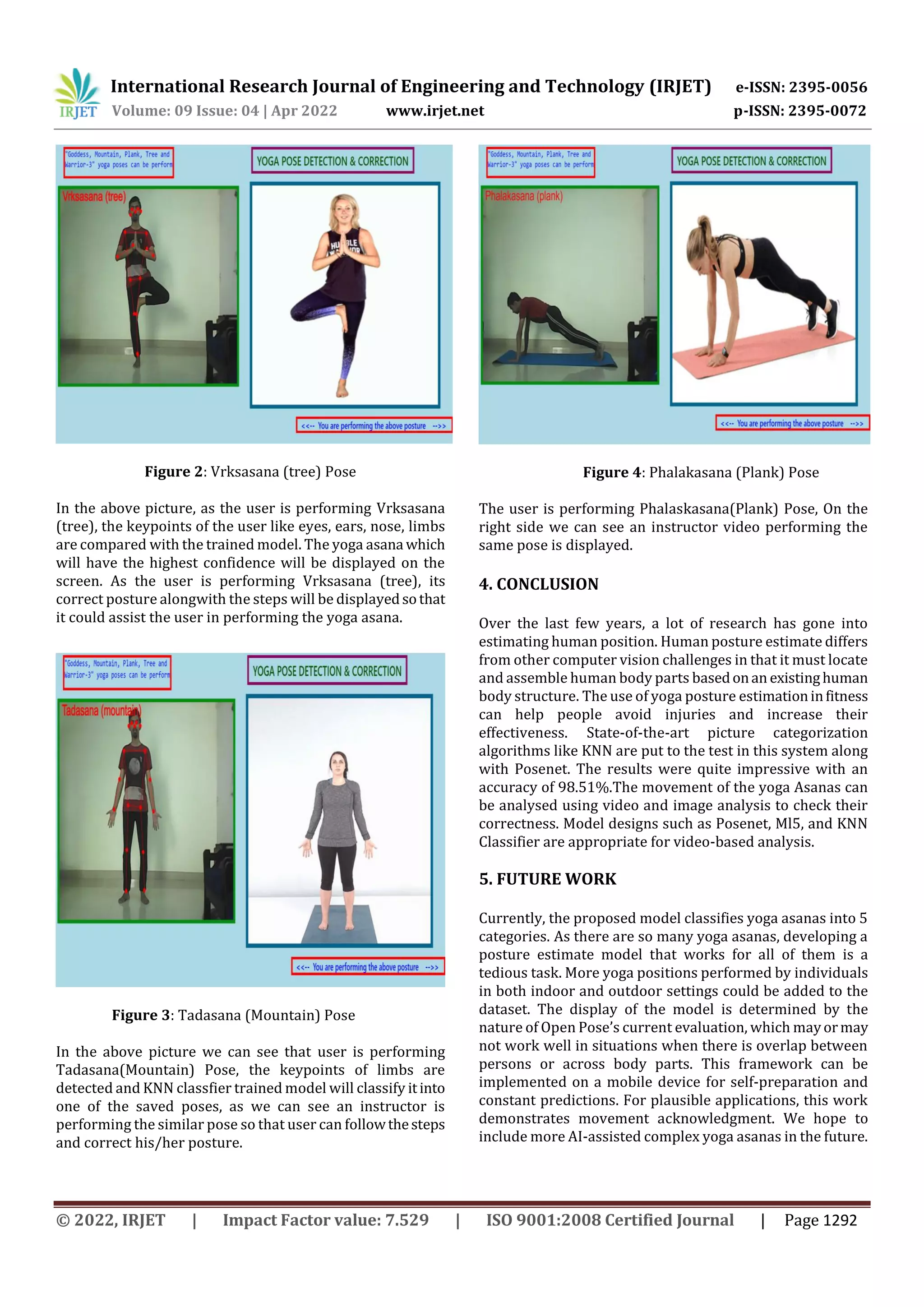
Figure 2: Vrksasana (tree) Pose
In the above picture, as the user is performing Vrksasana
(tree), the keypoints of the user like eyes, ears, nose, limbs
are compared with the trained model. The yoga asana which
will have the highest confidence will be displayed on the
screen. As the user is performing Vrksasana (tree), its
correct posture alongwith the steps will be displayedsothat
it could assist the user in performing the yoga asana.
Figure 3: Tadasana (Mountain) Pose
In the above picture we can see that user is performing
Tadasana(Mountain) Pose, the keypoints of limbs are
detected and KNN classfier trained model will classify itinto
one of the saved poses, as we can see an instructor is
performing the similar pose so that user can followthesteps
and correct his/her posture.
Figure 4: Phalakasana (Plank) Pose
The user is performing Phalaskasana(Plank) Pose, On the
right side we can see an instructor video performing the
same pose is displayed.
4. CONCLUSION
Over the last few years, a lot of research has gone into
estimating human position. Human posture estimate differs
from other computer vision challenges in that it must locate
and assemble human body parts basedonan existinghuman
body structure. The use of yoga posture estimationinfitness
can help people avoid injuries and increase their
effectiveness. State-of-the-art picture categorization
algorithms like KNN are put to the test in this system along
with Posenet. The results were quite impressive with an
accuracy of 98.51%.The movement of the yoga Asanas can
be analysed using video and image analysis to check their
correctness. Model designs such as Posenet, Ml5, and KNN
Classifier are appropriate for video-based analysis.
5. FUTURE WORK
Currently, the proposed model classifies yoga asanas into 5
categories. As there are so many yoga asanas, developing a
posture estimate model that works for all of them is a
tedious task. More yoga positions performed by individuals
in both indoor and outdoor settings could be added to the
dataset. The display of the model is determined by the
nature of Open Pose’s current evaluation, which mayormay
not work well in situations when there is overlap between
persons or across body parts. This framework can be
implemented on a mobile device for self-preparation and
constant predictions. For plausible applications, this work
demonstrates movement acknowledgment. We hope to
include more AI-assisted complex yoga asanas in the future.
International Research Journal of Engineering and Technology (IRJET) e-ISSN: 2395-0056
Volume: 09 Issue: 04 | Apr 2022 www.irjet.net p-ISSN: 2395-0072
© 2022, IRJET | Impact Factor value: 7.529 | ISO 9001:2008 Certified Journal | Page 1293
6. REFERENCES
[1] KNN classification [online], Available:
www.saedsayad.com/k_nearest_neighbors.htm
[2] Posenet - OpenPose [online], Available:
https://www.geeksforgeeks.org/posenetpose-
estimation/
[3] KNN classifier model [online], Available
https://www.Pyimagesearch.com/2016/08/08/k-nn-
classifier-for-image-classification/
[4] S. Patil, A. Pawar, A. Peshave, "Yoga tutor: visualization
and analysis using SURF algorithm". In: Proceedings of
2011 IEEE control system graduate research
colloquium, ICSGRC 2011.
[5] Santosh Kumar Yadav, Amitojdeep Singh, Abhishek
Gupta, Jagdish Lal Raheja, "Real-time Yoga recognition
using deep learning" (2019).
[6] W. Wu, W. Yin, F. Guo, “Learning and self-instruction
expert system for yoga”, Proc. Intl. Work Intelligent
System Application, 2010.
[7] H. -T. Chen, Yu-Zhen He, C. -L. Chou, S. -Y. Lee, B. -S. P.
Lin and J. -Y. Yu, "Computer-assistedself-trainingsystem
for sports exercise using kinects," 2013 IEEE
International Conference on Multimedia and Expo
Workshops (ICMEW), 2013, pp. 1-4, doi:
10.1109/ICMEW.2013.6618307.
[8] Shruti Kothari 2020 Yoga Pose ClassificationUsingDeep
Learning Ph.D. thesis SAN JOSE STATE UNIVERSITY.
[9] A. Chaudhari, O. Dalvi, O. Ramade and D. Ambawade,
"Yog-Guru: Real-Time Yoga Pose Correction System
Using Deep Learning Methods," 2021 International
Conference on Communication information and
Computing Technology (ICCICT), 2021, pp. 1-6, doi:
10.1109/ICCICT50803.2021.9509937.
[10] https://janmesh18.github.io/Yoga.github.io/ -Visitthis
website for reference and Project implementation

Yoga Pose Detection and Correction using Posenet and KNN

  • 1.
    International Research Journalof Engineering and Technology (IRJET) e-ISSN: 2395-0056 Volume: 09 Issue: 04 | Apr 2022 www.irjet.net p-ISSN: 2395-0072 © 2022, IRJET | Impact Factor value: 7.529 | ISO 9001:2008 Certified Journal | Page 1290 Yoga Pose Detection and Correction using Posenet and KNN Varsha Bhosale1, Pranjal Nandeshwar2, Abhishek Bale3, Janmesh Sankhe4 1Associate Professor, 2,3,4 Under-Graduate Student 1,2,3,4 Department of Information Technology, Vidyalankar Institute of Technology, Mumbai, India. ---------------------------------------------------------------------***--------------------------------------------------------------------- Abstract - The fundamental goal of Yoga pose detection and correction is to provide standard and correct yoga postures using computer vision. If the yoga postureisnot done properly, it can result in serious injuries and long-term issues. Analyzing human poses to detect and correct yoga poses can benefit humans living a healthier life in their homely environment. This project focuses on exploring the different approaches for yoga pose classification, so we are using PoseNet and KNN classifier. Using such deep learning algorithms, an individual can get the correct/ideal way/method to perform that specific yoga asana that he/she is trying to do. Using computer vision techniques and Open Pose (an open-source library), human pose estimation is used to estimate an individual's Yogaposture. Thesuggestedsystem recognises the difference between the actual and target positions and corrects the user with high accuracy by offering real-time visual output and necessary instructions to correct the identified pose. Key Words: KNN, Open Pose, Posenet, Pose Estimation, Crucial Angles. 1. INTRODUCTION Yoga, a centuries-old practice that is originally from India but is globally famous for its numerous spiritual, corporeal, and mental benefits, is a type of exercise with complex postures. The problem with yoga is that, like any other exercise, it is critical to practice it correctly because any incorrect position during a yoga session can be ineffectual and potentially inconvenient. This necessitatesthe presence of a trainer to supervise the meeting and correct the individual's stance. Since not every client approaches or has access to a trainer, a computerized reasoning-based application might be used to detect yoga poses and provide customized feedback to help people improvetheirstructure. As a result, we've proposed an artificial intelligence-based application that can recognise yoga stances and respond with a customised response to help users improve their postures. The purpose of this study is to gain a better knowledge of the many techniques used to classify yoga poses, including pose estimation, KNN classification [1], Posenet [2], and the KNN classifier model [3]. Lack of physical fitness increases the risk of adverse health conditions including coronary heart diseases, high blood pressure, stroke, metabolic syndrome,type2diabeteswhich leads to a decrease in the life expectancy of humans. In this work, pose estimation for the correction of yoga poses is implemented. Many pose detection systems areopensource which requires system setup andcamera. Thisisa basicyoga model that allows people to execute various yoga poses and adjust their yoga postures by looking at a reflected image. 2. LITERATURE SURVEY Deep learning is a promising area of research that allows us to examine large amounts of data in a scalable manner. Deep learning, unlike traditional machine learning models, does not require feature extraction or engineering since it understands complex patterns in data and extracts features on its own. Earlier work emphasized on the visual look of structures, which depict nature of human creation as a solid arrangement. Humans withskeletonsconnectingtheirbodily parts are employed to acquire knowledge into the human body. To assume that each body part is independent of the others, a preset kinematic body model is typically utilized. Extensive extensions have lately beencreated,suchasmixed, hierarchical, multimodal, and powerful appearance models, such as falling/sequential prediction. Each limb is represented by a layout that includes position, orientation, shape arrangement, and layout model. Patil et al. [4] suggested a technique for determining yoga posture discrepancies between an expert and a practitioner using picture contour information and speeded up robust features (SURF). However, characterizing and comparing postures nearly entirely on the basis of contour data is insufficient. A Yoga identification method utilizing a typical RGB camera was proposed by Santosh Kumar Yadav et al. [5]. Theyuseda high-definition webcam to acquire the data. UsingOpenPose, they scanned the user and discovered key points. The time- distributed CNN layer was used to recognize patterns between key points in a single frame, and the LSTM wasused to memorize the patterns discovered in recent frames. Their method eliminated the requirement for Kinect or any other specific technology to identify Yoga postures. Guo et al. [6] presented a picture and text-based intelligent systems for yoga training that includes inertial measuring units(IMUs)andtactors.However,thiscouldbeinconvenient forthe user, as well as disruptingthenaturalyogastance,and they failed to consider the practitioner's posture. [7] has described another technique for Kinect-based yoga pose correction that takes into account three yoga poses: warrior III, downward dog, and tree pose. However, their accuracy score is only 82.84 percent, which is not very impressive. Deep learning-based technologies have now supplanted the old skeletonization process.
  • 2.
    International Research Journalof Engineering and Technology (IRJET) e-ISSN: 2395-0056 Volume: 09 Issue: 04 | Apr 2022 www.irjet.net p-ISSN: 2395-0072 © 2022, IRJET | Impact Factor value: 7.529 | ISO 9001:2008 Certified Journal | Page 1291 Shruti Kothari [8] described a computational method for classifying Yoga poses from photos that uses deep learning, specifically CNN. For the classification model, they used a dataset of 1000 photos divided into six classes. This work was completed with nearly 85% correctness. Chaudhari et al. [9] built a system that provides clear feedback to the practitioner so that they can properly practise yoga postures using domain knowledge of five yoga positions. A CNN model was used to identify yoga positions, and a human-joint localizationmodelwasusedtofinddefects in the pose. 3. PROPOSED SYSTEM The dataset, which consists of a collection of nearly 400 distinct Images of each Yoga Pose. These Images are optimised to similar pixels and size, then blended to a single video. The Proposed Model will get trained using the output video which consist images of different poses where KNN classifier is used to detect the pose by detecting the key- points of the limbs of human and the model is saved. We are using webcam as input feed. Using webcam, we can get real- time Yoga Pose of the user and KNN classifier will identify significant points and will classify it into one of theYogaPose then we can see an instructor video performing the detected Yoga Pose. We can see the architecture diagram below Figure 1: Architecture diagram 3.1 KNN Classifier K-Nearest Neighbors is a Machine Learning algorithm that stores all different cases and classifies based on similarities. It is mostly used in Pattern Recognition technique. The KNN algorithm predicts the values of new data points based on 'feature similarity,' which implies that the new data point will be assigned a value depending onhowcloselyitmatches the points in the training set. Its operation is demonstrated using the procedures below: 1. A dataset is required for the implementation of any algorithm. As a result, the training and test data must be loaded during the first step of KNN. 2. The value of K, i.e. the data points closest to it. K can be any integer that is required to be selected. 3. Do the following for each point in the test data: i) Calculate the distance between each row of training data and the test data using one of the following methods: Euclidean, Manhattan, or Hamming distance. The Euclidean method is the most widely used method for calculating distance. ii) Sort them in ascending order depending on the distance value. iii) It then selects the top K rows from the sorted array. iv) The most frequent category of these rows will now be used to assign a category to the test point. 3.2 Dataset Dataset used for this are collected from Kaggle [11] and other open sources. It consists of images of 5 different yoga poses namely - Utkata Konasana (goddess), Tadasana (mountain), Phalakasana (plank), Vrksasana (tree), Virabhadrasana III (warrior 3). A total no. of 1578 Images are collected. 3.3 POSENET It is deep learning framework used to identify human poses in images and video sequences by identifying the critical points in human body and TrainingtheModel basedonthese key points. 3.4 Training Model An optimised video with all distinct yoga poses is created using python libraries such as TesnorFlow - Keras, OpenPose, NumPy. Now, The Deep learning framework will extract the key points from video sequence so that we can classify and train the model using a Frontend UI. Training Accuracy: 93.56% 3.5 Model Performance Using webcam, Model will extract the key points from the Yoga Pose performed by user. Depending upon the feed it will classify it to one of the trained Yoga Poses and then we can see a video of a Yoga Instructor performing the detected pose accurately so that user can learn and correct the posture accordingly. The results were promising with an accuracy rate of 98.51%.
  • 3.
    International Research Journalof Engineering and Technology (IRJET) e-ISSN: 2395-0056 Volume: 09 Issue: 04 | Apr 2022 www.irjet.net p-ISSN: 2395-0072 © 2022, IRJET | Impact Factor value: 7.529 | ISO 9001:2008 Certified Journal | Page 1292 Figure 2: Vrksasana (tree) Pose In the above picture, as the user is performing Vrksasana (tree), the keypoints of the user like eyes, ears, nose, limbs are compared with the trained model. The yoga asana which will have the highest confidence will be displayed on the screen. As the user is performing Vrksasana (tree), its correct posture alongwith the steps will be displayedsothat it could assist the user in performing the yoga asana. Figure 3: Tadasana (Mountain) Pose In the above picture we can see that user is performing Tadasana(Mountain) Pose, the keypoints of limbs are detected and KNN classfier trained model will classify itinto one of the saved poses, as we can see an instructor is performing the similar pose so that user can followthesteps and correct his/her posture. Figure 4: Phalakasana (Plank) Pose The user is performing Phalaskasana(Plank) Pose, On the right side we can see an instructor video performing the same pose is displayed. 4. CONCLUSION Over the last few years, a lot of research has gone into estimating human position. Human posture estimate differs from other computer vision challenges in that it must locate and assemble human body parts basedonan existinghuman body structure. The use of yoga posture estimationinfitness can help people avoid injuries and increase their effectiveness. State-of-the-art picture categorization algorithms like KNN are put to the test in this system along with Posenet. The results were quite impressive with an accuracy of 98.51%.The movement of the yoga Asanas can be analysed using video and image analysis to check their correctness. Model designs such as Posenet, Ml5, and KNN Classifier are appropriate for video-based analysis. 5. FUTURE WORK Currently, the proposed model classifies yoga asanas into 5 categories. As there are so many yoga asanas, developing a posture estimate model that works for all of them is a tedious task. More yoga positions performed by individuals in both indoor and outdoor settings could be added to the dataset. The display of the model is determined by the nature of Open Pose’s current evaluation, which mayormay not work well in situations when there is overlap between persons or across body parts. This framework can be implemented on a mobile device for self-preparation and constant predictions. For plausible applications, this work demonstrates movement acknowledgment. We hope to include more AI-assisted complex yoga asanas in the future.
  • 4.
    International Research Journalof Engineering and Technology (IRJET) e-ISSN: 2395-0056 Volume: 09 Issue: 04 | Apr 2022 www.irjet.net p-ISSN: 2395-0072 © 2022, IRJET | Impact Factor value: 7.529 | ISO 9001:2008 Certified Journal | Page 1293 6. REFERENCES [1] KNN classification [online], Available: www.saedsayad.com/k_nearest_neighbors.htm [2] Posenet - OpenPose [online], Available: https://www.geeksforgeeks.org/posenetpose- estimation/ [3] KNN classifier model [online], Available https://www.Pyimagesearch.com/2016/08/08/k-nn- classifier-for-image-classification/ [4] S. Patil, A. Pawar, A. Peshave, "Yoga tutor: visualization and analysis using SURF algorithm". In: Proceedings of 2011 IEEE control system graduate research colloquium, ICSGRC 2011. [5] Santosh Kumar Yadav, Amitojdeep Singh, Abhishek Gupta, Jagdish Lal Raheja, "Real-time Yoga recognition using deep learning" (2019). [6] W. Wu, W. Yin, F. Guo, “Learning and self-instruction expert system for yoga”, Proc. Intl. Work Intelligent System Application, 2010. [7] H. -T. Chen, Yu-Zhen He, C. -L. Chou, S. -Y. Lee, B. -S. P. Lin and J. -Y. Yu, "Computer-assistedself-trainingsystem for sports exercise using kinects," 2013 IEEE International Conference on Multimedia and Expo Workshops (ICMEW), 2013, pp. 1-4, doi: 10.1109/ICMEW.2013.6618307. [8] Shruti Kothari 2020 Yoga Pose ClassificationUsingDeep Learning Ph.D. thesis SAN JOSE STATE UNIVERSITY. [9] A. Chaudhari, O. Dalvi, O. Ramade and D. Ambawade, "Yog-Guru: Real-Time Yoga Pose Correction System Using Deep Learning Methods," 2021 International Conference on Communication information and Computing Technology (ICCICT), 2021, pp. 1-6, doi: 10.1109/ICCICT50803.2021.9509937. [10] https://janmesh18.github.io/Yoga.github.io/ -Visitthis website for reference and Project implementation