International Research Journal of Engineering and Technology (IRJET) e-ISSN: 2395-0056
Volume: 10 Issue: 03 | Mar 2023 www.irjet.net p-ISSN: 2395-0072
© 2023, IRJET | Impact Factor value: 8.226 | ISO 9001:2008 Certified Journal | Page 565
Study of AI Fitness Model Using Deep Learning
Ashwini Jadhav1, Nikita Sambari2, Pratiksha Shinde3, Lalita Borkar4, Samiksha Mohite5
1Assitant Professor, Dept. of Computer Engineering, Dr. D. Y. Patil Institute of Technology, Pimpri, Maharashtra,
India
12345UG Student, Dept. of Computer Engineering, Dr. D. Y. Patil Institute of Technology, Pimpri, Maharashtra, India
---------------------------------------------------------------------***---------------------------------------------------------------------
Abstract - In this era of booming technology, the application
of artificial intelligence and machine learning in everyday life
is rapidly increasing. Artificialintelligencehasbeenusedmuch
more frequently recently to detect and gauge human pose.
We're introducing "AI Fitness Genie," an app thattracksusers'
exercise poses, counts the required exercise repetitions, and
offers individualized, in-depth analysis about how to improve
users' body posture. It's a workout assistant and fitness guide
based on AI to guide people and to help them do the exercises
properly and keep them from chronic and immediate injuries.
This type of AI feature is similar to face recognition, butfor the
whole body. One of its applications is technology for
estimating human pose. Skeletonorcontourmodelling, aswell
as volume (3D body) modelling, are used to analyze the
position of the human body. We use the YOLO algorithm
because the aim of this project is to study several ways of
applying categorization. The estimate of human posture is
used to assess a person's yoga posture using computer vision
algorithms and Open Pose (an open-source framework).
Key Words: YOLO, Computer Vision, 3D, Estimation,
Guide, Exercises, Recognition
1. INTRODUCTION
Human Pose Estimation is the process of identifying and
pinpointing the essential parts of a human body in an image
or a video. The key points stand in for the joints and organs
of the human body, including the shoulders, elbows, wrists,
hips, knees, and ankles. The goal ofhumanposeestimationis
to accurately estimate the position of these key points in the
image or video frame, enabling the creation of a 3Dskeleton.
With the recent advancements in deep learning,
convolutional neural networks (CNN) have been proven to
be highly effective in solving complex computer vision
problems, including human pose estimation. Exercise is a
category of physical activity involving complicatedpostures.
It is a centuries-old practice with Indian origins but is now
practiced all over the world due to its multiple spiritual,
physical, and mental advantages. The issue with exercise is
that, like any exercise, it is essential to perform yoga poses
correctly because any wrong position might render the
workout ineffective and possibly uncomfortable. A trainer
must be there to oversee the meeting and improve the
person's posture because of this. Since not every client
approach or has access to a trainer, a computerized
reasoning-based application might be used to recognize
poses and provide individuals with tailoredfeedback tohelp
them improve their structure.
All things considered, human pose estimation isa significant
area of study that has the potential to change a number of
industries and enhance our daily lives.
The YOLO Algorithm is being used since the goal of this
study is to investigate various methods for classifying yoga
poses.
1.1 YOLO Algorithm
YOLO is a well-known object detectionalgorithmthatcarries
out object detection and localization in real-time using a
single convolutional neural network (CNN). Unlike other
object detection algorithms that use a sliding window
approach, YOLO divides an input image into a grid and
predicts bounding boxes and class probabilitiesforeachgrid
cell.
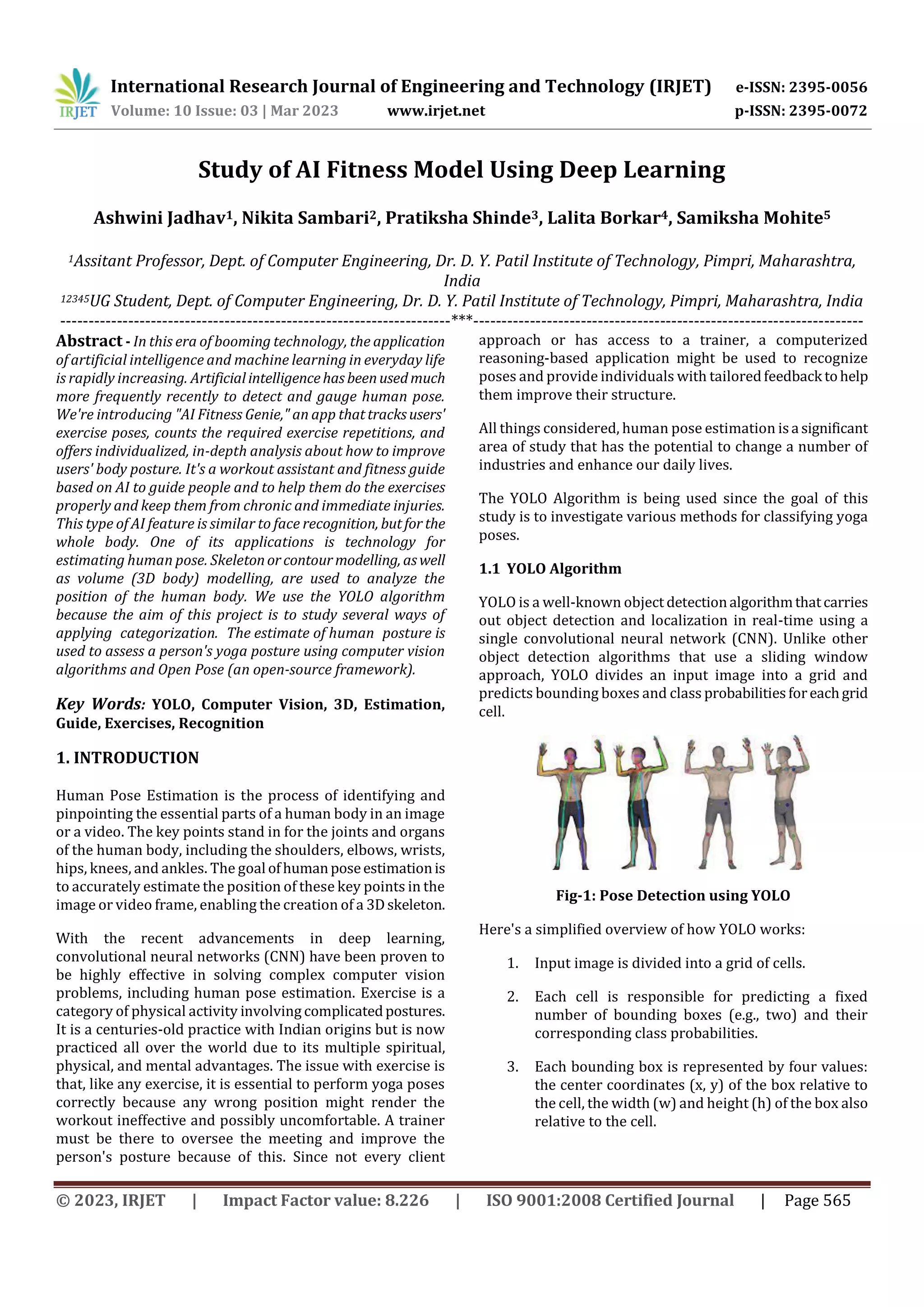
Fig-1: Pose Detection using YOLO
Here's a simplified overview of how YOLO works:
1. Input image is divided into a grid of cells.
2. Each cell is responsible for predicting a fixed
number of bounding boxes (e.g., two) and their
corresponding class probabilities.
3. Each bounding box is represented by four values:
the center coordinates (x, y) of the box relative to
the cell, the width (w) and height (h) of the box also
relative to the cell.
International Research Journal of Engineering and Technology (IRJET) e-ISSN: 2395-0056
Volume: 10 Issue: 03 | Mar 2023 www.irjet.net p-ISSN: 2395-0072
© 2023, IRJET | Impact Factor value: 8.226 | ISO 9001:2008 Certified Journal | Page 566
4. Each cell predicts the class probabilities for the
objects that may be present in the bounding boxes.
5. The final output is a set of bounding boxes and their
class probabilities that exceed a certain confidence
threshold.
The main advantage of YOLO is its speed, as it can perform
object detection and localization in real-time. However, it
can struggle with detectingsmall objectsorobjectswithhigh
aspect ratios due to its grid-based approach. Nonetheless,
YOLO has become a popular choice for various computer
vision applications, including autonomous driving,
surveillance, and robotics.
1.2. OpenPose
OpenPose is a popular computer vision framework for
human pose estimation, which can detect the key points or
joints of a human body from an image or video in real-time.
It uses a deep learning-based approach that combines
convolutional neural networks (CNNs) and graph-based
models to estimate the body key points.
Here's a simplified overview of how OpenPose works:
1. The input image or video frame is first fed into a
CNN, which extracts features from the image.
2. The output of the CNN is then fed into two
branches: one branch predicts the key points or
joints of the body, while the other predicts the
connections or limbs between the joints.
3. To predict the body key points, the model generates
a heatmap for each key point, which represents the
probability of the key point being present at each
pixel location in the image.
4. To predict the connections between the key points,
the model generates Part Affinity Fields (PAFs),
which represent the affinity or likelihood of a limb
connecting two key points.
5. The final step is to use a graph-based model to
combine the heatmaps and PAFs to estimate the
body pose.
OpenPose is capable of estimating the pose of multiple
people in complex scenes, as it can distinguish between
people based on their body shape and size. The framework
has a variety of applications, including human-computer
interaction, sports analysis, and health monitoring.
2. LITERATURE SURVEY
AI-based fitness models have gained significant attention in
recent years, due to their potential to improve the accuracy
and effectiveness of fitness programsandhealthmonitoring.
In this literature survey, we will provide a brief overview of
the existing literature on AI fitness models.
The AI fitness model is a machine learning approach that
utilizes data analysis and prediction algorithms to
personalize fitness programs based on the user's individual
goals, preferences, and physical characteristics. The model
can analyze large amounts of data and provide personalized
recommendations on exercise routines, nutrition plans, and
other health-related factors.
AI fitness models have a wide range of applications,
including personal fitness tracking, sports analytics, and
medical rehabilitation. These models can be integrated into
wearable devices, mobile apps, and other health monitoring
systems, allowing users to monitor their progress and
receive real-time feedback on their performance.
Despite the potential benefits, there are several challenges
associated with developing and implementing AI fitness
models. These include the need for large and diverse
datasets for training and evaluation, the risk of privacy and
security breaches, and the potential forbiasanderrorsinthe
AI algorithms.
Future research in AI fitness models should focus on
developing more accurate and personalized modelsthatcan
adapt to the user's changing needs and goals. This may
involve exploring new data sources and machine learning
techniques, as well as addressing the ethical and social
implications of these technologies. Additionally, research
should investigate ways to integrate AI fitness models into
existing healthcare systems and promote their adoption
among users.
3. METHODOLOGY
We introduce "AI Fitness Genie", an application that detects
the users exercise pose counts the specified exercise
repetitions and provides personalized, detailed analysis
about improving the users body posture.
This system takes textual datasets as input. We utilize
modules for preprocessing, feature extraction, and
classification that all use our LR algorithm since we are
aware that we are processing data and training a dataset on
the system. So, the dataset was first input as a textual
dataset, after which it was cleaned up and the raw data was
removed. The system then extracted the parameters or
characteristics of thedatasetinthe extractionportion.Giving
these geometry-based characteristics from the yoga dataset
to the classification process, which usesourYOLOAlgorithm
to detect the correctness of the user poses and complete the
session for specified time given. It analyzes the human
body’s position with skeleton or contours modeling
International Research Journal of Engineering and Technology (IRJET) e-ISSN: 2395-0056
Volume: 10 Issue: 03 | Mar 2023 www.irjet.net p-ISSN: 2395-0072
© 2023, IRJET | Impact Factor value: 8.226 | ISO 9001:2008 Certified Journal | Page 567
Using webcam, Model will extract the key points from the
Yoga Pose performed by user. The system will provide 3D
models performing different poses to detect the user’s pose
accurately so that user can learn and correct the posture
accordingly. The results were promising with an accuracy
rate of 98.51%.
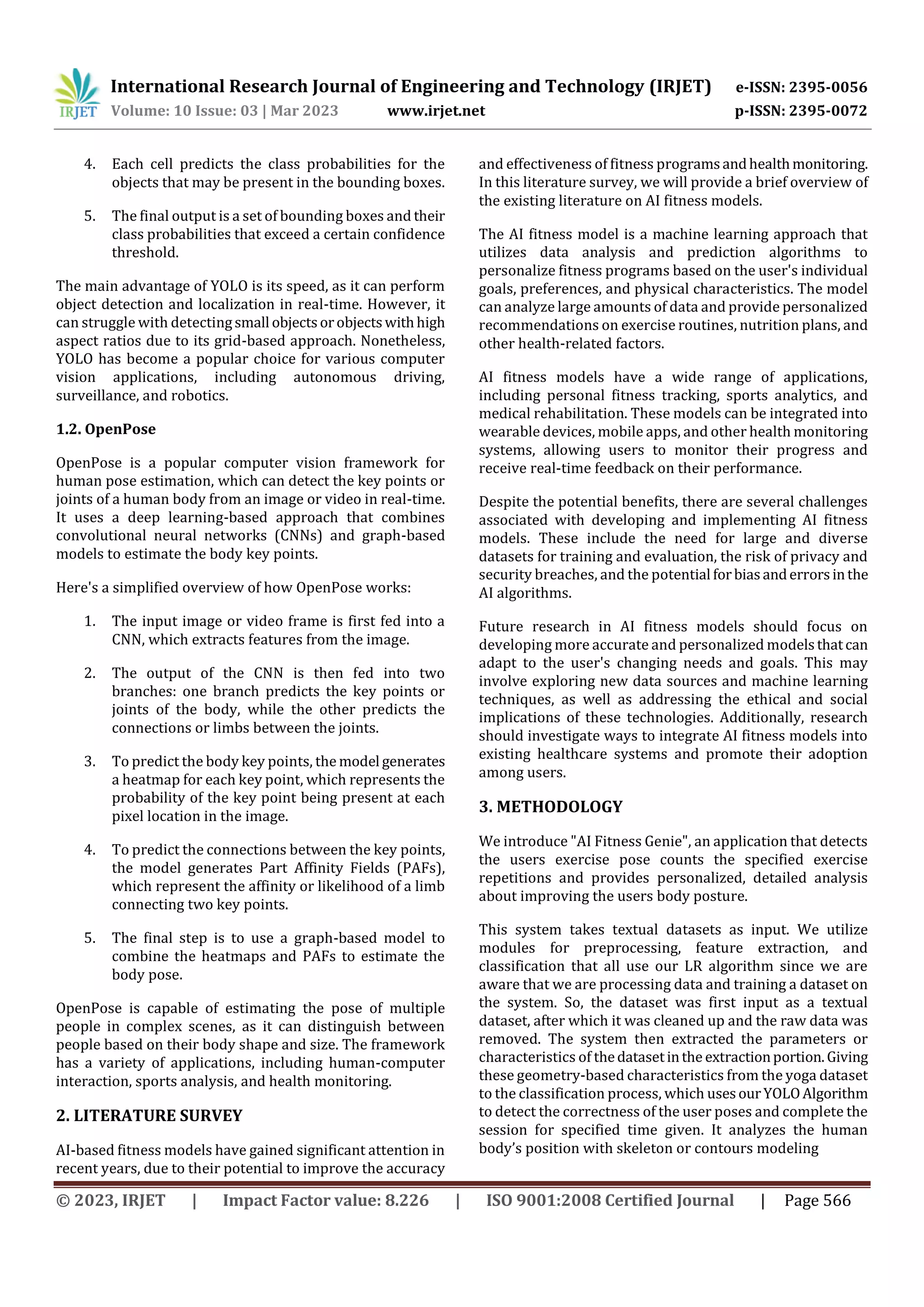
Following is the Flow Diagram for detection of Human Pose.
Fig-2. Flow diagram of AI Fitness Genie
2.1 SYSTEM ARCHITECTURE
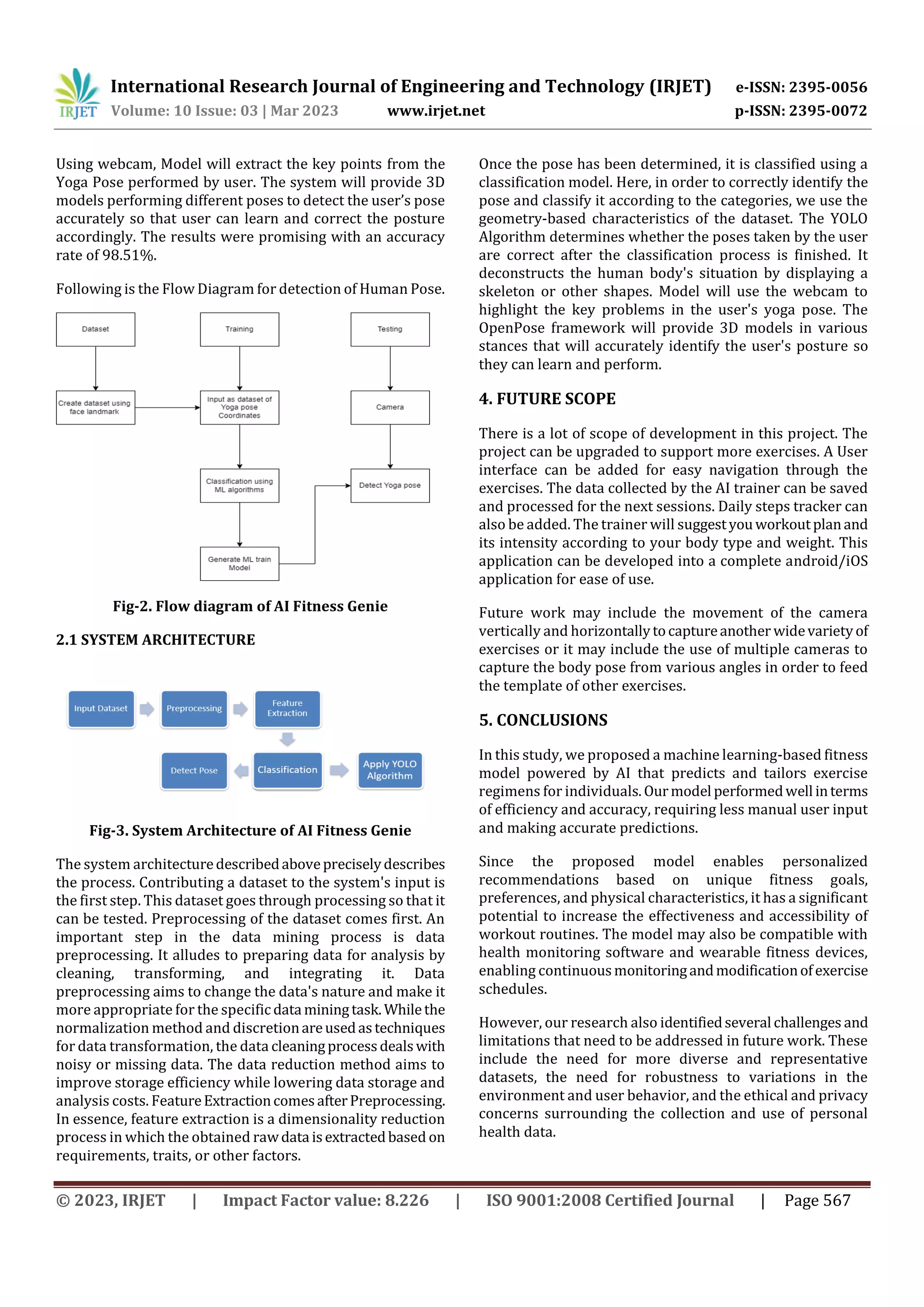
Fig-3. System Architecture of AI Fitness Genie
The system architecturedescribedabovepreciselydescribes
the process. Contributing a dataset to the system's input is
the first step. This dataset goes through processing so that it
can be tested. Preprocessing of the dataset comes first. An
important step in the data mining process is data
preprocessing. It alludes to preparing data for analysis by
cleaning, transforming, and integrating it. Data
preprocessing aims to change the data's nature and make it
more appropriate for the specificdata miningtask.Whilethe
normalization method and discretionareusedastechniques
for data transformation, the data cleaningprocessdealswith
noisy or missing data. The data reduction method aims to
improve storage efficiency while lowering data storage and
analysis costs. FeatureExtractioncomesafterPreprocessing.
In essence, feature extraction is a dimensionality reduction
process in which the obtained rawdata isextractedbased on
requirements, traits, or other factors.
Once the pose has been determined, it is classified using a
classification model. Here, in order to correctly identify the
pose and classify it according to the categories, we use the
geometry-based characteristics of the dataset. The YOLO
Algorithm determines whether the poses taken by the user
are correct after the classification process is finished. It
deconstructs the human body's situation by displaying a
skeleton or other shapes. Model will use the webcam to
highlight the key problems in the user's yoga pose. The
OpenPose framework will provide 3D models in various
stances that will accurately identify the user's posture so
they can learn and perform.
4. FUTURE SCOPE
There is a lot of scope of development in this project. The
project can be upgraded to support more exercises. A User
interface can be added for easy navigation through the
exercises. The data collected by the AI trainer can be saved
and processed for the next sessions. Daily steps tracker can
also be added. The trainer will suggestyouworkoutplanand
its intensity according to your body type and weight. This
application can be developed into a complete android/iOS
application for ease of use.
Future work may include the movement of the camera
vertically and horizontallytocaptureanother widevarietyof
exercises or it may include the use of multiple cameras to
capture the body pose from various angles in order to feed
the template of other exercises.
5. CONCLUSIONS
In this study, we proposed a machine learning-based fitness
model powered by AI that predicts and tailors exercise
regimens for individuals.Ourmodel performedwell interms
of efficiency and accuracy, requiring less manual user input
and making accurate predictions.
Since the proposed model enables personalized
recommendations based on unique fitness goals,
preferences, and physical characteristics, it has a significant
potential to increase the effectiveness and accessibility of
workout routines. The model may also be compatible with
health monitoring software and wearable fitness devices,
enabling continuousmonitoringandmodificationofexercise
schedules.
However, our research also identifiedseveral challenges and
limitations that need to be addressed in future work. These
include the need for more diverse and representative
datasets, the need for robustness to variations in the
environment and user behavior, and the ethical and privacy
concerns surrounding the collection and use of personal
health data.
International Research Journal of Engineering and Technology (IRJET) e-ISSN: 2395-0056
Volume: 10 Issue: 03 | Mar 2023 www.irjet.net p-ISSN: 2395-0072
© 2023, IRJET | Impact Factor value: 8.226 | ISO 9001:2008 Certified Journal | Page 568
REFERENCES
[1] V. Akuhota and S. F. Nedler, ”Core Strengthening,”
American Academy of Physical Medicine andRehabilitation,
2004.
[2] R. Szeliski, ”Computer Vision: Algorithms and
Applications,” Springer, 2010.
[3] G. Bradski and A. Kaehler, ”Learning OpenCV,” O’Reilly,
2008.
[4] Z. Cao, T. Simon, S.-E. Wei and Y. Sheikh, ”Realtime Multi-
Person 2D Pose Estimation using Part Affinity Fields,” The
Robotics Institute, Carnegie Mellon University, 2017.
[5] P. Ganesh, ”Human Pose Estimation : Simplified,”
Towards Data Science, 26 March 2019. [Online]. Available:
https://towardsdatascience.com/humanpose- estimation-
simplified6cfd88542ab3. [Accessed 3 April 2020].

Study of AI Fitness Model Using Deep Learning

  • 1.
    International Research Journalof Engineering and Technology (IRJET) e-ISSN: 2395-0056 Volume: 10 Issue: 03 | Mar 2023 www.irjet.net p-ISSN: 2395-0072 © 2023, IRJET | Impact Factor value: 8.226 | ISO 9001:2008 Certified Journal | Page 565 Study of AI Fitness Model Using Deep Learning Ashwini Jadhav1, Nikita Sambari2, Pratiksha Shinde3, Lalita Borkar4, Samiksha Mohite5 1Assitant Professor, Dept. of Computer Engineering, Dr. D. Y. Patil Institute of Technology, Pimpri, Maharashtra, India 12345UG Student, Dept. of Computer Engineering, Dr. D. Y. Patil Institute of Technology, Pimpri, Maharashtra, India ---------------------------------------------------------------------***--------------------------------------------------------------------- Abstract - In this era of booming technology, the application of artificial intelligence and machine learning in everyday life is rapidly increasing. Artificialintelligencehasbeenusedmuch more frequently recently to detect and gauge human pose. We're introducing "AI Fitness Genie," an app thattracksusers' exercise poses, counts the required exercise repetitions, and offers individualized, in-depth analysis about how to improve users' body posture. It's a workout assistant and fitness guide based on AI to guide people and to help them do the exercises properly and keep them from chronic and immediate injuries. This type of AI feature is similar to face recognition, butfor the whole body. One of its applications is technology for estimating human pose. Skeletonorcontourmodelling, aswell as volume (3D body) modelling, are used to analyze the position of the human body. We use the YOLO algorithm because the aim of this project is to study several ways of applying categorization. The estimate of human posture is used to assess a person's yoga posture using computer vision algorithms and Open Pose (an open-source framework). Key Words: YOLO, Computer Vision, 3D, Estimation, Guide, Exercises, Recognition 1. INTRODUCTION Human Pose Estimation is the process of identifying and pinpointing the essential parts of a human body in an image or a video. The key points stand in for the joints and organs of the human body, including the shoulders, elbows, wrists, hips, knees, and ankles. The goal ofhumanposeestimationis to accurately estimate the position of these key points in the image or video frame, enabling the creation of a 3Dskeleton. With the recent advancements in deep learning, convolutional neural networks (CNN) have been proven to be highly effective in solving complex computer vision problems, including human pose estimation. Exercise is a category of physical activity involving complicatedpostures. It is a centuries-old practice with Indian origins but is now practiced all over the world due to its multiple spiritual, physical, and mental advantages. The issue with exercise is that, like any exercise, it is essential to perform yoga poses correctly because any wrong position might render the workout ineffective and possibly uncomfortable. A trainer must be there to oversee the meeting and improve the person's posture because of this. Since not every client approach or has access to a trainer, a computerized reasoning-based application might be used to recognize poses and provide individuals with tailoredfeedback tohelp them improve their structure. All things considered, human pose estimation isa significant area of study that has the potential to change a number of industries and enhance our daily lives. The YOLO Algorithm is being used since the goal of this study is to investigate various methods for classifying yoga poses. 1.1 YOLO Algorithm YOLO is a well-known object detectionalgorithmthatcarries out object detection and localization in real-time using a single convolutional neural network (CNN). Unlike other object detection algorithms that use a sliding window approach, YOLO divides an input image into a grid and predicts bounding boxes and class probabilitiesforeachgrid cell. Fig-1: Pose Detection using YOLO Here's a simplified overview of how YOLO works: 1. Input image is divided into a grid of cells. 2. Each cell is responsible for predicting a fixed number of bounding boxes (e.g., two) and their corresponding class probabilities. 3. Each bounding box is represented by four values: the center coordinates (x, y) of the box relative to the cell, the width (w) and height (h) of the box also relative to the cell.
  • 2.
    International Research Journalof Engineering and Technology (IRJET) e-ISSN: 2395-0056 Volume: 10 Issue: 03 | Mar 2023 www.irjet.net p-ISSN: 2395-0072 © 2023, IRJET | Impact Factor value: 8.226 | ISO 9001:2008 Certified Journal | Page 566 4. Each cell predicts the class probabilities for the objects that may be present in the bounding boxes. 5. The final output is a set of bounding boxes and their class probabilities that exceed a certain confidence threshold. The main advantage of YOLO is its speed, as it can perform object detection and localization in real-time. However, it can struggle with detectingsmall objectsorobjectswithhigh aspect ratios due to its grid-based approach. Nonetheless, YOLO has become a popular choice for various computer vision applications, including autonomous driving, surveillance, and robotics. 1.2. OpenPose OpenPose is a popular computer vision framework for human pose estimation, which can detect the key points or joints of a human body from an image or video in real-time. It uses a deep learning-based approach that combines convolutional neural networks (CNNs) and graph-based models to estimate the body key points. Here's a simplified overview of how OpenPose works: 1. The input image or video frame is first fed into a CNN, which extracts features from the image. 2. The output of the CNN is then fed into two branches: one branch predicts the key points or joints of the body, while the other predicts the connections or limbs between the joints. 3. To predict the body key points, the model generates a heatmap for each key point, which represents the probability of the key point being present at each pixel location in the image. 4. To predict the connections between the key points, the model generates Part Affinity Fields (PAFs), which represent the affinity or likelihood of a limb connecting two key points. 5. The final step is to use a graph-based model to combine the heatmaps and PAFs to estimate the body pose. OpenPose is capable of estimating the pose of multiple people in complex scenes, as it can distinguish between people based on their body shape and size. The framework has a variety of applications, including human-computer interaction, sports analysis, and health monitoring. 2. LITERATURE SURVEY AI-based fitness models have gained significant attention in recent years, due to their potential to improve the accuracy and effectiveness of fitness programsandhealthmonitoring. In this literature survey, we will provide a brief overview of the existing literature on AI fitness models. The AI fitness model is a machine learning approach that utilizes data analysis and prediction algorithms to personalize fitness programs based on the user's individual goals, preferences, and physical characteristics. The model can analyze large amounts of data and provide personalized recommendations on exercise routines, nutrition plans, and other health-related factors. AI fitness models have a wide range of applications, including personal fitness tracking, sports analytics, and medical rehabilitation. These models can be integrated into wearable devices, mobile apps, and other health monitoring systems, allowing users to monitor their progress and receive real-time feedback on their performance. Despite the potential benefits, there are several challenges associated with developing and implementing AI fitness models. These include the need for large and diverse datasets for training and evaluation, the risk of privacy and security breaches, and the potential forbiasanderrorsinthe AI algorithms. Future research in AI fitness models should focus on developing more accurate and personalized modelsthatcan adapt to the user's changing needs and goals. This may involve exploring new data sources and machine learning techniques, as well as addressing the ethical and social implications of these technologies. Additionally, research should investigate ways to integrate AI fitness models into existing healthcare systems and promote their adoption among users. 3. METHODOLOGY We introduce "AI Fitness Genie", an application that detects the users exercise pose counts the specified exercise repetitions and provides personalized, detailed analysis about improving the users body posture. This system takes textual datasets as input. We utilize modules for preprocessing, feature extraction, and classification that all use our LR algorithm since we are aware that we are processing data and training a dataset on the system. So, the dataset was first input as a textual dataset, after which it was cleaned up and the raw data was removed. The system then extracted the parameters or characteristics of thedatasetinthe extractionportion.Giving these geometry-based characteristics from the yoga dataset to the classification process, which usesourYOLOAlgorithm to detect the correctness of the user poses and complete the session for specified time given. It analyzes the human body’s position with skeleton or contours modeling
  • 3.
    International Research Journalof Engineering and Technology (IRJET) e-ISSN: 2395-0056 Volume: 10 Issue: 03 | Mar 2023 www.irjet.net p-ISSN: 2395-0072 © 2023, IRJET | Impact Factor value: 8.226 | ISO 9001:2008 Certified Journal | Page 567 Using webcam, Model will extract the key points from the Yoga Pose performed by user. The system will provide 3D models performing different poses to detect the user’s pose accurately so that user can learn and correct the posture accordingly. The results were promising with an accuracy rate of 98.51%. Following is the Flow Diagram for detection of Human Pose. Fig-2. Flow diagram of AI Fitness Genie 2.1 SYSTEM ARCHITECTURE Fig-3. System Architecture of AI Fitness Genie The system architecturedescribedabovepreciselydescribes the process. Contributing a dataset to the system's input is the first step. This dataset goes through processing so that it can be tested. Preprocessing of the dataset comes first. An important step in the data mining process is data preprocessing. It alludes to preparing data for analysis by cleaning, transforming, and integrating it. Data preprocessing aims to change the data's nature and make it more appropriate for the specificdata miningtask.Whilethe normalization method and discretionareusedastechniques for data transformation, the data cleaningprocessdealswith noisy or missing data. The data reduction method aims to improve storage efficiency while lowering data storage and analysis costs. FeatureExtractioncomesafterPreprocessing. In essence, feature extraction is a dimensionality reduction process in which the obtained rawdata isextractedbased on requirements, traits, or other factors. Once the pose has been determined, it is classified using a classification model. Here, in order to correctly identify the pose and classify it according to the categories, we use the geometry-based characteristics of the dataset. The YOLO Algorithm determines whether the poses taken by the user are correct after the classification process is finished. It deconstructs the human body's situation by displaying a skeleton or other shapes. Model will use the webcam to highlight the key problems in the user's yoga pose. The OpenPose framework will provide 3D models in various stances that will accurately identify the user's posture so they can learn and perform. 4. FUTURE SCOPE There is a lot of scope of development in this project. The project can be upgraded to support more exercises. A User interface can be added for easy navigation through the exercises. The data collected by the AI trainer can be saved and processed for the next sessions. Daily steps tracker can also be added. The trainer will suggestyouworkoutplanand its intensity according to your body type and weight. This application can be developed into a complete android/iOS application for ease of use. Future work may include the movement of the camera vertically and horizontallytocaptureanother widevarietyof exercises or it may include the use of multiple cameras to capture the body pose from various angles in order to feed the template of other exercises. 5. CONCLUSIONS In this study, we proposed a machine learning-based fitness model powered by AI that predicts and tailors exercise regimens for individuals.Ourmodel performedwell interms of efficiency and accuracy, requiring less manual user input and making accurate predictions. Since the proposed model enables personalized recommendations based on unique fitness goals, preferences, and physical characteristics, it has a significant potential to increase the effectiveness and accessibility of workout routines. The model may also be compatible with health monitoring software and wearable fitness devices, enabling continuousmonitoringandmodificationofexercise schedules. However, our research also identifiedseveral challenges and limitations that need to be addressed in future work. These include the need for more diverse and representative datasets, the need for robustness to variations in the environment and user behavior, and the ethical and privacy concerns surrounding the collection and use of personal health data.
  • 4.
    International Research Journalof Engineering and Technology (IRJET) e-ISSN: 2395-0056 Volume: 10 Issue: 03 | Mar 2023 www.irjet.net p-ISSN: 2395-0072 © 2023, IRJET | Impact Factor value: 8.226 | ISO 9001:2008 Certified Journal | Page 568 REFERENCES [1] V. Akuhota and S. F. Nedler, ”Core Strengthening,” American Academy of Physical Medicine andRehabilitation, 2004. [2] R. Szeliski, ”Computer Vision: Algorithms and Applications,” Springer, 2010. [3] G. Bradski and A. Kaehler, ”Learning OpenCV,” O’Reilly, 2008. [4] Z. Cao, T. Simon, S.-E. Wei and Y. Sheikh, ”Realtime Multi- Person 2D Pose Estimation using Part Affinity Fields,” The Robotics Institute, Carnegie Mellon University, 2017. [5] P. Ganesh, ”Human Pose Estimation : Simplified,” Towards Data Science, 26 March 2019. [Online]. Available: https://towardsdatascience.com/humanpose- estimation- simplified6cfd88542ab3. [Accessed 3 April 2020].