The document presents Diffusemorph, an unsupervised image registration model utilizing diffusion models to estimate non-rigid voxel correspondences for medical images. It highlights the advantages of this new approach over classical and supervised methods, emphasizing its ability to generate high-quality image registrations without the need for labeled data. Experimental results demonstrate its effectiveness across various medical imaging datasets, suggesting significant improvements in registration accuracy.
![DiffuseMorph: Unsupervised Deformable Image Registration Using Diffusion Model
Research objectives
Deformable image registration
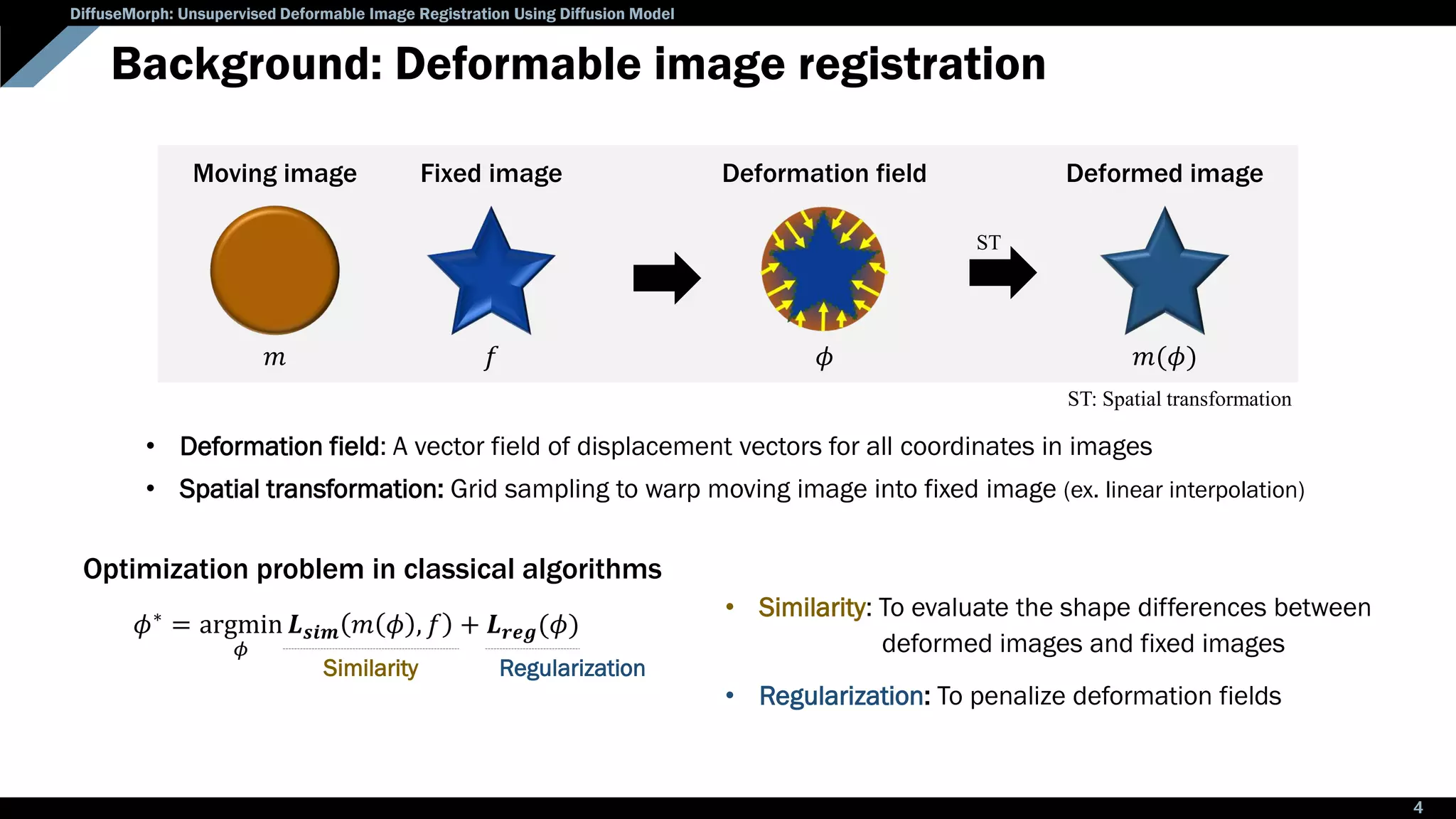
• To estimate non-rigid voxel correspondences between moving & fixed images
• Important for medical image analysis (ex. disease diagnosis)
Multiphase abdominal CT
PET MRI
Types Advantage Limitation
Classical iterative method High topology preservation Substantial time, high computational cost
Supervised learning No parameter tuning Depending on the ground-truth fields
Unsupervised learning No parameter tuning + No labels Potential for folding problem on the fields
[1] Du, Juan, et al., International Journal of Computer Mathematics, 2006.
2](https://image.slidesharecdn.com/2022eccvpresentationboahkim-221020115535-71fbd71b/75/DiffuseMorph-Unsupervised-Deformable-Image-Registration-Using-Diffusion-Model-2-2048.jpg)
![DiffuseMorph: Unsupervised Deformable Image Registration Using Diffusion Model
Research objectives
Deformable image registration
• To estimate non-rigid voxel correspondences between moving & fixed images
• Important for medical image analysis (ex. disease diagnosis)
Multiphase abdominal CT
PET MRI
• To perform image registration along the continuous trajectory
• To apply the denoising diffusion probabilistic model to image registration
Research goal
[1] Du, Juan, et al., International Journal of Computer Mathematics, 2006.
3](https://image.slidesharecdn.com/2022eccvpresentationboahkim-221020115535-71fbd71b/75/DiffuseMorph-Unsupervised-Deformable-Image-Registration-Using-Diffusion-Model-3-2048.jpg)
![DiffuseMorph: Unsupervised Deformable Image Registration Using Diffusion Model
Background: Denoising diffusion probabilistic model (DDPM)
[1] Jonathan Ho et al., NeurIPS 2020.
• To convert a data distribution to Gaussian noise
Forward diffusion process (𝒙𝟎 → 𝒙𝑻)
Gaussian transition for each target data 𝒙0:
⇒ 𝑝 𝒙𝑡 𝒙0 = 𝒩 𝒙𝑡; 𝛼𝑡𝒙0, 1 − 𝛼𝑡 𝑰
where 𝛼𝑡 = ς𝑠=1
𝑡
(1 − 𝛽𝑠)
𝑝 𝒙𝑡 𝒙𝑡−1 = 𝒩(𝒙𝑡; 1 − 𝛽𝑡𝒙𝑡−1, 𝛽𝑡𝑰)
• To sample image from Gaussian noise
Reverse generative process (𝒙𝑻 → 𝒙𝟎)
Parameterized Gaussian process:
𝑝𝜃 𝒙𝑡−1 𝒙𝑡 = 𝒩 𝒙𝑡−1; 𝜇𝜃 𝒙𝑡, 𝑡 , 𝜎𝑡
2
𝑰
𝒙𝑁~𝒩(0, 𝑰)
𝒙𝑡−1 =
1
1−𝛽𝑡
𝒙𝑡 −
𝛽𝑡
1−𝛼𝑡
𝝐𝜃 𝒙𝑡, 𝑡 + 𝜎𝑡𝒛
Generation for 𝑡 = 𝑁, 𝑁 − 1, … , 1:
Parameterized model
Image perturbation: 𝒙𝑡 = 𝛼𝑡𝒙0 + 1 − 𝛼𝑡𝝐
5](https://image.slidesharecdn.com/2022eccvpresentationboahkim-221020115535-71fbd71b/75/DiffuseMorph-Unsupervised-Deformable-Image-Registration-Using-Diffusion-Model-5-2048.jpg)
![DiffuseMorph: Unsupervised Deformable Image Registration Using Diffusion Model
Experiment 1
Intra-subject 2D face image registration
[1] Balakrishnan, G. et al., CVPR 2018. [2] Dalca, A.V. MICCAI 2018.
8
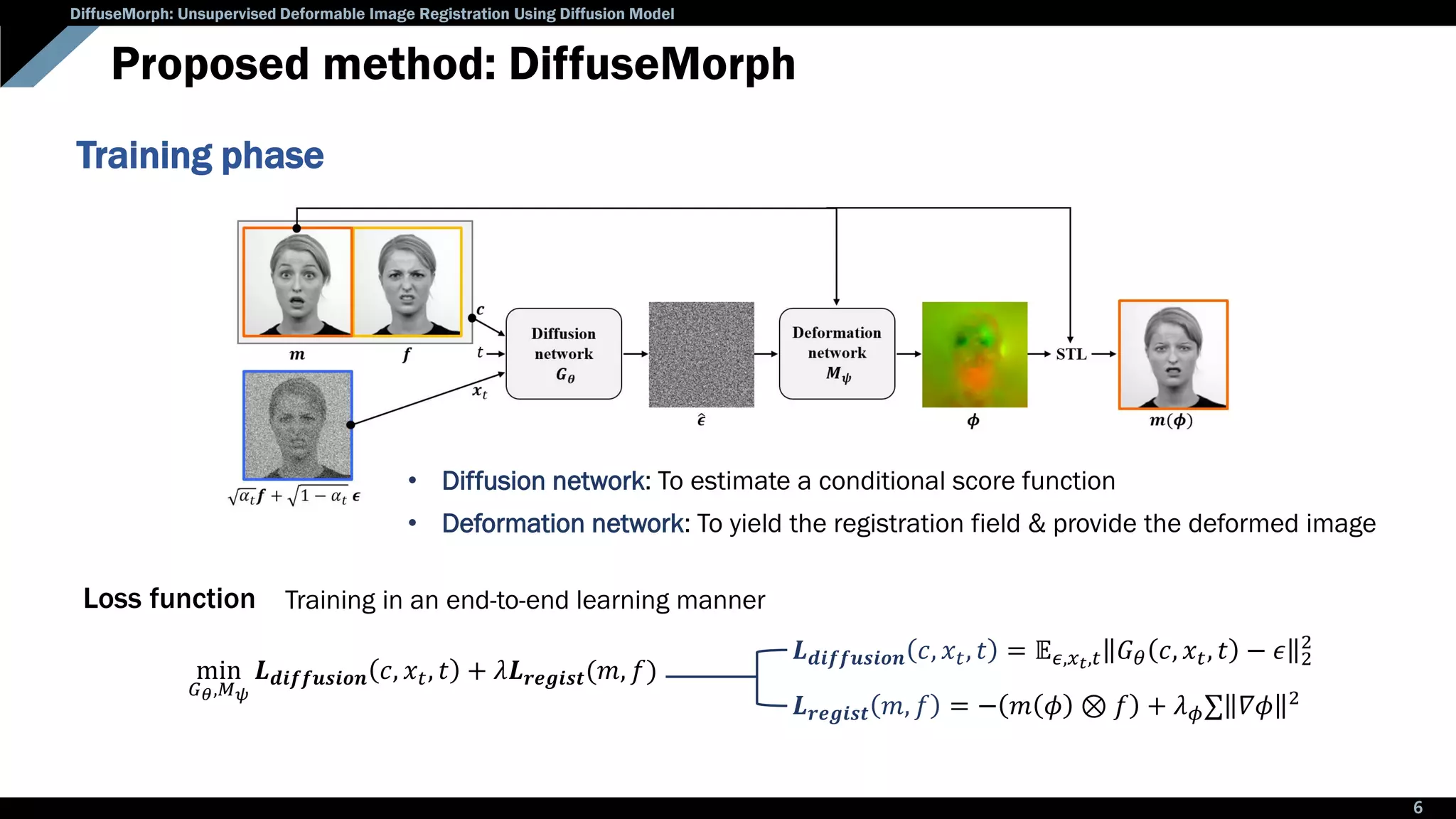
Methods NMSE x10−1
SSIM 𝐽𝜙 ≤ 0 (%)
Initial 0.363 (0.268) 0.823 (0.066) -
VM [1] 0.047 (0.057) 0.936 (0.024) 0.050 (0.106)
VM-diff [2] 0.034 (0.015) 0.957 (0.013) 0.014 (0.065)
Ours 0.032 (0.017) 0.964 (0.011) 0.017 (0.056)
• RaFD dataset (3 different gazed 8 expressions / Input size = 128x128)
• Training : Validation: Test = 53 : 7 : 7 (subjects)](https://image.slidesharecdn.com/2022eccvpresentationboahkim-221020115535-71fbd71b/75/DiffuseMorph-Unsupervised-Deformable-Image-Registration-Using-Diffusion-Model-8-2048.jpg)
![DiffuseMorph: Unsupervised Deformable Image Registration Using Diffusion Model
Experiment 2
Intra-subject 3D cardiac MR image registration
[1] Balakrishnan, G. et al., CVPR 2018. [2] Dalca, A.V. MICCAI 2018.
9
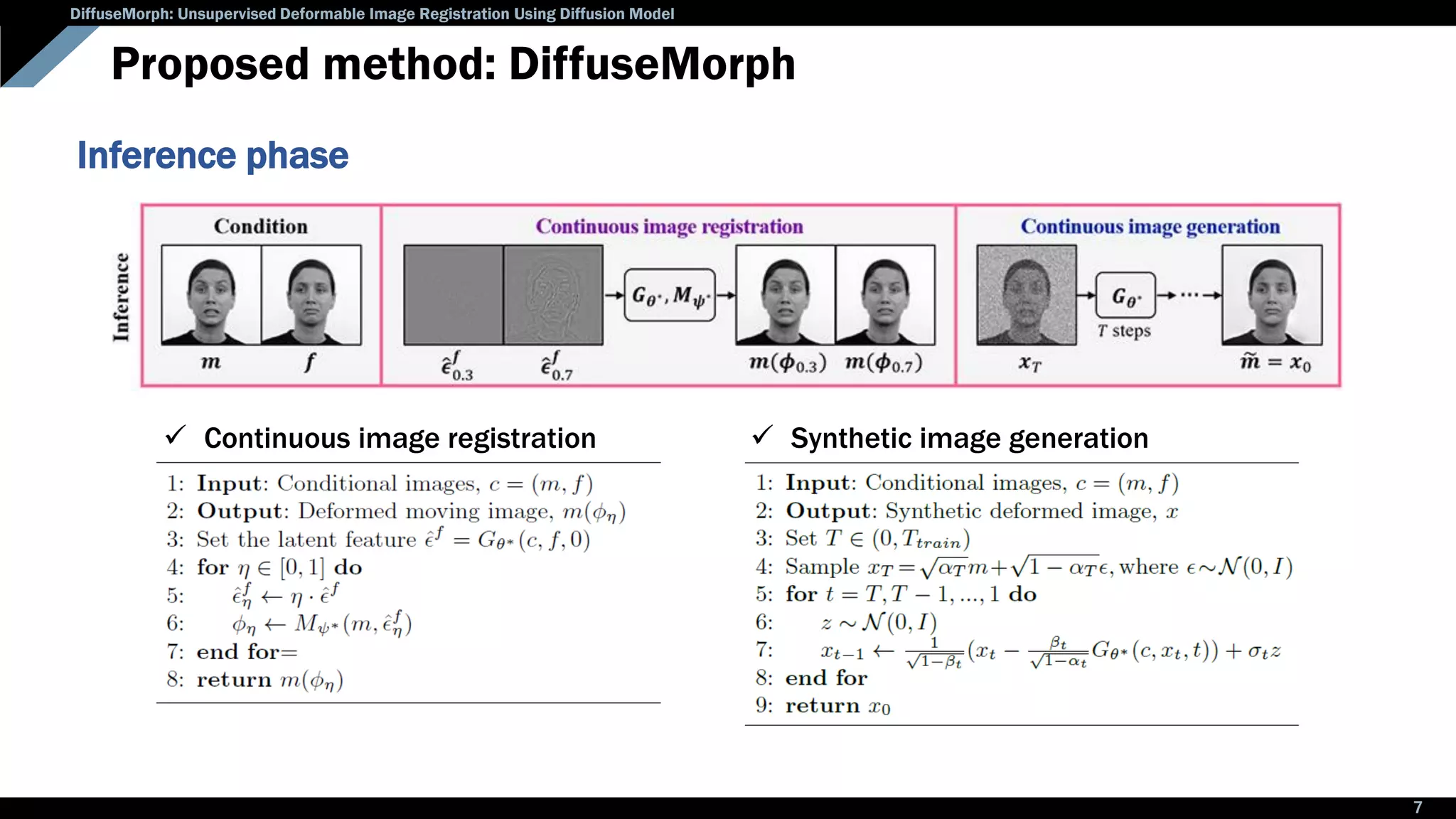
Methods Dice 𝐽𝜙 ≤ 0 (%)
Initial 0.642 (0.188) -
VM [1] 0.787 (0.113) 0.169 (0.109)
VM-diff [2] 0.794 (0.104) 0.291 (0.188)
Ours 0.802 (0.109) 0.161 (0.082)
• ACDC dataset (4D temporal cardiac MRI data/ input size = 128×128×32)
• Training : Test = 90 : 10 (scans)](https://image.slidesharecdn.com/2022eccvpresentationboahkim-221020115535-71fbd71b/75/DiffuseMorph-Unsupervised-Deformable-Image-Registration-Using-Diffusion-Model-9-2048.jpg)
![DiffuseMorph: Unsupervised Deformable Image Registration Using Diffusion Model
Experiment 3
Atlas-based 3D Brain MR Image Registration
10
Methods Dice 𝐽𝜙 ≤ 0 (%) Time (min)
Initial 0.616 (0.171) - -
SyN [1] 0.752 (0.140) 0.400 (0.100) 122, CPU
VM [2] 0.749 (0.145) 0.553 (0.075) 0.01, GPU
VM-diff [3] 0.731 (0.139) 0.631 (0.073) 0.01, GPU
SYMNet [4] 0.733 (0.148) 0.547 (0.049) 0.43, GPU
MSDIRNet [5] 0.751 (0.142) 0.804 (0.089) 2.06, GPU
CM [6] 0.750 (0.144) 0.510 (0.087) 0.01, GPU
Ours 0.756 (0.139) 0.505 (0.058) 0.01, GPU
• OASIS-3 dataset (T1-weights MRI data / input size = 160×192×224)
• Training : Validation : Test = 1027 : 93 : 129 (scans)
[1] Avants, B.B.et al., Medical image analysis, 2008 [2] Balakrishnan, G. et al., CVPR 2018. [3] Dalca, A.V. MICCAI 2018.
[4] Mok, T.C. et al., CVPR 2020 [5] Lei, Y. et al., Physics in Medicine & Biology, 2020. [6] Kim, B. et al., Medical image analysis 2021.](https://image.slidesharecdn.com/2022eccvpresentationboahkim-221020115535-71fbd71b/75/DiffuseMorph-Unsupervised-Deformable-Image-Registration-Using-Diffusion-Model-10-2048.jpg)



![[DL輪読会]PointNet++: Deep Hierarchical Feature Learning on Point Sets in a Metr...](https://cdn.slidesharecdn.com/ss_thumbnails/181214dlpointnet-181214053349-thumbnail.jpg?width=640&height=640&fit=bounds)


![[DL輪読会]World Models](https://cdn.slidesharecdn.com/ss_thumbnails/20180427-180427003856-thumbnail.jpg?width=640&height=640&fit=bounds)


![[DL輪読会]Geometric Unsupervised Domain Adaptation for Semantic Segmentation](https://cdn.slidesharecdn.com/ss_thumbnails/20220121gudalin-220121050547-thumbnail.jpg?width=640&height=640&fit=bounds)
![[DL輪読会]“Spatial Attention Point Network for Deep-learning-based Robust Autono...](https://cdn.slidesharecdn.com/ss_thumbnails/20210729kokiyamane-210730035349-thumbnail.jpg?width=640&height=640&fit=bounds)


![[GomGuard] 뉴런부터 YOLO 까지 - 딥러닝 전반에 대한 이야기](https://cdn.slidesharecdn.com/ss_thumbnails/part1mlp2cnn-slidesharev-180308015531-thumbnail.jpg?width=640&height=640&fit=bounds)


