Click to edit Master title style
1
Yersinia Enterocolitica
H a r j o t S i n g h ( 2 1 F E T 2 0 7 )
Click to edit Master title style
2
INTRODUCTION
2
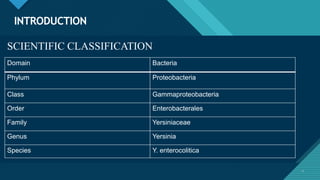
Domain Bacteria
Phylum Proteobacteria
Class Gammaproteobacteria
Order Enterobacterales
Family Yersiniaceae
Genus Yersinia
Species Y. enterocolitica
SCIENTIFIC CLASSIFICATION
Click to edit Master title style
3
INTRODUCTION
3
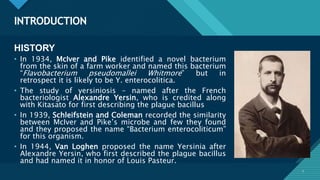
HISTORY
• In 1934, McIver and Pike identified a novel bacterium
from the skin of a farm worker and named this bacterium
“Flavobacterium pseudomallei Whitmore” but in
retrospect it is likely to be Y. enterocolitica.
• The study of yersiniosis – named after the French
bacteriologist Alexandre Yersin, who is credited along
with Kitasato for first describing the plague bacillus
• In 1939, Schleifstein and Coleman recorded the similarity
between McIver and Pike’s microbe and few they found
and they proposed the name “Bacterium enterocoliticum”
for this organism.
• In 1944, Van Loghen proposed the name Yersinia after
Alexandre Yersin, who first described the plague bacillus
and had named it in honor of Louis Pasteur.
Click to edit Master title style
4
INTRODUCTION
4
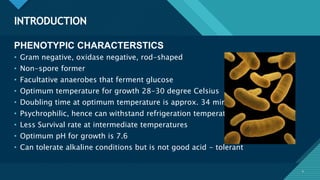
PHENOTYPIC CHARACTERSTICS
• Gram negative, oxidase negative, rod-shaped
• Non-spore former
• Facultative anaerobes that ferment glucose
• Optimum temperature for growth 28-30 degree Celsius
• Doubling time at optimum temperature is approx. 34 mins
• Psychrophilic, hence can withstand refrigeration temperatures
• Less Survival rate at intermediate temperatures
• Optimum pH for growth is 7.6
• Can tolerate alkaline conditions but is not good acid - tolerant
Click to edit Master title style
5
INTRODUCTION
5
CHARACTERSTICS
• Susceptible to heat
• Readily inactivated by pasteurization at 71.8 degree Celsius for 18s
• Also susceptible to:
 Ionizing and UV radiation
 High pressure homogenization
 Sodium nitrate and nitrite when added to food
 Chlorine
Click to edit Master title style
6
CLASSIFICATION
6
BIOTYPES
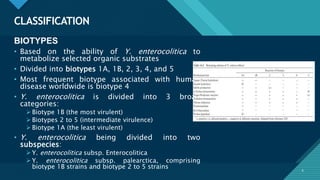
• Based on the ability of Y. enterocolitica to
metabolize selected organic substrates
• Divided into biotypes 1A, 1B, 2, 3, 4, and 5
• Most frequent biotype associated with human
disease worldwide is biotype 4
• Y. enterocolitica is divided into 3 broad
categories:
 Biotype 1B (the most virulent)
 Biotypes 2 to 5 (intermediate virulence)
 Biotype 1A (the least virulent)
• Y. enterocolitica being divided into two
subspecies:
 Y. enterocolitica subsp. Enterocolitica
 Y. enterocolitica subsp. palearctica, comprising
biotype 1B strains and biotype 2 to 5 strains
Click to edit Master title style
7
CLASSIFICATION
7
SEROTYPES
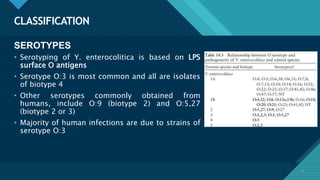
• Serotyping of Y. enterocolitica is based on LPS
surface O antigens
• Serotype O:3 is most common and all are isolates
of biotype 4
• Other serotypes commonly obtained from
humans, include O:9 (biotype 2) and O:5,27
(biotype 2 or 3)
• Majority of human infections are due to strains of
serotype O:3
Click to edit Master title style
8
CHARACTERSTICS OF INFECTION
8
Infection with the enteropathogenic yersiniae typically manifests as
nonspecific, self-limiting diarrhea but may produce a variety of
suppurative and autoimmune complications
ACUTE INFECTION
• It enter the gastrointestinal tract after ingestion in contaminated
food or water
• Median infective dose for humans is not known but is approx.
more than 𝟏𝟎𝟒 CFU
• Most symptomatic infections occur in children less than 5 years old
• Diarrhea accompanied by low-grade fever, headache and
abdominal pain are common symptoms of yersiniosis in children
• Lasts from a few days to 3 weeks, but some patients may develop
chronic enterocolitis, which may persist for several months
• Ileocolic intussusception, toxic megacolon, mesenteric vein
thrombosis are present in acute form of infection
Click to edit Master title style
9
CHARACTERSTICS OF INFECTION
9
• In adolescents, acute yersiniosis is present as a pseudoappendicular
syndrome due to acute inflammation of the terminal ileum or the
mesenteric lymph nodes
• Features of this syndrome are abdominal pain and tenderness localized to
the right lower quadrant and is similar to appendicitis
• Focal disease may be present as cellulitis, suppurative lymphadenitis, septic
arthritis, osteomyelitis, urinary tract infection, renal abscess, sinusitis,
pneumonia, lung abscess, or empyema
• Bacteremia is a rare complication of infection
• It is the presence of bacteria in the bloodstream and Y. enterocolitica is one
of the most important causes of fatal bacteremia
• Immunosuppression, blood dyscrasias, malnutrition, chronic renal failure,
cirrhosis, alcoholism, diabetes mellitus favours bacteremia occurrence
• Bacteremia also result from direct inoculation of Y. enterocolitica into the
circulation during blood transfusion
• The probable sources of these infections are blood donors with low-grade,
subclinical bacteremia.
Click to edit Master title style
10
CHARACTERSTICS OF INFECTION
10
AUTOIMMUNE COMPLICATIONS
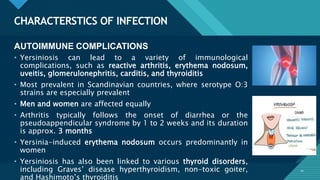
• Yersiniosis can lead to a variety of immunological
complications, such as reactive arthritis, erythema nodosum,
uveitis, glomerulonephritis, carditis, and thyroiditis
• Most prevalent in Scandinavian countries, where serotype O:3
strains are especially prevalent
• Men and women are affected equally
• Arthritis typically follows the onset of diarrhea or the
pseudoappendicular syndrome by 1 to 2 weeks and its duration
is approx. 3 months
• Yersinia-induced erythema nodosum occurs predominantly in
women
• Yersiniosis has also been linked to various thyroid disorders,
including Graves’ disease hyperthyroidism, non-toxic goiter,
and Hashimoto’s thyroiditis
Click to edit Master title style
11
RESERVOIRS
11
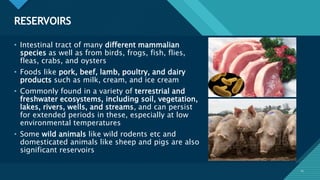
• Intestinal tract of many different mammalian
species as well as from birds, frogs, fish, flies,
fleas, crabs, and oysters
• Foods like pork, beef, lamb, poultry, and dairy
products such as milk, cream, and ice cream
• Commonly found in a variety of terrestrial and
freshwater ecosystems, including soil, vegetation,
lakes, rivers, wells, and streams, and can persist
for extended periods in these, especially at low
environmental temperatures
• Some wild animals like wild rodents etc and
domesticated animals like sheep and pigs are also
significant reservoirs
Click to edit Master title style
12
INCIDENCE OF INFECTIONS AND FOODBORNE OUTBREAKS
12
• In US, cases of yersiniosis from 1996 to 2007 determined that the
annual average incidences of Y. enterocolitica were 0.35 per 1000
and these are very low.
• For comparison, in 2007, the incidences of infections with
Campylobacter, Salmonella, Shigella, Shiga toxin producing E. coli,
and Yersinia were 12.79, 14.92, 6.26, 1.77, and 0.36 per 100,000,
respectively
OUTBREAKS
1. During the mid-1970s, yersiniosis caused by Y. enterocolitica
O:5,27 occurred among 138 Canadian schoolchildren who had
consumed raw milk, but the organism was not recovered from
the suspected source
2. In 1976, Y. enterocolitica serotype O:8 biotype 1B was
responsible for an outbreak in New York State that affected 217
people, 38 of whom were culture positive. The source of
infection was chocolate flavored milk, which evidently became
contaminated after pasteurization.
3. In 1981, an outbreak of Y. enterocolitica O:8 infection affected
35% of 455 individuals at a diet camp in New York State. Seven
patients were hospitalized as a result of infection, five of whom
Click to edit Master title style
13
INCIDENCE OF INFECTIONS AND FOODBORNE OUTBREAKS
13
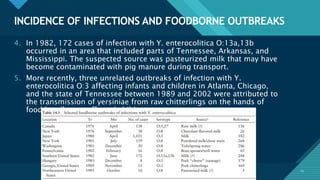
4. In 1982, 172 cases of infection with Y. enterocolitica O:13a,13b
occurred in an area that included parts of Tennessee, Arkansas, and
Mississippi. The suspected source was pasteurized milk that may have
become contaminated with pig manure during transport.
5. More recently, three unrelated outbreaks of infection with Y.
enterocolitica O:3 affecting infants and children in Atlanta, Chicago,
and the state of Tennessee between 1989 and 2002 were attributed to
the transmission of yersiniae from raw chitterlings on the hands of
food handlers to affected children
Click to edit Master title style
14
MECHANISMS OF PATHOGENICITY
14
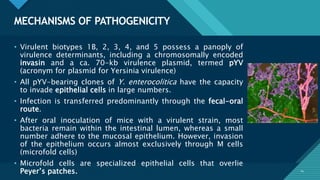
• Virulent biotypes 1B, 2, 3, 4, and 5 possess a panoply of
virulence determinants, including a chromosomally encoded
invasin and a ca. 70-kb virulence plasmid, termed pYV
(acronym for plasmid for Yersinia virulence)
• All pYV-bearing clones of Y. enterocolitica have the capacity
to invade epithelial cells in large numbers.
• Infection is transferred predominantly through the fecal-oral
route.
• After oral inoculation of mice with a virulent strain, most
bacteria remain within the intestinal lumen, whereas a small
number adhere to the mucosal epithelium. However, invasion
of the epithelium occurs almost exclusively through M cells
(microfold cells)
• Microfold cells are specialized epithelial cells that overlie
Peyer’s patches.
Click to edit Master title style
15
MECHANISMS OF PATHOGENICITY
15
• After penetrating the epithelium, Y. enterocolitica traverses the basement
membrane to reach the gut-associated lymphoid tissue, where it causes
localized tissue destruction and the formation of microabscesses
• Y. enterocolitica often spreads via the lymph to the draining mesenteric
lymph nodes, where it may also lead to microabscess formation
• If the bacteria enter the bloodstream, they can disseminate to any organ
but continue to show a tropism for lymphoid tissue.
• Y. enterocolitica is often regarded as a facultative intracellular pathogen
because of its innate resistance to killing by macrophages.
• Highly virulent (biotype 1B) strains of Y. enterocolitica can bypass the
Peyer’s patches and disseminate via the bloodstream directly
• Invasin, Ail, Myf fibrillae, ureases etc are main Chromosomal
Determinants of Virulence
Click to edit Master title style
16
VIRULENCE DETERMINANTS
16
Invasin
• Strains of Y. enterocolitica that carry pYV also produce a 91-kDa
surface-expressed protein termed invasin.
• It imbues the recipient with the ability to penetrate mammalian cells,
including epithelial cells and macrophages.
• The amino terminus of invasin is inserted in the bacterial outer
membrane, while the carboxyl terminus is exposed on the surface,
where it mediates binding to host cell integrins.
• Integrins are transmembrane proteins that communicate extracellular
signals to the cytoskeleton.
• Invasin plays a key role in virulence.
Click to edit Master title style
17
VIRULENCE DETERMINANTS
17
Ail
• Pathogenic strains of Y. enterocolitica produce an outer membrane protein
unrelated to invasin, which also confers invasive ability on E. coli.
• This 17-kDa peptide is specified by a chromosomal ail (attachment-
invasion) locus, so called because it mediates bacterial attachment to some
cultured epithelial cell lines and invasion of others.
• Ail may also enable yersiniae to persist extracellularly by protecting them
from complement-mediated killing.
• It is optimally expressed at 37°C (unlike invasin, which is optimally
expressed at 25°C
• Ail mutants fail to adhere to or invade cultured cells when the inv gene is
not expressed.
• An Ail-negative mutant of Y. enterocolitica showed no reduction in
virulence.
Click to edit Master title style
18
VIRULENCE DETERMINANTS
18
Myf Fibrillae
• There are some distinctive colonization factors on the surface, which
mediate their adherence to the intestinal epithelium
• These factors take the form of surface fimbriae, which allow the bacteria
to deliver their toxins close to epithelial cells while resisting removal by
peristalsis. Eg: Invasin
• Some strains of Y. enterocolitica produce a fimbrial adhesin, named Myf
(acronym for mucoid Yersinia fibrillae), because it bestows a mucoid
appearance on bacterial colonies that express it.
• Its main role in virulence may relate to its ability to mediate binding of
bacteria to intestinal mucus before the bacteria make contact with
epithelial cells.
Click to edit Master title style
19
VIRULENCE DETERMINANTS
19
LPS
• Y. enterocolitica can be classified as smooth or rough depending on the
amount of O-side chain polysaccharide attached to the inner core region
of the cell wall LPS.
• O-antigen-negative mutants of a Y. enterocolitica serotype O:8 strain
have impaired ability to colonize Peyer’s patches, spleen, and liver of
mice infected via different routes.
• These mutants also alter expression or function of other virulence-
associated determinants.
• The outer core region of LPS plays a role in maintaining outer membrane
integrity and may contribute to the resistance of Y. enterocolitica to
bactericidal peptides in host tissues and macrophages.
• Smooth LPS may also enhance virulence by increasing bacterial
hydrophilicity and thus facilitate their passage through the mucous
secretions that line the intestinal epithelium.
Click to edit Master title style
20
VIRULENCE DETERMINANTS
20
Phospholipase
• Some isolates of Y. enterocolitica are hemolytic due to the production of
phospholipase A (YplA).
• Strains in which YplA gene encoding this enzyme is not present show
diminished virulence.
• Phospholipase contributes to microabscess formation by Y. enterocolitica.
• YplA is secreted by Y. enterocolitica via the same type III export apparatus
as that used for flagellar proteins
Click to edit Master title style
21
VIRULENCE DETERMINANTS
21
Urease
• In Y. enterocolitica, acid tolerance relies on the production of urease, which
catalyzes the release of ammonia from urea and allows the bacteria to
resist pH as low as 2.5
• Acid tolerance is necessary to cause disease.
• Urease also contributes to the survival of Y. enterocolitica in host tissues
• Other virulence determinants include Heat stable enterotoxins, Iron
acquisition and the high-pathogenicity island (HPI), The YSA pathogenicity
island, T2SS
Click to edit Master title style
22
The Virulence Plasmid(pYV)
22
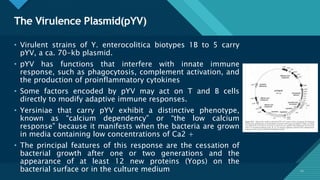
• Virulent strains of Y. enterocolitica biotypes 1B to 5 carry
pYV, a ca. 70-kb plasmid.
• pYV has functions that interfere with innate immune
response, such as phagocytosis, complement activation, and
the production of proinflammatory cytokines
• Some factors encoded by pYV may act on T and B cells
directly to modify adaptive immune responses.
• Yersiniae that carry pYV exhibit a distinctive phenotype,
known as “calcium dependency” or “the low calcium
response” because it manifests when the bacteria are grown
in media containing low concentrations of Ca2 +
• The principal features of this response are the cessation of
bacterial growth after one or two generations and the
appearance of at least 12 new proteins (Yops) on the
bacterial surface or in the culture medium
Click to edit Master title style
23
The Virulence Plasmid(pYV)
23
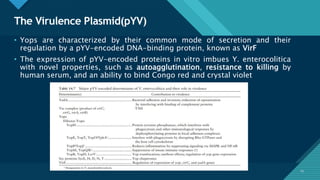
• Yops are characterized by their common mode of secretion and their
regulation by a pYV-encoded DNA-binding protein, known as VirF
• The expression of pYV-encoded proteins in vitro imbues Y. enterocolitica
with novel properties, such as autoagglutination, resistance to killing by
human serum, and an ability to bind Congo red and crystal violet
Click to edit Master title style
24
CONTROL MEASURES
24
• Don't serve or eat raw or undercooked meat.
• Drink and serve only pasteurized milk and milk products.
• Wash hands with soap and water before eating and preparing food; before
touching infants or their toys, bottles, or pacifiers; and after contact with
animals or handling raw meat.
• Use separate cutting boards for meat and other foods.
• Clean all cutting boards, countertops, and utensils with soap and hot water
after preparing raw meat. Or run them through the dishwasher.
• Always cook meat thoroughly before you eat it, especially pork products.
• Clean up animal poop and clean any area that the poop touched.
• The drugs of choice are the aminoglycosides or trimethoprim-
sulfamethoxazole. Other effective agents include tetracycline (not in
children), quinolones and cephalosporins
Click to edit Master title style
25
CONTROL MEASURES
25
• Sometimes surgery is required to drain an abdominal abscess, and surgical
exploration is warranted if appendicitis cannot be ruled out.
• Antibiotics should be used only in selected patients such as the elderly,
immunocompromised individuals or patients with diabetes.
Click to edit Master title style
26
REFERENCES
26
• Food Microbiology: Fundamentals and frontiers by Michael P. Doyle and Robert L.
Buchanan
• Muhammad Aziz, Varun S. Yelamanchili (2021). Yersinia Enterocolitica. National
Center for Biotechnology Information
• BAM Chapter 8: Yersinia enterocolitica
• Edward J Bottone (1999). Yersinia enterocolitica: overview and epidemiologic
correlates. Microbes and Infection Volume 1, Issue 4, April 1999, Pages 323-333
• Preventing Yersiniosis - Minnesota Dept. of Health (state.mn.us)
Click to edit Master title style
2727

Yersinia entercolitica

  • 1.
    Click to editMaster title style 1 Yersinia Enterocolitica H a r j o t S i n g h ( 2 1 F E T 2 0 7 )
  • 2.
    Click to editMaster title style 2 INTRODUCTION 2 Domain Bacteria Phylum Proteobacteria Class Gammaproteobacteria Order Enterobacterales Family Yersiniaceae Genus Yersinia Species Y. enterocolitica SCIENTIFIC CLASSIFICATION
  • 3.
    Click to editMaster title style 3 INTRODUCTION 3 HISTORY • In 1934, McIver and Pike identified a novel bacterium from the skin of a farm worker and named this bacterium “Flavobacterium pseudomallei Whitmore” but in retrospect it is likely to be Y. enterocolitica. • The study of yersiniosis – named after the French bacteriologist Alexandre Yersin, who is credited along with Kitasato for first describing the plague bacillus • In 1939, Schleifstein and Coleman recorded the similarity between McIver and Pike’s microbe and few they found and they proposed the name “Bacterium enterocoliticum” for this organism. • In 1944, Van Loghen proposed the name Yersinia after Alexandre Yersin, who first described the plague bacillus and had named it in honor of Louis Pasteur.
  • 4.
    Click to editMaster title style 4 INTRODUCTION 4 PHENOTYPIC CHARACTERSTICS • Gram negative, oxidase negative, rod-shaped • Non-spore former • Facultative anaerobes that ferment glucose • Optimum temperature for growth 28-30 degree Celsius • Doubling time at optimum temperature is approx. 34 mins • Psychrophilic, hence can withstand refrigeration temperatures • Less Survival rate at intermediate temperatures • Optimum pH for growth is 7.6 • Can tolerate alkaline conditions but is not good acid - tolerant
  • 5.
    Click to editMaster title style 5 INTRODUCTION 5 CHARACTERSTICS • Susceptible to heat • Readily inactivated by pasteurization at 71.8 degree Celsius for 18s • Also susceptible to:  Ionizing and UV radiation  High pressure homogenization  Sodium nitrate and nitrite when added to food  Chlorine
  • 6.
    Click to editMaster title style 6 CLASSIFICATION 6 BIOTYPES • Based on the ability of Y. enterocolitica to metabolize selected organic substrates • Divided into biotypes 1A, 1B, 2, 3, 4, and 5 • Most frequent biotype associated with human disease worldwide is biotype 4 • Y. enterocolitica is divided into 3 broad categories:  Biotype 1B (the most virulent)  Biotypes 2 to 5 (intermediate virulence)  Biotype 1A (the least virulent) • Y. enterocolitica being divided into two subspecies:  Y. enterocolitica subsp. Enterocolitica  Y. enterocolitica subsp. palearctica, comprising biotype 1B strains and biotype 2 to 5 strains
  • 7.
    Click to editMaster title style 7 CLASSIFICATION 7 SEROTYPES • Serotyping of Y. enterocolitica is based on LPS surface O antigens • Serotype O:3 is most common and all are isolates of biotype 4 • Other serotypes commonly obtained from humans, include O:9 (biotype 2) and O:5,27 (biotype 2 or 3) • Majority of human infections are due to strains of serotype O:3
  • 8.
    Click to editMaster title style 8 CHARACTERSTICS OF INFECTION 8 Infection with the enteropathogenic yersiniae typically manifests as nonspecific, self-limiting diarrhea but may produce a variety of suppurative and autoimmune complications ACUTE INFECTION • It enter the gastrointestinal tract after ingestion in contaminated food or water • Median infective dose for humans is not known but is approx. more than 𝟏𝟎𝟒 CFU • Most symptomatic infections occur in children less than 5 years old • Diarrhea accompanied by low-grade fever, headache and abdominal pain are common symptoms of yersiniosis in children • Lasts from a few days to 3 weeks, but some patients may develop chronic enterocolitis, which may persist for several months • Ileocolic intussusception, toxic megacolon, mesenteric vein thrombosis are present in acute form of infection
  • 9.
    Click to editMaster title style 9 CHARACTERSTICS OF INFECTION 9 • In adolescents, acute yersiniosis is present as a pseudoappendicular syndrome due to acute inflammation of the terminal ileum or the mesenteric lymph nodes • Features of this syndrome are abdominal pain and tenderness localized to the right lower quadrant and is similar to appendicitis • Focal disease may be present as cellulitis, suppurative lymphadenitis, septic arthritis, osteomyelitis, urinary tract infection, renal abscess, sinusitis, pneumonia, lung abscess, or empyema • Bacteremia is a rare complication of infection • It is the presence of bacteria in the bloodstream and Y. enterocolitica is one of the most important causes of fatal bacteremia • Immunosuppression, blood dyscrasias, malnutrition, chronic renal failure, cirrhosis, alcoholism, diabetes mellitus favours bacteremia occurrence • Bacteremia also result from direct inoculation of Y. enterocolitica into the circulation during blood transfusion • The probable sources of these infections are blood donors with low-grade, subclinical bacteremia.
  • 10.
    Click to editMaster title style 10 CHARACTERSTICS OF INFECTION 10 AUTOIMMUNE COMPLICATIONS • Yersiniosis can lead to a variety of immunological complications, such as reactive arthritis, erythema nodosum, uveitis, glomerulonephritis, carditis, and thyroiditis • Most prevalent in Scandinavian countries, where serotype O:3 strains are especially prevalent • Men and women are affected equally • Arthritis typically follows the onset of diarrhea or the pseudoappendicular syndrome by 1 to 2 weeks and its duration is approx. 3 months • Yersinia-induced erythema nodosum occurs predominantly in women • Yersiniosis has also been linked to various thyroid disorders, including Graves’ disease hyperthyroidism, non-toxic goiter, and Hashimoto’s thyroiditis
  • 11.
    Click to editMaster title style 11 RESERVOIRS 11 • Intestinal tract of many different mammalian species as well as from birds, frogs, fish, flies, fleas, crabs, and oysters • Foods like pork, beef, lamb, poultry, and dairy products such as milk, cream, and ice cream • Commonly found in a variety of terrestrial and freshwater ecosystems, including soil, vegetation, lakes, rivers, wells, and streams, and can persist for extended periods in these, especially at low environmental temperatures • Some wild animals like wild rodents etc and domesticated animals like sheep and pigs are also significant reservoirs
  • 12.
    Click to editMaster title style 12 INCIDENCE OF INFECTIONS AND FOODBORNE OUTBREAKS 12 • In US, cases of yersiniosis from 1996 to 2007 determined that the annual average incidences of Y. enterocolitica were 0.35 per 1000 and these are very low. • For comparison, in 2007, the incidences of infections with Campylobacter, Salmonella, Shigella, Shiga toxin producing E. coli, and Yersinia were 12.79, 14.92, 6.26, 1.77, and 0.36 per 100,000, respectively OUTBREAKS 1. During the mid-1970s, yersiniosis caused by Y. enterocolitica O:5,27 occurred among 138 Canadian schoolchildren who had consumed raw milk, but the organism was not recovered from the suspected source 2. In 1976, Y. enterocolitica serotype O:8 biotype 1B was responsible for an outbreak in New York State that affected 217 people, 38 of whom were culture positive. The source of infection was chocolate flavored milk, which evidently became contaminated after pasteurization. 3. In 1981, an outbreak of Y. enterocolitica O:8 infection affected 35% of 455 individuals at a diet camp in New York State. Seven patients were hospitalized as a result of infection, five of whom
  • 13.
    Click to editMaster title style 13 INCIDENCE OF INFECTIONS AND FOODBORNE OUTBREAKS 13 4. In 1982, 172 cases of infection with Y. enterocolitica O:13a,13b occurred in an area that included parts of Tennessee, Arkansas, and Mississippi. The suspected source was pasteurized milk that may have become contaminated with pig manure during transport. 5. More recently, three unrelated outbreaks of infection with Y. enterocolitica O:3 affecting infants and children in Atlanta, Chicago, and the state of Tennessee between 1989 and 2002 were attributed to the transmission of yersiniae from raw chitterlings on the hands of food handlers to affected children
  • 14.
    Click to editMaster title style 14 MECHANISMS OF PATHOGENICITY 14 • Virulent biotypes 1B, 2, 3, 4, and 5 possess a panoply of virulence determinants, including a chromosomally encoded invasin and a ca. 70-kb virulence plasmid, termed pYV (acronym for plasmid for Yersinia virulence) • All pYV-bearing clones of Y. enterocolitica have the capacity to invade epithelial cells in large numbers. • Infection is transferred predominantly through the fecal-oral route. • After oral inoculation of mice with a virulent strain, most bacteria remain within the intestinal lumen, whereas a small number adhere to the mucosal epithelium. However, invasion of the epithelium occurs almost exclusively through M cells (microfold cells) • Microfold cells are specialized epithelial cells that overlie Peyer’s patches.
  • 15.
    Click to editMaster title style 15 MECHANISMS OF PATHOGENICITY 15 • After penetrating the epithelium, Y. enterocolitica traverses the basement membrane to reach the gut-associated lymphoid tissue, where it causes localized tissue destruction and the formation of microabscesses • Y. enterocolitica often spreads via the lymph to the draining mesenteric lymph nodes, where it may also lead to microabscess formation • If the bacteria enter the bloodstream, they can disseminate to any organ but continue to show a tropism for lymphoid tissue. • Y. enterocolitica is often regarded as a facultative intracellular pathogen because of its innate resistance to killing by macrophages. • Highly virulent (biotype 1B) strains of Y. enterocolitica can bypass the Peyer’s patches and disseminate via the bloodstream directly • Invasin, Ail, Myf fibrillae, ureases etc are main Chromosomal Determinants of Virulence
  • 16.
    Click to editMaster title style 16 VIRULENCE DETERMINANTS 16 Invasin • Strains of Y. enterocolitica that carry pYV also produce a 91-kDa surface-expressed protein termed invasin. • It imbues the recipient with the ability to penetrate mammalian cells, including epithelial cells and macrophages. • The amino terminus of invasin is inserted in the bacterial outer membrane, while the carboxyl terminus is exposed on the surface, where it mediates binding to host cell integrins. • Integrins are transmembrane proteins that communicate extracellular signals to the cytoskeleton. • Invasin plays a key role in virulence.
  • 17.
    Click to editMaster title style 17 VIRULENCE DETERMINANTS 17 Ail • Pathogenic strains of Y. enterocolitica produce an outer membrane protein unrelated to invasin, which also confers invasive ability on E. coli. • This 17-kDa peptide is specified by a chromosomal ail (attachment- invasion) locus, so called because it mediates bacterial attachment to some cultured epithelial cell lines and invasion of others. • Ail may also enable yersiniae to persist extracellularly by protecting them from complement-mediated killing. • It is optimally expressed at 37°C (unlike invasin, which is optimally expressed at 25°C • Ail mutants fail to adhere to or invade cultured cells when the inv gene is not expressed. • An Ail-negative mutant of Y. enterocolitica showed no reduction in virulence.
  • 18.
    Click to editMaster title style 18 VIRULENCE DETERMINANTS 18 Myf Fibrillae • There are some distinctive colonization factors on the surface, which mediate their adherence to the intestinal epithelium • These factors take the form of surface fimbriae, which allow the bacteria to deliver their toxins close to epithelial cells while resisting removal by peristalsis. Eg: Invasin • Some strains of Y. enterocolitica produce a fimbrial adhesin, named Myf (acronym for mucoid Yersinia fibrillae), because it bestows a mucoid appearance on bacterial colonies that express it. • Its main role in virulence may relate to its ability to mediate binding of bacteria to intestinal mucus before the bacteria make contact with epithelial cells.
  • 19.
    Click to editMaster title style 19 VIRULENCE DETERMINANTS 19 LPS • Y. enterocolitica can be classified as smooth or rough depending on the amount of O-side chain polysaccharide attached to the inner core region of the cell wall LPS. • O-antigen-negative mutants of a Y. enterocolitica serotype O:8 strain have impaired ability to colonize Peyer’s patches, spleen, and liver of mice infected via different routes. • These mutants also alter expression or function of other virulence- associated determinants. • The outer core region of LPS plays a role in maintaining outer membrane integrity and may contribute to the resistance of Y. enterocolitica to bactericidal peptides in host tissues and macrophages. • Smooth LPS may also enhance virulence by increasing bacterial hydrophilicity and thus facilitate their passage through the mucous secretions that line the intestinal epithelium.
  • 20.
    Click to editMaster title style 20 VIRULENCE DETERMINANTS 20 Phospholipase • Some isolates of Y. enterocolitica are hemolytic due to the production of phospholipase A (YplA). • Strains in which YplA gene encoding this enzyme is not present show diminished virulence. • Phospholipase contributes to microabscess formation by Y. enterocolitica. • YplA is secreted by Y. enterocolitica via the same type III export apparatus as that used for flagellar proteins
  • 21.
    Click to editMaster title style 21 VIRULENCE DETERMINANTS 21 Urease • In Y. enterocolitica, acid tolerance relies on the production of urease, which catalyzes the release of ammonia from urea and allows the bacteria to resist pH as low as 2.5 • Acid tolerance is necessary to cause disease. • Urease also contributes to the survival of Y. enterocolitica in host tissues • Other virulence determinants include Heat stable enterotoxins, Iron acquisition and the high-pathogenicity island (HPI), The YSA pathogenicity island, T2SS
  • 22.
    Click to editMaster title style 22 The Virulence Plasmid(pYV) 22 • Virulent strains of Y. enterocolitica biotypes 1B to 5 carry pYV, a ca. 70-kb plasmid. • pYV has functions that interfere with innate immune response, such as phagocytosis, complement activation, and the production of proinflammatory cytokines • Some factors encoded by pYV may act on T and B cells directly to modify adaptive immune responses. • Yersiniae that carry pYV exhibit a distinctive phenotype, known as “calcium dependency” or “the low calcium response” because it manifests when the bacteria are grown in media containing low concentrations of Ca2 + • The principal features of this response are the cessation of bacterial growth after one or two generations and the appearance of at least 12 new proteins (Yops) on the bacterial surface or in the culture medium
  • 23.
    Click to editMaster title style 23 The Virulence Plasmid(pYV) 23 • Yops are characterized by their common mode of secretion and their regulation by a pYV-encoded DNA-binding protein, known as VirF • The expression of pYV-encoded proteins in vitro imbues Y. enterocolitica with novel properties, such as autoagglutination, resistance to killing by human serum, and an ability to bind Congo red and crystal violet
  • 24.
    Click to editMaster title style 24 CONTROL MEASURES 24 • Don't serve or eat raw or undercooked meat. • Drink and serve only pasteurized milk and milk products. • Wash hands with soap and water before eating and preparing food; before touching infants or their toys, bottles, or pacifiers; and after contact with animals or handling raw meat. • Use separate cutting boards for meat and other foods. • Clean all cutting boards, countertops, and utensils with soap and hot water after preparing raw meat. Or run them through the dishwasher. • Always cook meat thoroughly before you eat it, especially pork products. • Clean up animal poop and clean any area that the poop touched. • The drugs of choice are the aminoglycosides or trimethoprim- sulfamethoxazole. Other effective agents include tetracycline (not in children), quinolones and cephalosporins
  • 25.
    Click to editMaster title style 25 CONTROL MEASURES 25 • Sometimes surgery is required to drain an abdominal abscess, and surgical exploration is warranted if appendicitis cannot be ruled out. • Antibiotics should be used only in selected patients such as the elderly, immunocompromised individuals or patients with diabetes.
  • 26.
    Click to editMaster title style 26 REFERENCES 26 • Food Microbiology: Fundamentals and frontiers by Michael P. Doyle and Robert L. Buchanan • Muhammad Aziz, Varun S. Yelamanchili (2021). Yersinia Enterocolitica. National Center for Biotechnology Information • BAM Chapter 8: Yersinia enterocolitica • Edward J Bottone (1999). Yersinia enterocolitica: overview and epidemiologic correlates. Microbes and Infection Volume 1, Issue 4, April 1999, Pages 323-333 • Preventing Yersiniosis - Minnesota Dept. of Health (state.mn.us)
  • 27.
    Click to editMaster title style 2727