Solving Pitch Problem in Paper and Pulp
Industry
1
Suby Mon Benny
MSc Microbiology
20LS601032
An Introduction to Paper
& Pulp Industry
 The pulp and paper industry converts wood or recycled
fibre into pulp and primary forms of paper.
 In the 1800s, there was a shift away from using cotton
rags for paper production. Wood became the most
important source of fiber.
 First mechanical and then chemical methods have
been developed to produce pulp from wood.
2
Production process
3
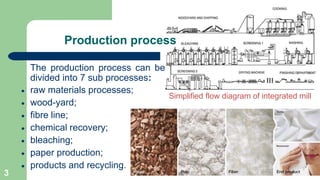
Simplified flow diagram of integrated mill
The production process can be
divided into 7 sub processes:
 raw materials processes;
 wood-yard;
 fibre line;
 chemical recovery;
 bleaching;
 paper production;
 products and recycling.
Pulping processes
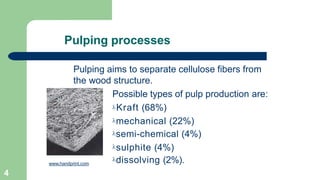
Pulping aims to separate cellulose fibers from
the wood structure.
Possible types of pulp production are:
Kraft (68%)
mechanical (22%)
semi-chemical (4%)
sulphite (4%)
dissolving (2%).
www.handprint.com
4
4
Kraft Pulping
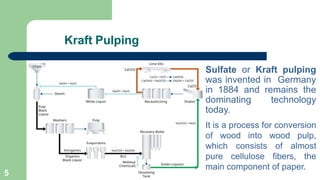
Sulfate or Kraft pulping
was invented in Germany
in 1884 and remains the
dominating technology
today.
It is a process for conversion
of wood into wood pulp,
which consists of almost
pure cellulose fibers, the
main component of paper.
7
5
Environmental problems
6
Regulated wastes and
emissions from the pulp and
paper industry include liquid
and solid wastes, air
emissions, and wastewater.
 Air emissions
 Wastewater releases
 Solid waste
6
Raw water use
 Pulp mills are big water
users.
 Consumption of fresh
water can seriously
harm habitats near
mills, reduce water
levels necessary for
fish, and change water
temperature, a critical
environmental factor for
fish.
10
7
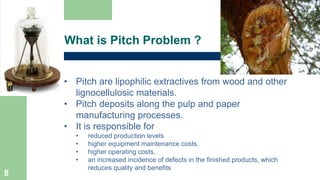
What is Pitch Problem ?
• Pitch are lipophilic extractives from wood and other
lignocellulosic materials.
• Pitch deposits along the pulp and paper
manufacturing processes.
• It is responsible for
• reduced production levels
• higher equipment maintenance costs,
• higher operating costs,
• an increased incidence of defects in the finished products, which
reduces quality and benefits
8
Pitch deposition in pulp
processing
• Mechanical pulping only affects slightly the
composition of extractives.
• Chemical pulping saponifies triglycerides.
• Sterol and tri-terpenol esters are much less
affected.
• The wood extractives remaining in the
unbleached pulp are carried over to the bleach
plant.
• The use of totally chlorine free (TCF) bleaching
in place of elementary chlorine free (ECF)
bleaching is increasing the severity of pitch
problems
9
Solving the Problem
• Traditional methods:
• Natural “seasoning”
• Adsorption or dispersion of the pitch particles with
chemicals
• Fungal pitch control:
Wood decaying fungi, including
1. white-rot (Funalia trogii,
Bjerkandera, Pleurotus
pulmonarius),
2. brown-rot,
10
• Enzymatic pitch control:
• Hydrolytic enzymes- Lipases
• Oxidative enzymes- Oxidoreductases
(laccases- 2,2′-azinobis(3-
ethylbenzothiazoline- 6-sulphonic acid
[ABTS], 1-hydroxybenzotriazole [HBT] ),
lipoxygenases.
3. soft-rot, and
4. sap stain (Ophiostoma, Ceratocystis,
Leptographium) species
11
Source: Microbial Enzymes and Their Application
in Pulp and Paper Industry
Abdulhadi Yakubu, Upasana Saikia, and Ashish Vyas
Ideal paper mill
• From cleaner production point of view is a chlorine-free and zero-
discharge one, with minimized quantity and toxicity of air pollution and
solid wastes.
• It is seen that closed loops represent the most effective approach to save
both energy and resource consumption and at the same way to decrease
all kind of wastes production.
• Such an approach is developed in the form of paper recycling, different
types of substances re-use during production processes, coproduction and
chemicals recovery.
• Future research can develop more sustainable reuse options for Kraft
pulping solid wastes, as well as pulping methods that result in purified by-
products that can serve as feedstock for other manufacturing processes.
12
Conclusion
2
• Lipophilic extractives are responsible for pitch
problems.
• Pulp mills are almost always located near large bodies
of water due to their substantial demand for water.
• Delignification of chemical pulps releases considerable
amounts of organic material into the environment,
particularly into rivers or lakes.
• The process effluents can be treated in a
biological effluent treatment plant, which can
substantially reduce their toxicity.
13
14
Solving pitch problem

Solving pitch problem

  • 1.
    Solving Pitch Problemin Paper and Pulp Industry 1 Suby Mon Benny MSc Microbiology 20LS601032
  • 2.
    An Introduction toPaper & Pulp Industry  The pulp and paper industry converts wood or recycled fibre into pulp and primary forms of paper.  In the 1800s, there was a shift away from using cotton rags for paper production. Wood became the most important source of fiber.  First mechanical and then chemical methods have been developed to produce pulp from wood. 2
  • 3.
    Production process 3 Simplified flowdiagram of integrated mill The production process can be divided into 7 sub processes:  raw materials processes;  wood-yard;  fibre line;  chemical recovery;  bleaching;  paper production;  products and recycling.
  • 4.
    Pulping processes Pulping aimsto separate cellulose fibers from the wood structure. Possible types of pulp production are: Kraft (68%) mechanical (22%) semi-chemical (4%) sulphite (4%) dissolving (2%). www.handprint.com 4 4
  • 5.
    Kraft Pulping Sulfate orKraft pulping was invented in Germany in 1884 and remains the dominating technology today. It is a process for conversion of wood into wood pulp, which consists of almost pure cellulose fibers, the main component of paper. 7 5
  • 6.
    Environmental problems 6 Regulated wastesand emissions from the pulp and paper industry include liquid and solid wastes, air emissions, and wastewater.  Air emissions  Wastewater releases  Solid waste 6
  • 7.
    Raw water use Pulp mills are big water users.  Consumption of fresh water can seriously harm habitats near mills, reduce water levels necessary for fish, and change water temperature, a critical environmental factor for fish. 10 7
  • 8.
    What is PitchProblem ? • Pitch are lipophilic extractives from wood and other lignocellulosic materials. • Pitch deposits along the pulp and paper manufacturing processes. • It is responsible for • reduced production levels • higher equipment maintenance costs, • higher operating costs, • an increased incidence of defects in the finished products, which reduces quality and benefits 8
  • 9.
    Pitch deposition inpulp processing • Mechanical pulping only affects slightly the composition of extractives. • Chemical pulping saponifies triglycerides. • Sterol and tri-terpenol esters are much less affected. • The wood extractives remaining in the unbleached pulp are carried over to the bleach plant. • The use of totally chlorine free (TCF) bleaching in place of elementary chlorine free (ECF) bleaching is increasing the severity of pitch problems 9
  • 10.
    Solving the Problem •Traditional methods: • Natural “seasoning” • Adsorption or dispersion of the pitch particles with chemicals • Fungal pitch control: Wood decaying fungi, including 1. white-rot (Funalia trogii, Bjerkandera, Pleurotus pulmonarius), 2. brown-rot, 10
  • 11.
    • Enzymatic pitchcontrol: • Hydrolytic enzymes- Lipases • Oxidative enzymes- Oxidoreductases (laccases- 2,2′-azinobis(3- ethylbenzothiazoline- 6-sulphonic acid [ABTS], 1-hydroxybenzotriazole [HBT] ), lipoxygenases. 3. soft-rot, and 4. sap stain (Ophiostoma, Ceratocystis, Leptographium) species 11
  • 12.
    Source: Microbial Enzymesand Their Application in Pulp and Paper Industry Abdulhadi Yakubu, Upasana Saikia, and Ashish Vyas
  • 13.
    Ideal paper mill •From cleaner production point of view is a chlorine-free and zero- discharge one, with minimized quantity and toxicity of air pollution and solid wastes. • It is seen that closed loops represent the most effective approach to save both energy and resource consumption and at the same way to decrease all kind of wastes production. • Such an approach is developed in the form of paper recycling, different types of substances re-use during production processes, coproduction and chemicals recovery. • Future research can develop more sustainable reuse options for Kraft pulping solid wastes, as well as pulping methods that result in purified by- products that can serve as feedstock for other manufacturing processes. 12
  • 14.
    Conclusion 2 • Lipophilic extractivesare responsible for pitch problems. • Pulp mills are almost always located near large bodies of water due to their substantial demand for water. • Delignification of chemical pulps releases considerable amounts of organic material into the environment, particularly into rivers or lakes. • The process effluents can be treated in a biological effluent treatment plant, which can substantially reduce their toxicity. 13
  • 15.

Editor's Notes

  • #6 The kraft process entails treatment of wood chips with a hot mixture of water, sodium hydroxide (NaOH), and sodium sulfide (Na2S), known as white liquor, that breaks the bonds that link lignin, hemicellulose, and cellulose.
  • #7 related with this process are: sulphur dioxide, nitrous oxides, particulate matter, methanol, polycyclic organic matter, hydrogen chloride, formaldehyde, chloroform, phenol and chlorinated phenolics, dioxins, furans and other chlorinated compounds. include chlorinated phenolics, dioxins, furans and other chlorinated compounds, phosphates and suspended sediments. Paper mills also produce non-hazardous solid waste such as sludge derived from their pulping and bleaching operations.
  • #8 The total requirement of raw water has through cleaner production measures been reduced from about 200-300 m3 per ton of pulp in 1970 to well below 50m3/ton, in some mills even below 10 m3/ton.
  • #9 They can be referred to as wood resin, includes alkanes, fatty alcohols, fatty acids, resin acids, sterols, other terpenoids, conjugated sterols, triglycerides and waxes.
  • #10 where they react with the bleaching agents due to lower reactivity with pulp lipids. Pitch colloidal particles surviving bleaching can deposit in pulp reducing its quality, or on equipment causing the shutdown of mill operations.
  • #11 accomplished by adding alum, talc, ionic or nonionic dispersants, cationic polymers and other types of additives During wood storage, the content of extractives is decreased since some of them are subjected to hydrolytic or oxidative transformation by plant enzymes as well as by the action of wood colonizing microorganisms. ability to colonize lignified plant materials Basidiomycetes, ascomycetous fungi Laccases are metalloenzymes including four catalytic coppers in their molecular structure a class of non-heme iron-containing dioxygenases that catalyze the oxygenation of unsaturated fatty acids and their esters
  • #15 Therefore, biotechnological technologies capable of modifying these compounds would be potential tools for reducing pitch problems during pulp and paper manufacture. include fatty acids, fatty alcohols, resin acids, hydrocarbons, steroids, triterpenoids and triglycerides. The wastewater effluent can also be a major source of pollution, containing lignin's from the trees, high biological oxygen demand (BOD) and dissolved organic carbon (DOC), along with alcohols, chlorates, heavy metals, and chelating agents.