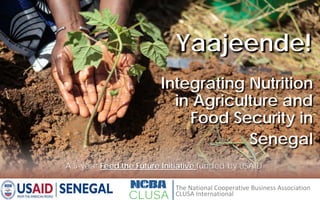
Integrating Nutrition
in Agriculture and
Food Security in
Senegal
A 5-year Feed the Future Initiative funded by USAID
Yaajeende!
The National Cooperative Business Association
CLUSA International
USAID|Yaajeende Project Overview
• Focused on 3 regions
• One of the first USAID funded
projects designed around FTF
• 5 Year $40 million USAID
investment, started 11/2010
• Target beneficiaries = Mothers
and children under 5 years old
• Partners
USAID Perspectives on Yaajeende Design
Alignment with
Government Strategies:
• National Heath
Strategy Plan
• National Agricultural
Investment Plan
Important gaps to fill in
North Eastern and
Southern regions:
• High level of
food insecurity:
Kedougou 39%
Matam 26.2%
Tamba 26.2%
Yaajeende Project Objectives
• Engage in country-led, integrated
approach to accelerate the
participation of 500,000 rural poor in
growth
• Reduce malnutrition in children under
5 years old by:
• 30% reduction in underweight
• 30% reduction stunting
We learned from our projects
Senegal
Niger
Uganda
Zimbabwe
Mozambique
Namibia
Yaajeende – Nutrition-Led-Agriculture for Food Security
USDA Millet - Improving Millet Value Chain through Conservation Farming
Wula Naafa - Agriculture Natural Resource Management Project
OFDA Moringa - Moringa Intensification Project to Help Respond to and
Mitigate the Drought Disaster in Niger
Arziki - Niger Food Security Program
USDA Uganda - Uganda Conservation Farming Initiative
ZIMAIED - Zimbabwe Agricultural Income and Employment Development
SANA - Food Security through Nutrition and Agriculture in Mozambique
OFDA Namibia - Conservation Agriculture Program for Northern
Namibia to Help Mitigate Drought Disasters
Activity Integration
Food Security
Food
Fruits & Vegetables
Geographically Specific
Target Populations
Deficiency Focused
Health Impact Driven
Integrated Approaches
Small and medium Scale Ag.
Smallholders
Artisanal & Subsistence Ag.
Resiliency
Inequity Focused
Money
Field Crops & Cereals
Geographically Broad
Non-targeted
Market Focused
Yield & Income Impact Driven
Business (VC) Approaches
Large Scale Agriculture
Emerging & Large Scale Farmers
Commercial Agriculture
Efficiency
Rising Tide Lifts all Boats
Economic Growth
Vs.
Different Perspectives
Key Approaches
• Focus on micronutrient deficiencies
• Asset and Skill-building for Women
• Science-based Resources
• Fostering a Local Private Sector
• Understanding who is at risk and what the
deficiencies are in each zone
• Designing activities to have nutritional impact and
address micronutrient deficiencies :
• Local fortification
• Biofortified crops (millet, beans, OSP)
• Improved horticulture (gardening, fruit trees)
• Animal source food (poultry, goat, sheep)
• Wild food
The essence of Nutrition Led Agriculture
What Does
it Mean
• Running Nutrition education and WASH programs to support these activities
• Engaging actively in partnerships with education, health/Wash, agric research and
extension services, private sector and local governments
• Developing markets for these foods: support markets (seed, inputs, tools), demand
creation
Integrating Nutrition into the Value Chain
Value chain model illustrative examples: making the linkages
• Marketing of fortified food products- communication
• Increased production linked to school feeding programs- community
• Elimination of lean season via improved processing and storage- community
• Link processors and traders to regional food aid programs- clinical &
community
• Access to credit/financing for off-farm income-generating activities
like artisanal fortification of local cereals & salt iodization- community
• Transfer commercial farm skills to household gardens to increase food
diversity- community
• Use income to diversify food-basket- community
• Invest in small ruminants for income and/or dietary supplements-
community
• Advance a policy framework for the safe, sustainable production of
commercially fortified cooking oil and soft wheat flour- policy
• Develop communication strategies that promote Essential Nutrition
Actions & create demand for fortified and diverse local foods, including
agriculture extension agents- communication
• Ensure that information used in decision making for crops to plant and
household purchases reflect commercial farm and nutrition
consideration- community
Market demand
Producers/ farmers
Input suppliers
Other
Processors/
traders
Producer
organizations
Asset and Skill-building for Women
The Heart of CLUSA’s Feed the
Future Approach
• Women active across all pillars
• Availability: main target for Bio-
reclamation of Degraded Lands, land
titles, Animal placement, Tools acquiring
translating in Know-How acquisition and
clear Can-do-Attitude
• Access: 42% of active CBSPs, key role
marketing of Ag products, have good
access to credit
• Utilization: strongly involved in WASH,
BCC and nutrition education activities
• Governance/Stability: Space & Voice in
Local governance, CSOs, Citizen Working
Groups that advocate for FSN priorities
Fostering a Local Private Sector
• Availability (Production) is constrained by farmer's lack of
ACCESS to quality agricultural inputs/support
services/knowledge;
A central problem is ACCESS at the LOCAL level:
• ACCESS to micronutrient rich
food is constrained by a lack of
dynamic, LOCAL agro-
entrepreneurs that purchase,
transport, stock properly,
process and sell foods on the
LOCAL market
Community-based Solution
Providers are a key
innovation
Community-Based Solution Providers (CBSP’s)
Market-based, driven
by bottlenecks, gaps in
the Value Chain
Agents vetted by the
community=trust
Agricultural and
nutritional products
and services
Autonomous entrepreneurs
(commission-based)
Reduce risks and
transaction costs for
business providers
Agreements between
CBSP networks and
input suppliers
Results to Date – end of Year 3
• 781 CBSPs (including CNVs) are active
• 827 CBSPs have received partial training and are now being
integrated into the project’s CBSP networks
• 128 CBSPs sold more than USD $758,000 of subsidized and
nonsubsidized inputs, exceeding the target of $600,000
• Increased consumption of micro-nutrient rich vegetables among
participants by an average of 21 kg each and sales of garden
produce of USD $160,000;
• Community Nutrition Volunteers (CNV) used social marketing to
increase access to fortified food and nutrition products
• 25 Citizen Working Groups established strong model for
public/private engagement allowing the project to achieve scale
and conduct innovative activities
Lessons Learned
 It is very important to integrate research
 Linkages with National institutions increases
efficacy
 Partnership and evidence based approaches
lead to adoption and scaling up
 Value chains need to incorporate horticulture
for nutritional outcomes
 Governance is critical for building resilience
 Scaling relies on role of producer organizations/co-
ops and local private sector services/products
 Women play critical role in all four pillars of food
security
 Learning and adjusting reinforces and improves
integration
Thank You!
Papa Sene
Senior Technical Advisor, CLUSA International
1401 New York Avenue, NW • Suite 1100 • Washington, DC 20005 • 202.383.5463 • www.NCBA.coop

Integrating Nutrition in Agriculture in Senegal

  • 1.
    Integrating Nutrition in Agricultureand Food Security in Senegal A 5-year Feed the Future Initiative funded by USAID Yaajeende! The National Cooperative Business Association CLUSA International
  • 2.
    USAID|Yaajeende Project Overview •Focused on 3 regions • One of the first USAID funded projects designed around FTF • 5 Year $40 million USAID investment, started 11/2010 • Target beneficiaries = Mothers and children under 5 years old • Partners
  • 3.
    USAID Perspectives onYaajeende Design Alignment with Government Strategies: • National Heath Strategy Plan • National Agricultural Investment Plan Important gaps to fill in North Eastern and Southern regions: • High level of food insecurity: Kedougou 39% Matam 26.2% Tamba 26.2%
  • 4.
    Yaajeende Project Objectives •Engage in country-led, integrated approach to accelerate the participation of 500,000 rural poor in growth • Reduce malnutrition in children under 5 years old by: • 30% reduction in underweight • 30% reduction stunting
  • 5.
    We learned fromour projects Senegal Niger Uganda Zimbabwe Mozambique Namibia Yaajeende – Nutrition-Led-Agriculture for Food Security USDA Millet - Improving Millet Value Chain through Conservation Farming Wula Naafa - Agriculture Natural Resource Management Project OFDA Moringa - Moringa Intensification Project to Help Respond to and Mitigate the Drought Disaster in Niger Arziki - Niger Food Security Program USDA Uganda - Uganda Conservation Farming Initiative ZIMAIED - Zimbabwe Agricultural Income and Employment Development SANA - Food Security through Nutrition and Agriculture in Mozambique OFDA Namibia - Conservation Agriculture Program for Northern Namibia to Help Mitigate Drought Disasters
  • 6.
  • 7.
    Food Security Food Fruits &Vegetables Geographically Specific Target Populations Deficiency Focused Health Impact Driven Integrated Approaches Small and medium Scale Ag. Smallholders Artisanal & Subsistence Ag. Resiliency Inequity Focused Money Field Crops & Cereals Geographically Broad Non-targeted Market Focused Yield & Income Impact Driven Business (VC) Approaches Large Scale Agriculture Emerging & Large Scale Farmers Commercial Agriculture Efficiency Rising Tide Lifts all Boats Economic Growth Vs. Different Perspectives
  • 8.
    Key Approaches • Focuson micronutrient deficiencies • Asset and Skill-building for Women • Science-based Resources • Fostering a Local Private Sector
  • 9.
    • Understanding whois at risk and what the deficiencies are in each zone • Designing activities to have nutritional impact and address micronutrient deficiencies : • Local fortification • Biofortified crops (millet, beans, OSP) • Improved horticulture (gardening, fruit trees) • Animal source food (poultry, goat, sheep) • Wild food The essence of Nutrition Led Agriculture What Does it Mean • Running Nutrition education and WASH programs to support these activities • Engaging actively in partnerships with education, health/Wash, agric research and extension services, private sector and local governments • Developing markets for these foods: support markets (seed, inputs, tools), demand creation
  • 10.
    Integrating Nutrition intothe Value Chain Value chain model illustrative examples: making the linkages • Marketing of fortified food products- communication • Increased production linked to school feeding programs- community • Elimination of lean season via improved processing and storage- community • Link processors and traders to regional food aid programs- clinical & community • Access to credit/financing for off-farm income-generating activities like artisanal fortification of local cereals & salt iodization- community • Transfer commercial farm skills to household gardens to increase food diversity- community • Use income to diversify food-basket- community • Invest in small ruminants for income and/or dietary supplements- community • Advance a policy framework for the safe, sustainable production of commercially fortified cooking oil and soft wheat flour- policy • Develop communication strategies that promote Essential Nutrition Actions & create demand for fortified and diverse local foods, including agriculture extension agents- communication • Ensure that information used in decision making for crops to plant and household purchases reflect commercial farm and nutrition consideration- community Market demand Producers/ farmers Input suppliers Other Processors/ traders Producer organizations
  • 11.
    Asset and Skill-buildingfor Women The Heart of CLUSA’s Feed the Future Approach • Women active across all pillars • Availability: main target for Bio- reclamation of Degraded Lands, land titles, Animal placement, Tools acquiring translating in Know-How acquisition and clear Can-do-Attitude • Access: 42% of active CBSPs, key role marketing of Ag products, have good access to credit • Utilization: strongly involved in WASH, BCC and nutrition education activities • Governance/Stability: Space & Voice in Local governance, CSOs, Citizen Working Groups that advocate for FSN priorities
  • 12.
    Fostering a LocalPrivate Sector • Availability (Production) is constrained by farmer's lack of ACCESS to quality agricultural inputs/support services/knowledge; A central problem is ACCESS at the LOCAL level: • ACCESS to micronutrient rich food is constrained by a lack of dynamic, LOCAL agro- entrepreneurs that purchase, transport, stock properly, process and sell foods on the LOCAL market
  • 13.
    Community-based Solution Providers area key innovation Community-Based Solution Providers (CBSP’s) Market-based, driven by bottlenecks, gaps in the Value Chain Agents vetted by the community=trust Agricultural and nutritional products and services Autonomous entrepreneurs (commission-based) Reduce risks and transaction costs for business providers Agreements between CBSP networks and input suppliers
  • 14.
    Results to Date– end of Year 3 • 781 CBSPs (including CNVs) are active • 827 CBSPs have received partial training and are now being integrated into the project’s CBSP networks • 128 CBSPs sold more than USD $758,000 of subsidized and nonsubsidized inputs, exceeding the target of $600,000 • Increased consumption of micro-nutrient rich vegetables among participants by an average of 21 kg each and sales of garden produce of USD $160,000; • Community Nutrition Volunteers (CNV) used social marketing to increase access to fortified food and nutrition products • 25 Citizen Working Groups established strong model for public/private engagement allowing the project to achieve scale and conduct innovative activities
  • 15.
    Lessons Learned  Itis very important to integrate research  Linkages with National institutions increases efficacy  Partnership and evidence based approaches lead to adoption and scaling up  Value chains need to incorporate horticulture for nutritional outcomes  Governance is critical for building resilience  Scaling relies on role of producer organizations/co- ops and local private sector services/products  Women play critical role in all four pillars of food security  Learning and adjusting reinforces and improves integration
  • 16.
    Thank You! Papa Sene SeniorTechnical Advisor, CLUSA International 1401 New York Avenue, NW • Suite 1100 • Washington, DC 20005 • 202.383.5463 • www.NCBA.coop