Engaging Businesses in SUN Country
National Nutrition Strategies’
SUN Business Network Workshop: East & Southern Africa
10-12th June, Nairobi Safari Park Club, Kenya
Mawuli Sablah
Chief Technical Advisor – CAADP Nutrition
Mainstreaming – FAO – Regional Office for Africa
Presentation outline
 Nutrition Trends in Africa
 Challenges on food systems and nutrition
 Opportunities to engage private sector to improve food
system for nutrition
 Food systems and the private sector; working for nutrition
 Conclusions
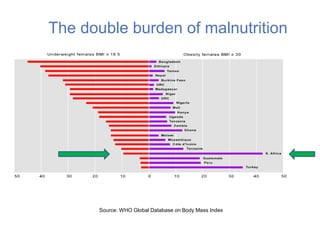
The double burden of malnutrition
Source: WHO Global Database on Body Mass Index
0
10
20
30
40
50
60
70
80
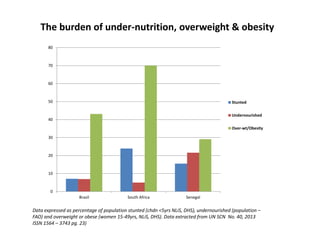
Brazil South Africa Senegal
Stunted
Undernourished
Over-wt/Obesity
The burden of under-nutrition, overweight & obesity
Data expressed as percentage of population stunted (chdn <5yrs NLiS, DHS), undernourished (population –
FAO) and overweight or obese (women 15-49yrs, NLiS, DHS). Data extracted from UN SCN No. 40, 2013
ISSN 1564 – 3743 pg. 23)
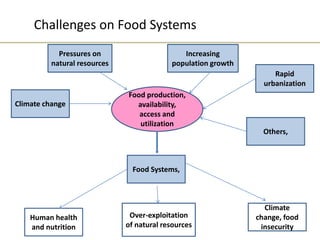
Food production,
availability,
access and
utilization
Pressures on
natural resources
Climate change
Others,
Rapid
urbanization
Increasing
population growth
Food Systems,
Human health
and nutrition
Climate
change, food
insecurity
Over-exploitation
of natural resources
Challenges on Food Systems
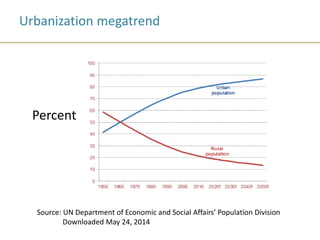
Urbanization megatrend
Percent
Source: UN Department of Economic and Social Affairs’ Population Division
Downloaded May 24, 2014
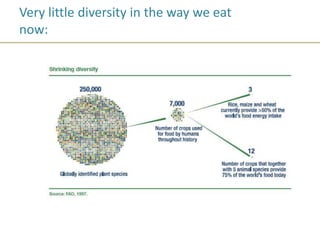
Very little diversity in the way we eat
now:
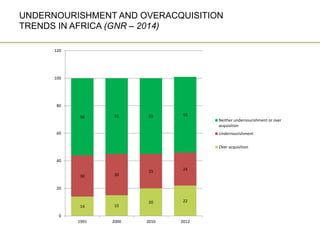
UNDERNOURISHMENT AND OVERACQUISITION
TRENDS IN AFRICA (GNR – 2014)
14 15
20 22
30 30
25 24
56 55 55 55
0
20
40
60
80
100
120
1991 2000 2010 2012
Neither undernourishment or over
acquisition
Undernourishment
Over acquisition
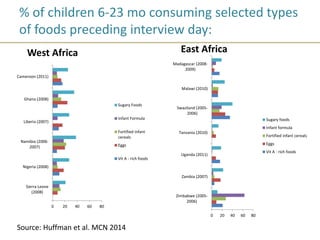
Source: Huffman et al. MCN 2014
0 20 40 60 80
Sierra Leone
(2008)
Nigeria (2008)
Namibia (2006-
2007)
Liberia (2007)
Ghana (2008)
Cameroon (2011)
Sugary Foods
Infant Formula
Fortified infant
cereals
Eggs
Vit A - rich foods
0 20 40 60 80
Zimbabwe (2005-
2006)
Zambia (2007)
Uganda (2011)
Tanzania (2010)
Swaziland (2005-
2006)
Malawi (2010)
Madagascar (2008-
2009)
Sugary foods
Infant formula
Fortified infant cereals
Eggs
Vit A - rich foods
West Africa East Africa
% of children 6-23 mo consuming selected types
of foods preceding interview day:
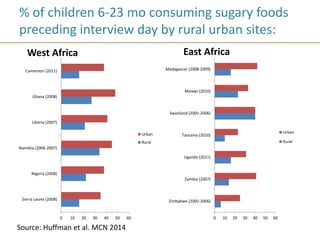
% of children 6-23 mo consuming sugary foods
preceding interview day by rural urban sites:
0 10 20 30 40 50 60
Sierra Leone (2008)
Nigeria (2008)
Namibia (2006-2007)
Liberia (2007)
Ghana (2008)
Cameroon (2011)
Urban
Rural
0 10 20 30 40 50 60
Zimbabwe (2005-2006)
Zambia (2007)
Uganda (2011)
Tanzania (2010)
Swaziland (2005-2006)
Malawi (2010)
Madagascar (2008-2009)
Urban
Rural
West Africa East Africa
Source: Huffman et al. MCN 2014
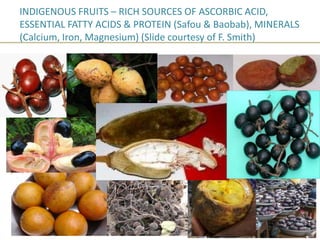
INDIGENOUS FRUITS – RICH SOURCES OF ASCORBIC ACID,
ESSENTIAL FATTY ACIDS & PROTEIN (Safou & Baobab), MINERALS
(Calcium, Iron, Magnesium) (Slide courtesy of F. Smith)
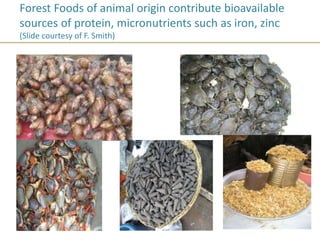
Forest Foods of animal origin contribute bioavailable
sources of protein, micronutrients such as iron, zinc
(Slide courtesy of F. Smith)
The Food System Is Broken: We Need to
Involve All Stakeholder Groups in Finding
Solutions
Posted: 05/05/2014 1:43 pm EDT Updated:
05/05/2014 1:59 pm EDT
OPed in the Huffington Post
by the Executive Director of the Global Alliance
for Improved Nutrition (GAIN).
Basic underlying cause
Poor Quality of diets
Over-processed foods: energy
dense, high in sugar, fat, salt
Local foods and indigenous foods
considered inferior; foods for the
poor
Changes in the diet of populations
 Globalization, urbanization and rising income
growth lead to dietary change. Diets include more:
• animal food products
• fats and oils
• Sugars and high levels of salt
• ultra-processed foods
 Declines in consumption of traditional protein
sources including legumes
Opportunities for Private
Sector to positively influence
the food system
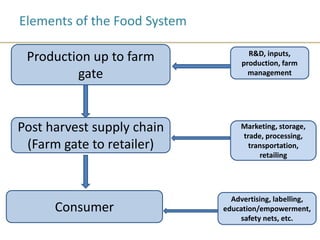
What is the Food System?
Food Systems:
includes the entire range of activities from
agricultural inputs and productions, through
processing, marketing and retailing to consumption.
Food systems also involve the people and
institutions …and technological environment in
which these activities take place (SAFA, 2013)”
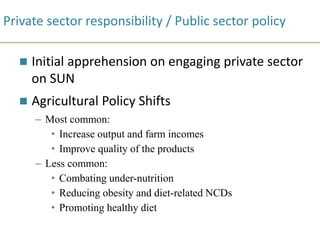
Private sector responsibility / Public sector policy
 Initial apprehension on engaging private sector
on SUN
 Agricultural Policy Shifts
– Most common:
• Increase output and farm incomes
• Improve quality of the products
– Less common:
• Combating under-nutrition
• Reducing obesity and diet-related NCDs
• Promoting healthy diet
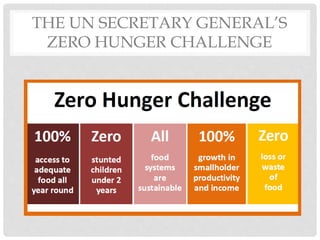
THE UN SECRETARY GENERAL’S
ZERO HUNGER CHALLENGE
Elements of the Food System
Production up to farm
gate
Post harvest supply chain
(Farm gate to retailer)
Consumer
R&D, inputs,
production, farm
management
Advertising, labelling,
education/empowerment,
safety nets, etc.
Marketing, storage,
trade, processing,
transportation,
retailing
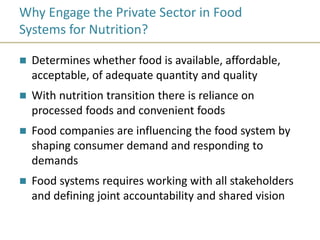
Why Engage the Private Sector in Food
Systems for Nutrition?
 Determines whether food is available, affordable,
acceptable, of adequate quantity and quality
 With nutrition transition there is reliance on
processed foods and convenient foods
 Food companies are influencing the food system by
shaping consumer demand and responding to
demands
 Food systems requires working with all stakeholders
and defining joint accountability and shared vision
Adequate
dietary intake
Health
Access to safe
water, sanitation
& adequate
HEALTH services
Good nutrition and
health
Quantity and quality of actual RESOURCES human, economic &
organisational and the way they are controlled
Potential resources: environment, technology, people
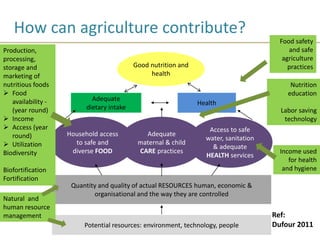
How can agriculture contribute?
Adequate
maternal & child
CARE practices
Household access
to safe and
diverse FOOD
Production,
processing,
storage and
marketing of
nutritious foods
 Food
availability -
(year round)
 Income
 Access (year
round)
 Utilization
Biodiversity
Biofortification
Fortification
Natural and
human resource
management
Nutrition
education
Labor saving
technology
Income used
for health
and hygiene
Food safety
and safe
agriculture
practices
Ref:
Dufour 2011
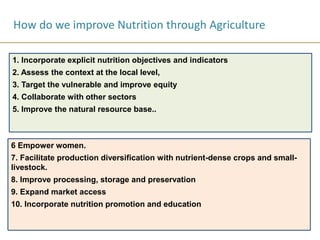
1. Incorporate explicit nutrition objectives and indicators
2. Assess the context at the local level,
3. Target the vulnerable and improve equity
4. Collaborate with other sectors
5. Improve the natural resource base..
6 Empower women.
7. Facilitate production diversification with nutrient-dense crops and small-
livestock.
8. Improve processing, storage and preservation
9. Expand market access
10. Incorporate nutrition promotion and education
How do we improve Nutrition through Agriculture
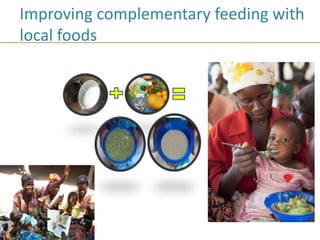
Improving complementary feeding with
local foods
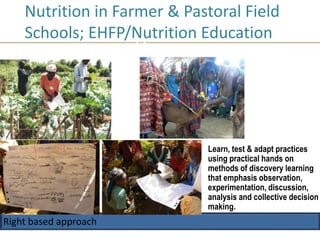
Approach
Right based approach
Learn, test & adapt practices
using practical hands on
methods of discovery learning
that emphasis observation,
experimentation, discussion,
analysis and collective decision
making.
Nutrition in Farmer & Pastoral Field
Schools; EHFP/Nutrition Education
ICN - 2
• Political declaration endorsed by member
states (Rome Declaration on Nutrition)
* Framework for action to guide
implementation of political commitments on
Nutrition
• Defining the rules of engagement,
standards, enforcing regulations, tax
incentives and compliance monitoring.
Private Sector is accountable - To:
i. Promote value chains for enhanced nutrition, improved
processing, storage and preservation while expanding
market access
ii. Increase access to micronutrient rich foods; large scale
fortification and bio-fortified food products
iii. Diversify household food production and consumption
through food-based approaches including animal source
foods
iv. promote Nutrition Research and Information systems
v. Promote Nutrition Education, BCC & Advocacy for
accountable food business operations
Engage private sector appropriately to improve
food system for better nutrition outcomes
 Increasing incentives for the private sector to channel inputs
and services for enhancing food production and marketing
systems that promote increased access to safe and
nutritious foods
 Ensuring that the operations of the private sector do not
endanger and violate the fundamental human right to
adequate nutritious food by the most vulnerable groups;
women and children
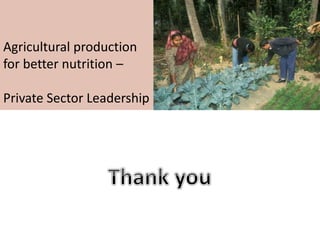
Agricultural production
for better nutrition –
Private Sector Leadership

Mawuli Sablah, Chief Technical Advisor, CAADP Nutrition at FAO Regional Office for Africa

  • 1.
    Engaging Businesses inSUN Country National Nutrition Strategies’ SUN Business Network Workshop: East & Southern Africa 10-12th June, Nairobi Safari Park Club, Kenya Mawuli Sablah Chief Technical Advisor – CAADP Nutrition Mainstreaming – FAO – Regional Office for Africa
  • 2.
    Presentation outline  NutritionTrends in Africa  Challenges on food systems and nutrition  Opportunities to engage private sector to improve food system for nutrition  Food systems and the private sector; working for nutrition  Conclusions
  • 4.
    The double burdenof malnutrition Source: WHO Global Database on Body Mass Index
  • 5.
    0 10 20 30 40 50 60 70 80 Brazil South AfricaSenegal Stunted Undernourished Over-wt/Obesity The burden of under-nutrition, overweight & obesity Data expressed as percentage of population stunted (chdn <5yrs NLiS, DHS), undernourished (population – FAO) and overweight or obese (women 15-49yrs, NLiS, DHS). Data extracted from UN SCN No. 40, 2013 ISSN 1564 – 3743 pg. 23)
  • 6.
    Food production, availability, access and utilization Pressureson natural resources Climate change Others, Rapid urbanization Increasing population growth Food Systems, Human health and nutrition Climate change, food insecurity Over-exploitation of natural resources Challenges on Food Systems
  • 7.
    Urbanization megatrend Percent Source: UNDepartment of Economic and Social Affairs’ Population Division Downloaded May 24, 2014
  • 8.
    Very little diversityin the way we eat now:
  • 9.
    UNDERNOURISHMENT AND OVERACQUISITION TRENDSIN AFRICA (GNR – 2014) 14 15 20 22 30 30 25 24 56 55 55 55 0 20 40 60 80 100 120 1991 2000 2010 2012 Neither undernourishment or over acquisition Undernourishment Over acquisition
  • 10.
    Source: Huffman etal. MCN 2014 0 20 40 60 80 Sierra Leone (2008) Nigeria (2008) Namibia (2006- 2007) Liberia (2007) Ghana (2008) Cameroon (2011) Sugary Foods Infant Formula Fortified infant cereals Eggs Vit A - rich foods 0 20 40 60 80 Zimbabwe (2005- 2006) Zambia (2007) Uganda (2011) Tanzania (2010) Swaziland (2005- 2006) Malawi (2010) Madagascar (2008- 2009) Sugary foods Infant formula Fortified infant cereals Eggs Vit A - rich foods West Africa East Africa % of children 6-23 mo consuming selected types of foods preceding interview day:
  • 11.
    % of children6-23 mo consuming sugary foods preceding interview day by rural urban sites: 0 10 20 30 40 50 60 Sierra Leone (2008) Nigeria (2008) Namibia (2006-2007) Liberia (2007) Ghana (2008) Cameroon (2011) Urban Rural 0 10 20 30 40 50 60 Zimbabwe (2005-2006) Zambia (2007) Uganda (2011) Tanzania (2010) Swaziland (2005-2006) Malawi (2010) Madagascar (2008-2009) Urban Rural West Africa East Africa Source: Huffman et al. MCN 2014
  • 12.
    INDIGENOUS FRUITS –RICH SOURCES OF ASCORBIC ACID, ESSENTIAL FATTY ACIDS & PROTEIN (Safou & Baobab), MINERALS (Calcium, Iron, Magnesium) (Slide courtesy of F. Smith)
  • 13.
    Forest Foods ofanimal origin contribute bioavailable sources of protein, micronutrients such as iron, zinc (Slide courtesy of F. Smith)
  • 14.
    The Food SystemIs Broken: We Need to Involve All Stakeholder Groups in Finding Solutions Posted: 05/05/2014 1:43 pm EDT Updated: 05/05/2014 1:59 pm EDT OPed in the Huffington Post by the Executive Director of the Global Alliance for Improved Nutrition (GAIN).
  • 15.
    Basic underlying cause PoorQuality of diets Over-processed foods: energy dense, high in sugar, fat, salt Local foods and indigenous foods considered inferior; foods for the poor
  • 16.
    Changes in thediet of populations  Globalization, urbanization and rising income growth lead to dietary change. Diets include more: • animal food products • fats and oils • Sugars and high levels of salt • ultra-processed foods  Declines in consumption of traditional protein sources including legumes
  • 17.
    Opportunities for Private Sectorto positively influence the food system
  • 18.
    What is theFood System? Food Systems: includes the entire range of activities from agricultural inputs and productions, through processing, marketing and retailing to consumption. Food systems also involve the people and institutions …and technological environment in which these activities take place (SAFA, 2013)”
  • 19.
    Private sector responsibility/ Public sector policy  Initial apprehension on engaging private sector on SUN  Agricultural Policy Shifts – Most common: • Increase output and farm incomes • Improve quality of the products – Less common: • Combating under-nutrition • Reducing obesity and diet-related NCDs • Promoting healthy diet
  • 20.
    THE UN SECRETARYGENERAL’S ZERO HUNGER CHALLENGE
  • 21.
    Elements of theFood System Production up to farm gate Post harvest supply chain (Farm gate to retailer) Consumer R&D, inputs, production, farm management Advertising, labelling, education/empowerment, safety nets, etc. Marketing, storage, trade, processing, transportation, retailing
  • 22.
    Why Engage thePrivate Sector in Food Systems for Nutrition?  Determines whether food is available, affordable, acceptable, of adequate quantity and quality  With nutrition transition there is reliance on processed foods and convenient foods  Food companies are influencing the food system by shaping consumer demand and responding to demands  Food systems requires working with all stakeholders and defining joint accountability and shared vision
  • 23.
    Adequate dietary intake Health Access tosafe water, sanitation & adequate HEALTH services Good nutrition and health Quantity and quality of actual RESOURCES human, economic & organisational and the way they are controlled Potential resources: environment, technology, people How can agriculture contribute? Adequate maternal & child CARE practices Household access to safe and diverse FOOD Production, processing, storage and marketing of nutritious foods  Food availability - (year round)  Income  Access (year round)  Utilization Biodiversity Biofortification Fortification Natural and human resource management Nutrition education Labor saving technology Income used for health and hygiene Food safety and safe agriculture practices Ref: Dufour 2011
  • 24.
    1. Incorporate explicitnutrition objectives and indicators 2. Assess the context at the local level, 3. Target the vulnerable and improve equity 4. Collaborate with other sectors 5. Improve the natural resource base.. 6 Empower women. 7. Facilitate production diversification with nutrient-dense crops and small- livestock. 8. Improve processing, storage and preservation 9. Expand market access 10. Incorporate nutrition promotion and education How do we improve Nutrition through Agriculture
  • 25.
  • 26.
    Approach Right based approach Learn,test & adapt practices using practical hands on methods of discovery learning that emphasis observation, experimentation, discussion, analysis and collective decision making. Nutrition in Farmer & Pastoral Field Schools; EHFP/Nutrition Education
  • 27.
    ICN - 2 •Political declaration endorsed by member states (Rome Declaration on Nutrition) * Framework for action to guide implementation of political commitments on Nutrition • Defining the rules of engagement, standards, enforcing regulations, tax incentives and compliance monitoring.
  • 28.
    Private Sector isaccountable - To: i. Promote value chains for enhanced nutrition, improved processing, storage and preservation while expanding market access ii. Increase access to micronutrient rich foods; large scale fortification and bio-fortified food products iii. Diversify household food production and consumption through food-based approaches including animal source foods iv. promote Nutrition Research and Information systems v. Promote Nutrition Education, BCC & Advocacy for accountable food business operations
  • 29.
    Engage private sectorappropriately to improve food system for better nutrition outcomes  Increasing incentives for the private sector to channel inputs and services for enhancing food production and marketing systems that promote increased access to safe and nutritious foods  Ensuring that the operations of the private sector do not endanger and violate the fundamental human right to adequate nutritious food by the most vulnerable groups; women and children
  • 30.
    Agricultural production for betternutrition – Private Sector Leadership