Kenya Agricultural Research Institute                            www.kari.org


              Mainstreaming Biodiversity
             Conservation and Sustainable
               Use for Improved Human
               Nutrition and Wellbeing
                  Country Presentation for Kenya
                                      1st ISC Meeting
                               Rio de Janeiro 25th April 2012

                           Maureen Miruka & Festus Murithi
                         Kenya Agricultural Research Institute
                                                                       1
Kenya Agricultural Research Institute                      www.kari.org


                           Introduction –KARI
     • Established through an Act of Parliament (Cap 250,
       revised 1979) and became operational in 1986.
     • Accounts for more than half of the total research and
       development (R&D) expenditure in Kenya
     • Is responsible for research on crops (except research on
       coffee, tea and sugarcane), livestock, and land and
       water resources.
     • Has a network of national, commodity factor & regional
       research centres responsible for applied and adaptive
       research in respective regions.
     • It currently has a staff capacity of 2,930 with 543 being
       researchers and the rest support staff.
                                                                 2
Kenya Agricultural Research Institute                www.kari.org


            KARI goals and thematic areas
     • Institutional goals: i) generating and promoting
       technologies and innovations; ii) developing and
       promoting markets and marketing strategies; iii)
       facilitating and advocating policy options; iv)
       strengthening capacity for value chain research;
       and v) enhancing availability of knowledge,
       information and technologies.
     • Thematic research areas: crops; livestock;
       integrated natural resource management;
       biotechnology and genetic resources
       management; socio-economic and applied
       statistics; and adaptive research, outreach and
       partnerships.
                                                           3
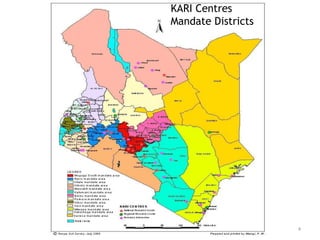
KARI Centres
Mandate Districts


                    4
Kenya Agricultural Research Institute           www.kari.org


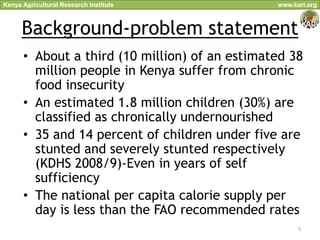
      Background-problem statement
      • About a third (10 million) of an estimated 38
        million people in Kenya suffer from chronic
        food insecurity
      • An estimated 1.8 million children (30%) are
        classified as chronically undernourished
      • 35 and 14 percent of children under five are
        stunted and severely stunted respectively
        (KDHS 2008/9)-Even in years of self
        sufficiency
      • The national per capita calorie supply per
        day is less than the FAO recommended rates
                                                      5
Kenya Agricultural Research Institute           www.kari.org


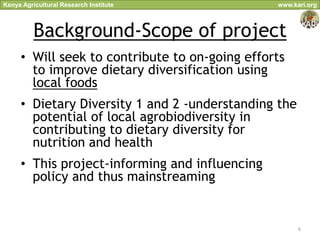
          Background-Scope of project
     • Will seek to contribute to on-going efforts
       to improve dietary diversification using
       local foods
     • Dietary Diversity 1 and 2 -understanding the
       potential of local agrobiodiversity in
       contributing to dietary diversity for
       nutrition and health
     • This project-informing and influencing
       policy and thus mainstreaming


                                                      6
Kenya Agricultural Research Institute              www.kari.org


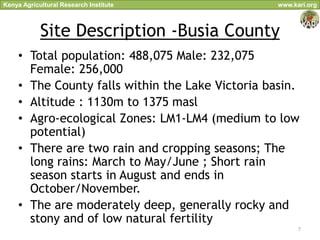
            Site Description -Busia County
     • Total population: 488,075 Male: 232,075
       Female: 256,000
     • The County falls within the Lake Victoria basin.
     • Altitude : 1130m to 1375 masl
     • Agro-ecological Zones: LM1-LM4 (medium to low
       potential)
     • There are two rain and cropping seasons; The
       long rains: March to May/June ; Short rain
       season starts in August and ends in
       October/November.
     • The are moderately deep, generally rocky and
       stony and of low natural fertility
                                                         7
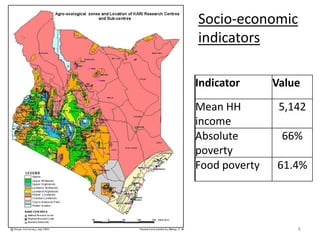
Socio-economic
indicators

Indicator      Value
Mean HH         5,142
income
Absolute        66%
poverty
Food poverty   61.4%


                   8
Kenya Agricultural Research Institute                       www.kari.org

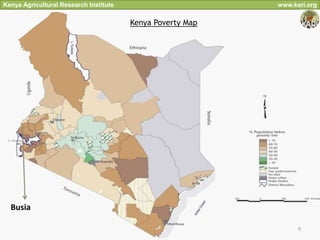
                                        Kenya Poverty Map


  Busia

                                                                  9
Kenya Agricultural Research Institute                   www.kari.org


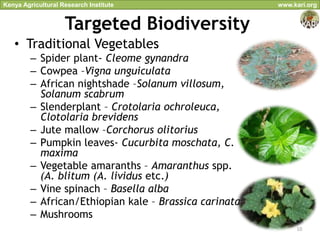
                    Targeted Biodiversity
   • Traditional Vegetables
         – Spider plant- Cleome gynandra
         – Cowpea –Vigna unguiculata
         – African nightshade –Solanum villosum,
           Solanum scabrum
         – Slenderplant – Crotolaria ochroleuca,
           Clotolaria brevidens
         – Jute mallow –Corchorus olitorius
         – Pumpkin leaves- Cucurbita moschata, C.
           maxima
         – Vegetable amaranths – Amaranthus spp.
           (A. blitum (A. lividus etc.)
         – Vine spinach – Basella alba
         – African/Ethiopian kale – Brassica carinata
         – Mushrooms
                                                             10
Kenya Agricultural Research Institute                  www.kari.org


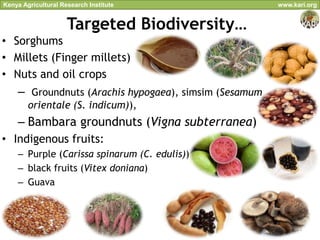
                     Targeted Biodiversity…
• Sorghums
• Millets (Finger millets)
• Nuts and oil crops
    – Groundnuts (Arachis hypogaea), simsim (Sesamum
        orientale (S. indicum)),
    – Bambara groundnuts (Vigna subterranea)
• Indigenous fruits:
    – Purple (Carissa spinarum (C. edulis))
    – black fruits (Vitex doniana)
    – Guava


                                                            11
Kenya Agricultural Research Institute   www.kari.org


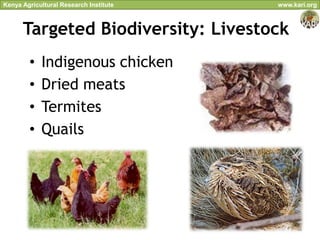
      Targeted Biodiversity: Livestock
        •   Indigenous chicken
        •   Dried meats
        •   Termites
        •   Quails


                                             12
Kenya Agricultural Research Institute                      www.kari.org


             Activities: Knowledge base
        1.1 Assessments in Pilot Sites
             – Baseline studies
             – Nutritional value of select biodiversity
             – Nutritional status of target population
             – Training in participatory food, nutrition
               and health assessment methodology
        1.2 Information Management
             – Production information on species
             – Food composition of target species
             – Comparative studies
                                                                13
Kenya Agricultural Research Institute         www.kari.org


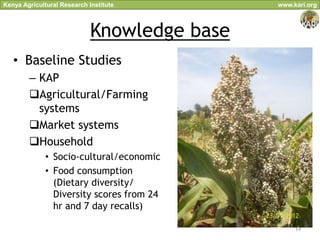
                             Knowledge base
   • Baseline Studies
        – KAP
        Agricultural/Farming
          systems
        Market systems
        Household
              • Socio-cultural/economic
              • Food consumption
                (Dietary diversity/
                Diversity scores from 24
                hr and 7 day recalls)

                                                   14
Kenya Agricultural Research Institute     www.kari.org


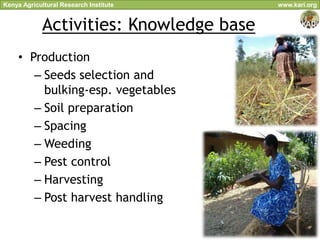
             Activities: Knowledge base
     • Production
        – Seeds selection and
          bulking-esp. vegetables
        – Soil preparation
        – Spacing
        – Weeding
        – Pest control
        – Harvesting
        – Post harvest handling

                                               15
Kenya Agricultural Research Institute              www.kari.org


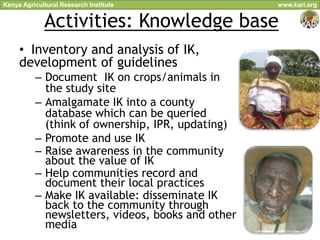
             Activities: Knowledge base
     • Inventory and analysis of IK,
     development of guidelines
          – Document IK on crops/animals in
            the study site
          – Amalgamate IK into a county
            database which can be queried
            (think of ownership, IPR, updating)
          – Promote and use IK
          – Raise awareness in the community
            about the value of IK
          – Help communities record and
            document their local practices
          – Make IK available: disseminate IK
            back to the community through
            newsletters, videos, books and other
            media                                       16
Kenya Agricultural Research Institute                              www.kari.org

                      Activities:
            Policy & Regulatory Framework
       • 2.1 Developing policies and strategies to mainstream
            – Analysis and synthesis of sector policies
       • 2.2 Establishing cross sectoral platforms
            – Creation of local, regional and national fora
       • 2.3 Drafting policy guidance
            – Development of evidence-backed policy recommendations &
              guidelines
       • 2.4 Improving marketing options
            –   Value chain analysis of target species
            –   Identification and analysis of input and output markets
            –   Value addition of the species
            –   Capacity building of target groups -market linkages,
                collective marketing

                                                                          17
Kenya Agricultural Research Institute   www.kari.org


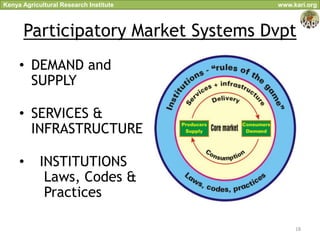
      Participatory Market Systems Dvpt
     • DEMAND and
       SUPPLY

     • SERVICES &
       INFRASTRUCTURE

     •      INSTITUTIONS
             Laws, Codes &
             Practices

                                             18
Kenya Agricultural Research Institute                              www.kari.org


      Activities: Awareness & Outscaling
       • 3.1 Best Practices for mobilising agrobiodiversity
            – Packaging & dissemination of best practices for
              mobilizing biodiversity
       • 3.2 Improving capacity of relevant actors
            – Development of guidelines and training modules
       • 3.3 National information campaigns
            – Development of awareness materials
            – Publicity fora- seed fairs, print and electronic media,
              exhibitions
       • Guidelines for improved use of nutritionally rich
         foods
            – Development of training modules
       • Documentation of tools & methods for mainstreaming
            – Development and sharing of information using policy
              briefs, journal articles and project reports
                                                                        19
Kenya Agricultural Research Institute          www.kari.org


                Awareness raising strategy
          • Local NGOs to reach communities
          • Flagship crops & livestock
          • Diversity of markets
          • Institutional markets
          • Key selling points – Good sources of
            micro-nutrients
          • Stakeholder participation in promotion


                                                    20
Kenya Agricultural Research Institute      www.kari.org


                    Promotion techniques
     • School gardens and meals
       programs
     • Education    and    awareness
       material (T-shirt, brochures,
       banners, posters)
     • Use of the media (FM radios,
       TV stations)
     • Fairs -Food and seed fairs
       involving    famer     groups,
       restaurants and manufacturers
     • Cultural events hosted by
       large hotels and serving local
       foods
     • Publications and resources
                                                21
Kenya Agricultural Research Institute                        www.kari.org


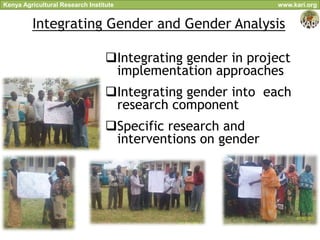
         Integrating Gender and Gender Analysis

                                  Integrating gender in project
                                   implementation approaches
                                  Integrating gender into each
                                   research component
                                  Specific research and
                                   interventions on gender
Kenya Agricultural Research Institute            www.kari.org


                              Country Partners
     • Kenya Agricultural Research Institute
     • Kenyatta University
     • National Museums of Kenya
     • Ministries of Agriculture, Health & Education
     • NGOs -Rural Outreach Program & market
       linkages
     • National Environmental Management
       Authority

     *Role of Private Sector
     *Role of ASCU & MoA Policy Division
                                                      23
Kenya Agricultural Research Institute               www.kari.org


           Capacity Building –strengths
     •   Socio-economics, policy and marketing research
     •   Participatory Monitoring and Evaluation
     •   Nutrition, public health & epidemiology
     •   Documentation of indigenous knowledge
     •   Seed science and biodiversity conservation
     •   Ethno-botany and agro-biodiversity promotion
     •   Food nutrition and dietetics
     •   Public health nutrition
     •   Policy Analysis
     •   Gender mainstreaming and analysis

                                                          24
Kenya Agricultural Research Institute         www.kari.org


                    Capacity Building-Needs
     •   Market development and linkages
     •   Policy Engagement
     •   Nutrient and phytochemical analysis
     •   Product development
     •   Climate change
     •   Participatory Monitoring and Evaluation
     •   Public awareness
     •   Partnerships

                                                   25
Kenya Agricultural Research Institute           www.kari.org


                                Opportunities
       •   Public awareness on health foods
       •   Political good will –e.g. ASDS, FSNP
       •   Studentships
       •   International partners
       •   Outreach and partnerships focus in KARI
           and CGIAR


                                                     26
Kenya Agricultural Research Institute              www.kari.org


                       Immediate Next Steps
     •   National Steering Committee Meeting
     •   Administrative issues
     •   Specific site selection (Village level)
     •   Reconnaissance visits
     •   Baseline studies planning and execution

     Studentships

                                                        27
Kenya Agricultural Research Institute       www.kari.org


                             AHSANTE SANA

BFN Project - Kenya component

  • 1.
    Kenya Agricultural ResearchInstitute www.kari.org Mainstreaming Biodiversity Conservation and Sustainable Use for Improved Human Nutrition and Wellbeing Country Presentation for Kenya 1st ISC Meeting Rio de Janeiro 25th April 2012 Maureen Miruka & Festus Murithi Kenya Agricultural Research Institute 1
  • 2.
    Kenya Agricultural ResearchInstitute www.kari.org Introduction –KARI • Established through an Act of Parliament (Cap 250, revised 1979) and became operational in 1986. • Accounts for more than half of the total research and development (R&D) expenditure in Kenya • Is responsible for research on crops (except research on coffee, tea and sugarcane), livestock, and land and water resources. • Has a network of national, commodity factor & regional research centres responsible for applied and adaptive research in respective regions. • It currently has a staff capacity of 2,930 with 543 being researchers and the rest support staff. 2
  • 3.
    Kenya Agricultural ResearchInstitute www.kari.org KARI goals and thematic areas • Institutional goals: i) generating and promoting technologies and innovations; ii) developing and promoting markets and marketing strategies; iii) facilitating and advocating policy options; iv) strengthening capacity for value chain research; and v) enhancing availability of knowledge, information and technologies. • Thematic research areas: crops; livestock; integrated natural resource management; biotechnology and genetic resources management; socio-economic and applied statistics; and adaptive research, outreach and partnerships. 3
  • 4.
  • 5.
    Kenya Agricultural ResearchInstitute www.kari.org Background-problem statement • About a third (10 million) of an estimated 38 million people in Kenya suffer from chronic food insecurity • An estimated 1.8 million children (30%) are classified as chronically undernourished • 35 and 14 percent of children under five are stunted and severely stunted respectively (KDHS 2008/9)-Even in years of self sufficiency • The national per capita calorie supply per day is less than the FAO recommended rates 5
  • 6.
    Kenya Agricultural ResearchInstitute www.kari.org Background-Scope of project • Will seek to contribute to on-going efforts to improve dietary diversification using local foods • Dietary Diversity 1 and 2 -understanding the potential of local agrobiodiversity in contributing to dietary diversity for nutrition and health • This project-informing and influencing policy and thus mainstreaming 6
  • 7.
    Kenya Agricultural ResearchInstitute www.kari.org Site Description -Busia County • Total population: 488,075 Male: 232,075 Female: 256,000 • The County falls within the Lake Victoria basin. • Altitude : 1130m to 1375 masl • Agro-ecological Zones: LM1-LM4 (medium to low potential) • There are two rain and cropping seasons; The long rains: March to May/June ; Short rain season starts in August and ends in October/November. • The are moderately deep, generally rocky and stony and of low natural fertility 7
  • 8.
    Socio-economic indicators Indicator Value Mean HH 5,142 income Absolute 66% poverty Food poverty 61.4% 8
  • 9.
    Kenya Agricultural ResearchInstitute www.kari.org Kenya Poverty Map Busia 9
  • 10.
    Kenya Agricultural ResearchInstitute www.kari.org Targeted Biodiversity • Traditional Vegetables – Spider plant- Cleome gynandra – Cowpea –Vigna unguiculata – African nightshade –Solanum villosum, Solanum scabrum – Slenderplant – Crotolaria ochroleuca, Clotolaria brevidens – Jute mallow –Corchorus olitorius – Pumpkin leaves- Cucurbita moschata, C. maxima – Vegetable amaranths – Amaranthus spp. (A. blitum (A. lividus etc.) – Vine spinach – Basella alba – African/Ethiopian kale – Brassica carinata – Mushrooms 10
  • 11.
    Kenya Agricultural ResearchInstitute www.kari.org Targeted Biodiversity… • Sorghums • Millets (Finger millets) • Nuts and oil crops – Groundnuts (Arachis hypogaea), simsim (Sesamum orientale (S. indicum)), – Bambara groundnuts (Vigna subterranea) • Indigenous fruits: – Purple (Carissa spinarum (C. edulis)) – black fruits (Vitex doniana) – Guava 11
  • 12.
    Kenya Agricultural ResearchInstitute www.kari.org Targeted Biodiversity: Livestock • Indigenous chicken • Dried meats • Termites • Quails 12
  • 13.
    Kenya Agricultural ResearchInstitute www.kari.org Activities: Knowledge base 1.1 Assessments in Pilot Sites – Baseline studies – Nutritional value of select biodiversity – Nutritional status of target population – Training in participatory food, nutrition and health assessment methodology 1.2 Information Management – Production information on species – Food composition of target species – Comparative studies 13
  • 14.
    Kenya Agricultural ResearchInstitute www.kari.org Knowledge base • Baseline Studies – KAP Agricultural/Farming systems Market systems Household • Socio-cultural/economic • Food consumption (Dietary diversity/ Diversity scores from 24 hr and 7 day recalls) 14
  • 15.
    Kenya Agricultural ResearchInstitute www.kari.org Activities: Knowledge base • Production – Seeds selection and bulking-esp. vegetables – Soil preparation – Spacing – Weeding – Pest control – Harvesting – Post harvest handling 15
  • 16.
    Kenya Agricultural ResearchInstitute www.kari.org Activities: Knowledge base • Inventory and analysis of IK, development of guidelines – Document IK on crops/animals in the study site – Amalgamate IK into a county database which can be queried (think of ownership, IPR, updating) – Promote and use IK – Raise awareness in the community about the value of IK – Help communities record and document their local practices – Make IK available: disseminate IK back to the community through newsletters, videos, books and other media 16
  • 17.
    Kenya Agricultural ResearchInstitute www.kari.org Activities: Policy & Regulatory Framework • 2.1 Developing policies and strategies to mainstream – Analysis and synthesis of sector policies • 2.2 Establishing cross sectoral platforms – Creation of local, regional and national fora • 2.3 Drafting policy guidance – Development of evidence-backed policy recommendations & guidelines • 2.4 Improving marketing options – Value chain analysis of target species – Identification and analysis of input and output markets – Value addition of the species – Capacity building of target groups -market linkages, collective marketing 17
  • 18.
    Kenya Agricultural ResearchInstitute www.kari.org Participatory Market Systems Dvpt • DEMAND and SUPPLY • SERVICES & INFRASTRUCTURE • INSTITUTIONS Laws, Codes & Practices 18
  • 19.
    Kenya Agricultural ResearchInstitute www.kari.org Activities: Awareness & Outscaling • 3.1 Best Practices for mobilising agrobiodiversity – Packaging & dissemination of best practices for mobilizing biodiversity • 3.2 Improving capacity of relevant actors – Development of guidelines and training modules • 3.3 National information campaigns – Development of awareness materials – Publicity fora- seed fairs, print and electronic media, exhibitions • Guidelines for improved use of nutritionally rich foods – Development of training modules • Documentation of tools & methods for mainstreaming – Development and sharing of information using policy briefs, journal articles and project reports 19
  • 20.
    Kenya Agricultural ResearchInstitute www.kari.org Awareness raising strategy • Local NGOs to reach communities • Flagship crops & livestock • Diversity of markets • Institutional markets • Key selling points – Good sources of micro-nutrients • Stakeholder participation in promotion 20
  • 21.
    Kenya Agricultural ResearchInstitute www.kari.org Promotion techniques • School gardens and meals programs • Education and awareness material (T-shirt, brochures, banners, posters) • Use of the media (FM radios, TV stations) • Fairs -Food and seed fairs involving famer groups, restaurants and manufacturers • Cultural events hosted by large hotels and serving local foods • Publications and resources 21
  • 22.
    Kenya Agricultural ResearchInstitute www.kari.org Integrating Gender and Gender Analysis Integrating gender in project implementation approaches Integrating gender into each research component Specific research and interventions on gender
  • 23.
    Kenya Agricultural ResearchInstitute www.kari.org Country Partners • Kenya Agricultural Research Institute • Kenyatta University • National Museums of Kenya • Ministries of Agriculture, Health & Education • NGOs -Rural Outreach Program & market linkages • National Environmental Management Authority *Role of Private Sector *Role of ASCU & MoA Policy Division 23
  • 24.
    Kenya Agricultural ResearchInstitute www.kari.org Capacity Building –strengths • Socio-economics, policy and marketing research • Participatory Monitoring and Evaluation • Nutrition, public health & epidemiology • Documentation of indigenous knowledge • Seed science and biodiversity conservation • Ethno-botany and agro-biodiversity promotion • Food nutrition and dietetics • Public health nutrition • Policy Analysis • Gender mainstreaming and analysis 24
  • 25.
    Kenya Agricultural ResearchInstitute www.kari.org Capacity Building-Needs • Market development and linkages • Policy Engagement • Nutrient and phytochemical analysis • Product development • Climate change • Participatory Monitoring and Evaluation • Public awareness • Partnerships 25
  • 26.
    Kenya Agricultural ResearchInstitute www.kari.org Opportunities • Public awareness on health foods • Political good will –e.g. ASDS, FSNP • Studentships • International partners • Outreach and partnerships focus in KARI and CGIAR 26
  • 27.
    Kenya Agricultural ResearchInstitute www.kari.org Immediate Next Steps • National Steering Committee Meeting • Administrative issues • Specific site selection (Village level) • Reconnaissance visits • Baseline studies planning and execution Studentships 27
  • 28.
    Kenya Agricultural ResearchInstitute www.kari.org AHSANTE SANA