The Biodiversity for Food and Nutrition Initiative
Teresa Borelli, Programme Specialist
SADC Meeting, Rome 27 February 2015
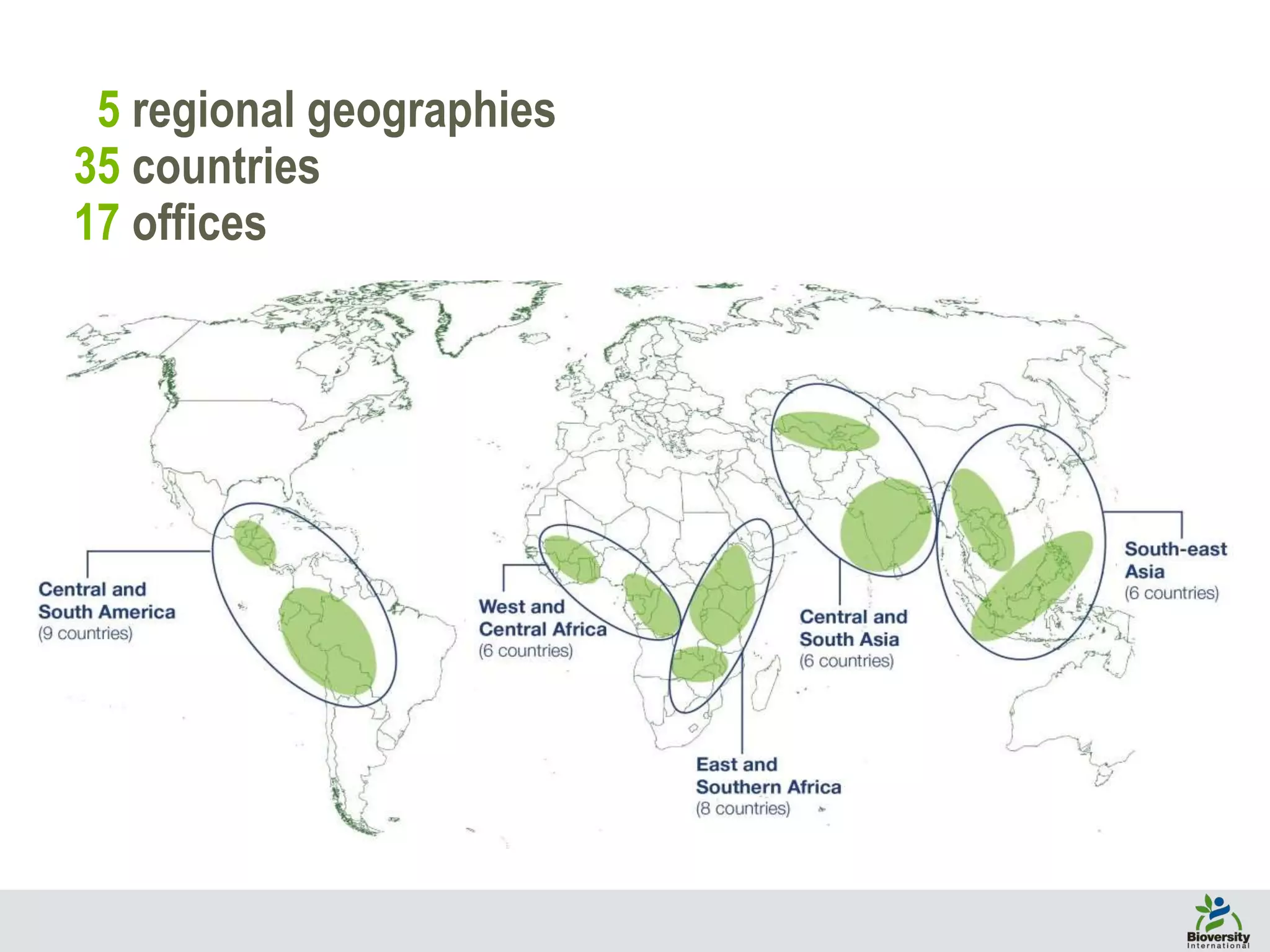
05 regional geographies
35 countries
17 offices
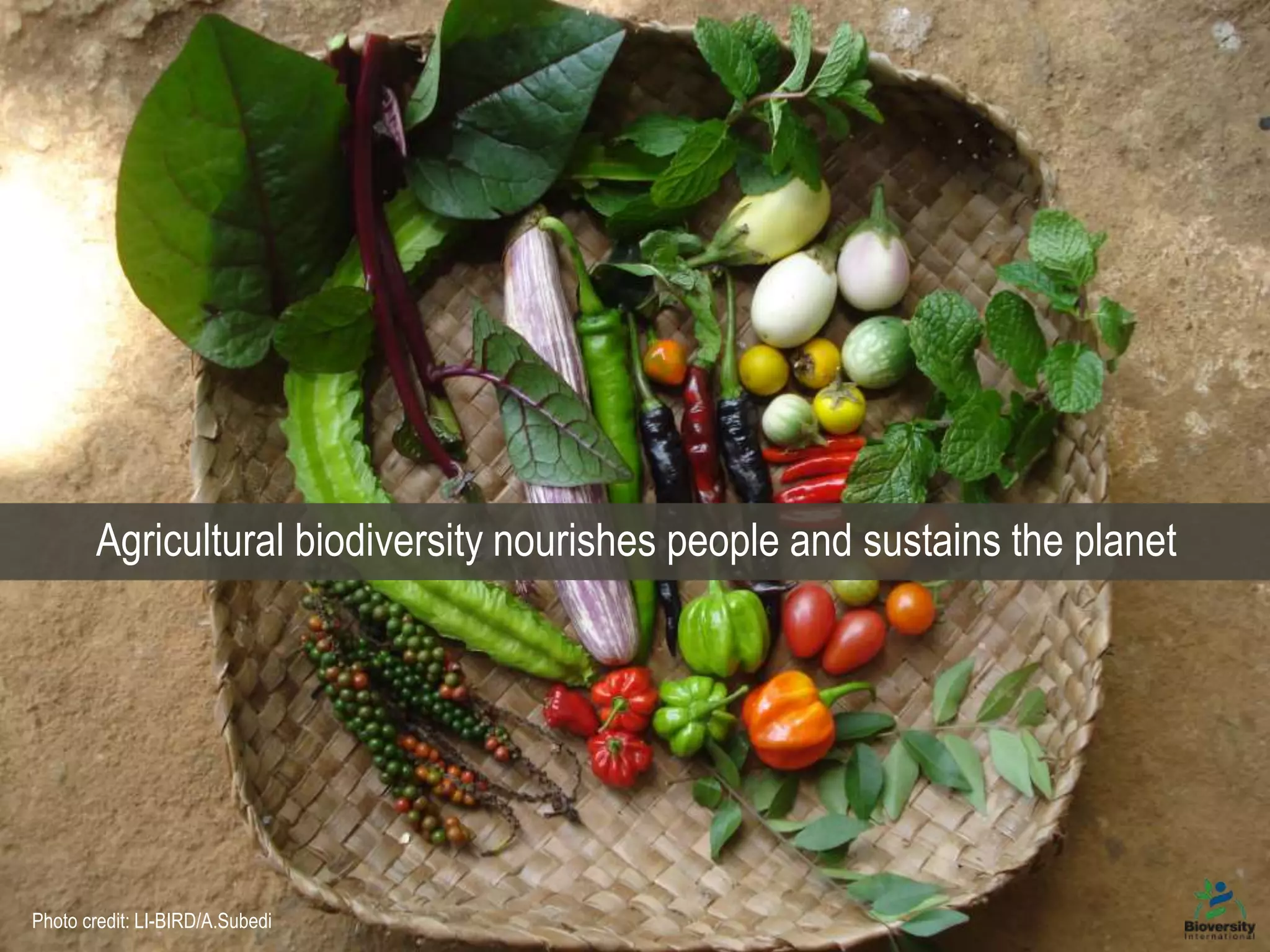
Agricultural biodiversity nourishes people and sustains the planet
Photo credit: LI-BIRD/A.Subedi
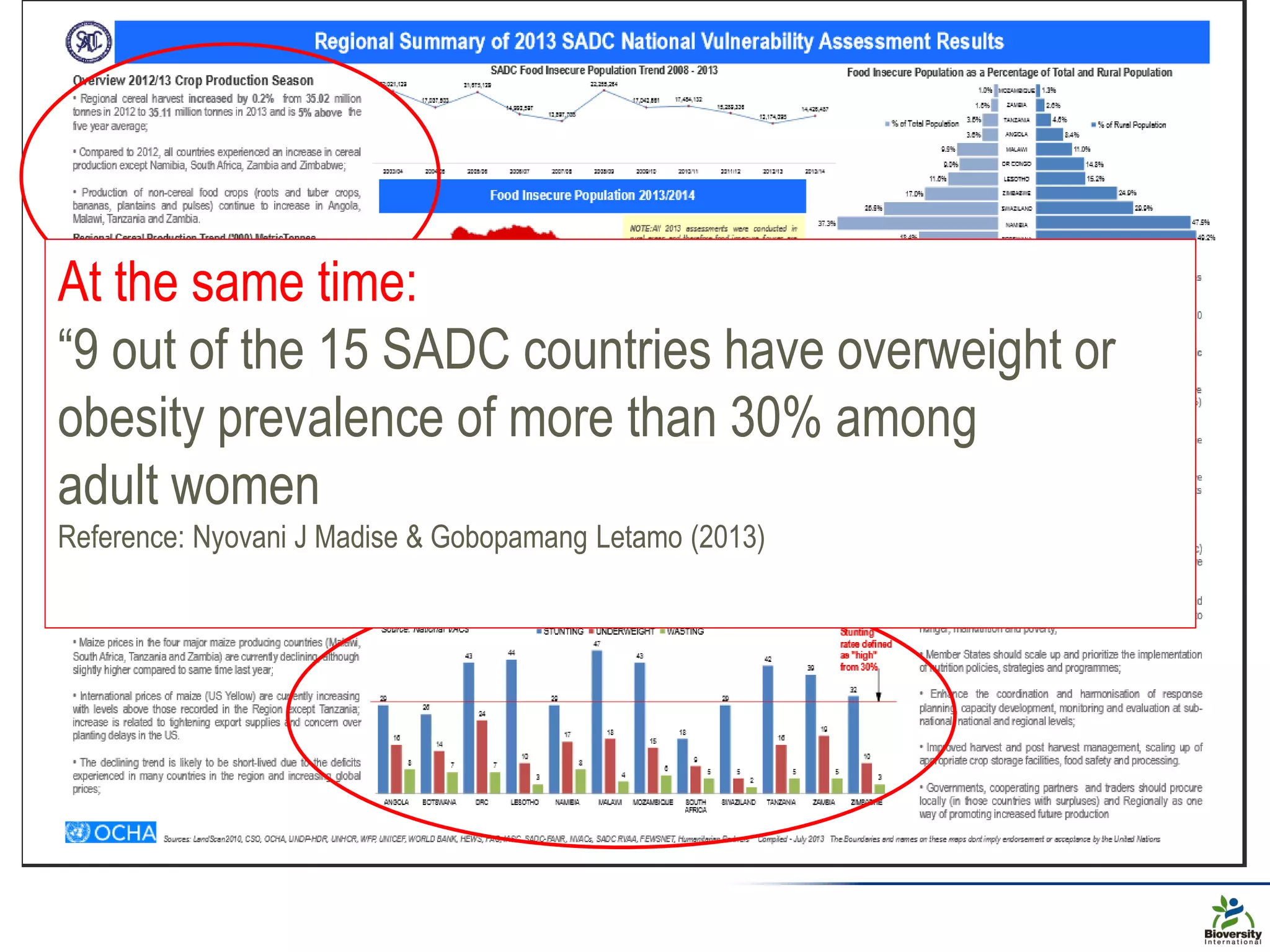
At the same time:
“9 out of the 15 SADC countries have overweight or
obesity prevalence of more than 30% among
adult women
Reference: Nyovani J Madise & Gobopamang Letamo (2013)
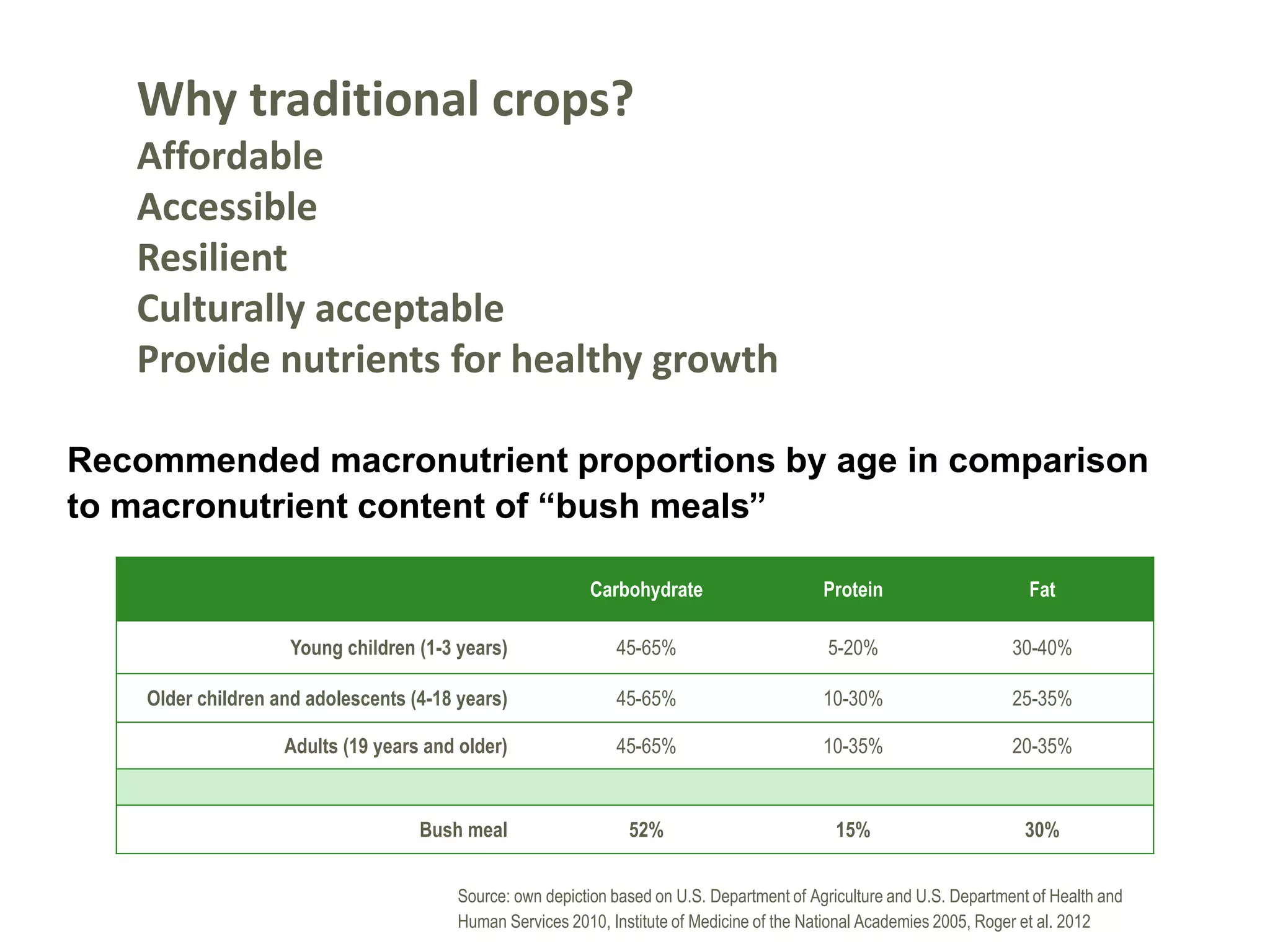
Carbohydrate Protein Fat
Young children (1-3 years) 45-65% 5-20% 30-40%
Older children and adolescents (4-18 years) 45-65% 10-30% 25-35%
Adults (19 years and older) 45-65% 10-35% 20-35%
Bush meal 52% 15% 30%
Source: own depiction based on U.S. Department of Agriculture and U.S. Department of Health and
Human Services 2010, Institute of Medicine of the National Academies 2005, Roger et al. 2012
Recommended macronutrient proportions by age in comparison
to macronutrient content of “bush meals”
Why traditional crops?
Affordable
Accessible
Resilient
Culturally acceptable
Provide nutrients for healthy growth
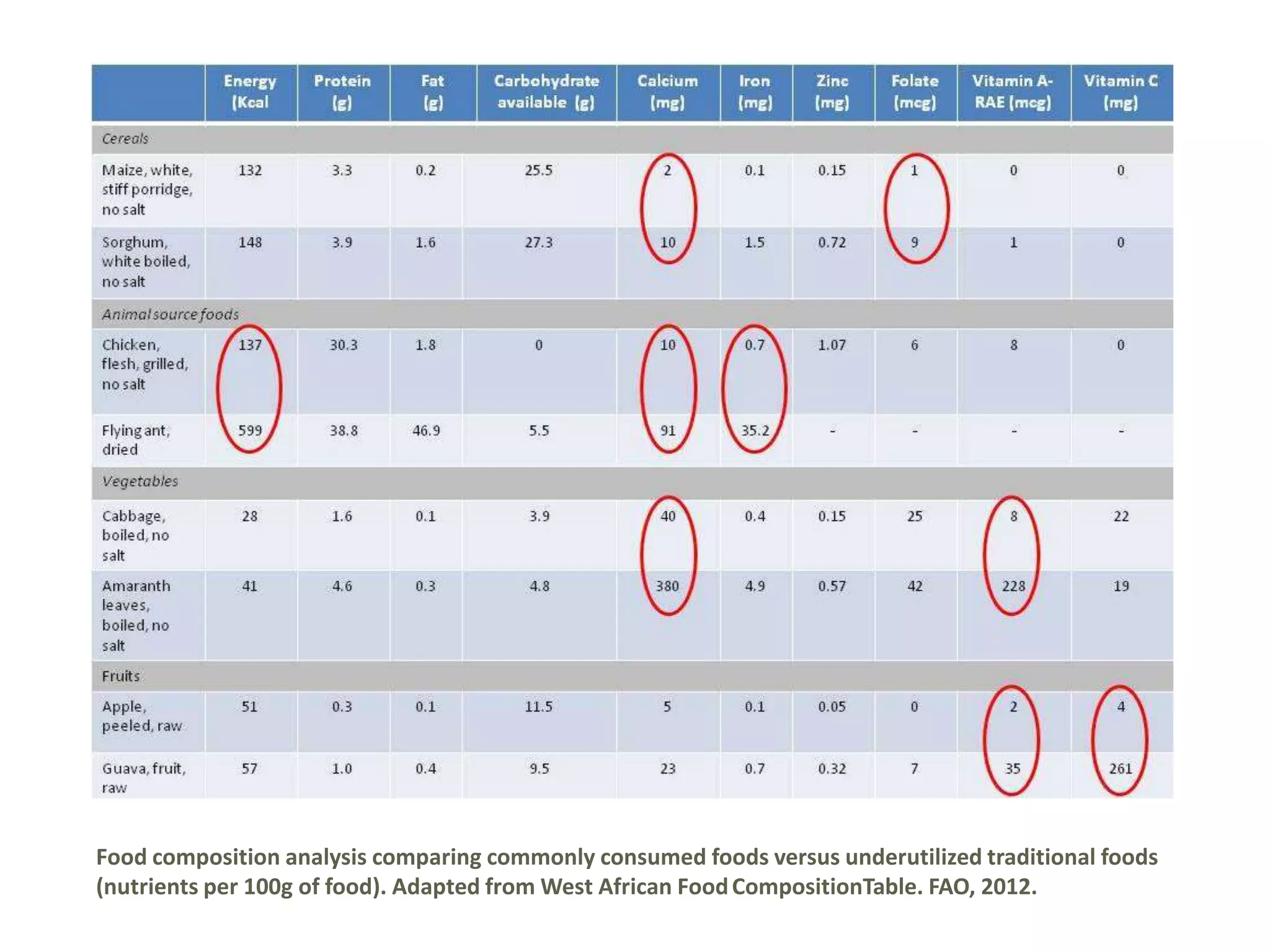
Food composition analysis comparing commonly consumed foods versus underutilized traditional foods
(nutrients per 100g of food). Adapted from West African FoodCompositionTable. FAO, 2012.
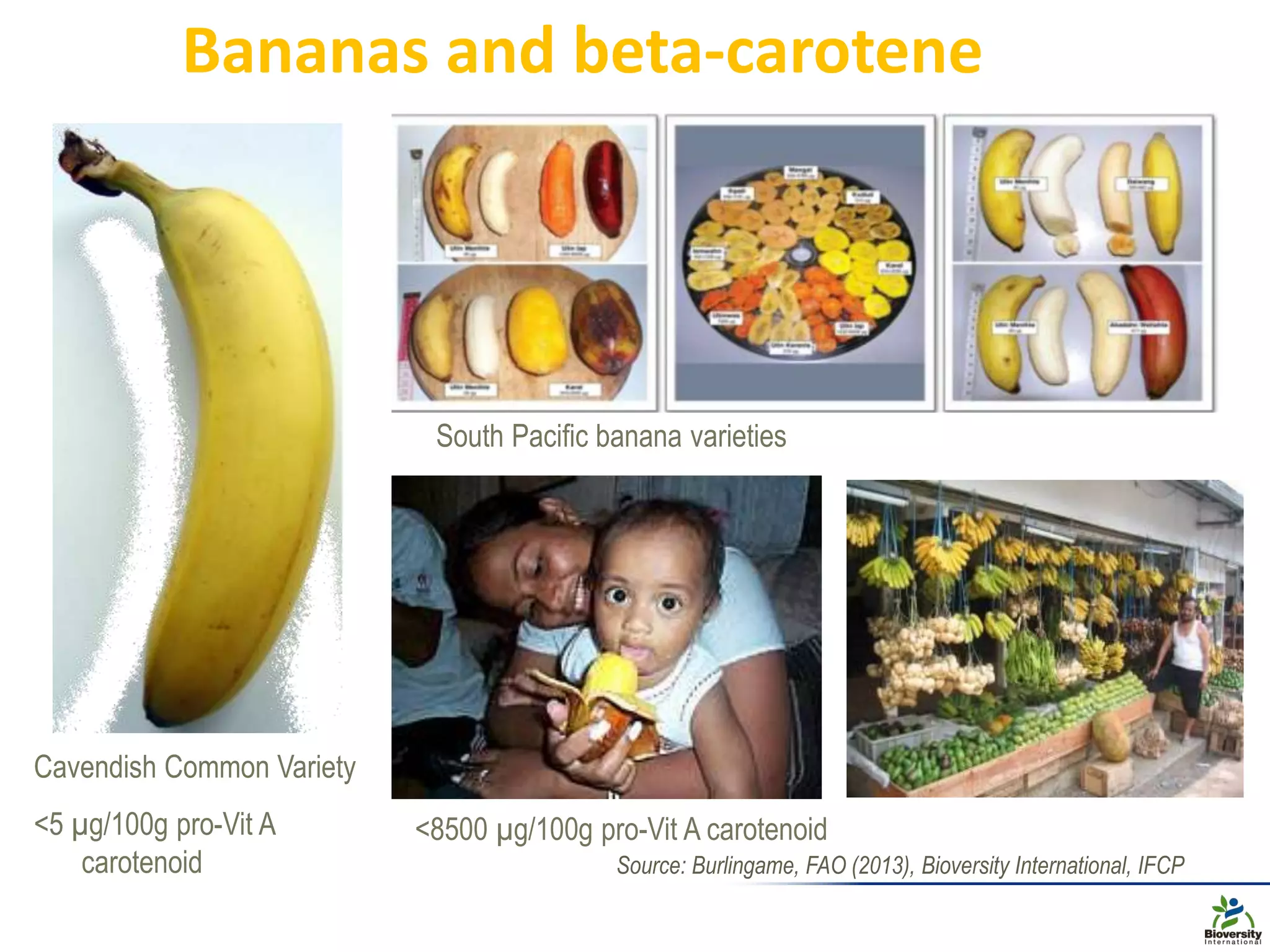
Bananas and beta-carotene
Cavendish Common Variety
<5 µg/100g pro-Vit A
carotenoid
<8500 µg/100g pro-Vit A carotenoid
South Pacific banana varieties
Source: Burlingame, FAO (2013), Bioversity International, IFCP
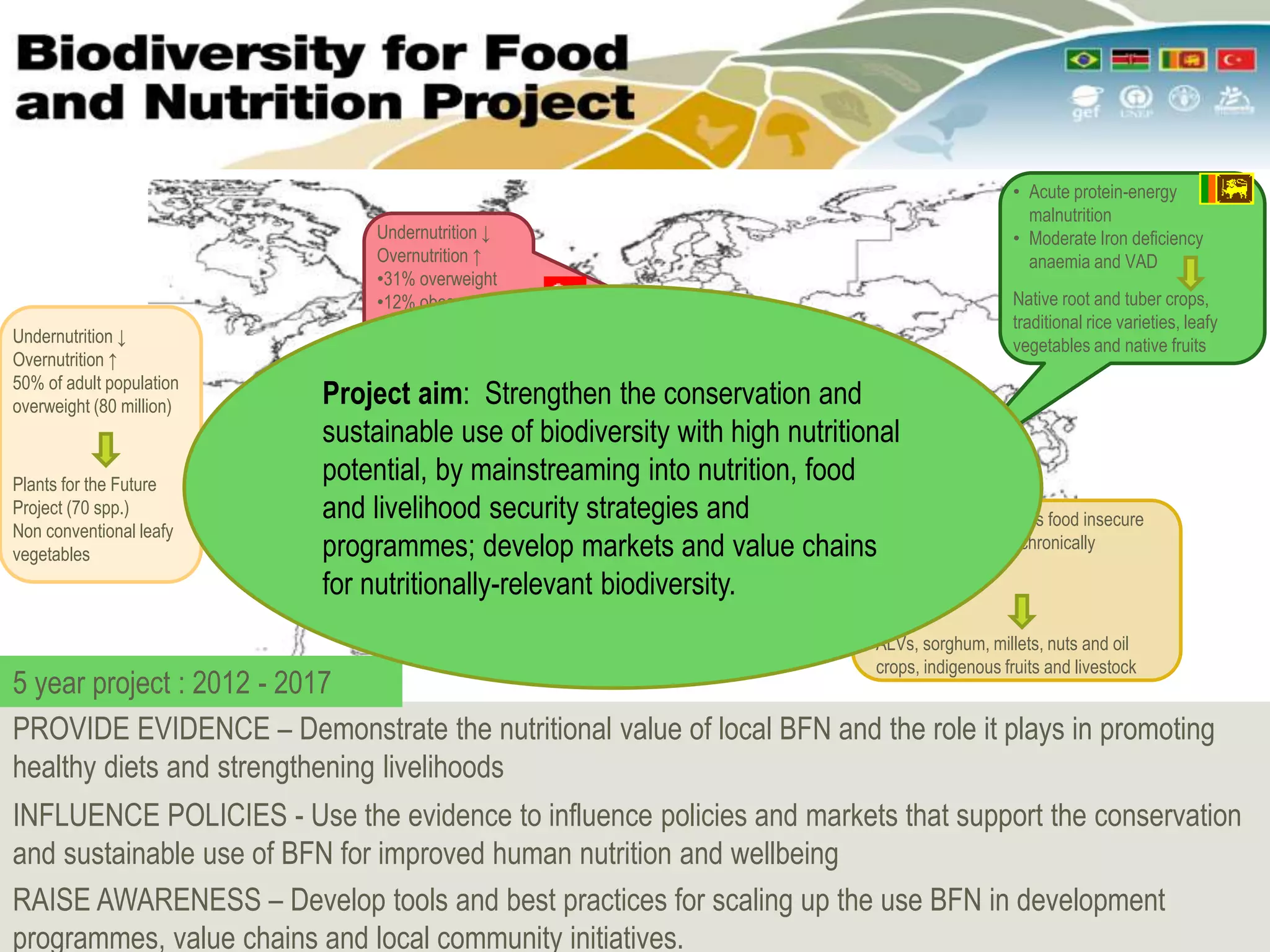
PROVIDE EVIDENCE – Demonstrate the nutritional value of local BFN and the role it plays in promoting
healthy diets and strengthening livelihoods
INFLUENCE POLICIES - Use the evidence to influence policies and markets that support the conservation
and sustainable use of BFN for improved human nutrition and wellbeing
RAISE AWARENESS – Develop tools and best practices for scaling up the use BFN in development
programmes, value chains and local community initiatives.
•1/3 of the population is food insecure
•1.8 million children chronically
undernourished
ALVs, sorghum, millets, nuts and oil
crops, indigenous fruits and livestock
Undernutrition ↓
Overnutrition ↑
50% of adult population
overweight (80 million)
Plants for the Future
Project (70 spp.)
Non conventional leafy
vegetables
Undernutrition ↓
Overnutrition ↑
•31% overweight
•12% obese
28 spp. local edible
plant species
• Acute protein-energy
malnutrition
• Moderate Iron deficiency
anaemia and VAD
Native root and tuber crops,
traditional rice varieties, leafy
vegetables and native fruits
5 year project : 2012 - 2017
Project aim: Strengthen the conservation and
sustainable use of biodiversity with high nutritional
potential, by mainstreaming into nutrition, food
and livelihood security strategies and
programmes; develop markets and value chains
for nutritionally-relevant biodiversity.
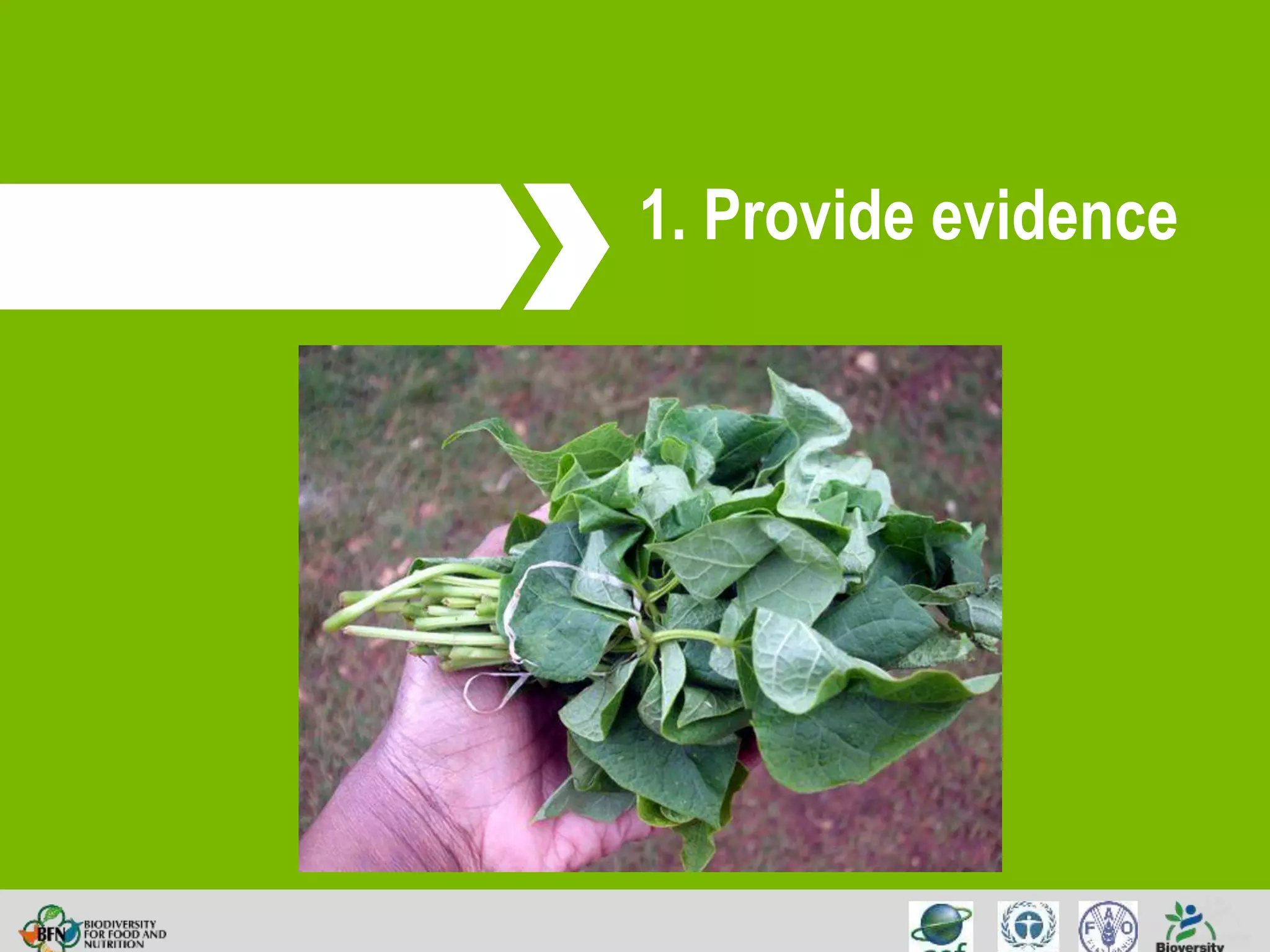
1. Provide evidence
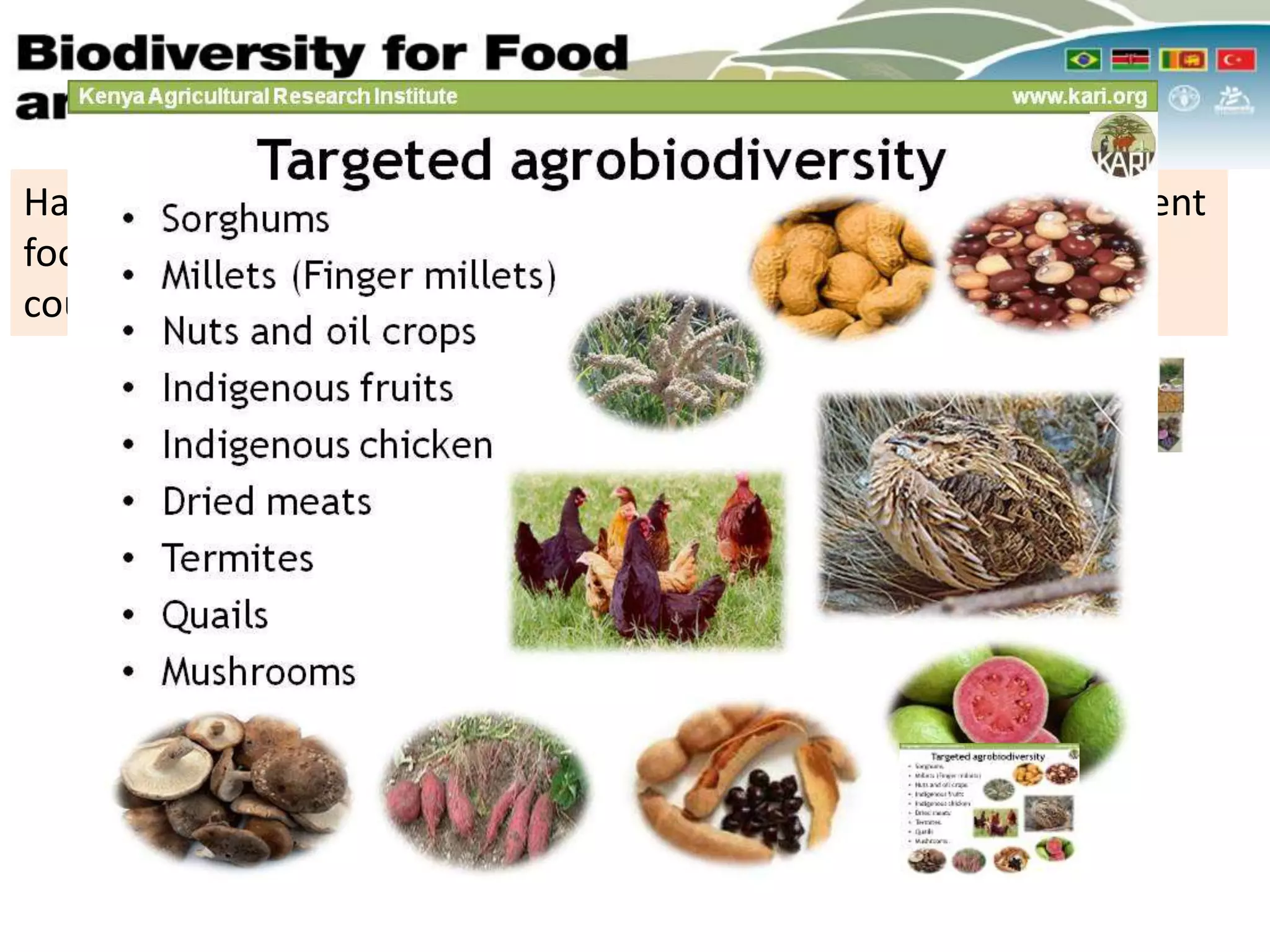
Harness traditional foods to broaden the food basket, create resilient
food systems and provide livelihood options in the four partner
countries
Sub-Saharan Africa
Food System
2. Influence policies
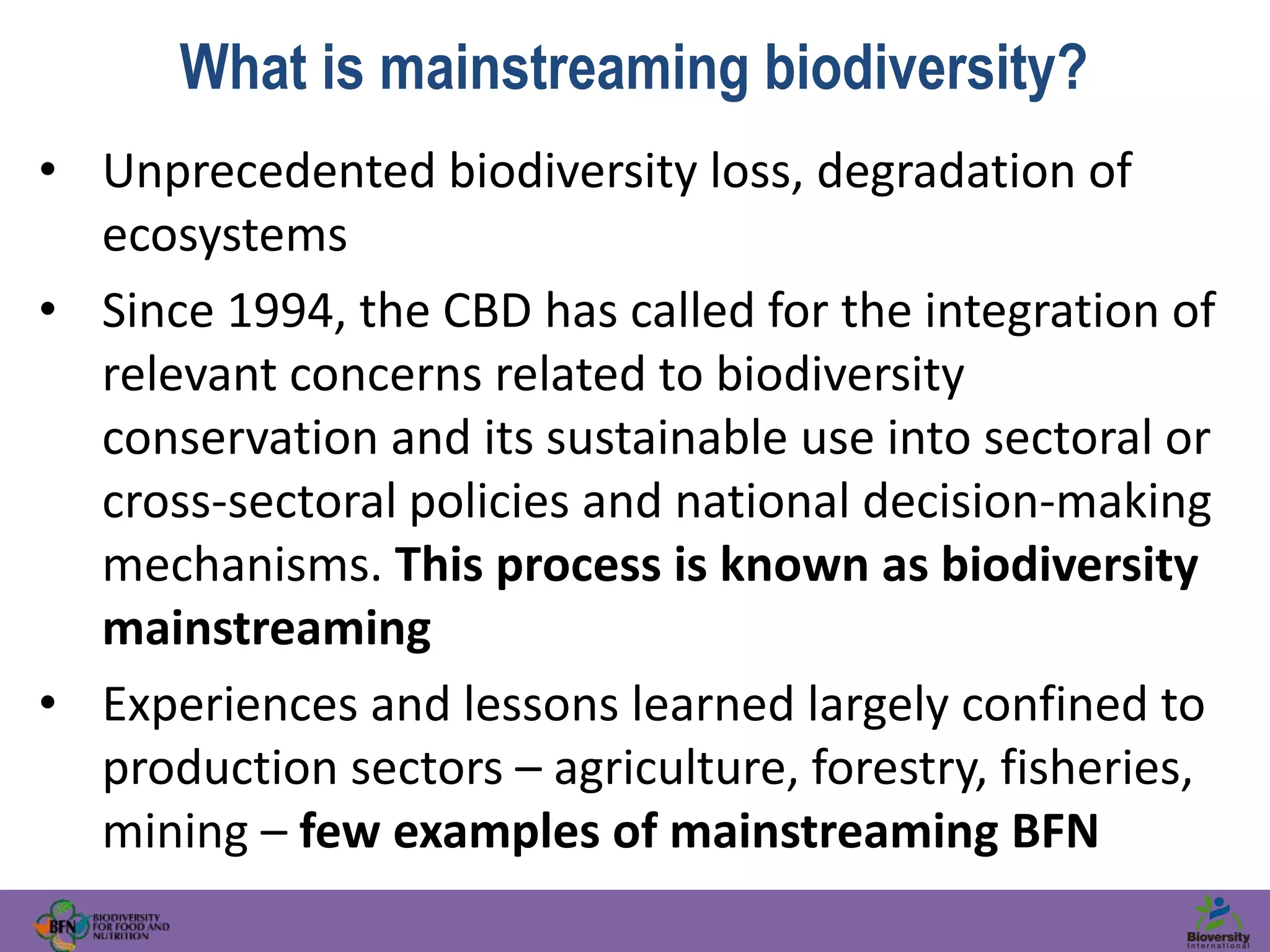
What is mainstreaming biodiversity?
• Unprecedented biodiversity loss, degradation of
ecosystems
• Since 1994, the CBD has called for the integration of
relevant concerns related to biodiversity
conservation and its sustainable use into sectoral or
cross-sectoral policies and national decision-making
mechanisms. This process is known as biodiversity
mainstreaming
• Experiences and lessons learned largely confined to
production sectors – agriculture, forestry, fisheries,
mining – few examples of mainstreaming BFN
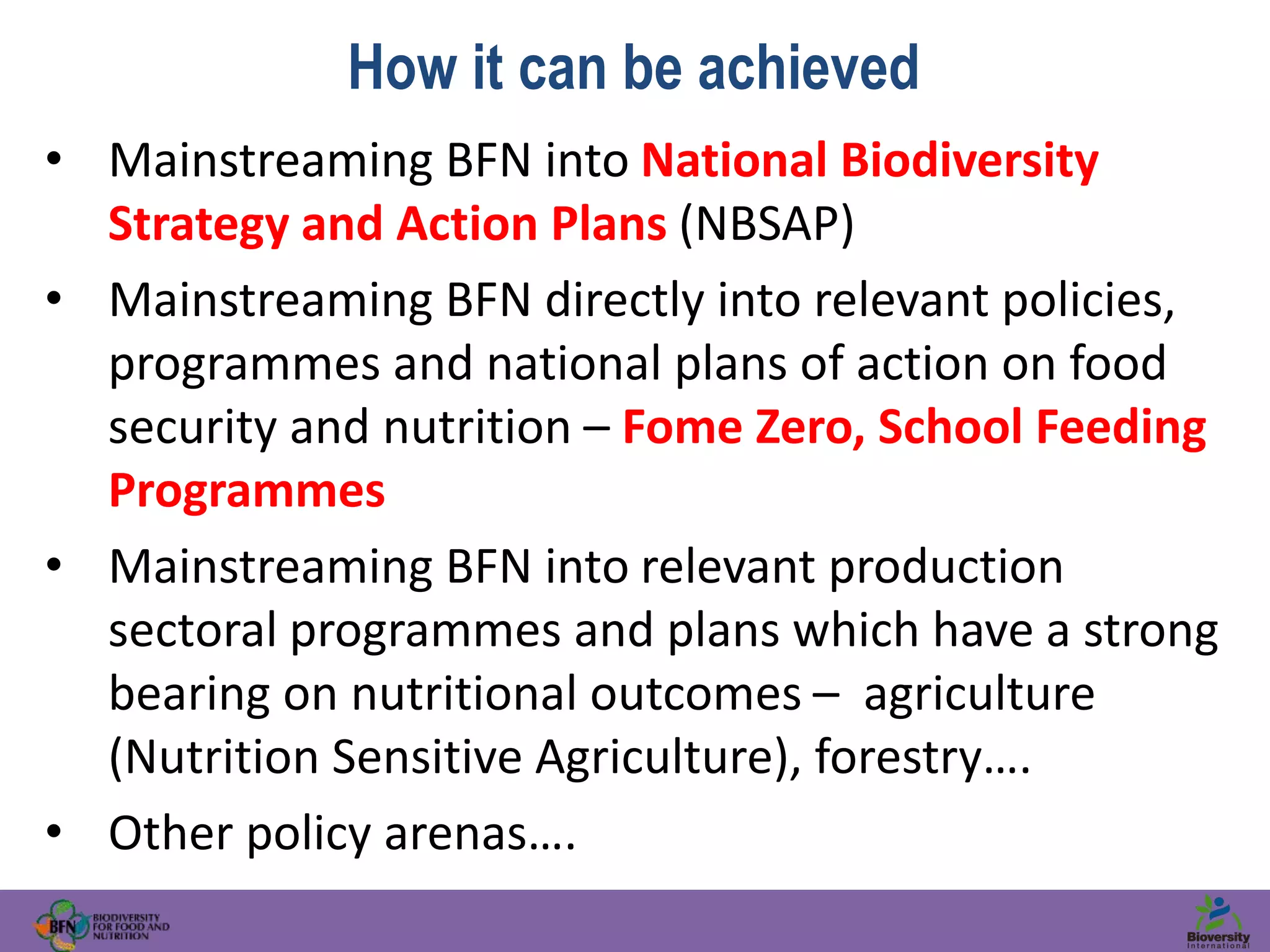
How it can be achieved
• Mainstreaming BFN into National Biodiversity
Strategy and Action Plans (NBSAP)
• Mainstreaming BFN directly into relevant policies,
programmes and national plans of action on food
security and nutrition – Fome Zero, School Feeding
Programmes
• Mainstreaming BFN into relevant production
sectoral programmes and plans which have a strong
bearing on nutritional outcomes – agriculture
(Nutrition Sensitive Agriculture), forestry….
• Other policy arenas….
15
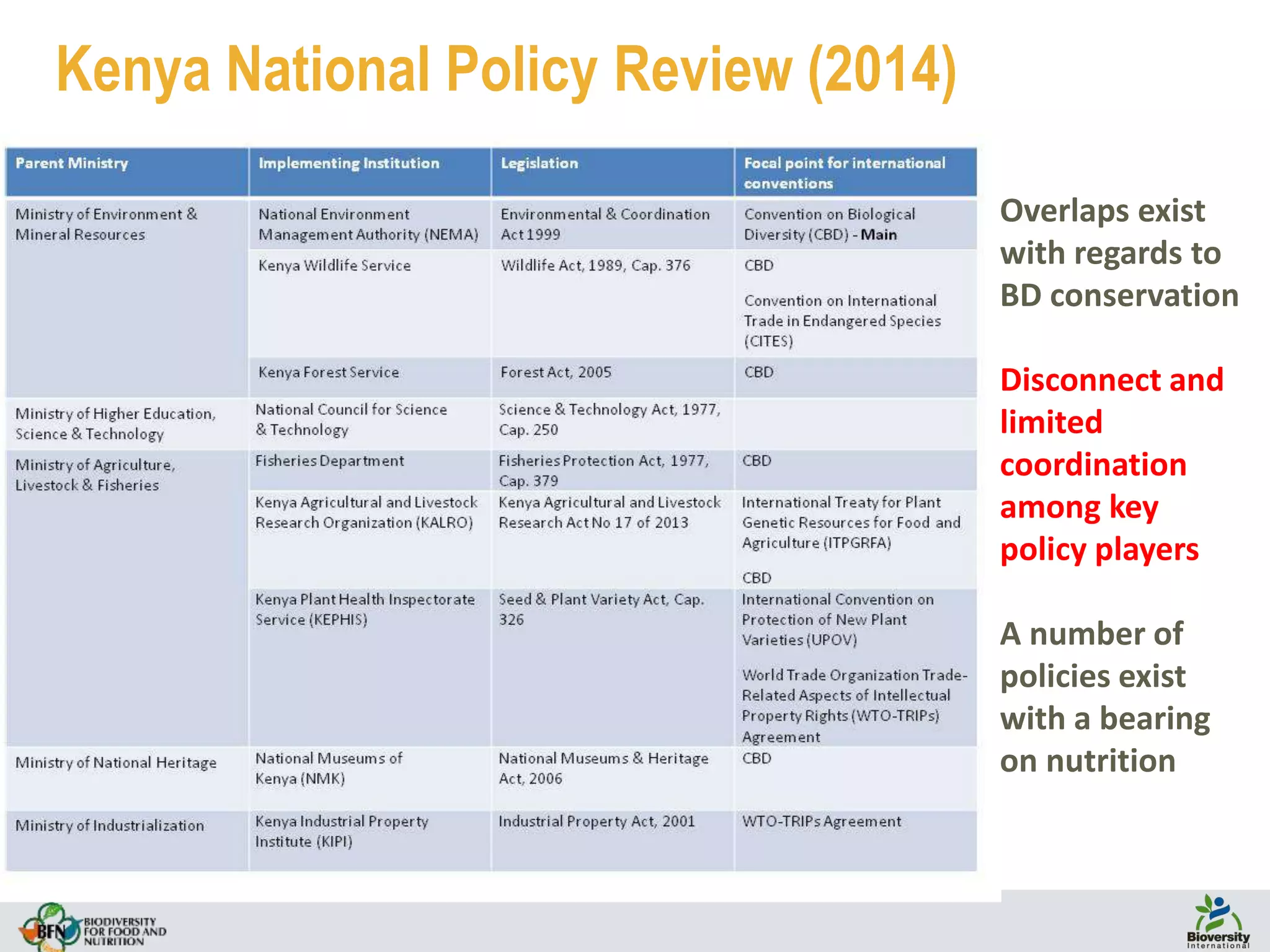
Kenya National Policy Review (2014)
Overlaps exist
with regards to
BD conservation
Disconnect and
limited
coordination
among key
policy players
A number of
policies exist
with a bearing
on nutrition
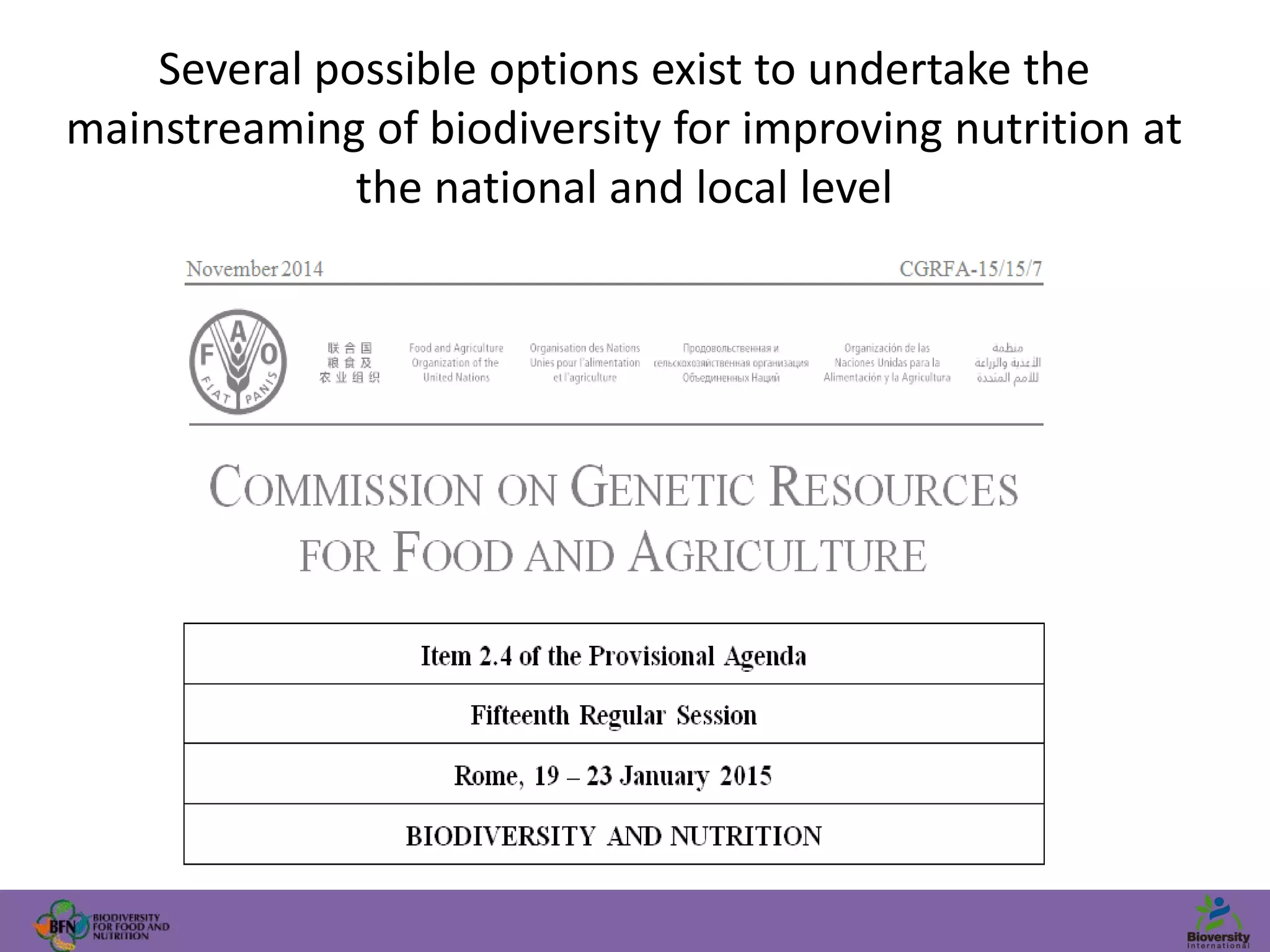
Several possible options exist to undertake the
mainstreaming of biodiversity for improving nutrition at
the national and local level
5. Raising
Awareness
19
20
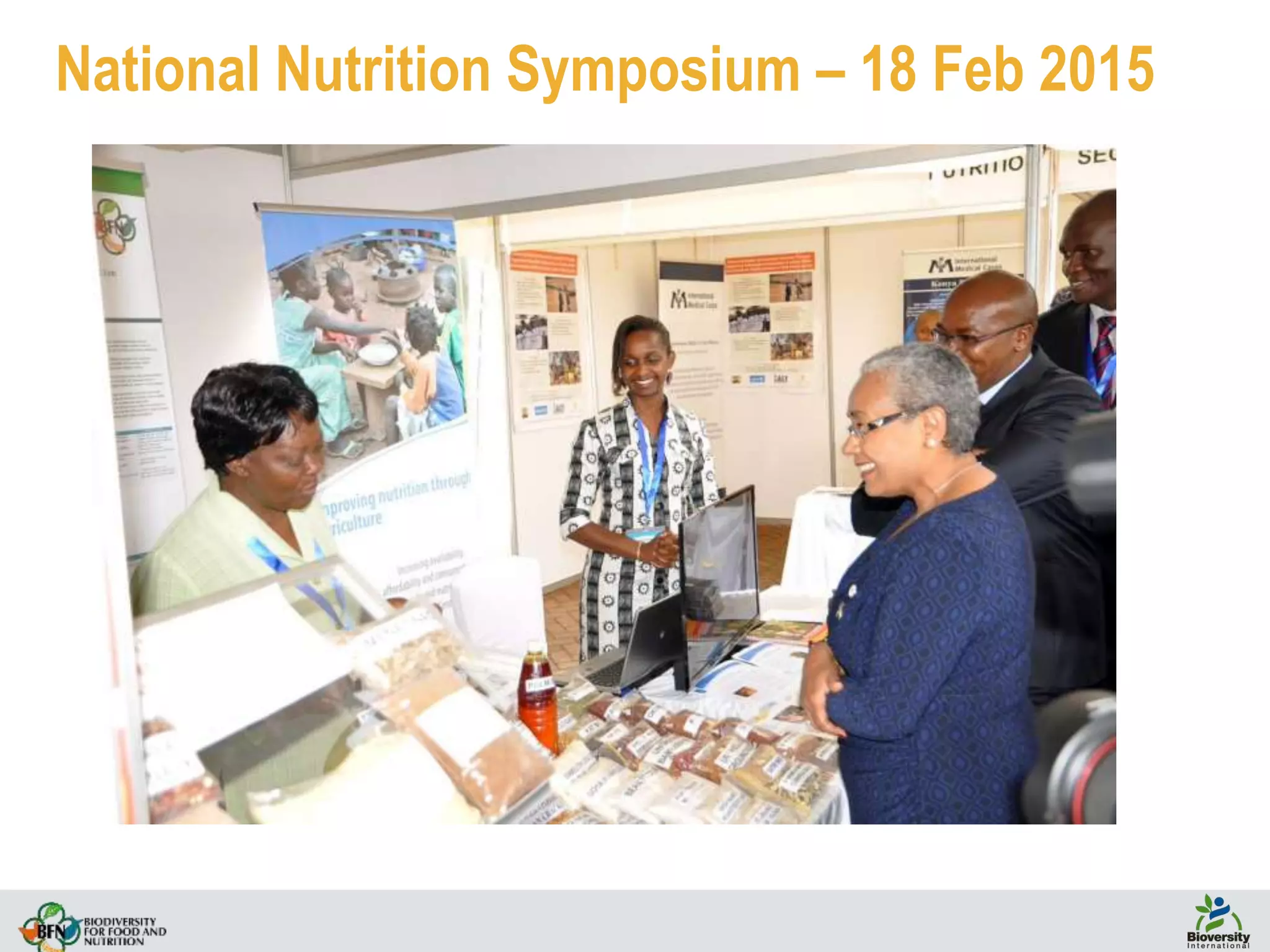
National Nutrition Symposium – 18 Feb 2015
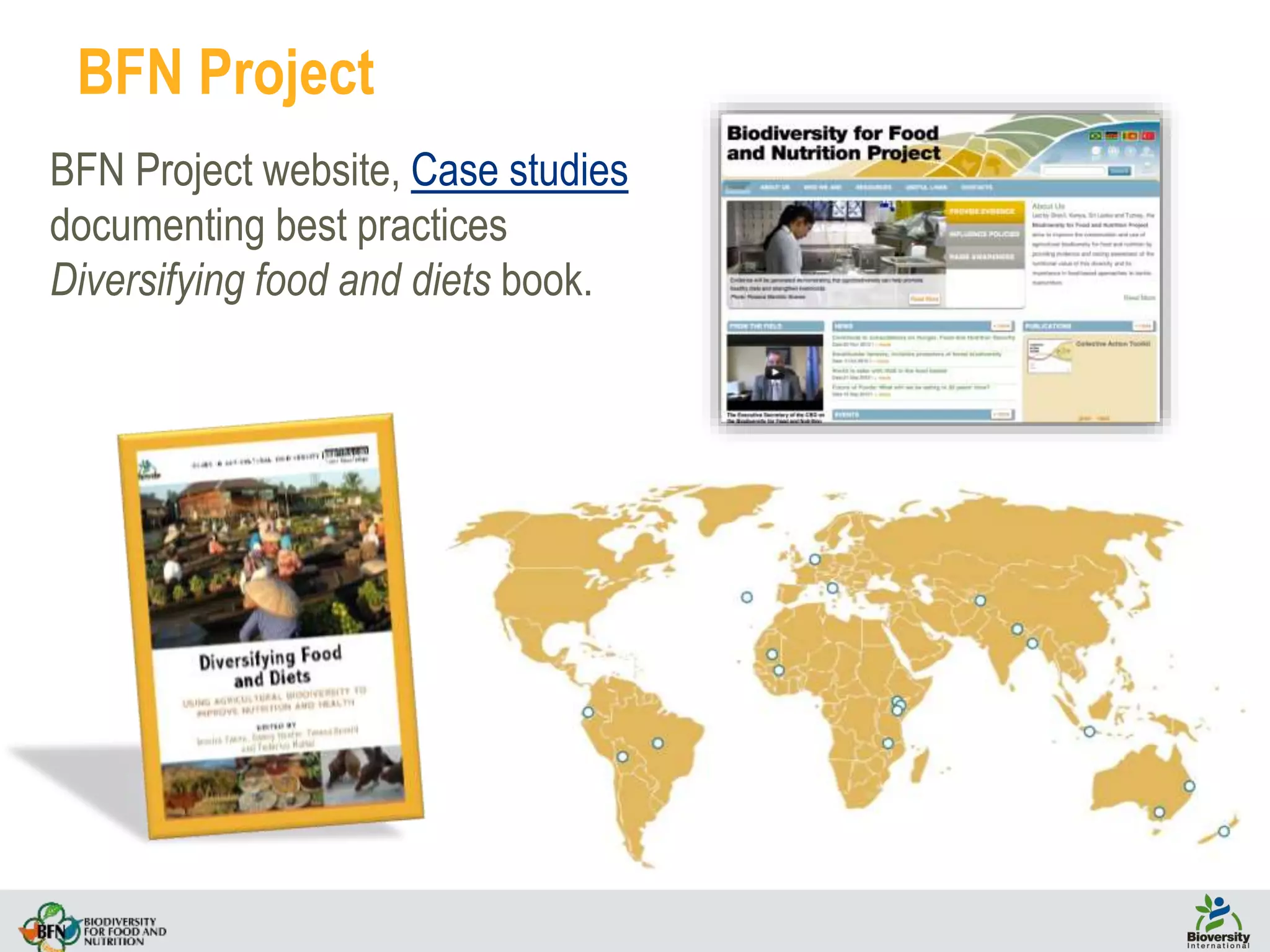
BFN Project
BFN Project website, Case studies
documenting best practices
Diversifying food and diets book.
Thank you
www.b4fn.org

Presentation of BFN activities to SADC countries - Feb 2015

  • 1.
    The Biodiversity forFood and Nutrition Initiative Teresa Borelli, Programme Specialist SADC Meeting, Rome 27 February 2015
  • 2.
    05 regional geographies 35countries 17 offices
  • 3.
    Agricultural biodiversity nourishespeople and sustains the planet Photo credit: LI-BIRD/A.Subedi
  • 5.
    At the sametime: “9 out of the 15 SADC countries have overweight or obesity prevalence of more than 30% among adult women Reference: Nyovani J Madise & Gobopamang Letamo (2013)
  • 6.
    Carbohydrate Protein Fat Youngchildren (1-3 years) 45-65% 5-20% 30-40% Older children and adolescents (4-18 years) 45-65% 10-30% 25-35% Adults (19 years and older) 45-65% 10-35% 20-35% Bush meal 52% 15% 30% Source: own depiction based on U.S. Department of Agriculture and U.S. Department of Health and Human Services 2010, Institute of Medicine of the National Academies 2005, Roger et al. 2012 Recommended macronutrient proportions by age in comparison to macronutrient content of “bush meals” Why traditional crops? Affordable Accessible Resilient Culturally acceptable Provide nutrients for healthy growth
  • 7.
    Food composition analysiscomparing commonly consumed foods versus underutilized traditional foods (nutrients per 100g of food). Adapted from West African FoodCompositionTable. FAO, 2012.
  • 8.
    Bananas and beta-carotene CavendishCommon Variety <5 µg/100g pro-Vit A carotenoid <8500 µg/100g pro-Vit A carotenoid South Pacific banana varieties Source: Burlingame, FAO (2013), Bioversity International, IFCP
  • 9.
    PROVIDE EVIDENCE –Demonstrate the nutritional value of local BFN and the role it plays in promoting healthy diets and strengthening livelihoods INFLUENCE POLICIES - Use the evidence to influence policies and markets that support the conservation and sustainable use of BFN for improved human nutrition and wellbeing RAISE AWARENESS – Develop tools and best practices for scaling up the use BFN in development programmes, value chains and local community initiatives. •1/3 of the population is food insecure •1.8 million children chronically undernourished ALVs, sorghum, millets, nuts and oil crops, indigenous fruits and livestock Undernutrition ↓ Overnutrition ↑ 50% of adult population overweight (80 million) Plants for the Future Project (70 spp.) Non conventional leafy vegetables Undernutrition ↓ Overnutrition ↑ •31% overweight •12% obese 28 spp. local edible plant species • Acute protein-energy malnutrition • Moderate Iron deficiency anaemia and VAD Native root and tuber crops, traditional rice varieties, leafy vegetables and native fruits 5 year project : 2012 - 2017 Project aim: Strengthen the conservation and sustainable use of biodiversity with high nutritional potential, by mainstreaming into nutrition, food and livelihood security strategies and programmes; develop markets and value chains for nutritionally-relevant biodiversity.
  • 10.
  • 11.
    Harness traditional foodsto broaden the food basket, create resilient food systems and provide livelihood options in the four partner countries Sub-Saharan Africa Food System
  • 12.
  • 13.
    What is mainstreamingbiodiversity? • Unprecedented biodiversity loss, degradation of ecosystems • Since 1994, the CBD has called for the integration of relevant concerns related to biodiversity conservation and its sustainable use into sectoral or cross-sectoral policies and national decision-making mechanisms. This process is known as biodiversity mainstreaming • Experiences and lessons learned largely confined to production sectors – agriculture, forestry, fisheries, mining – few examples of mainstreaming BFN
  • 14.
    How it canbe achieved • Mainstreaming BFN into National Biodiversity Strategy and Action Plans (NBSAP) • Mainstreaming BFN directly into relevant policies, programmes and national plans of action on food security and nutrition – Fome Zero, School Feeding Programmes • Mainstreaming BFN into relevant production sectoral programmes and plans which have a strong bearing on nutritional outcomes – agriculture (Nutrition Sensitive Agriculture), forestry…. • Other policy arenas….
  • 15.
    15 Kenya National PolicyReview (2014) Overlaps exist with regards to BD conservation Disconnect and limited coordination among key policy players A number of policies exist with a bearing on nutrition
  • 17.
    Several possible optionsexist to undertake the mainstreaming of biodiversity for improving nutrition at the national and local level
  • 18.
  • 19.
  • 20.
  • 21.
    BFN Project BFN Projectwebsite, Case studies documenting best practices Diversifying food and diets book.
  • 22.

Editor's Notes

  • #3 Bioversity International is a global research-for-development organization. We research issues around agricultural biodiversity that is relevant for developing countries, particularly rural communities. How can agricultural biodiversity contribute to food security? Nutrition security? Livelihoods? Better ecosystems? We work in many different countries, but we have tried to concentrate on places that have a high amount of biodiversity, which are often also hubs of rural poverty. Broadly, the geographies are highlighted here, and we put ore emphasis on certain countries within those geographies. We have 17 offices at the moment, but very different in size. Rome, for example, as the HQ, has about 100 people in the people. Whereas for example in Ethiopia, we have only one or two people. The biggest offices on each continent include Cali in Colombia, Nairobi in Kenya and Serdang in Malaysia. Although recently the Delhi office in India has been heading management in Asia. (can emphasize area based on audience).
  • #4 Agricultural biodiversity is the biological variety that exists among crops, animals and other organisms used for food and agriculture. It is now widely recognised that agrobiodiversity plays an important role in providing the diversity of nutrients (51 overall) needed for healthy growth and living. More importantly it can provide a local solution to diet-related nutrition and health conditions such as nutrient deficiencies and obesity that are becoming a growing burden on national health budgets and economies. The problem is that much of this diversity is disappearing.
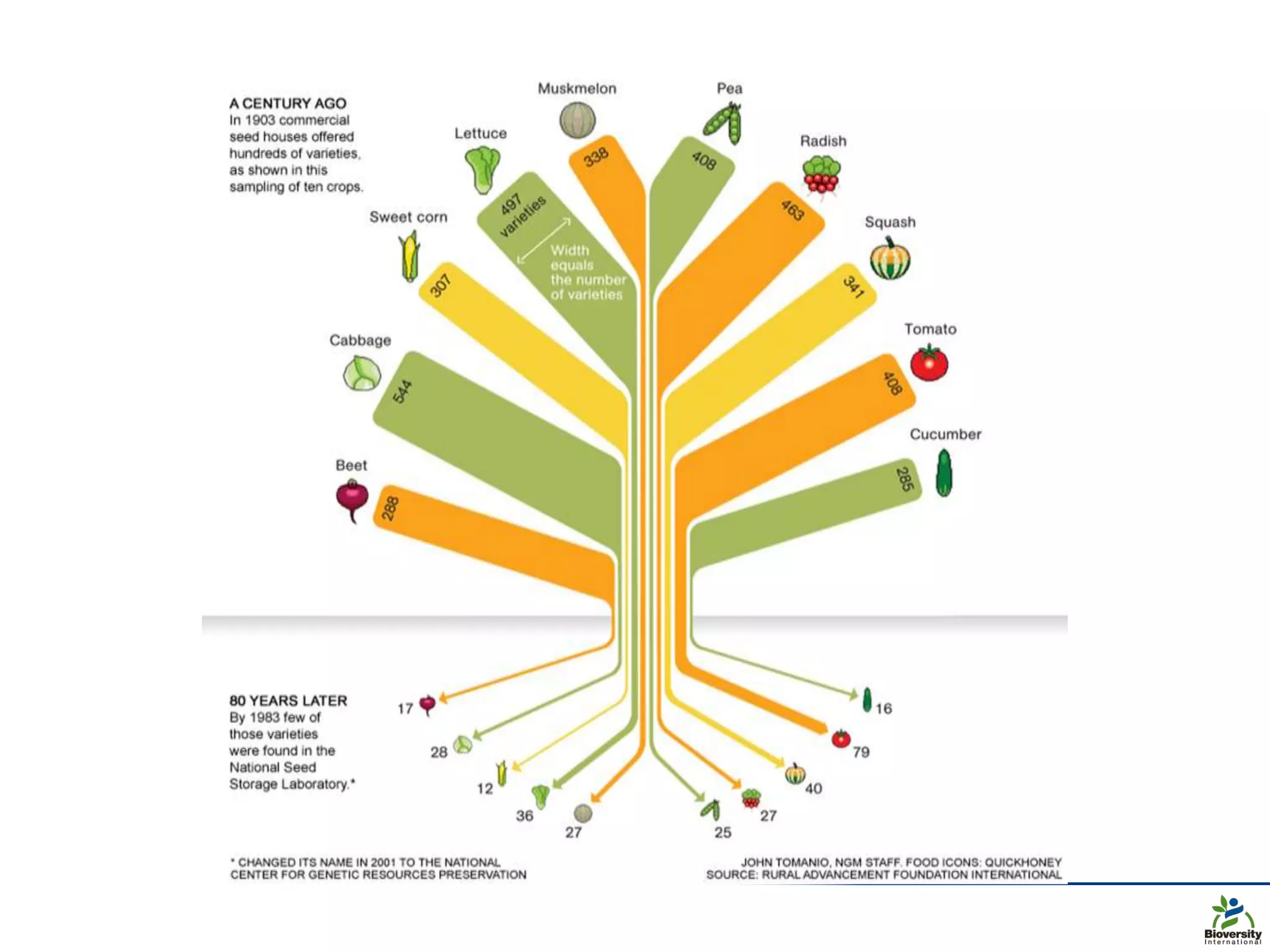
  • #5 As we've come to depend on a handful of commercial varieties of fruits and vegetables, thousands of heirloom varieties have disappeared. It's hard to know exactly how many have been lost over the past century, but a study conducted in 1983 by the Rural Advancement Foundation International gave a clue to the scope of the problem. It compared USDA listings of seed varieties sold by commercial U.S. seed houses in 1903 with those in the U.S. National Seed Storage Laboratory in 1983. The survey, which included 66 crops, found that about 93 percent of the varieties had gone extinct. I’ve said that BFN has the potential to impact nutrition
  • #6 Almost all countries in the world suffer from one form of malnutrition: be it either under or over-nutrition
  • #7 The reliance on a few staple crops. We have largely ignored the vast majority of the world’s Biodiversity for food and nutrition, where there is an immense diversity between species as well as within species much of it vastly superior in nutritional terms compared to the few crops we have come to rely on. Even within a species this varietal difference in nutrients can be vast – why worry about biofortification?
  • #8 The reliance on a few staple crops. We have largely ignored the vast majority of the world’s Biodiversity for food and nutrition, where there is an immense diversity between species as well as within species much of it vastly superior in nutritional terms compared to the few crops we have come to rely on. Even within a species this varietal difference in nutrients can be vast – why worry about biofortification?
  • #9 8
  • #11 DIVIDER SLIDE You can use it to introduce a section of your presentation.
  • #12 Countries have no limit as to what agrobiodiversity they can use (plant or animal). Mention Plants for the future initiative.
  • #13 DIVIDER SLIDE You can use it to introduce a section of your presentation.
  • #14 Mainstreaming Biodiversity Conservation and Use for Human Nutrition and Well-being.
  • #16 To find suitable entry points for mainstreaming biodiversity into policies, programmes and national and regional plans of action on nutrition. Time consuming exercise – It takes much time to build long-lasting partnerships particularly with the high staff turnover in many of the Ministries NPMU in Kenya has been successful in gathering influence and has since been invite to join the Nutrition InterAgency Committee of the Scaling Up Nutrition Movement. The BFN has provided a perfect platform for the coming together of actors from the various ministries. Kenya has been especially successful at the County level where it has established partnerships with various ministries and is busy drafting Busia County’s new Biodiversity Action Plan that takes into consideration BFN.
  • #18 FAO Commission on Genetic Resources for Food and Agriculture at its 14th Session in 2013 formally recognised nutrients and diets, as well as food, as ecosystem services Furthermore, the Commission requested the preparation of guidelines to facilitate the process of mainstreaming biodiversity into policies, programmes and national and regional plans of action on nutrition These guidelines were endorsed at the 15th Session of the CGRFA in Rome in January 2015
  • #19 DIVIDER SLIDE You can use it to introduce a section of your presentation.
  • #23 DIVIDER SLIDE You can use it to introduce a section of your presentation.