Psyllids
Psyllids
Psyllids are aphidlike insects that secrete
sticky honeydew. Some species produce white wax,
distort leaves and shoots, stunt plant growth, or cause
defoliation.Management includes providing proper plant
care, conserving psyllid natural enemies, and applying
low-toxicity insecticides when needed.Most plants can
tolerate low to moderate numbers of psyllids.
Plants commonly affected include:
✦ Acacia, boxwood, eucalyptus, eugenia, pepper tree,
and some other ornamentals.
✦ Pear, potato, and tomato.
Damage resembles that from some aphids,
scale insects, and whiteflies. Look for:
✦ Abundant sticky honeydew that psyllids excrete as
they suck plant sap.
✦ Black sooty mold growing on the honeydew.
✦ Curly or powdery wax or, in certain species,
crystallized covers called “lerps.”
✦ Distorted or galled leaves or shoots or
prematurely dropping foliage.
Learn to recognize psyllids.
✦ Adults are 1
⁄10 to 1
⁄5 inch long and hold their
wings rooflike over their bodies.
✦ Adults are quite active, often jumping away
when disturbed.
✦ Nymphs are flattened and oblong to round. Some
can move, but pit-making species don’t.
✦ Nymphs of several species that feed on eucalyptus
are hidden under hardened covers (lerps).
To reduce problems, use an integrated program.
✦ Provide plants with appropriate environmental
conditions and cultural care, especially proper
irrigation; conditions vary for each location and
plant species.
✦ Choose plant species or cultivars that psyllids
don’t infest or that are less susceptible to these
pests, such as certain acacia and eucalyptus.
✦ Learn how to recognize and
conserve psyllid parasites and
predators. Certain psyllids can
be controlled biologically unless
natural enemies are disrupted. University of California
Statewide Integrated Pest
Management Program
✦ Avoid stimulating succulent growth. Especially
avoid fertilization and unnecessary pruning.
✦ For topiary eugenia, shear growing tips about
every three weeks and leave the clippings as
mulch on the ground for at least three weeks to
allow parasites to emerge.
What about insecticides?
✦ Don’t treat plants with insecticides unless you
have an intolerable psyllid infestation.
✦ Avoid insecticides that injure natural enemies.
Common psyllid natural enemies include lady
beetles, pirate bugs, and parasitic wasps.
✦ If you must treat, select insecticidal soaps, oils,
and other least-toxic products, or use a systemic
insecticide (preferably soil-applied) for especially
intolerable problems. Systemic insecticides may be
toxic to honey bees and other beneficial insects.
June 2011
Minimize the use of pesticides that pollute our
waterways. Use nonchemical alternatives or less
toxic pesticide products whenever possible. Read
product labels carefully and follow instructions
on proper use, storage, and disposal.
For more information about managing pests, contact your
University of California Cooperative Extension office
listed under the county government pages of your phone book
or visit the UC IPM Web site at www.ipm.ucdavis.edu.
See Pest Notes: Psyllids or Pest Notes: Eucalyptus Redgum
Lerp Psyllid at www.ipm.ucdavis.edu for more details.
What you use in your landscape
affects our rivers and oceans!
University of California
Cooperative Extension
Statewide IPM Program
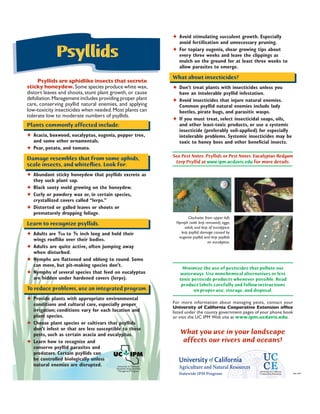
Clockwise from upper left:
Nymph (with lerp removed), eggs,
adult, and lerp of eucalyptus
lerp psyllid; damage caused by
eugenia psyllid; and lerp psyllids
on eucalyptus.

Psyllids Quick Tips Natural Pest Control

  • 1.
    Psyllids Psyllids Psyllids are aphidlikeinsects that secrete sticky honeydew. Some species produce white wax, distort leaves and shoots, stunt plant growth, or cause defoliation.Management includes providing proper plant care, conserving psyllid natural enemies, and applying low-toxicity insecticides when needed.Most plants can tolerate low to moderate numbers of psyllids. Plants commonly affected include: ✦ Acacia, boxwood, eucalyptus, eugenia, pepper tree, and some other ornamentals. ✦ Pear, potato, and tomato. Damage resembles that from some aphids, scale insects, and whiteflies. Look for: ✦ Abundant sticky honeydew that psyllids excrete as they suck plant sap. ✦ Black sooty mold growing on the honeydew. ✦ Curly or powdery wax or, in certain species, crystallized covers called “lerps.” ✦ Distorted or galled leaves or shoots or prematurely dropping foliage. Learn to recognize psyllids. ✦ Adults are 1 ⁄10 to 1 ⁄5 inch long and hold their wings rooflike over their bodies. ✦ Adults are quite active, often jumping away when disturbed. ✦ Nymphs are flattened and oblong to round. Some can move, but pit-making species don’t. ✦ Nymphs of several species that feed on eucalyptus are hidden under hardened covers (lerps). To reduce problems, use an integrated program. ✦ Provide plants with appropriate environmental conditions and cultural care, especially proper irrigation; conditions vary for each location and plant species. ✦ Choose plant species or cultivars that psyllids don’t infest or that are less susceptible to these pests, such as certain acacia and eucalyptus. ✦ Learn how to recognize and conserve psyllid parasites and predators. Certain psyllids can be controlled biologically unless natural enemies are disrupted. University of California Statewide Integrated Pest Management Program ✦ Avoid stimulating succulent growth. Especially avoid fertilization and unnecessary pruning. ✦ For topiary eugenia, shear growing tips about every three weeks and leave the clippings as mulch on the ground for at least three weeks to allow parasites to emerge. What about insecticides? ✦ Don’t treat plants with insecticides unless you have an intolerable psyllid infestation. ✦ Avoid insecticides that injure natural enemies. Common psyllid natural enemies include lady beetles, pirate bugs, and parasitic wasps. ✦ If you must treat, select insecticidal soaps, oils, and other least-toxic products, or use a systemic insecticide (preferably soil-applied) for especially intolerable problems. Systemic insecticides may be toxic to honey bees and other beneficial insects. June 2011 Minimize the use of pesticides that pollute our waterways. Use nonchemical alternatives or less toxic pesticide products whenever possible. Read product labels carefully and follow instructions on proper use, storage, and disposal. For more information about managing pests, contact your University of California Cooperative Extension office listed under the county government pages of your phone book or visit the UC IPM Web site at www.ipm.ucdavis.edu. See Pest Notes: Psyllids or Pest Notes: Eucalyptus Redgum Lerp Psyllid at www.ipm.ucdavis.edu for more details. What you use in your landscape affects our rivers and oceans! University of California Cooperative Extension Statewide IPM Program Clockwise from upper left: Nymph (with lerp removed), eggs, adult, and lerp of eucalyptus lerp psyllid; damage caused by eugenia psyllid; and lerp psyllids on eucalyptus.