Elm Leaf Beetle 
Integrated Pest Management for Home Gardeners and Landscape Professionals 
The elm leaf beetle, Xanthogaleruca 
(=Pyrrhalta) luteola, is a leaf-chewing 
pest of elm trees, especially European 
elm species. American and most Asian 
elm species are less severely fed upon. 
Most Chinese elm cultivars, zelkova, 
and many newer elm cultivars are 
infrequently fed upon. 
IDENTIFICATION 
Adults are 1/4 inch long, olive-green 
beetles with black, longitudinal stripes 
along the margin and center of the back 
(Figure 1). Females lay yellowish eggs 
in double rows of about 5 to 25 on the 
underside of leaves. Eggs become gray-ish 
before hatching. Larvae resemble 
caterpillars and are black when newly 
hatched and shortly after molting 
(shedding the old skin). After feeding, 
larvae become yellowish to green with 
rows of tiny dark tubercles (projec-tions). 
Third-instar larvae grow up to 
1/3 inch long and have dense rows of 
dark tubercles down their sides that 
resemble two black stripes (Figure 2). 
Pupae are orange to bright yellow. 
LIFE CYCLE 
The elm leaf beetle develops through 
four life stages: egg, larva, pupa, and 
adult (Figure 3). Adults commonly 
overwinter in bark crevices and wood-piles 
or in buildings. In spring they fly 
to elm foliage and chew leaves, and 
females lay eggs. Eggs hatch into lar-vae 
that develop through three instars 
(growth stages) over a period of several 
weeks while chewing on foliage and 
then crawl down the tree trunk. Ma-ture 
larvae become curled and inactive 
(a stage referred to as prepupae), then 
pupate, sometimes in large numbers, 
around the tree base. After about 10 
days as pupae, adults emerge and fly to 
the canopy to feed and, during spring 
and summer, lay eggs. The elm leaf 
beetle has at least one generation a 
year in northern California and two 
to three generations in central and 
southern California. 
DAMAGE 
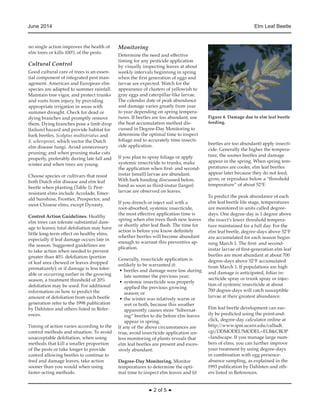
Adults chew entirely through the leaf, 
often in a shothole pattern. Larvae 
skeletonize the leaf surface, causing 
damaged foliage to turn brown to 
whitish (Figure 4). Elm leaf beetles, 
when abundant, can entirely defoli-ate 
large elm trees, which eliminates 
summer shade and reduces the aes-thetic 
value of trees. Repeated, exten-sive 
defoliation weakens elms, caus-ing 
trees to decline. However, the elm 
leaf beetle has not been a significant, 
widespread problem in California 
since the 1990s. 
MANAGEMENT 
It is essential to correctly identify the 
cause of damaged elm leaves before 
taking management action. European 
flea weevil, Orchestes alni, also chews 
holes in elm leaves and causes elms 
to defoliate. This introduced beetle 
has become a serious elm pest in the 
eastern United States, but currently 
does not occur in California. Also 
from a distance, foliage severely 
chewed by beetles resembles the 
browning and dieback caused by 
Dutch elm disease fungi, Ophiostoma 
(=Ceratocystis) ulmi and O. novo-ulmi. 
Report any suspected Dutch elm dis-ease, 
European flea weevil, or other 
new pests to the local county agricul-tural 
commissioner. 
Where the elm leaf beetle is a prob-lem, 
manage it with an integrated 
program that incorporates good 
cultural practices, conservation of 
natural enemies, regular monitoring, 
and the use of less-persistent insecti-cides, 
Figure 1. Adult, eggs, and first-instar 
larva of elm leaf beetle. 
Figure 2. Third-instar elm leaf beetle 
larvae. 
Figure 3. Elm leaf beetle stages and life 
cycle. 
bark banding, or systemic insec-ticide. 
Recognize that elm leaf beetle 
populations historically have fluctu-ated 
dramatically from year to year and 
trees do not warrant treatment most 
years. When management is warranted, 
use a combination of methods; because 
PEST NOTES Publication 7403 
Statewide Integrated Pest Management Program June 2014
June 2014 Elm Leaf Beetle 
◆ 2 of 5 ◆ 
no single action improves the health of 
elm trees or kills 100% of the pests. 
Cultural Control 
Good cultural care of trees is an essen-tial 
component of integrated pest man-agement. 
American and European elm 
species are adapted to summer rainfall. 
Maintain tree vigor, and protect trunks 
and roots from injury, by providing 
appropriate irrigation in areas with 
summer drought. Check for dead or 
dying branches and promptly remove 
them. Dying branches pose a limb drop 
(failure) hazard and provide habitat for 
bark beetles, Scolytus multistriatus and 
S. schevyrewi, which vector the Dutch 
elm disease fungi. Avoid unnecessary 
pruning; and when pruning make cuts 
properly, preferably during late fall and 
winter and when trees are young. 
Choose species or cultivars that resist 
both Dutch elm disease and elm leaf 
beetle when planting (Table 1). Pest-resistant 
elms include Accolade, Emer-ald 
Sunshine, Frontier, Prospector, and 
most Chinese elms, except Dynasty. 
Control Action Guidelines. Healthy 
elm trees can tolerate substantial dam-age 
to leaves; total defoliation may have 
little long-term effect on healthy elms, 
especially if leaf damage occurs late in 
the season. Suggested guidelines are 
to take action when needed to prevent 
greater than 40% defoliation (portion 
of leaf area chewed or leaves dropped 
prematurely); or if damage is less toler-able 
or occurring earlier in the growing 
season, a treatment threshold of 20% 
defoliation may be used. For additional 
information on how to predict the 
amount of defoliation from each beetle 
generation refer to the 1998 publication 
by Dahlsten and others listed in Refer-ences. 
Timing of action varies according to the 
control methods and situation. To avoid 
unacceptable defoliation, when using 
methods that kill a smaller proportion 
of the pests or take longer to provide 
control allowing beetles to continue to 
feed and damage leaves, take action 
sooner than you would when using 
faster-acting methods. 
Monitoring 
Determine the need and effective 
timing for any pesticide application 
by visually inspecting leaves at about 
weekly intervals beginning in spring 
when the first generation of eggs and 
larvae are expected. Watch for the 
appearance of clusters of yellowish to 
gray eggs and caterpillar-like larvae. 
The calendar date of peak abundance 
and damage varies greatly from year 
to year depending on spring tempera-tures. 
If beetles are too abundant, use 
the heat accumulation method dis-cussed 
in Degree-Day Monitoring to 
determine the optimal time to inspect 
foliage and to accurately time insecti-cide 
application. 
If you plan to spray foliage or apply 
systemic insecticide to trunks, make 
the application when first- and second-instar 
(small) larvae are abundant. 
With bark banding discussed below, 
band as soon as third-instar (larger) 
larvae are observed on leaves. 
If you drench or inject soil with a 
root-absorbed, systemic insecticide, 
the most effective application time is 
spring when elm trees flush new leaves 
or shortly after leaf flush. The time for 
action is before you know definitely 
whether beetles will become abundant 
enough to warrant this preventive ap-plication. 
Generally, insecticide application is 
unlikely to be warranted if: 
• beetles and damage were low during 
late summer the previous year; 
• systemic insecticide was properly 
applied the previous growing 
season; or 
• the winter was relatively warm or 
wet or both, because this weather 
apparently causes more “hibernat-ing” 
beetles to die before elm leaves 
appear in spring. 
If any of the above circumstances are 
true, avoid insecticide application un-less 
monitoring of plants reveals that 
elm leaf beetles are present and exces-sively 
abundant. 
Degree-Day Monitoring. Monitor 
temperatures to determine the opti-mal 
time to inspect elm leaves and (if 
Figure 4. Damage due to elm leaf beetle 
feeding. 
beetles are too abundant) apply insecti-cide. 
Generally the higher the tempera-ture, 
the sooner beetles and damage 
appear in the spring. When spring tem-peratures 
are cooler, elm leaf beetles 
appear later because they do not feed, 
grow, or reproduce below a “threshold 
temperature” of about 52°F. 
To predict the peak abundance of each 
elm leaf beetle life stage, temperatures 
are monitored in units called degree-days. 
One degree-day is 1 degree above 
the insect’s lower threshold tempera-ture 
maintained for a full day. For the 
elm leaf beetle, degree-days above 52°F 
are accumulated for each season begin-ning 
March 1. The first- and second-instar 
larvae of first-generation elm leaf 
beetles are most abundant at about 700 
degree-days above 52°F accumulated 
from March 1. If populations are high 
and damage is anticipated, foliar in-secticide 
spray or trunk spray or injec-tion 
of systemic insecticide at about 
700 degree-days will catch susceptible 
larvae at their greatest abundance. 
Elm leaf beetle development can eas-ily 
be predicted using the point-and-click, 
degree-day calculator online at 
http://www.ipm.ucanr.edu/calludt. 
cgi/DDMODEL?MODEL=ELB&CROP 
=landscape. If you manage large num-bers 
of elms, you can further improve 
your treatment by using degree-days 
in combination with egg presence-absence 
sampling, as explained in the 
1993 publication by Dahlsten and oth-ers 
listed in References.
June 2014 Elm Leaf Beetle 
◆ 3 of 5 ◆ 
Biological Control 
Elm leaf beetle populations are usu-ally 
low at least partly because of 
biological control by native predators 
and introduced parasites. Predators 
of the elm leaf beetle include certain 
bugs, earwigs, lacewing larvae, and 
predaceous ground beetles. The easiest 
to recognize parasite is a small black 
tachinid fly, Erynniopsis antennata. After 
Erynniopsis larvae feed inside and 
kill beetle larvae, the parasite’s 1/5 
inch long, black to reddish pupae can 
be seen at the tree base among the 
yellowish, unparasitized beetle pupae 
(Figure 5). For more photographs of this 
beneficial fly, see the Natural Enemies 
Gallery at www.ipm.ucanr.edu/PMG/ 
NE/elm_leaf_beetle_parasite.html. 
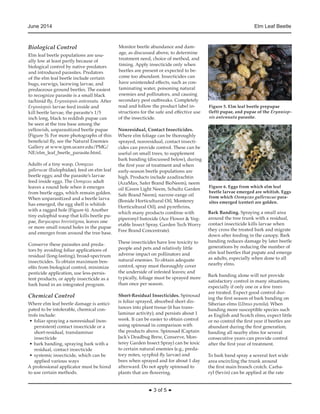
Adults of a tiny wasp, Oomyzus 
gallerucae (Eulophidae), feed on elm leaf 
beetle eggs; and the parasite’s larvae 
feed inside eggs. The Oomyzus adult 
leaves a round hole when it emerges 
from beetle eggs, which remain golden. 
When unparasitized and a beetle larva 
has emerged, the egg shell is whitish 
with a ragged hole (Figure 6). Another 
tiny eulophid wasp that kills beetle pu-pae, 
Baryscapus brevistigma, leaves one 
or more small round holes in the pupae 
and emerges from around the tree base. 
Conserve these parasites and preda-tors 
by avoiding foliar applications of 
residual (long-lasting), broad-spectrum 
insecticides. To obtain maximum ben-efits 
from biological control, minimize 
pesticide application, use less-persis-tent 
products, or apply insecticide as a 
bark band in an integrated program. 
Chemical Control 
Where elm leaf beetle damage is antici-pated 
to be intolerable, chemical con-trols 
include: 
• foliar spraying a nonresidual (non-persistent) 
contact insecticide or a 
short-residual, translaminar 
insecticide 
• bark banding, spraying bark with a 
residual, contact insecticide 
• systemic insecticide, which can be 
applied various ways 
A professional applicator must be hired 
to use certain methods. 
Monitor beetle abundance and dam-age, 
as discussed above, to determine 
treatment need, choice of method, and 
timing. Apply insecticide only when 
beetles are present or expected to be-come 
too abundant. Insecticides can 
have unintended effects, such as con-taminating 
water, poisoning natural 
enemies and pollinators, and causing 
secondary pest outbreaks. Completely 
read and follow the product label in-structions 
for the safe and effective use 
of the insecticide. 
Nonresidual, Contact Insecticides. 
Where elm foliage can be thoroughly 
sprayed, nonresidual, contact insecti-cides 
can provide control. These can be 
useful on small trees, to supplement 
bark banding (discussed below), during 
the first year of treatment and when 
early-season beetle populations are 
high. Products include azadirachtin 
(AzaMax, Safer Brand BioNeem), neem 
oil (Green Light Neem, Schultz Garden 
Safe Brand Neem), narrow-range oil 
(Bonide Horticultural Oil, Monterey 
Horticultural Oil), and pyrethrins, 
which many products combine with 
piperonyl butoxide (Ace Flower & Veg-etable 
Insect Spray, Garden Tech Worry 
Free Brand Concentrate). 
These insecticides have low toxicity to 
people and pets and relatively little 
adverse impact on pollinators and 
natural enemies. To obtain adequate 
control, spray must thoroughly cover 
the underside of infested leaves; and 
typically, foliage must be sprayed more 
than once per season. 
Short-Residual Insecticides. Spinosad 
is foliar sprayed, absorbed short dis-tances 
into plant tissue (it has trans-laminar 
activity), and persists about 1 
week. It can be easier to obtain control 
using spinosad in comparison with 
the products above. Spinosad (Captain 
Jack’s Deadbug Brew, Conserve, Mon-terey 
Garden Insect Spray) can be toxic 
to certain natural enemies (e.g., preda-tory 
mites, syrphid fly larvae) and 
bees when sprayed and for about 1 day 
afterward. Do not apply spinosad to 
plants that are flowering. 
Figure 5. Elm leaf beetle prepupae 
(left) pupae, and pupae of the Erynniop-sis 
antennata parasite. 
Figure 6. Eggs from which elm leaf 
beetle larvae emerged are whitish. Eggs 
from which Oomyzus gallerucae para-sites 
emerged (center) are golden. 
Bark Banding. Spraying a small area 
around the tree trunk with a residual, 
contact insecticide kills larvae when 
they cross the treated bark and migrate 
down after feeding in the canopy. Bark 
banding reduces damage by later beetle 
generations by reducing the number of 
elm leaf beetles that pupate and emerge 
as adults, especially when done to all 
nearby elms. 
Bark banding alone will not provide 
satisfactory control in many situations, 
especially if only one or a few trees 
are treated. Expect good control dur-ing 
the first season of bark banding on 
Siberian elms (Ulmus pumila). When 
banding more susceptible species such 
as English and Scotch elms, expect little 
or no control the first year if beetles are 
abundant during the first generation; 
banding all nearby elms for several 
consecutive years can provide control 
after the first year of treatment. 
To bark band spray a several feet wide 
area encircling the trunk around 
the first main branch crotch. Carba-ryl 
(Sevin) can be applied at the rate
June 2014 Elm Leaf Beetle 
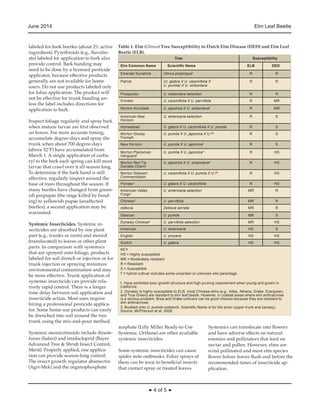
Table 1. Elm (Ulmus) Tree Susceptibility to Dutch Elm Disease (DED) and Elm Leaf 
Beetle (ELB). 
Elm Common Name Scientific Name ELB DED 
Emerald Sunshine Ulmus propinqua3 R R 
Patriot (U. glabra X U. carpinifolia X 
◆ 4 of 5 ◆ 
labeled for bark beetles (about 2% active 
ingredient). Pyrethroids (e.g., fluvalin-ate) 
labeled for application to bark also 
provide control. Bark banding may 
need to be done by a licensed pesticide 
applicator, because effective products 
generally are not available for home 
users. Do not use products labeled only 
for foliar application. The product will 
not be effective for trunk banding un-less 
the label includes directions for 
application to bark. 
Inspect foliage regularly and spray bark 
when mature larvae are first observed 
on leaves. For more accurate timing, 
accumulate degree-days and spray the 
trunk when about 700 degree-days 
(above 52°F) have accumulated from 
March 1. A single application of carba-ryl 
to the bark each spring can kill most 
larvae that crawl over it all season long. 
To determine if the bark band is still 
effective, regularly inspect around the 
base of trees throughout the season. If 
many beetles have changed from green-ish 
prepupae (the stage killed by band-ing) 
to yellowish pupae (unaffected 
beetles), a second application may be 
warranted. 
Systemic Insecticides. Systemic in-secticides 
are absorbed by one plant 
part (e.g., trunks or roots) and moved 
(translocated) to leaves or other plant 
parts. In comparison with systemics 
that are sprayed onto foliage, products 
labeled for soil drench or injection or for 
trunk injection or spraying minimize 
environmental contamination and may 
be more effective. Trunk application of 
systemic insecticide can provide rela-tively 
rapid control. There is a longer 
time delay between soil application and 
insecticide action. Most uses require 
hiring a professional pesticide applica-tor. 
Some home-use products can easily 
be drenched into soil around the tree 
trunk using the mix-and-pour method. 
Systemic neonicotinoids include dinote-furan 
(Safari) and imidacloprid (Bayer 
Advanced Tree & Shrub Insect Control, 
Merit). Properly applied, one applica-tion 
can provide season-long control. 
The insect growth regulator abamectin 
(Agri-Mek) and the organophosphate 
Tree Susceptibility 
acephate (Lilly Miller Ready-to-Use 
Systemic, Orthene) are other available 
systemic insecticides. 
Some systemic insecticides can cause 
spider mite outbreaks. Foliar sprays of 
them can be toxic to beneficial insects 
that contact spray or treated leaves. 
Systemics can translocate into flowers 
and have adverse effects on natural 
enemies and pollinators that feed on 
nectar and pollen. However, elms are 
wind pollinated and most elm species 
flower before leaves flush and before the 
recommended times of insecticide ap-plication. 
U. pumila) X U. wilsoniana 
R R 
Prospector U. wilsoniana selection R R 
Frontier U. carpinifolia X U. parvifolia R MR 
Morton Accolade U. japonica X U. wilsoniana3 R MR 
American New 
U. americana selection R S 
Horizon 
Homestead U. glabra X U. carpinifolia X U. pumila R S 
Morton Glossy 
Triumph 
U. pumila X U. japonica X U.?3 R S 
New Horizon U. pumila X U. japonica3 R S 
Morton Plainsman 
Vanguard1 
U. pumila X U. japonica3 R HS 
Morton Red Tip 
Danada Charm 
U. japonica X U. wilsoniana3 R HS 
Morton Stalwart 
Commendation 
U. carpinifolia X U. pumila X U.?3 R HS 
Pioneer1 U. glabra X U. carpinifolia R HS 
American Valley 
U. americana selection MR R 
Forge1 
Chinese2 U. parvifolia MR R 
zelkova Zelkova serrata MR R 
Siberian U. pumila MR S 
Dynasty Chinese2 U. parvifolia selection MR HS 
American U. americana HS S 
English U. procera HS HS 
Scotch U. glabra HS HS 
KEY 
HS = Highly susceptible 
MR = Moderately resistant 
R = Resistant 
S = Susceptible 
? = hybrid cultivar includes some uncertain or unknown elm parentage 
1. Have exhibited poor growth structure and high pruning requirement when young and grown in 
California. 
2. Dynasty is highly susceptible to ELB, most Chinese elms (e.g., Allee, Athena, Drake, Evergreen, 
and True Green) are resistant to elm leaf beetle. However, in coastal areas where elm anthracnose 
is a serious problem, Brea and Drake cultivars can be good choices because they are resistant to 
elm anthracnose. 
3. Budded onto U. pumila rootstock, Scientific Name is for the scion (upper trunk and canopy). 
Source: McPherson et al. 2009.
June 2014 Elm Leaf Beetle 
AUTHORS: S. H. Dreistadt, UC IPM Program, 
UC Davis; and A. B. Lawson, Entomology, 
California State University, Fresno. 
TECHNICAL EDITOR: M. L. Flint 
EDITOR: K. Beverlin 
ILLUSTRATIONS: Figs. 1–2 and 4–6, J. 
K. Clark; Fig. 3, adult, first instar, second 
instar: L. O. Howard. 1895. The Shade-tree 
Insect Problem in the Eastern United 
States. Yearbook of the USDA. Washington, 
D.C.; egg cluster, prepupa: F. Silvestri. 
1910. Bollettino del Laboratario di Zoologia 
Generale e Agraria. Portici 4:246-289; Third 
instar: John Muir Institute. 1979. The Elm Leaf 
Beetle. Berkeley, CA; Pupa: G. W. Herrick. 
1913. Cornell Univ. Agric. Exp. Sta. Bull. 333. 
This and other Pest Notes are available at 
www.ipm.ucanr.edu. 
For more information, contact the University of 
California Cooperative Extension office in your 
county. See your telephone directory for addresses 
and phone numbers, or visit http://ucanr.org/ce.cfm. 
Dreistadt, S. H., D. L. Dahlsten, D. L. 
Rowney, S. M. Tait, G. Y. Yokota, and 
W. A. Copper. 1991. Treatment of de-structive 
elm leaf beetle should be 
timed by temperature monitoring. 
Calif. Agric. 45(2):23–25. Univ. Calif. 
Agric. Nat. Res. Also available online at 
http://californiaagriculture.ucanr.edu. 
McPherson, G., L. Costello, J. Harding, 
S. Dreistadt, M. L. Flint, and S. Mezger. 
2009. National elm trial: Initial report 
from Northern California. Western 
Arborist. Fall 2009:32–36. Also avail-able 
online at http://www.fs.fed.us/ 
psw/programs/uesd/uep/products/ 
CUFR_780_Elm_trials_2009.pdf. 
University of California scientists and other 
qualified professionals have anonymously peer 
reviewed this publication for technical accuracy. 
The ANR Associate Editor for Pest Management 
managed this process. 
To simplify information, trade names of products 
have been used. No endorsement of named products 
is intended, nor is criticism implied of similar products 
that are not mentioned. 
This material is partially based upon work 
supported by the Extension Service, U.S. Department 
of Agriculture, under special project Section 3(d), 
Integrated Pest Management. 
WARNING ON THE USE OF CHEMICALS 
Pesticides are poisonous. Always read and carefully follow all precautions and safety recommendations 
given on the container label. Store all chemicals in the original, labeled containers in a locked cabinet or shed, 
away from food or feeds, and out of the reach of children, unauthorized persons, pets, and livestock. 
Pesticides applied in your home and landscape can move and contaminate creeks, rivers, and oceans. 
Confine chemicals to the property being treated. Avoid drift onto neighboring properties, especially gardens 
containing fruits or vegetables ready to be picked. 
Do not place containers containing pesticide in the trash or pour pesticides down the sink or toilet. Either use 
the pesticide according to the label, or take unwanted pesticides to a Household Hazardous Waste Collection 
site. Contact your county agricultural commissioner for additional information on safe container disposal and 
for the location of the Household Hazardous Waste Collection site nearest you. Dispose of empty containers 
by following label directions. Never reuse or burn the containers or dispose of them in such a manner that 
they may contaminate water supplies or natural waterways. 
ANR NONDISCRIMINATION AND AFFIRMATIVE ACTION POLICY STATEMENT 
It is the policy of the University of California (UC) and the UC Division of Agriculture & Natural 
Resources not to engage in discrimination against or harassment of any person in any of its programs 
or activities (Complete nondiscrimination policy statement can be found at http://ucanr.edu/ 
sites/anrstaff/files/183099.pdf). 
Inquiries regarding ANR’s nondiscrimination policies may be directed to Linda Marie Manton, 
Affirmative Action Contact, University of California, Agriculture and Natural Resources, 
2801 Second Street, Davis, CA 95618, (530) 750-1318. 
◆ 5 of 5 ◆ 
Produced by UC Statewide 
Integrated Pest Management Program 
University of California, Davis, CA 95618-7774 
Calif. Agric. Nat. Res. Also available 
online at http://californiaagriculture. 
ucanr.edu. 
Dahlsten, D. L., S. M. Tait, D. L. Rowney, 
and B. J. Gingg. 1993. A monitoring sys-tem 
and developing ecologically sound 
treatments for elm leaf beetle. J. Arbo-riculture 
19(4):181–186. Also available 
online at http://joa.isa-arbor.com. 
Dreistadt, S. H., J. K. Clark, and M. L. 
Flint. 2004. Pests of Landscape Trees and 
Shrubs: An Integrated Pest Management 
Guide. 2nd ed. Oakland: Univ. Calif. 
Agric. Nat. Res. Publ. 3359. 
Unless the product label directs other-wise, 
do not apply systemic insecticides 
to plants during flowering or shortly 
before flowering, wait until after plants 
have completed their seasonal flower-ing. 
With soil application, when pos-sible, 
wait until nearby plants also have 
completed flowering as their roots may 
take up some of the soil-applied insec-ticide. 
If applying systemic insecticide, use 
soil application or a trunk spray when-ever 
possible. It is difficult to repeatedly 
place insecticide at the proper depth 
with systemic injection and implants, 
and these methods injure trees and can 
spread plant pathogens on contami-nated 
tools. When injecting or implant-ing 
multiple trees, before moving to 
work on each new tree, scrub any plant 
sap from tools or equipment that pen-etrate 
trees and disinfect tools with a 
registered disinfectant (e.g., bleach). At 
least 1 to 2 minutes of disinfectant con-tact 
time between contaminated uses is 
generally required. Consider rotating 
work among several tools and use a 
freshly disinfected tool while the most 
recently used tools are being soaked in 
disinfectant. Avoid methods that cause 
large wounds, such as implants placed 
in holes drilled in trunks. Do not im-plant 
or inject roots or trunks more 
than once a year. 
Residual, Foliar Sprays. Foliar sprays 
of broad-spectrum insecticides with 
residues that can persist for weeks are 
not recommended for elm leaf beetle 
control. Products to avoid include 
carbamates (carbaryl or Sevin), nonsys-temic 
organophosphates (malathion), 
and pyrethroids (fluvalinate, perme-thrin). 
These are highly toxic to natural 
enemies and pollinators and can cause 
spider mite outbreaks. Because their 
use in landscapes and gardens can run 
or wash off into storm drains and con-taminate 
municipal wastewater, these 
insecticides are being found in surface 
water and are adversely affecting non-target, 
aquatic organisms. 
REFERENCES 
Dahlsten, D. L., D. L. Rowney, and A. 
B. Lawson. 1998. IPM helps control elm 
leaf beetle. Calif. Agric. 52(2):18–24. Univ.

Elm Leaf Beetle Integrated Pest Management

  • 1.
    Elm Leaf Beetle Integrated Pest Management for Home Gardeners and Landscape Professionals The elm leaf beetle, Xanthogaleruca (=Pyrrhalta) luteola, is a leaf-chewing pest of elm trees, especially European elm species. American and most Asian elm species are less severely fed upon. Most Chinese elm cultivars, zelkova, and many newer elm cultivars are infrequently fed upon. IDENTIFICATION Adults are 1/4 inch long, olive-green beetles with black, longitudinal stripes along the margin and center of the back (Figure 1). Females lay yellowish eggs in double rows of about 5 to 25 on the underside of leaves. Eggs become gray-ish before hatching. Larvae resemble caterpillars and are black when newly hatched and shortly after molting (shedding the old skin). After feeding, larvae become yellowish to green with rows of tiny dark tubercles (projec-tions). Third-instar larvae grow up to 1/3 inch long and have dense rows of dark tubercles down their sides that resemble two black stripes (Figure 2). Pupae are orange to bright yellow. LIFE CYCLE The elm leaf beetle develops through four life stages: egg, larva, pupa, and adult (Figure 3). Adults commonly overwinter in bark crevices and wood-piles or in buildings. In spring they fly to elm foliage and chew leaves, and females lay eggs. Eggs hatch into lar-vae that develop through three instars (growth stages) over a period of several weeks while chewing on foliage and then crawl down the tree trunk. Ma-ture larvae become curled and inactive (a stage referred to as prepupae), then pupate, sometimes in large numbers, around the tree base. After about 10 days as pupae, adults emerge and fly to the canopy to feed and, during spring and summer, lay eggs. The elm leaf beetle has at least one generation a year in northern California and two to three generations in central and southern California. DAMAGE Adults chew entirely through the leaf, often in a shothole pattern. Larvae skeletonize the leaf surface, causing damaged foliage to turn brown to whitish (Figure 4). Elm leaf beetles, when abundant, can entirely defoli-ate large elm trees, which eliminates summer shade and reduces the aes-thetic value of trees. Repeated, exten-sive defoliation weakens elms, caus-ing trees to decline. However, the elm leaf beetle has not been a significant, widespread problem in California since the 1990s. MANAGEMENT It is essential to correctly identify the cause of damaged elm leaves before taking management action. European flea weevil, Orchestes alni, also chews holes in elm leaves and causes elms to defoliate. This introduced beetle has become a serious elm pest in the eastern United States, but currently does not occur in California. Also from a distance, foliage severely chewed by beetles resembles the browning and dieback caused by Dutch elm disease fungi, Ophiostoma (=Ceratocystis) ulmi and O. novo-ulmi. Report any suspected Dutch elm dis-ease, European flea weevil, or other new pests to the local county agricul-tural commissioner. Where the elm leaf beetle is a prob-lem, manage it with an integrated program that incorporates good cultural practices, conservation of natural enemies, regular monitoring, and the use of less-persistent insecti-cides, Figure 1. Adult, eggs, and first-instar larva of elm leaf beetle. Figure 2. Third-instar elm leaf beetle larvae. Figure 3. Elm leaf beetle stages and life cycle. bark banding, or systemic insec-ticide. Recognize that elm leaf beetle populations historically have fluctu-ated dramatically from year to year and trees do not warrant treatment most years. When management is warranted, use a combination of methods; because PEST NOTES Publication 7403 Statewide Integrated Pest Management Program June 2014
  • 2.
    June 2014 ElmLeaf Beetle ◆ 2 of 5 ◆ no single action improves the health of elm trees or kills 100% of the pests. Cultural Control Good cultural care of trees is an essen-tial component of integrated pest man-agement. American and European elm species are adapted to summer rainfall. Maintain tree vigor, and protect trunks and roots from injury, by providing appropriate irrigation in areas with summer drought. Check for dead or dying branches and promptly remove them. Dying branches pose a limb drop (failure) hazard and provide habitat for bark beetles, Scolytus multistriatus and S. schevyrewi, which vector the Dutch elm disease fungi. Avoid unnecessary pruning; and when pruning make cuts properly, preferably during late fall and winter and when trees are young. Choose species or cultivars that resist both Dutch elm disease and elm leaf beetle when planting (Table 1). Pest-resistant elms include Accolade, Emer-ald Sunshine, Frontier, Prospector, and most Chinese elms, except Dynasty. Control Action Guidelines. Healthy elm trees can tolerate substantial dam-age to leaves; total defoliation may have little long-term effect on healthy elms, especially if leaf damage occurs late in the season. Suggested guidelines are to take action when needed to prevent greater than 40% defoliation (portion of leaf area chewed or leaves dropped prematurely); or if damage is less toler-able or occurring earlier in the growing season, a treatment threshold of 20% defoliation may be used. For additional information on how to predict the amount of defoliation from each beetle generation refer to the 1998 publication by Dahlsten and others listed in Refer-ences. Timing of action varies according to the control methods and situation. To avoid unacceptable defoliation, when using methods that kill a smaller proportion of the pests or take longer to provide control allowing beetles to continue to feed and damage leaves, take action sooner than you would when using faster-acting methods. Monitoring Determine the need and effective timing for any pesticide application by visually inspecting leaves at about weekly intervals beginning in spring when the first generation of eggs and larvae are expected. Watch for the appearance of clusters of yellowish to gray eggs and caterpillar-like larvae. The calendar date of peak abundance and damage varies greatly from year to year depending on spring tempera-tures. If beetles are too abundant, use the heat accumulation method dis-cussed in Degree-Day Monitoring to determine the optimal time to inspect foliage and to accurately time insecti-cide application. If you plan to spray foliage or apply systemic insecticide to trunks, make the application when first- and second-instar (small) larvae are abundant. With bark banding discussed below, band as soon as third-instar (larger) larvae are observed on leaves. If you drench or inject soil with a root-absorbed, systemic insecticide, the most effective application time is spring when elm trees flush new leaves or shortly after leaf flush. The time for action is before you know definitely whether beetles will become abundant enough to warrant this preventive ap-plication. Generally, insecticide application is unlikely to be warranted if: • beetles and damage were low during late summer the previous year; • systemic insecticide was properly applied the previous growing season; or • the winter was relatively warm or wet or both, because this weather apparently causes more “hibernat-ing” beetles to die before elm leaves appear in spring. If any of the above circumstances are true, avoid insecticide application un-less monitoring of plants reveals that elm leaf beetles are present and exces-sively abundant. Degree-Day Monitoring. Monitor temperatures to determine the opti-mal time to inspect elm leaves and (if Figure 4. Damage due to elm leaf beetle feeding. beetles are too abundant) apply insecti-cide. Generally the higher the tempera-ture, the sooner beetles and damage appear in the spring. When spring tem-peratures are cooler, elm leaf beetles appear later because they do not feed, grow, or reproduce below a “threshold temperature” of about 52°F. To predict the peak abundance of each elm leaf beetle life stage, temperatures are monitored in units called degree-days. One degree-day is 1 degree above the insect’s lower threshold tempera-ture maintained for a full day. For the elm leaf beetle, degree-days above 52°F are accumulated for each season begin-ning March 1. The first- and second-instar larvae of first-generation elm leaf beetles are most abundant at about 700 degree-days above 52°F accumulated from March 1. If populations are high and damage is anticipated, foliar in-secticide spray or trunk spray or injec-tion of systemic insecticide at about 700 degree-days will catch susceptible larvae at their greatest abundance. Elm leaf beetle development can eas-ily be predicted using the point-and-click, degree-day calculator online at http://www.ipm.ucanr.edu/calludt. cgi/DDMODEL?MODEL=ELB&CROP =landscape. If you manage large num-bers of elms, you can further improve your treatment by using degree-days in combination with egg presence-absence sampling, as explained in the 1993 publication by Dahlsten and oth-ers listed in References.
  • 3.
    June 2014 ElmLeaf Beetle ◆ 3 of 5 ◆ Biological Control Elm leaf beetle populations are usu-ally low at least partly because of biological control by native predators and introduced parasites. Predators of the elm leaf beetle include certain bugs, earwigs, lacewing larvae, and predaceous ground beetles. The easiest to recognize parasite is a small black tachinid fly, Erynniopsis antennata. After Erynniopsis larvae feed inside and kill beetle larvae, the parasite’s 1/5 inch long, black to reddish pupae can be seen at the tree base among the yellowish, unparasitized beetle pupae (Figure 5). For more photographs of this beneficial fly, see the Natural Enemies Gallery at www.ipm.ucanr.edu/PMG/ NE/elm_leaf_beetle_parasite.html. Adults of a tiny wasp, Oomyzus gallerucae (Eulophidae), feed on elm leaf beetle eggs; and the parasite’s larvae feed inside eggs. The Oomyzus adult leaves a round hole when it emerges from beetle eggs, which remain golden. When unparasitized and a beetle larva has emerged, the egg shell is whitish with a ragged hole (Figure 6). Another tiny eulophid wasp that kills beetle pu-pae, Baryscapus brevistigma, leaves one or more small round holes in the pupae and emerges from around the tree base. Conserve these parasites and preda-tors by avoiding foliar applications of residual (long-lasting), broad-spectrum insecticides. To obtain maximum ben-efits from biological control, minimize pesticide application, use less-persis-tent products, or apply insecticide as a bark band in an integrated program. Chemical Control Where elm leaf beetle damage is antici-pated to be intolerable, chemical con-trols include: • foliar spraying a nonresidual (non-persistent) contact insecticide or a short-residual, translaminar insecticide • bark banding, spraying bark with a residual, contact insecticide • systemic insecticide, which can be applied various ways A professional applicator must be hired to use certain methods. Monitor beetle abundance and dam-age, as discussed above, to determine treatment need, choice of method, and timing. Apply insecticide only when beetles are present or expected to be-come too abundant. Insecticides can have unintended effects, such as con-taminating water, poisoning natural enemies and pollinators, and causing secondary pest outbreaks. Completely read and follow the product label in-structions for the safe and effective use of the insecticide. Nonresidual, Contact Insecticides. Where elm foliage can be thoroughly sprayed, nonresidual, contact insecti-cides can provide control. These can be useful on small trees, to supplement bark banding (discussed below), during the first year of treatment and when early-season beetle populations are high. Products include azadirachtin (AzaMax, Safer Brand BioNeem), neem oil (Green Light Neem, Schultz Garden Safe Brand Neem), narrow-range oil (Bonide Horticultural Oil, Monterey Horticultural Oil), and pyrethrins, which many products combine with piperonyl butoxide (Ace Flower & Veg-etable Insect Spray, Garden Tech Worry Free Brand Concentrate). These insecticides have low toxicity to people and pets and relatively little adverse impact on pollinators and natural enemies. To obtain adequate control, spray must thoroughly cover the underside of infested leaves; and typically, foliage must be sprayed more than once per season. Short-Residual Insecticides. Spinosad is foliar sprayed, absorbed short dis-tances into plant tissue (it has trans-laminar activity), and persists about 1 week. It can be easier to obtain control using spinosad in comparison with the products above. Spinosad (Captain Jack’s Deadbug Brew, Conserve, Mon-terey Garden Insect Spray) can be toxic to certain natural enemies (e.g., preda-tory mites, syrphid fly larvae) and bees when sprayed and for about 1 day afterward. Do not apply spinosad to plants that are flowering. Figure 5. Elm leaf beetle prepupae (left) pupae, and pupae of the Erynniop-sis antennata parasite. Figure 6. Eggs from which elm leaf beetle larvae emerged are whitish. Eggs from which Oomyzus gallerucae para-sites emerged (center) are golden. Bark Banding. Spraying a small area around the tree trunk with a residual, contact insecticide kills larvae when they cross the treated bark and migrate down after feeding in the canopy. Bark banding reduces damage by later beetle generations by reducing the number of elm leaf beetles that pupate and emerge as adults, especially when done to all nearby elms. Bark banding alone will not provide satisfactory control in many situations, especially if only one or a few trees are treated. Expect good control dur-ing the first season of bark banding on Siberian elms (Ulmus pumila). When banding more susceptible species such as English and Scotch elms, expect little or no control the first year if beetles are abundant during the first generation; banding all nearby elms for several consecutive years can provide control after the first year of treatment. To bark band spray a several feet wide area encircling the trunk around the first main branch crotch. Carba-ryl (Sevin) can be applied at the rate
  • 4.
    June 2014 ElmLeaf Beetle Table 1. Elm (Ulmus) Tree Susceptibility to Dutch Elm Disease (DED) and Elm Leaf Beetle (ELB). Elm Common Name Scientific Name ELB DED Emerald Sunshine Ulmus propinqua3 R R Patriot (U. glabra X U. carpinifolia X ◆ 4 of 5 ◆ labeled for bark beetles (about 2% active ingredient). Pyrethroids (e.g., fluvalin-ate) labeled for application to bark also provide control. Bark banding may need to be done by a licensed pesticide applicator, because effective products generally are not available for home users. Do not use products labeled only for foliar application. The product will not be effective for trunk banding un-less the label includes directions for application to bark. Inspect foliage regularly and spray bark when mature larvae are first observed on leaves. For more accurate timing, accumulate degree-days and spray the trunk when about 700 degree-days (above 52°F) have accumulated from March 1. A single application of carba-ryl to the bark each spring can kill most larvae that crawl over it all season long. To determine if the bark band is still effective, regularly inspect around the base of trees throughout the season. If many beetles have changed from green-ish prepupae (the stage killed by band-ing) to yellowish pupae (unaffected beetles), a second application may be warranted. Systemic Insecticides. Systemic in-secticides are absorbed by one plant part (e.g., trunks or roots) and moved (translocated) to leaves or other plant parts. In comparison with systemics that are sprayed onto foliage, products labeled for soil drench or injection or for trunk injection or spraying minimize environmental contamination and may be more effective. Trunk application of systemic insecticide can provide rela-tively rapid control. There is a longer time delay between soil application and insecticide action. Most uses require hiring a professional pesticide applica-tor. Some home-use products can easily be drenched into soil around the tree trunk using the mix-and-pour method. Systemic neonicotinoids include dinote-furan (Safari) and imidacloprid (Bayer Advanced Tree & Shrub Insect Control, Merit). Properly applied, one applica-tion can provide season-long control. The insect growth regulator abamectin (Agri-Mek) and the organophosphate Tree Susceptibility acephate (Lilly Miller Ready-to-Use Systemic, Orthene) are other available systemic insecticides. Some systemic insecticides can cause spider mite outbreaks. Foliar sprays of them can be toxic to beneficial insects that contact spray or treated leaves. Systemics can translocate into flowers and have adverse effects on natural enemies and pollinators that feed on nectar and pollen. However, elms are wind pollinated and most elm species flower before leaves flush and before the recommended times of insecticide ap-plication. U. pumila) X U. wilsoniana R R Prospector U. wilsoniana selection R R Frontier U. carpinifolia X U. parvifolia R MR Morton Accolade U. japonica X U. wilsoniana3 R MR American New U. americana selection R S Horizon Homestead U. glabra X U. carpinifolia X U. pumila R S Morton Glossy Triumph U. pumila X U. japonica X U.?3 R S New Horizon U. pumila X U. japonica3 R S Morton Plainsman Vanguard1 U. pumila X U. japonica3 R HS Morton Red Tip Danada Charm U. japonica X U. wilsoniana3 R HS Morton Stalwart Commendation U. carpinifolia X U. pumila X U.?3 R HS Pioneer1 U. glabra X U. carpinifolia R HS American Valley U. americana selection MR R Forge1 Chinese2 U. parvifolia MR R zelkova Zelkova serrata MR R Siberian U. pumila MR S Dynasty Chinese2 U. parvifolia selection MR HS American U. americana HS S English U. procera HS HS Scotch U. glabra HS HS KEY HS = Highly susceptible MR = Moderately resistant R = Resistant S = Susceptible ? = hybrid cultivar includes some uncertain or unknown elm parentage 1. Have exhibited poor growth structure and high pruning requirement when young and grown in California. 2. Dynasty is highly susceptible to ELB, most Chinese elms (e.g., Allee, Athena, Drake, Evergreen, and True Green) are resistant to elm leaf beetle. However, in coastal areas where elm anthracnose is a serious problem, Brea and Drake cultivars can be good choices because they are resistant to elm anthracnose. 3. Budded onto U. pumila rootstock, Scientific Name is for the scion (upper trunk and canopy). Source: McPherson et al. 2009.
  • 5.
    June 2014 ElmLeaf Beetle AUTHORS: S. H. Dreistadt, UC IPM Program, UC Davis; and A. B. Lawson, Entomology, California State University, Fresno. TECHNICAL EDITOR: M. L. Flint EDITOR: K. Beverlin ILLUSTRATIONS: Figs. 1–2 and 4–6, J. K. Clark; Fig. 3, adult, first instar, second instar: L. O. Howard. 1895. The Shade-tree Insect Problem in the Eastern United States. Yearbook of the USDA. Washington, D.C.; egg cluster, prepupa: F. Silvestri. 1910. Bollettino del Laboratario di Zoologia Generale e Agraria. Portici 4:246-289; Third instar: John Muir Institute. 1979. The Elm Leaf Beetle. Berkeley, CA; Pupa: G. W. Herrick. 1913. Cornell Univ. Agric. Exp. Sta. Bull. 333. This and other Pest Notes are available at www.ipm.ucanr.edu. For more information, contact the University of California Cooperative Extension office in your county. See your telephone directory for addresses and phone numbers, or visit http://ucanr.org/ce.cfm. Dreistadt, S. H., D. L. Dahlsten, D. L. Rowney, S. M. Tait, G. Y. Yokota, and W. A. Copper. 1991. Treatment of de-structive elm leaf beetle should be timed by temperature monitoring. Calif. Agric. 45(2):23–25. Univ. Calif. Agric. Nat. Res. Also available online at http://californiaagriculture.ucanr.edu. McPherson, G., L. Costello, J. Harding, S. Dreistadt, M. L. Flint, and S. Mezger. 2009. National elm trial: Initial report from Northern California. Western Arborist. Fall 2009:32–36. Also avail-able online at http://www.fs.fed.us/ psw/programs/uesd/uep/products/ CUFR_780_Elm_trials_2009.pdf. University of California scientists and other qualified professionals have anonymously peer reviewed this publication for technical accuracy. The ANR Associate Editor for Pest Management managed this process. To simplify information, trade names of products have been used. No endorsement of named products is intended, nor is criticism implied of similar products that are not mentioned. This material is partially based upon work supported by the Extension Service, U.S. Department of Agriculture, under special project Section 3(d), Integrated Pest Management. WARNING ON THE USE OF CHEMICALS Pesticides are poisonous. Always read and carefully follow all precautions and safety recommendations given on the container label. Store all chemicals in the original, labeled containers in a locked cabinet or shed, away from food or feeds, and out of the reach of children, unauthorized persons, pets, and livestock. Pesticides applied in your home and landscape can move and contaminate creeks, rivers, and oceans. Confine chemicals to the property being treated. Avoid drift onto neighboring properties, especially gardens containing fruits or vegetables ready to be picked. Do not place containers containing pesticide in the trash or pour pesticides down the sink or toilet. Either use the pesticide according to the label, or take unwanted pesticides to a Household Hazardous Waste Collection site. Contact your county agricultural commissioner for additional information on safe container disposal and for the location of the Household Hazardous Waste Collection site nearest you. Dispose of empty containers by following label directions. Never reuse or burn the containers or dispose of them in such a manner that they may contaminate water supplies or natural waterways. ANR NONDISCRIMINATION AND AFFIRMATIVE ACTION POLICY STATEMENT It is the policy of the University of California (UC) and the UC Division of Agriculture & Natural Resources not to engage in discrimination against or harassment of any person in any of its programs or activities (Complete nondiscrimination policy statement can be found at http://ucanr.edu/ sites/anrstaff/files/183099.pdf). Inquiries regarding ANR’s nondiscrimination policies may be directed to Linda Marie Manton, Affirmative Action Contact, University of California, Agriculture and Natural Resources, 2801 Second Street, Davis, CA 95618, (530) 750-1318. ◆ 5 of 5 ◆ Produced by UC Statewide Integrated Pest Management Program University of California, Davis, CA 95618-7774 Calif. Agric. Nat. Res. Also available online at http://californiaagriculture. ucanr.edu. Dahlsten, D. L., S. M. Tait, D. L. Rowney, and B. J. Gingg. 1993. A monitoring sys-tem and developing ecologically sound treatments for elm leaf beetle. J. Arbo-riculture 19(4):181–186. Also available online at http://joa.isa-arbor.com. Dreistadt, S. H., J. K. Clark, and M. L. Flint. 2004. Pests of Landscape Trees and Shrubs: An Integrated Pest Management Guide. 2nd ed. Oakland: Univ. Calif. Agric. Nat. Res. Publ. 3359. Unless the product label directs other-wise, do not apply systemic insecticides to plants during flowering or shortly before flowering, wait until after plants have completed their seasonal flower-ing. With soil application, when pos-sible, wait until nearby plants also have completed flowering as their roots may take up some of the soil-applied insec-ticide. If applying systemic insecticide, use soil application or a trunk spray when-ever possible. It is difficult to repeatedly place insecticide at the proper depth with systemic injection and implants, and these methods injure trees and can spread plant pathogens on contami-nated tools. When injecting or implant-ing multiple trees, before moving to work on each new tree, scrub any plant sap from tools or equipment that pen-etrate trees and disinfect tools with a registered disinfectant (e.g., bleach). At least 1 to 2 minutes of disinfectant con-tact time between contaminated uses is generally required. Consider rotating work among several tools and use a freshly disinfected tool while the most recently used tools are being soaked in disinfectant. Avoid methods that cause large wounds, such as implants placed in holes drilled in trunks. Do not im-plant or inject roots or trunks more than once a year. Residual, Foliar Sprays. Foliar sprays of broad-spectrum insecticides with residues that can persist for weeks are not recommended for elm leaf beetle control. Products to avoid include carbamates (carbaryl or Sevin), nonsys-temic organophosphates (malathion), and pyrethroids (fluvalinate, perme-thrin). These are highly toxic to natural enemies and pollinators and can cause spider mite outbreaks. Because their use in landscapes and gardens can run or wash off into storm drains and con-taminate municipal wastewater, these insecticides are being found in surface water and are adversely affecting non-target, aquatic organisms. REFERENCES Dahlsten, D. L., D. L. Rowney, and A. B. Lawson. 1998. IPM helps control elm leaf beetle. Calif. Agric. 52(2):18–24. Univ.