EUCALYPTUS REDGUM LERP PSYLLID 
Integrated Pest Management for Home Gardeners and Landscape Professionals 
The redgum lerp psyllid (Glycaspis 
brimblecombei) was found in Los Ange-les 
in 1998 and has spread throughout 
much of California. This insect from 
Australia also occurs in Arizona, Flori-da, 
Hawaii, and Mexico on a variety of 
eucalyptus species. 
IDENTIFICATION 
AND LIFE CYCLE 
Psyllids are plant-juice sucking homop-terans 
in the insect family Psyllidae. 
Redgum lerp psyllid nymphs (im-matures) 
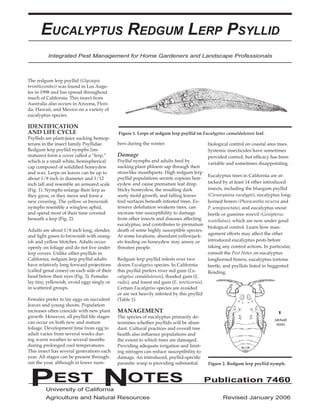
form a cover called a “lerp,” 
which is a small white, hemispherical 
cap composed of solidified honeydew 
and wax. Lerps on leaves can be up to 
about 1/8 inch in diameter and 1/12 
inch tall and resemble an armored scale 
(Fig. 1). Nymphs enlarge their lerp as 
they grow, or they move and form a 
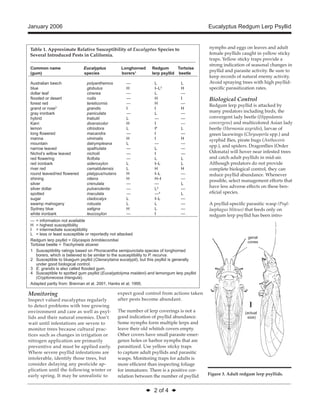
new covering. The yellow or brownish 
nymphs resemble a wingless aphid, 
and spend most of their time covered 
beneath a lerp (Fig. 2). 
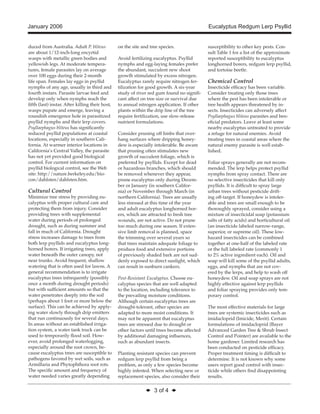
Adults are about 1/8 inch long, slender, 
and light green to brownish with orang-ish 
and yellow blotches. Adults occur 
openly on foliage and do not live under 
lerp covers. Unlike other psyllids in 
California, redgum lerp psyllid adults 
have relatively long forward projections 
(called genal cones) on each side of their 
head below their eyes (Fig. 3). Females 
lay tiny, yellowish, ovoid eggs singly or 
in scattered groups. 
Females prefer to lay eggs on succulent 
leaves and young shoots. Population 
increases often coincide with new plant 
growth. However, all psyllid life stages 
can occur on both new and mature 
foliage. Development time from egg to 
adult varies from several weeks dur-ing 
warm weather to several months 
during prolonged cool temperatures. 
This insect has several generations each 
year. All stages can be present through-out 
the year, although in lower num-bers 
Figure 1. Lerps of redgum lerp psyllid on Eucalyptus camaldulensis leaf. 
during the winter. 
Damage 
Psyllid nymphs and adults feed by 
sucking plant phloem sap through their 
strawlike mouthparts. High redgum lerp 
psyllid populations secrete copious hon-eydew 
and cause premature leaf drop. 
Sticky honeydew, the resulting dark 
sooty mold growth, and falling leaves 
foul surfaces beneath infested trees. Ex-tensive 
defoliation weakens trees, can 
increase tree susceptibility to damage 
from other insects and diseases affecting 
eucalyptus, and contributes to premature 
death of some highly susceptible species. 
At some locations, abundant yellowjack-ets 
feeding on honeydew may annoy or 
threaten people. 
Redgum lerp psyllid infests over two 
dozen Eucalyptus species. In California 
this psyllid prefers river red gum (Eu-calyptus 
camaldulensis), flooded gum (E. 
rudis), and forest red gum (E. tereticornis). 
Certain Eucalyptus species are avoided 
or are not heavily infested by this psyllid 
(Table 1). 
MANAGEMENT 
The species of eucalyptus primarily de-termines 
whether psyllids will be abun-dant. 
Cultural practices and overall tree 
health also influence populations and 
the extent to which trees are damaged. 
Providing adequate irrigation and limit-ing 
nitrogen can reduce susceptibility to 
damage. An introduced, psyllid-specific 
parasitic wasp is providing substantial 
biological control on coastal area trees. 
Systemic insecticides have sometimes 
provided control, but efficacy has been 
variable and sometimes disappointing. 
Eucalyptus trees in California are at-tacked 
by at least 14 other introduced 
insects, including the bluegum psyllid 
(Ctenarytaina eucalypti), eucalyptus long-horned 
borers (Phoracantha recurva and 
P. semipunctata), and eucalyptus snout 
beetle or gumtree weevil (Gonipterus 
scutellatus), which are now under good 
biological control. Learn how man-agement 
efforts may affect the other 
introduced eucalyptus pests before 
taking any control actions. In particular, 
consult the Pest Notes on eucalyptus 
longhorned borers, eucalyptus tortoise 
beetle, and psyllids listed in Suggested 
Reading. 
(actual 
size) 
Figure 2. Redgum lerp psyllid nymph. 
PEST NOTES Publication 7460 
University of California 
Agriculture and Natural Resources Revised January 2006
January 2006 Eucalyptus Redgum Lerp Psyllid 
Table 1. Approximate Relative Susceptibility of Eucalyptus Species to 
Several Introduced Pests in California. 
Common name Eucalyptus Longhorned Redgum Tortoise 
(gum) species borers1 lerp psyllid beetle 
Australian beech polyanthemos — L L 
blue globulus H I–L2 H 
dollar leaf cinerea — L — 
flooded or desert rudis — H I 
forest red tereticornis — H — 
grand or rose3 grandis I I H 
gray ironbark paniculata — L — 
hybrid trabutii L — — 
Karri diversicolor H I — 
lemon citriodora L I4 L 
long flowered macandra — I — 
manna viminalis H I H 
mountain dalrympleana L — — 
narrow leaved spathulata — L — 
Nichol’s willow leaved nicholii — I — 
red flowering ficifolia — L L 
red ironbark sideroxylon L I–L L 
river red camaldulensis L H H 
round leaved/red flowered platypus/nutans H I–L — 
shining nitens H H–I — 
silver crenulata — — L 
silver dollar pulverulenta — L2 — 
spotted maculata — —4 L 
sugar cladocalyx L I–L — 
swamp mahogany robusta L L — 
Sydney blue saligna H L — 
white ironbark leucoxylon — I — 
— = information not available 
H = highest susceptibility 
I = intermediate susceptibility 
L = less or least susceptible or reportedly not attacked 
Redgum lerp psyllid = Glycaspis brimblecombei 
Tortoise beetle = Trachymela sloanei 
1 Susceptibility ratings based on Phoracantha semipunctata species of longhorned 
borers, which is believed to be similar to the susceptibility to P. recurva. 
2 Susceptible to bluegum psyllid (Ctenarytaina eucalypti), but this psyllid is generally 
◆ 2 of 4 ◆ 
under good biological control. 
3 E. grandis is also called flooded gum. 
4 Susceptible to spotted gum psyllid (Eucalyptolyma maideni) and lemongum lerp psyllid 
(Cryptoneossa triangula). 
Adapted partly from: Brennan et al. 2001, Hanks et al. 1995. 
Monitoring 
Inspect valued eucalyptus regularly 
to detect problems with tree growing 
environment and care as well as psyl-lids 
and their natural enemies. Don’t 
wait until infestations are severe to 
monitor trees because cultural prac-tices 
such as changes in irrigation or 
nitrogen application are primarily 
preventive and must be applied early. 
Where severe psyllid infestations are 
intolerable, identify those trees, but 
consider delaying any pesticide ap-plication 
until the following winter or 
early spring. It may be unrealistic to 
expect good control from actions taken 
after pests become abundant. 
The number of lerp coverings is not a 
good indication of psyllid abundance. 
Some nymphs form multiple lerps and 
leave their old whitish covers empty. 
Other covers have small parasite emer-gence 
holes or harbor nymphs that are 
parasitized. Use yellow sticky traps 
to capture adult psyllids and parasitic 
wasps. Monitoring traps for adults is 
more efficient than inspecting foliage 
for immatures. There is a positive cor-relation 
between the number of psyllid 
nymphs and eggs on leaves and adult 
female psyllids caught in yellow sticky 
traps. Yellow sticky traps provide a 
strong indication of seasonal changes in 
psyllid and parasite activity. Be sure to 
keep records of natural enemy activity. 
Avoid spraying trees with high psyllid-specific 
parasitization rates. 
Biological Control 
Redgum lerp psyllid is attacked by 
many predators including birds, the 
convergent lady beetle (Hippodamia 
convergens) and multicolored Asian lady 
beetle (Harmonia axyridis), larvae of 
green lacewings (Chrysoperla spp.) and 
syrphid flies, pirate bugs (Anthocoris 
spp.), and spiders. Dragonflies (Order 
Odonata) will hover near infested trees 
and catch adult psyllids in mid-air. 
Although predators do not provide 
complete biological control, they can 
reduce psyllid abundance. Whenever 
possible, select management efforts that 
have less adverse effects on these ben-eficial 
species. 
A psyllid-specific parasitic wasp (Psyl-laephagus 
bliteus) that feeds only on 
redgum lerp psyllid has been intro- 
genal 
cones 
(actual 
size) 
Figure 3. Adult redgum lerp psyllids.
January 2006 Eucalyptus Redgum Lerp Psyllid 
◆ 3 of 4 ◆ 
duced from Australia. Adult P. bliteus 
are about 1/12-inch-long encyrtid 
wasps with metallic green bodies and 
yellowish legs. At moderate tempera-tures, 
female parasites lay on average 
over 100 eggs during their 2-month 
life span. Females lay eggs in psyllid 
nymphs of any age, usually in third and 
fourth instars. Parasite larvae feed and 
develop only when nymphs reach the 
fifth (last) instar. After killing their host, 
wasps pupate and emerge, leaving a 
roundish emergence hole in parasitized 
psyllid nymphs and their lerp covers. 
Psyllaephagus bliteus has significantly 
reduced psyllid populations at coastal 
locations, especially in southern Cali-fornia. 
At warmer interior locations in 
California’s Central Valley, the parasite 
has not yet provided good biological 
control. For current information on 
psyllid biological control, see the Web 
site: http://nature.berkeley.edu/bio-con/ 
dahlsten/dahlsten.htm. 
Cultural Control 
Minimize tree stress by providing eu-calyptus 
with proper cultural care and 
protecting them from injury. Consider 
providing trees with supplemental 
water during periods of prolonged 
drought, such as during summer and 
fall in much of California. Drought 
stress increases damage to trees from 
both lerp psyllids and eucalyptus long-horned 
borers. If irrigating trees, apply 
water beneath the outer canopy, not 
near trunks. Avoid frequent, shallow 
watering that is often used for lawns. A 
general recommendation is to irrigate 
eucalyptus trees infrequently (possibly 
once a month during drought periods) 
but with sufficient amounts so that the 
water penetrates deeply into the soil 
(perhaps about 1 foot or more below the 
surface). This can be achieved by apply-ing 
water slowly through drip emitters 
that run continuously for several days. 
In areas without an established irriga-tion 
system, a water tank truck can be 
used to temporarily flood soil. How-ever, 
avoid prolonged waterlogging, 
especially around the root crown, be-cause 
eucalyptus trees are susceptible to 
pathogens favored by wet soils, such as 
Armillaria and Phytophthora root rots. 
The specific amount and frequency of 
water needed varies greatly depending 
on the site and tree species. 
Avoid fertilizing eucalyptus. Psyllid 
nymphs and egg-laying females prefer 
the abundant, succulent new shoot 
growth stimulated by excess nitrogen. 
Eucalyptus rarely require nitrogen fer-tilization 
for good growth. A six-year 
study of river red gum found no signifi-cant 
affect on tree size or survival due 
to annual nitrogen application. If other 
plants within the drip line of the tree 
require fertilization, use slow-release 
nutrient formulations. 
Consider pruning off limbs that over-hang 
surfaces where dripping honey-dew 
is especially intolerable. Be aware 
that pruning often stimulates new 
growth of succulent foliage, which is 
preferred by psyllids. Except for dead 
or hazardous branches, which should 
be removed whenever they appear, 
prune eucalyptus only during Decem-ber 
or January (in southern Califor-nia) 
or November through March (in 
northern California). Trees are usually 
less stressed at this time of the year 
and adult eucalyptus longhorned bor-ers, 
which are attracted to fresh tree 
wounds, are not active. Do not prune 
too much during one season. If exten-sive 
limb removal is planned, space 
the trimming over several years so 
that trees maintain adequate foliage to 
produce food and extensive portions 
of previously shaded bark are not sud-denly 
exposed to direct sunlight, which 
can result in sunburn cankers. 
Pest-Resistant Eucalyptus. Choose eu-calyptus 
species that are well adapted 
to the location, including tolerance to 
the prevailing moisture conditions. 
Although certain eucalyptus trees are 
drought-tolerant, other species are 
adapted to more moist conditions. It 
may not be apparent that eucalyptus 
trees are stressed due to drought or 
other factors until trees become affected 
by additional damaging influences, 
such as abundant insects. 
Planting resistant species can prevent 
redgum lerp psyllid from being a 
problem, as only a few species become 
highly infested. When selecting new or 
replacement species, also consider their 
susceptibility to other key pests. Con-sult 
Table 1 for a list of the approximate 
reported susceptibility to eucalyptus 
longhorned borers, redgum lerp psyllid, 
and tortoise beetle. 
Chemical Control 
Insecticide efficacy has been variable. 
Consider treating only those trees 
where the pest has been intolerable or 
tree health appears threatened by in-sects. 
Insecticides can adversely affect 
Psyllaephagus bliteus parasites and ben-eficial 
predators. Leave at least some 
nearby eucalyptus untreated to provide 
a refuge for natural enemies. Avoid 
treating trees in coastal areas where the 
natural enemy parasite is well estab-lished. 
Foliar sprays generally are not recom-mended. 
The lerp helps protect psyllid 
nymphs from spray contact. There are 
no selective insecticides that kill only 
psyllids. It is difficult to spray large 
urban trees without pesticide drift-ing 
off-target. If honeydew is intoler-able 
and trees are small enough to be 
thoroughly sprayed, consider using a 
mixture of insecticidal soap (potassium 
salts of fatty acids) and horticultural oil 
(an insecticide labeled narrow-range, 
superior, or supreme oil). These low-hazard 
insecticides can be combined 
together at one-half of the labeled rate 
or the full labeled rate (commonly 1 
to 2% active ingredient each). Oil and 
soap will kill some of the psyllid adults, 
eggs, and nymphs that are not cov-ered 
by the lerps, and help to wash off 
honeydew. Oil and soap sprays are not 
highly effective against lerp psyllids 
and foliar spraying provides only tem-porary 
control. 
The most effective materials for large 
trees are systemic insecticides such as 
imidacloprid (Imicide, Merit). Certain 
formulations of imidacloprid (Bayer 
Advanced Garden Tree & Shrub Insect 
Control and Pointer) are available to the 
home gardener. Limited research has 
been conducted on pesticide efficacy. 
Proper treatment timing is difficult to 
determine. It is not known why some 
users report good control with insec-ticide 
while others find disappointing 
results.
January 2006 Eucalyptus Redgum Lerp Psyllid 
◆ 4 of 4 ◆ 
For more information contact the University 
of California Cooperative Extension or 
agricultural commissioner’s office in your 
county. See your telephone directory for 
addresses and phone numbers. 
AUTHORS: T. D. Paine, Dept. of Entomol-ogy, 
UC Riverside; S. H. Dreistadt, UC IPM 
Program; and R. W. Garrison and R. J. Gill, 
Calif. Dept. Food Agric., Sacramento 
TECHNICAL EDITOR: M. L. Flint 
COORDINATION, DESIGN, & 
PRODUCTION: P. N. Galin 
ILLUSTRATIONS: R. W. Garrison 
Produced by IPM Education & Publications, 
UC Statewide IPM Program, University of 
California, Davis, CA 95616-8620 
This Pest Note is available on the World 
Wide Web (http://www.ipm.ucdavis.edu) 
This publication has been anonymously peer 
reviewed for technical accuracy by University of 
California scientists and other qualified profession-als. 
This review process was managed by the ANR 
Associate Editor for Pest Management. 
To simplify information, trade names of products 
have been used. No endorsement of named products 
is intended, nor is criticism implied of similar products 
that are not mentioned. 
This material is partially based upon work supported 
by the Extension Service, U.S. Department of 
Agriculture, under special project Section 3(d), 
Integrated Pest Management. 
WARNING ON THE USE OF CHEMICALS 
Pesticides are poisonous. Always read and carefully follow all precautions and safety recommendations 
given on the container label. Store all chemicals in the original labeled containers in a locked cabinet or shed, 
away from food or feeds, and out of the reach of children, unauthorized persons, pets, and livestock. 
Confine chemicals to the property being treated. Avoid drift onto neighboring properties, especially gardens 
containing fruits or vegetables ready to be picked. 
Do not place containers containing pesticide in the trash nor pour pesticides down sink or toilet. Either use 
the pesticide according to the label or take unwanted pesticides to a Household Hazardous Waste Collection 
site. Contact your county agricultural commissioner for additional information on safe container disposal and 
for the location of the Household Hazardous Waste Collection site nearest you. Dispose of empty containers 
by following label directions. Never reuse or burn the containers or dispose of them in such a manner that 
they may contaminate water supplies or natural waterways. 
The University of California prohibits discrimination against or harassment of any person employed 
by or seeking employment with the University on the basis of race, color, national origin, religion, sex, 
physical or mental disability, medical condition (cancer-related or genetic characteristics), ancestry, 
marital status, age, sexual orientation, citizenship, or status as a covered veteran (covered veterans are 
special disabled veterans, recently separated veterans, Vietnam-era veterans, or any other veterans who 
served on active duty during a war or in a campaign or expedition for which a campaign badge has been 
authorized). University policy is intended to be consistent with the provisions of applicable State and 
Federal laws. Inquiries regarding the University’s equal employment opportunity policies may be directed 
to the Affirmative Action/Staff Personnel Services Director, University of California, Agriculture and Natural 
Resources, 300 Lakeside Drive, 6th Floor, Oakland, CA 94612-3550, (510) 987-0096. 
Systemic insecticides are available for 
application into trunks or roots or by 
spraying foliage. Imidacloprid is also 
available to both home gardeners and 
professionals for application on or into 
soil beneath trees. When using system-ics, 
whenever possible consider making 
a soil application instead of injecting 
or implanting trees. Injecting or im-planting 
trunks or roots injures trees, 
and it is difficult to repeatedly place 
insecticide at the proper depth. Espe-cially 
avoid methods that cause large 
wounds, such as implants placed in 
holes drilled in trunks. Do not implant 
or inject roots or trunks more than once 
a year. Foliar sprays of broad-spectrum, 
persistent insecticides are not recom-mended 
because of drift and negative 
impacts on natural enemies. 
Imidacloprid may be effective when ap-plied 
to soil during late winter to early 
spring or before rainfall or irrigation are 
expected to facilitate root absorption of 
the insecticide. Summer application to 
stressed, heavily infested trees is less 
likely to be effective and is not recom-mended. 
For more discussion and illus-trations 
on using systemic insecticides, 
consult Pest Notes: Hackberry Woolly 
Aphid listed in Suggested Readings. 
REFERENCES 
Brennan, E. B., G. F. Hrusa, S. A. Wein-baum, 
and W. Levison. 2001. Resis-tance 
of Eucalyptus species to Glycaspis 
brimblecombei (Homoptera: Psyllidae) in 
the San Francisco Bay Area. Pan-Pacific 
Entomologist 77: 249–253. 
Garrison, R. W. 1998. New agricultural 
pest for Southern California: Redgum 
lerp psyllid, Glycaspis brimblecombei. Los 
Angeles County Agricultural Commis-sioner’s 
Office. 2 pp. 
Gill, R. J. 1998. New state records: 
Redgum lerp psyllid, Glycaspis brimble-combei. 
California Plant Pest and Disease 
Report. 17(1-3): 7–8. 
Hanks, L. M., T. D. Paine, J. G. Millar, 
and J. L. Hom. 1995. Variation among 
Eucalyptus species in resistance to Eu-calyptus 
longhorned borer in southern 
California. Entomologia Experimentalis et 
Applicata 74: 185–194. 
SUGGESTED READINGS 
More publications by D. L. Dahlsten, 
including current information on psyl-lid 
biological control, may be found at 
the Center for Biological Control, Univ. 
Calif. Berkeley Web site http://nature. 
berkeley.edu/biocon/dahlsten/dahl-sten. 
htm 
Imported Parasitic Wasp Helps Control 
Red Gum Lerp Psyllid. 2005. D.L. Dahl-sten, 
K. M. Daane, T. D. Paine et. al. 
Calif. Agric. 59(4): 229–234. 
Pest Notes: Eucalyptus Longhorned Borers. 
Jan. 2000. T. D. Paine, J. G. Millar, and S. 
H. Dreistadt. Oakland: Univ. Calif. Ag-ric. 
Nat. Res. Publ. 7425. 
Pest Notes: Eucalyptus Tortoise Beetle. Jan. 
2003. J. G. Millar, K. Campbell, R. W. 
Garrison, and S. H. Dreistadt. Oakland: 
Univ. Calif. Agric. Nat. Res. Publ. 74104. 
Pest Notes: Hackberry Woolly Aphid. 2005. 
A. W. Lawson and S. H. Dreistadt. Oak-land: 
Univ. Calif. Agric. Nat. Res. Publ. 
74111. 
Pest Notes: Psyllids. May 2001. S. H. 
Dreistadt, and D. H. Dahlsten. Oakland: 
Univ. Calif. Agric. Nat. Res. Publ. 7423. 
UC scientists apply IPM techniques 
to new eucalyptus pests. 2000. T. D. 
Paine, D. L. Dahlsten, J. G. Millar, M. S. 
Hoddle, and L. M. Hanks. Calif. Agric. 
54(6): 8–13. ❖

Eucalyptus Redgum Lerp Psyllid Integrated Pest Management

  • 1.
    EUCALYPTUS REDGUM LERPPSYLLID Integrated Pest Management for Home Gardeners and Landscape Professionals The redgum lerp psyllid (Glycaspis brimblecombei) was found in Los Ange-les in 1998 and has spread throughout much of California. This insect from Australia also occurs in Arizona, Flori-da, Hawaii, and Mexico on a variety of eucalyptus species. IDENTIFICATION AND LIFE CYCLE Psyllids are plant-juice sucking homop-terans in the insect family Psyllidae. Redgum lerp psyllid nymphs (im-matures) form a cover called a “lerp,” which is a small white, hemispherical cap composed of solidified honeydew and wax. Lerps on leaves can be up to about 1/8 inch in diameter and 1/12 inch tall and resemble an armored scale (Fig. 1). Nymphs enlarge their lerp as they grow, or they move and form a new covering. The yellow or brownish nymphs resemble a wingless aphid, and spend most of their time covered beneath a lerp (Fig. 2). Adults are about 1/8 inch long, slender, and light green to brownish with orang-ish and yellow blotches. Adults occur openly on foliage and do not live under lerp covers. Unlike other psyllids in California, redgum lerp psyllid adults have relatively long forward projections (called genal cones) on each side of their head below their eyes (Fig. 3). Females lay tiny, yellowish, ovoid eggs singly or in scattered groups. Females prefer to lay eggs on succulent leaves and young shoots. Population increases often coincide with new plant growth. However, all psyllid life stages can occur on both new and mature foliage. Development time from egg to adult varies from several weeks dur-ing warm weather to several months during prolonged cool temperatures. This insect has several generations each year. All stages can be present through-out the year, although in lower num-bers Figure 1. Lerps of redgum lerp psyllid on Eucalyptus camaldulensis leaf. during the winter. Damage Psyllid nymphs and adults feed by sucking plant phloem sap through their strawlike mouthparts. High redgum lerp psyllid populations secrete copious hon-eydew and cause premature leaf drop. Sticky honeydew, the resulting dark sooty mold growth, and falling leaves foul surfaces beneath infested trees. Ex-tensive defoliation weakens trees, can increase tree susceptibility to damage from other insects and diseases affecting eucalyptus, and contributes to premature death of some highly susceptible species. At some locations, abundant yellowjack-ets feeding on honeydew may annoy or threaten people. Redgum lerp psyllid infests over two dozen Eucalyptus species. In California this psyllid prefers river red gum (Eu-calyptus camaldulensis), flooded gum (E. rudis), and forest red gum (E. tereticornis). Certain Eucalyptus species are avoided or are not heavily infested by this psyllid (Table 1). MANAGEMENT The species of eucalyptus primarily de-termines whether psyllids will be abun-dant. Cultural practices and overall tree health also influence populations and the extent to which trees are damaged. Providing adequate irrigation and limit-ing nitrogen can reduce susceptibility to damage. An introduced, psyllid-specific parasitic wasp is providing substantial biological control on coastal area trees. Systemic insecticides have sometimes provided control, but efficacy has been variable and sometimes disappointing. Eucalyptus trees in California are at-tacked by at least 14 other introduced insects, including the bluegum psyllid (Ctenarytaina eucalypti), eucalyptus long-horned borers (Phoracantha recurva and P. semipunctata), and eucalyptus snout beetle or gumtree weevil (Gonipterus scutellatus), which are now under good biological control. Learn how man-agement efforts may affect the other introduced eucalyptus pests before taking any control actions. In particular, consult the Pest Notes on eucalyptus longhorned borers, eucalyptus tortoise beetle, and psyllids listed in Suggested Reading. (actual size) Figure 2. Redgum lerp psyllid nymph. PEST NOTES Publication 7460 University of California Agriculture and Natural Resources Revised January 2006
  • 2.
    January 2006 EucalyptusRedgum Lerp Psyllid Table 1. Approximate Relative Susceptibility of Eucalyptus Species to Several Introduced Pests in California. Common name Eucalyptus Longhorned Redgum Tortoise (gum) species borers1 lerp psyllid beetle Australian beech polyanthemos — L L blue globulus H I–L2 H dollar leaf cinerea — L — flooded or desert rudis — H I forest red tereticornis — H — grand or rose3 grandis I I H gray ironbark paniculata — L — hybrid trabutii L — — Karri diversicolor H I — lemon citriodora L I4 L long flowered macandra — I — manna viminalis H I H mountain dalrympleana L — — narrow leaved spathulata — L — Nichol’s willow leaved nicholii — I — red flowering ficifolia — L L red ironbark sideroxylon L I–L L river red camaldulensis L H H round leaved/red flowered platypus/nutans H I–L — shining nitens H H–I — silver crenulata — — L silver dollar pulverulenta — L2 — spotted maculata — —4 L sugar cladocalyx L I–L — swamp mahogany robusta L L — Sydney blue saligna H L — white ironbark leucoxylon — I — — = information not available H = highest susceptibility I = intermediate susceptibility L = less or least susceptible or reportedly not attacked Redgum lerp psyllid = Glycaspis brimblecombei Tortoise beetle = Trachymela sloanei 1 Susceptibility ratings based on Phoracantha semipunctata species of longhorned borers, which is believed to be similar to the susceptibility to P. recurva. 2 Susceptible to bluegum psyllid (Ctenarytaina eucalypti), but this psyllid is generally ◆ 2 of 4 ◆ under good biological control. 3 E. grandis is also called flooded gum. 4 Susceptible to spotted gum psyllid (Eucalyptolyma maideni) and lemongum lerp psyllid (Cryptoneossa triangula). Adapted partly from: Brennan et al. 2001, Hanks et al. 1995. Monitoring Inspect valued eucalyptus regularly to detect problems with tree growing environment and care as well as psyl-lids and their natural enemies. Don’t wait until infestations are severe to monitor trees because cultural prac-tices such as changes in irrigation or nitrogen application are primarily preventive and must be applied early. Where severe psyllid infestations are intolerable, identify those trees, but consider delaying any pesticide ap-plication until the following winter or early spring. It may be unrealistic to expect good control from actions taken after pests become abundant. The number of lerp coverings is not a good indication of psyllid abundance. Some nymphs form multiple lerps and leave their old whitish covers empty. Other covers have small parasite emer-gence holes or harbor nymphs that are parasitized. Use yellow sticky traps to capture adult psyllids and parasitic wasps. Monitoring traps for adults is more efficient than inspecting foliage for immatures. There is a positive cor-relation between the number of psyllid nymphs and eggs on leaves and adult female psyllids caught in yellow sticky traps. Yellow sticky traps provide a strong indication of seasonal changes in psyllid and parasite activity. Be sure to keep records of natural enemy activity. Avoid spraying trees with high psyllid-specific parasitization rates. Biological Control Redgum lerp psyllid is attacked by many predators including birds, the convergent lady beetle (Hippodamia convergens) and multicolored Asian lady beetle (Harmonia axyridis), larvae of green lacewings (Chrysoperla spp.) and syrphid flies, pirate bugs (Anthocoris spp.), and spiders. Dragonflies (Order Odonata) will hover near infested trees and catch adult psyllids in mid-air. Although predators do not provide complete biological control, they can reduce psyllid abundance. Whenever possible, select management efforts that have less adverse effects on these ben-eficial species. A psyllid-specific parasitic wasp (Psyl-laephagus bliteus) that feeds only on redgum lerp psyllid has been intro- genal cones (actual size) Figure 3. Adult redgum lerp psyllids.
  • 3.
    January 2006 EucalyptusRedgum Lerp Psyllid ◆ 3 of 4 ◆ duced from Australia. Adult P. bliteus are about 1/12-inch-long encyrtid wasps with metallic green bodies and yellowish legs. At moderate tempera-tures, female parasites lay on average over 100 eggs during their 2-month life span. Females lay eggs in psyllid nymphs of any age, usually in third and fourth instars. Parasite larvae feed and develop only when nymphs reach the fifth (last) instar. After killing their host, wasps pupate and emerge, leaving a roundish emergence hole in parasitized psyllid nymphs and their lerp covers. Psyllaephagus bliteus has significantly reduced psyllid populations at coastal locations, especially in southern Cali-fornia. At warmer interior locations in California’s Central Valley, the parasite has not yet provided good biological control. For current information on psyllid biological control, see the Web site: http://nature.berkeley.edu/bio-con/ dahlsten/dahlsten.htm. Cultural Control Minimize tree stress by providing eu-calyptus with proper cultural care and protecting them from injury. Consider providing trees with supplemental water during periods of prolonged drought, such as during summer and fall in much of California. Drought stress increases damage to trees from both lerp psyllids and eucalyptus long-horned borers. If irrigating trees, apply water beneath the outer canopy, not near trunks. Avoid frequent, shallow watering that is often used for lawns. A general recommendation is to irrigate eucalyptus trees infrequently (possibly once a month during drought periods) but with sufficient amounts so that the water penetrates deeply into the soil (perhaps about 1 foot or more below the surface). This can be achieved by apply-ing water slowly through drip emitters that run continuously for several days. In areas without an established irriga-tion system, a water tank truck can be used to temporarily flood soil. How-ever, avoid prolonged waterlogging, especially around the root crown, be-cause eucalyptus trees are susceptible to pathogens favored by wet soils, such as Armillaria and Phytophthora root rots. The specific amount and frequency of water needed varies greatly depending on the site and tree species. Avoid fertilizing eucalyptus. Psyllid nymphs and egg-laying females prefer the abundant, succulent new shoot growth stimulated by excess nitrogen. Eucalyptus rarely require nitrogen fer-tilization for good growth. A six-year study of river red gum found no signifi-cant affect on tree size or survival due to annual nitrogen application. If other plants within the drip line of the tree require fertilization, use slow-release nutrient formulations. Consider pruning off limbs that over-hang surfaces where dripping honey-dew is especially intolerable. Be aware that pruning often stimulates new growth of succulent foliage, which is preferred by psyllids. Except for dead or hazardous branches, which should be removed whenever they appear, prune eucalyptus only during Decem-ber or January (in southern Califor-nia) or November through March (in northern California). Trees are usually less stressed at this time of the year and adult eucalyptus longhorned bor-ers, which are attracted to fresh tree wounds, are not active. Do not prune too much during one season. If exten-sive limb removal is planned, space the trimming over several years so that trees maintain adequate foliage to produce food and extensive portions of previously shaded bark are not sud-denly exposed to direct sunlight, which can result in sunburn cankers. Pest-Resistant Eucalyptus. Choose eu-calyptus species that are well adapted to the location, including tolerance to the prevailing moisture conditions. Although certain eucalyptus trees are drought-tolerant, other species are adapted to more moist conditions. It may not be apparent that eucalyptus trees are stressed due to drought or other factors until trees become affected by additional damaging influences, such as abundant insects. Planting resistant species can prevent redgum lerp psyllid from being a problem, as only a few species become highly infested. When selecting new or replacement species, also consider their susceptibility to other key pests. Con-sult Table 1 for a list of the approximate reported susceptibility to eucalyptus longhorned borers, redgum lerp psyllid, and tortoise beetle. Chemical Control Insecticide efficacy has been variable. Consider treating only those trees where the pest has been intolerable or tree health appears threatened by in-sects. Insecticides can adversely affect Psyllaephagus bliteus parasites and ben-eficial predators. Leave at least some nearby eucalyptus untreated to provide a refuge for natural enemies. Avoid treating trees in coastal areas where the natural enemy parasite is well estab-lished. Foliar sprays generally are not recom-mended. The lerp helps protect psyllid nymphs from spray contact. There are no selective insecticides that kill only psyllids. It is difficult to spray large urban trees without pesticide drift-ing off-target. If honeydew is intoler-able and trees are small enough to be thoroughly sprayed, consider using a mixture of insecticidal soap (potassium salts of fatty acids) and horticultural oil (an insecticide labeled narrow-range, superior, or supreme oil). These low-hazard insecticides can be combined together at one-half of the labeled rate or the full labeled rate (commonly 1 to 2% active ingredient each). Oil and soap will kill some of the psyllid adults, eggs, and nymphs that are not cov-ered by the lerps, and help to wash off honeydew. Oil and soap sprays are not highly effective against lerp psyllids and foliar spraying provides only tem-porary control. The most effective materials for large trees are systemic insecticides such as imidacloprid (Imicide, Merit). Certain formulations of imidacloprid (Bayer Advanced Garden Tree & Shrub Insect Control and Pointer) are available to the home gardener. Limited research has been conducted on pesticide efficacy. Proper treatment timing is difficult to determine. It is not known why some users report good control with insec-ticide while others find disappointing results.
  • 4.
    January 2006 EucalyptusRedgum Lerp Psyllid ◆ 4 of 4 ◆ For more information contact the University of California Cooperative Extension or agricultural commissioner’s office in your county. See your telephone directory for addresses and phone numbers. AUTHORS: T. D. Paine, Dept. of Entomol-ogy, UC Riverside; S. H. Dreistadt, UC IPM Program; and R. W. Garrison and R. J. Gill, Calif. Dept. Food Agric., Sacramento TECHNICAL EDITOR: M. L. Flint COORDINATION, DESIGN, & PRODUCTION: P. N. Galin ILLUSTRATIONS: R. W. Garrison Produced by IPM Education & Publications, UC Statewide IPM Program, University of California, Davis, CA 95616-8620 This Pest Note is available on the World Wide Web (http://www.ipm.ucdavis.edu) This publication has been anonymously peer reviewed for technical accuracy by University of California scientists and other qualified profession-als. This review process was managed by the ANR Associate Editor for Pest Management. To simplify information, trade names of products have been used. No endorsement of named products is intended, nor is criticism implied of similar products that are not mentioned. This material is partially based upon work supported by the Extension Service, U.S. Department of Agriculture, under special project Section 3(d), Integrated Pest Management. WARNING ON THE USE OF CHEMICALS Pesticides are poisonous. Always read and carefully follow all precautions and safety recommendations given on the container label. Store all chemicals in the original labeled containers in a locked cabinet or shed, away from food or feeds, and out of the reach of children, unauthorized persons, pets, and livestock. Confine chemicals to the property being treated. Avoid drift onto neighboring properties, especially gardens containing fruits or vegetables ready to be picked. Do not place containers containing pesticide in the trash nor pour pesticides down sink or toilet. Either use the pesticide according to the label or take unwanted pesticides to a Household Hazardous Waste Collection site. Contact your county agricultural commissioner for additional information on safe container disposal and for the location of the Household Hazardous Waste Collection site nearest you. Dispose of empty containers by following label directions. Never reuse or burn the containers or dispose of them in such a manner that they may contaminate water supplies or natural waterways. The University of California prohibits discrimination against or harassment of any person employed by or seeking employment with the University on the basis of race, color, national origin, religion, sex, physical or mental disability, medical condition (cancer-related or genetic characteristics), ancestry, marital status, age, sexual orientation, citizenship, or status as a covered veteran (covered veterans are special disabled veterans, recently separated veterans, Vietnam-era veterans, or any other veterans who served on active duty during a war or in a campaign or expedition for which a campaign badge has been authorized). University policy is intended to be consistent with the provisions of applicable State and Federal laws. Inquiries regarding the University’s equal employment opportunity policies may be directed to the Affirmative Action/Staff Personnel Services Director, University of California, Agriculture and Natural Resources, 300 Lakeside Drive, 6th Floor, Oakland, CA 94612-3550, (510) 987-0096. Systemic insecticides are available for application into trunks or roots or by spraying foliage. Imidacloprid is also available to both home gardeners and professionals for application on or into soil beneath trees. When using system-ics, whenever possible consider making a soil application instead of injecting or implanting trees. Injecting or im-planting trunks or roots injures trees, and it is difficult to repeatedly place insecticide at the proper depth. Espe-cially avoid methods that cause large wounds, such as implants placed in holes drilled in trunks. Do not implant or inject roots or trunks more than once a year. Foliar sprays of broad-spectrum, persistent insecticides are not recom-mended because of drift and negative impacts on natural enemies. Imidacloprid may be effective when ap-plied to soil during late winter to early spring or before rainfall or irrigation are expected to facilitate root absorption of the insecticide. Summer application to stressed, heavily infested trees is less likely to be effective and is not recom-mended. For more discussion and illus-trations on using systemic insecticides, consult Pest Notes: Hackberry Woolly Aphid listed in Suggested Readings. REFERENCES Brennan, E. B., G. F. Hrusa, S. A. Wein-baum, and W. Levison. 2001. Resis-tance of Eucalyptus species to Glycaspis brimblecombei (Homoptera: Psyllidae) in the San Francisco Bay Area. Pan-Pacific Entomologist 77: 249–253. Garrison, R. W. 1998. New agricultural pest for Southern California: Redgum lerp psyllid, Glycaspis brimblecombei. Los Angeles County Agricultural Commis-sioner’s Office. 2 pp. Gill, R. J. 1998. New state records: Redgum lerp psyllid, Glycaspis brimble-combei. California Plant Pest and Disease Report. 17(1-3): 7–8. Hanks, L. M., T. D. Paine, J. G. Millar, and J. L. Hom. 1995. Variation among Eucalyptus species in resistance to Eu-calyptus longhorned borer in southern California. Entomologia Experimentalis et Applicata 74: 185–194. SUGGESTED READINGS More publications by D. L. Dahlsten, including current information on psyl-lid biological control, may be found at the Center for Biological Control, Univ. Calif. Berkeley Web site http://nature. berkeley.edu/biocon/dahlsten/dahl-sten. htm Imported Parasitic Wasp Helps Control Red Gum Lerp Psyllid. 2005. D.L. Dahl-sten, K. M. Daane, T. D. Paine et. al. Calif. Agric. 59(4): 229–234. Pest Notes: Eucalyptus Longhorned Borers. Jan. 2000. T. D. Paine, J. G. Millar, and S. H. Dreistadt. Oakland: Univ. Calif. Ag-ric. Nat. Res. Publ. 7425. Pest Notes: Eucalyptus Tortoise Beetle. Jan. 2003. J. G. Millar, K. Campbell, R. W. Garrison, and S. H. Dreistadt. Oakland: Univ. Calif. Agric. Nat. Res. Publ. 74104. Pest Notes: Hackberry Woolly Aphid. 2005. A. W. Lawson and S. H. Dreistadt. Oak-land: Univ. Calif. Agric. Nat. Res. Publ. 74111. Pest Notes: Psyllids. May 2001. S. H. Dreistadt, and D. H. Dahlsten. Oakland: Univ. Calif. Agric. Nat. Res. Publ. 7423. UC scientists apply IPM techniques to new eucalyptus pests. 2000. T. D. Paine, D. L. Dahlsten, J. G. Millar, M. S. Hoddle, and L. M. Hanks. Calif. Agric. 54(6): 8–13. ❖